 Add to Chrome
 Add to Firefox
 Add to Edge
Large Language Models Illuminate a Progressive Pathway to Artificial Healthcare Assistant: A Review
Nov 03, 2023


With the rapid development of artificial intelligence, large language models (LLMs) have shown promising capabilities in mimicking human-level language comprehension and reasoning. This has sparked significant interest in applying LLMs to enhance various aspects of healthcare, ranging from medical education to clinical decision support. However, medicine involves multifaceted data modalities and nuanced reasoning skills, presenting challenges for integrating LLMs. This paper provides a comprehensive review on the applications and implications of LLMs in medicine. It begins by examining the fundamental applications of general-purpose and specialized LLMs, demonstrating their utilities in knowledge retrieval, research support, clinical workflow automation, and diagnostic assistance. Recognizing the inherent multimodality of medicine, the review then focuses on multimodal LLMs, investigating their ability to process diverse data types like medical imaging and EHRs to augment diagnostic accuracy. To address LLMs' limitations regarding personalization and complex clinical reasoning, the paper explores the emerging development of LLM-powered autonomous agents for healthcare. Furthermore, it summarizes the evaluation methodologies for assessing LLMs' reliability and safety in medical contexts. Overall, this review offers an extensive analysis on the transformative potential of LLMs in modern medicine. It also highlights the pivotal need for continuous optimizations and ethical oversight before these models can be effectively integrated into clinical practice. Visit https://github.com/mingze-yuan/Awesome-LLM-Healthcare for an accompanying GitHub repository containing latest papers.

Private Learning with Public Features
Oct 24, 2023We study a class of private learning problems in which the data is a join of private and public features. This is often the case in private personalization tasks such as recommendation or ad prediction, in which features related to individuals are sensitive, while features related to items (the movies or songs to be recommended, or the ads to be shown to users) are publicly available and do not require protection. A natural question is whether private algorithms can achieve higher utility in the presence of public features. We give a positive answer for multi-encoder models where one of the encoders operates on public features. We develop new algorithms that take advantage of this separation by only protecting certain sufficient statistics (instead of adding noise to the gradient). This method has a guaranteed utility improvement for linear regression, and importantly, achieves the state of the art on two standard private recommendation benchmarks, demonstrating the importance of methods that adapt to the private-public feature separation.
Enhancing High-Resolution 3D Generation through Pixel-wise Gradient Clipping
Oct 19, 2023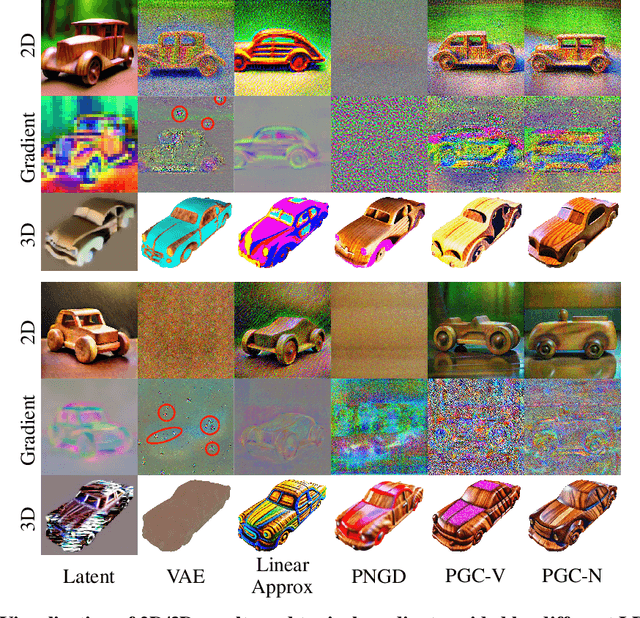
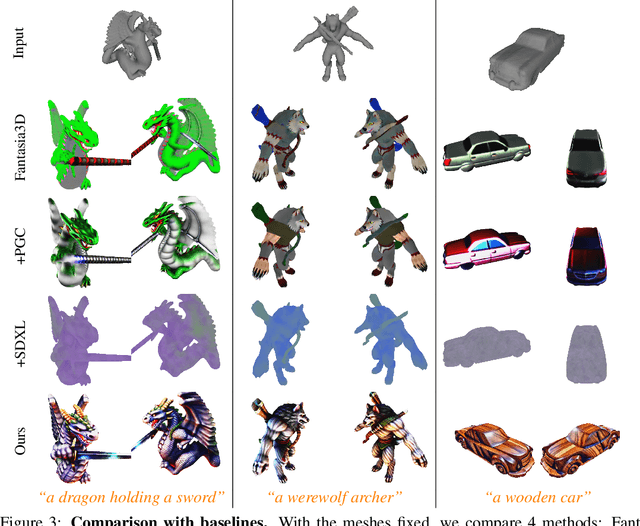
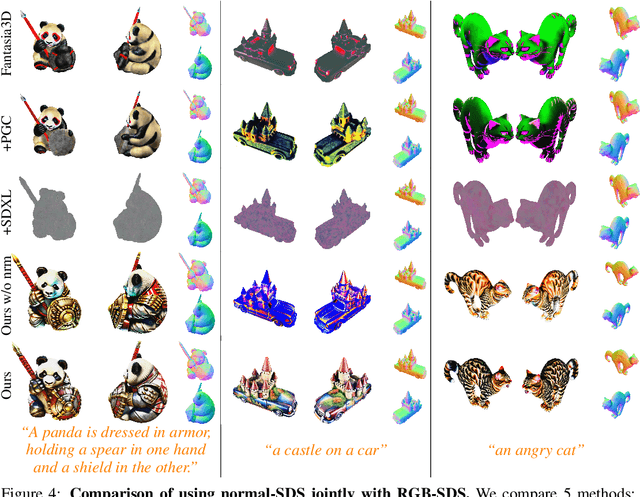
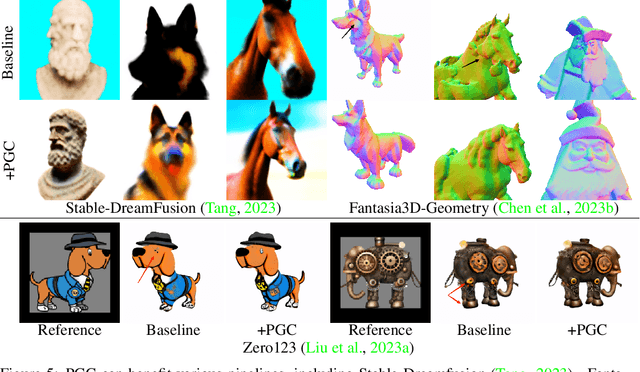
High-resolution 3D object generation remains a challenging task primarily due to the limited availability of comprehensive annotated training data. Recent advancements have aimed to overcome this constraint by harnessing image generative models, pretrained on extensive curated web datasets, using knowledge transfer techniques like Score Distillation Sampling (SDS). Efficiently addressing the requirements of high-resolution rendering often necessitates the adoption of latent representation-based models, such as the Latent Diffusion Model (LDM). In this framework, a significant challenge arises: To compute gradients for individual image pixels, it is necessary to backpropagate gradients from the designated latent space through the frozen components of the image model, such as the VAE encoder used within LDM. However, this gradient propagation pathway has never been optimized, remaining uncontrolled during training. We find that the unregulated gradients adversely affect the 3D model's capacity in acquiring texture-related information from the image generative model, leading to poor quality appearance synthesis. To address this overarching challenge, we propose an innovative operation termed Pixel-wise Gradient Clipping (PGC) designed for seamless integration into existing 3D generative models, thereby enhancing their synthesis quality. Specifically, we control the magnitude of stochastic gradients by clipping the pixel-wise gradients efficiently, while preserving crucial texture-related gradient directions. Despite this simplicity and minimal extra cost, extensive experiments demonstrate the efficacy of our PGC in enhancing the performance of existing 3D generative models for high-resolution object rendering.
Real-time Photorealistic Dynamic Scene Representation and Rendering with 4D Gaussian Splatting
Oct 16, 2023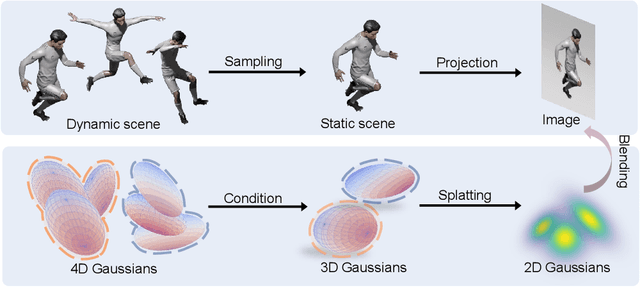

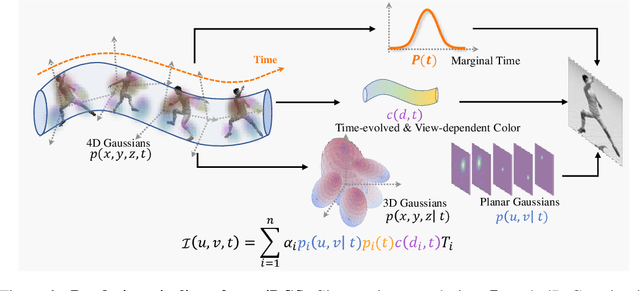

Reconstructing dynamic 3D scenes from 2D images and generating diverse views over time is challenging due to scene complexity and temporal dynamics. Despite advancements in neural implicit models, limitations persist: (i) Inadequate Scene Structure: Existing methods struggle to reveal the spatial and temporal structure of dynamic scenes from directly learning the complex 6D plenoptic function. (ii) Scaling Deformation Modeling: Explicitly modeling scene element deformation becomes impractical for complex dynamics. To address these issues, we consider the spacetime as an entirety and propose to approximate the underlying spatio-temporal 4D volume of a dynamic scene by optimizing a collection of 4D primitives, with explicit geometry and appearance modeling. Learning to optimize the 4D primitives enables us to synthesize novel views at any desired time with our tailored rendering routine. Our model is conceptually simple, consisting of a 4D Gaussian parameterized by anisotropic ellipses that can rotate arbitrarily in space and time, as well as view-dependent and time-evolved appearance represented by the coefficient of 4D spherindrical harmonics. This approach offers simplicity, flexibility for variable-length video and end-to-end training, and efficient real-time rendering, making it suitable for capturing complex dynamic scene motions. Experiments across various benchmarks, including monocular and multi-view scenarios, demonstrate our 4DGS model's superior visual quality and efficiency.
CLIN: A Continually Learning Language Agent for Rapid Task Adaptation and Generalization
Oct 16, 2023Language agents have shown some ability to interact with an external environment, e.g., a virtual world such as ScienceWorld, to perform complex tasks, e.g., growing a plant, without the startup costs of reinforcement learning. However, despite their zero-shot capabilities, these agents to date do not continually improve over time beyond performance refinement on a specific task. Here we present CLIN, the first language-based agent to achieve this, so that it continually improves over multiple trials, including when both the environment and task are varied, and without requiring parameter updates. Our approach is to use a persistent, dynamic, textual memory centered on causal abstractions (rather than general "helpful hints") that is regularly updated after each trial so that the agent gradually learns useful knowledge for new trials. In the ScienceWorld benchmark, CLIN is able to continually improve on repeated trials on the same task and environment, outperforming state-of-the-art reflective language agents like Reflexion by 23 absolute points. CLIN can also transfer its learning to new environments (or new tasks), improving its zero-shot performance by 4 points (13 for new tasks) and can further improve performance there through continual memory updates, enhancing performance by an additional 17 points (7 for new tasks). This suggests a new architecture for agents built on frozen models that can still continually and rapidly improve over time.
CBARF: Cascaded Bundle-Adjusting Neural Radiance Fields from Imperfect Camera Poses
Oct 15, 2023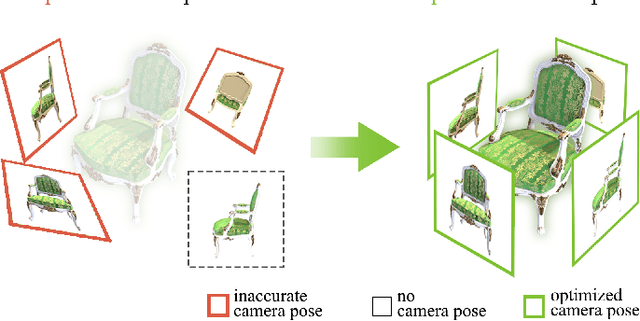
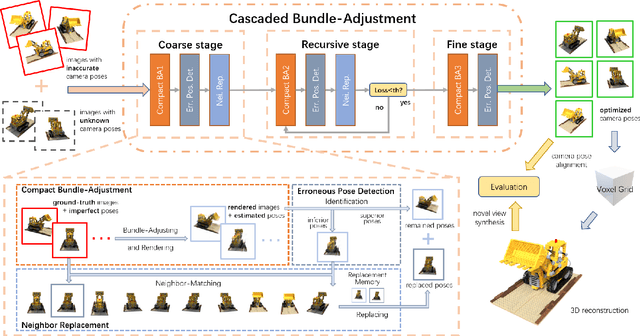
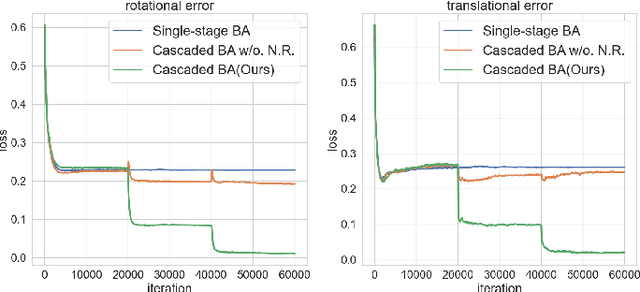
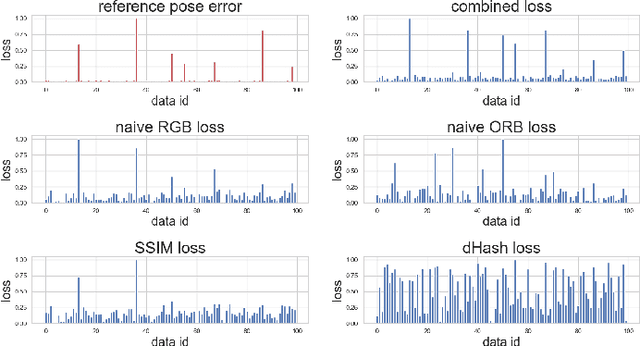
Existing volumetric neural rendering techniques, such as Neural Radiance Fields (NeRF), face limitations in synthesizing high-quality novel views when the camera poses of input images are imperfect. To address this issue, we propose a novel 3D reconstruction framework that enables simultaneous optimization of camera poses, dubbed CBARF (Cascaded Bundle-Adjusting NeRF).In a nutshell, our framework optimizes camera poses in a coarse-to-fine manner and then reconstructs scenes based on the rectified poses. It is observed that the initialization of camera poses has a significant impact on the performance of bundle-adjustment (BA). Therefore, we cascade multiple BA modules at different scales to progressively improve the camera poses. Meanwhile, we develop a neighbor-replacement strategy to further optimize the results of BA in each stage. In this step, we introduce a novel criterion to effectively identify poorly estimated camera poses. Then we replace them with the poses of neighboring cameras, thus further eliminating the impact of inaccurate camera poses. Once camera poses have been optimized, we employ a density voxel grid to generate high-quality 3D reconstructed scenes and images in novel views. Experimental results demonstrate that our CBARF model achieves state-of-the-art performance in both pose optimization and novel view synthesis, especially in the existence of large camera pose noise.
Multi-Depth Branches Network for Efficient Image Super-Resolution
Sep 29, 2023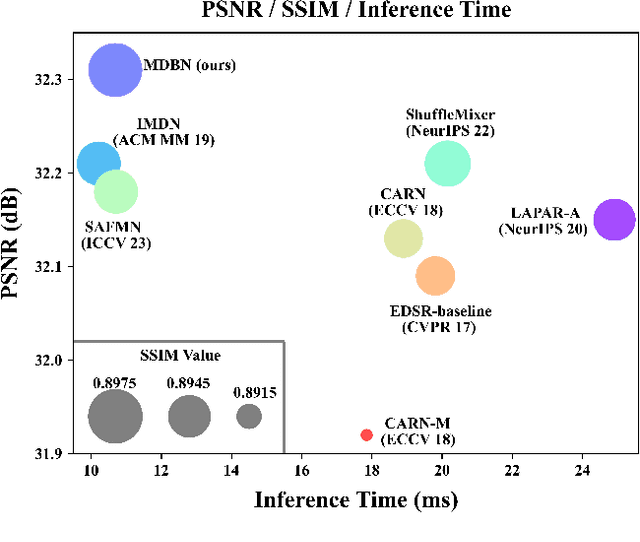

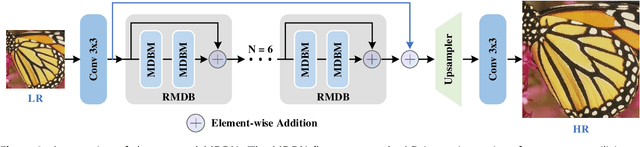

Significant progress has been made in the field of super-resolution (SR), yet many convolutional neural networks (CNNs) based SR models primarily focus on restoring high-frequency details, often overlooking crucial low-frequency contour information. Transformer-based SR methods, while incorporating global structural details, frequently come with an abundance of parameters, leading to high computational overhead. In this paper, we address these challenges by introducing a Multi-Depth Branches Network (MDBN). This framework extends the ResNet architecture by integrating an additional branch that captures vital structural characteristics of images. Our proposed multi-depth branches module (MDBM) involves the stacking of convolutional kernels of identical size at varying depths within distinct branches. By conducting a comprehensive analysis of the feature maps, we observe that branches with differing depths can extract contour and detail information respectively. By integrating these branches, the overall architecture can preserve essential low-frequency semantic structural information during the restoration of high-frequency visual elements, which is more closely with human visual cognition. Compared to GoogLeNet-like models, our basic multi-depth branches structure has fewer parameters, higher computational efficiency, and improved performance. Our model outperforms state-of-the-art (SOTA) lightweight SR methods with less inference time. Our code is available at https://github.com/thy960112/MDBN
Choice-75: A Dataset on Decision Branching in Script Learning
Sep 21, 2023Script learning studies how daily events unfold. Previous works tend to consider a script as a linear sequence of events while ignoring the potential branches that arise due to people's circumstantial choices. We hence propose Choice-75, the first benchmark that challenges intelligent systems to predict decisions given descriptive scenarios, containing 75 scripts and more than 600 scenarios. While large language models demonstrate overall decent performances, there is still notable room for improvement in many hard scenarios.
Private Matrix Factorization with Public Item Features
Sep 17, 2023
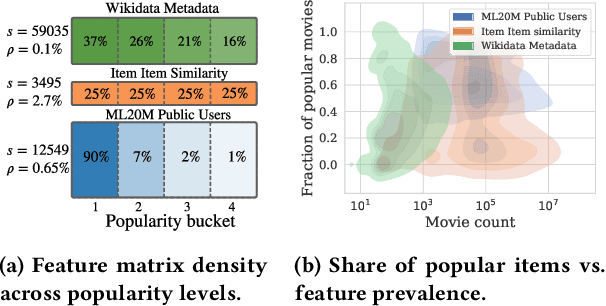
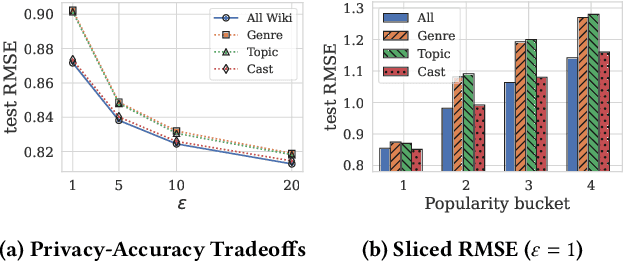
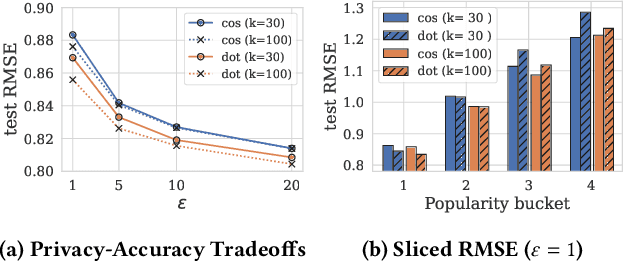
We consider the problem of training private recommendation models with access to public item features. Training with Differential Privacy (DP) offers strong privacy guarantees, at the expense of loss in recommendation quality. We show that incorporating public item features during training can help mitigate this loss in quality. We propose a general approach based on collective matrix factorization (CMF), that works by simultaneously factorizing two matrices: the user feedback matrix (representing sensitive data) and an item feature matrix that encodes publicly available (non-sensitive) item information. The method is conceptually simple, easy to tune, and highly scalable. It can be applied to different types of public item data, including: (1) categorical item features; (2) item-item similarities learned from public sources; and (3) publicly available user feedback. Furthermore, these data modalities can be collectively utilized to fully leverage public data. Evaluating our method on a standard DP recommendation benchmark, we find that using public item features significantly narrows the quality gap between private models and their non-private counterparts. As privacy constraints become more stringent, models rely more heavily on public side features for recommendation. This results in a smooth transition from collaborative filtering to item-based contextual recommendations.
SAMUS: Adapting Segment Anything Model for Clinically-Friendly and Generalizable Ultrasound Image Segmentation
Sep 13, 2023Segment anything model (SAM), an eminent universal image segmentation model, has recently gathered considerable attention within the domain of medical image segmentation. Despite the remarkable performance of SAM on natural images, it grapples with significant performance degradation and limited generalization when confronted with medical images, particularly with those involving objects of low contrast, faint boundaries, intricate shapes, and diminutive sizes. In this paper, we propose SAMUS, a universal model tailored for ultrasound image segmentation. In contrast to previous SAM-based universal models, SAMUS pursues not only better generalization but also lower deployment cost, rendering it more suitable for clinical applications. Specifically, based on SAM, a parallel CNN branch is introduced to inject local features into the ViT encoder through cross-branch attention for better medical image segmentation. Then, a position adapter and a feature adapter are developed to adapt SAM from natural to medical domains and from requiring large-size inputs (1024x1024) to small-size inputs (256x256) for more clinical-friendly deployment. A comprehensive ultrasound dataset, comprising about 30k images and 69k masks and covering six object categories, is collected for verification. Extensive comparison experiments demonstrate SAMUS's superiority against the state-of-the-art task-specific models and universal foundation models under both task-specific evaluation and generalization evaluation. Moreover, SAMUS is deployable on entry-level GPUs, as it has been liberated from the constraints of long sequence encoding. The code, data, and models will be released at https://github.com/xianlin7/SAMUS.