 Add to Chrome
 Add to Firefox
 Add to Edge
Children's English Reading Story Generation via Supervised Fine-Tuning of Compact LLMs with Controllable Difficulty and Safety
May 13, 2026
Large Language Models (LLMs) are widely applied in educational practices, such as for generating children's stories. However, the generated stories are often too difficult for children to read, and the operational cost of LLMs hinders their widespread adoption in educational settings. We used an existing expert-designed children's reading curriculum and its corresponding generated stories from GPT-4o and Llama 3.3 70B to design different experiments for fine-tuning three 8B-parameter LLMs, which then generated new English reading stories that were subjected to quantitative and qualitative evaluation. Our method prioritizes controllability over scale, enabling educators to target reading levels and error patterns with a compact, affordable model. Our evaluation results show that with appropriate fine-tuning designs, children's English reading stories generated by 8B LLMs perform better on difficulty-related metrics than those from zero-shot GPT-4o and Llama 3.3 70B, with almost no discernible safety issues. Such fine-tuned LLMs could be more broadly used by teachers, parents, and children in classrooms and at home to generate engaging English reading stories with children's interests, controllable difficulty and safety.

Language model driven: a PROTAC generation pipeline with dual constraints of structure and property
Dec 12, 2024The imperfect modeling of ternary complexes has limited the application of computer-aided drug discovery tools in PROTAC research and development. In this study, an AI-assisted approach for PROTAC molecule design pipeline named LM-PROTAC was developed, which stands for language model driven Proteolysis Targeting Chimera, by embedding a transformer-based generative model with dual constraints on structure and properties, referred to as the DCT. This study utilized the fragmentation representation of molecules and developed a language model driven pipeline. Firstly, a language model driven affinity model for protein compounds to screen molecular fragments with high affinity for the target protein. Secondly, structural and physicochemical properties of these fragments were constrained during the generation process to meet specific scenario requirements. Finally, a two-round screening of the preliminary generated molecules using a multidimensional property prediction model to generate a batch of PROTAC molecules capable of degrading disease-relevant target proteins for validation in vitro experiments, thus achieving a complete solution for AI-assisted PROTAC drug generation. Taking the tumor key target Wnt3a as an example, the LM-PROTAC pipeline successfully generated PROTAC molecules capable of inhibiting Wnt3a. The results show that DCT can efficiently generate PROTAC that targets and hydrolyses Wnt3a.
Multi-Depth Branches Network for Efficient Image Super-Resolution
Sep 29, 2023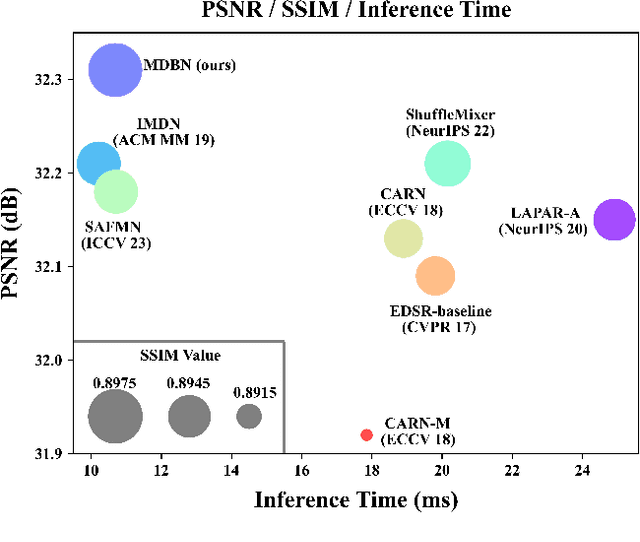

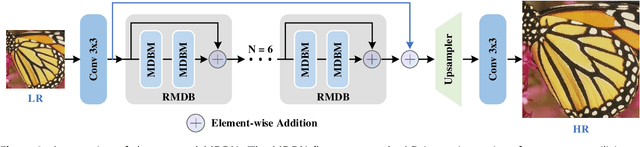

Significant progress has been made in the field of super-resolution (SR), yet many convolutional neural networks (CNNs) based SR models primarily focus on restoring high-frequency details, often overlooking crucial low-frequency contour information. Transformer-based SR methods, while incorporating global structural details, frequently come with an abundance of parameters, leading to high computational overhead. In this paper, we address these challenges by introducing a Multi-Depth Branches Network (MDBN). This framework extends the ResNet architecture by integrating an additional branch that captures vital structural characteristics of images. Our proposed multi-depth branches module (MDBM) involves the stacking of convolutional kernels of identical size at varying depths within distinct branches. By conducting a comprehensive analysis of the feature maps, we observe that branches with differing depths can extract contour and detail information respectively. By integrating these branches, the overall architecture can preserve essential low-frequency semantic structural information during the restoration of high-frequency visual elements, which is more closely with human visual cognition. Compared to GoogLeNet-like models, our basic multi-depth branches structure has fewer parameters, higher computational efficiency, and improved performance. Our model outperforms state-of-the-art (SOTA) lightweight SR methods with less inference time. Our code is available at https://github.com/thy960112/MDBN