 Add to Chrome
 Add to Firefox
 Add to Edge
UniVIE: A Unified Label Space Approach to Visual Information Extraction from Form-like Documents
Jan 17, 2024
Existing methods for Visual Information Extraction (VIE) from form-like documents typically fragment the process into separate subtasks, such as key information extraction, key-value pair extraction, and choice group extraction. However, these approaches often overlook the hierarchical structure of form documents, including hierarchical key-value pairs and hierarchical choice groups. To address these limitations, we present a new perspective, reframing VIE as a relation prediction problem and unifying labels of different tasks into a single label space. This unified approach allows for the definition of various relation types and effectively tackles hierarchical relationships in form-like documents. In line with this perspective, we present UniVIE, a unified model that addresses the VIE problem comprehensively. UniVIE functions using a coarse-to-fine strategy. It initially generates tree proposals through a tree proposal network, which are subsequently refined into hierarchical trees by a relation decoder module. To enhance the relation prediction capabilities of UniVIE, we incorporate two novel tree constraints into the relation decoder: a tree attention mask and a tree level embedding. Extensive experimental evaluations on both our in-house dataset HierForms and a publicly available dataset SIBR, substantiate that our method achieves state-of-the-art results, underscoring the effectiveness and potential of our unified approach in advancing the field of VIE.

Dynamic Relation Transformer for Contextual Text Block Detection
Jan 17, 2024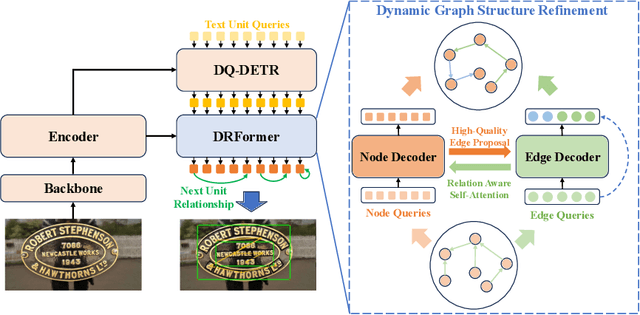

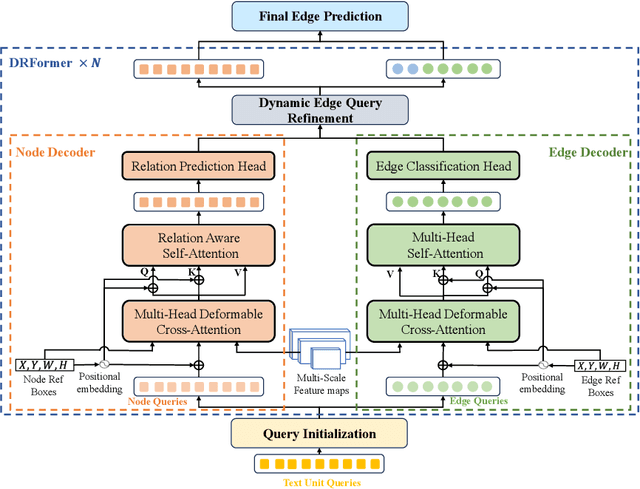

Contextual Text Block Detection (CTBD) is the task of identifying coherent text blocks within the complexity of natural scenes. Previous methodologies have treated CTBD as either a visual relation extraction challenge within computer vision or as a sequence modeling problem from the perspective of natural language processing. We introduce a new framework that frames CTBD as a graph generation problem. This methodology consists of two essential procedures: identifying individual text units as graph nodes and discerning the sequential reading order relationships among these units as graph edges. Leveraging the cutting-edge capabilities of DQ-DETR for node detection, our framework innovates further by integrating a novel mechanism, a Dynamic Relation Transformer (DRFormer), dedicated to edge generation. DRFormer incorporates a dual interactive transformer decoder that deftly manages a dynamic graph structure refinement process. Through this iterative process, the model systematically enhances the graph's fidelity, ultimately resulting in improved precision in detecting contextual text blocks. Comprehensive experimental evaluations conducted on both SCUT-CTW-Context and ReCTS-Context datasets substantiate that our method achieves state-of-the-art results, underscoring the effectiveness and potential of our graph generation framework in advancing the field of CTBD.
Perceptual Quality Assessment for Video Frame Interpolation
Dec 25, 2023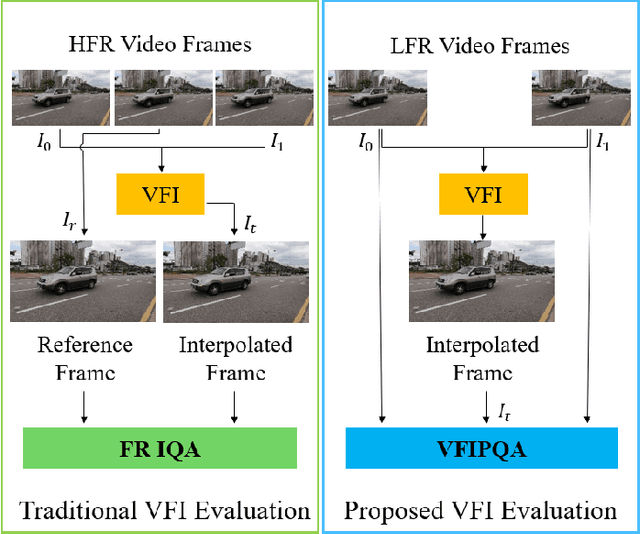
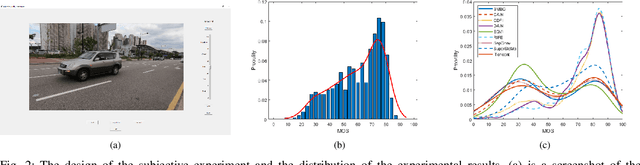
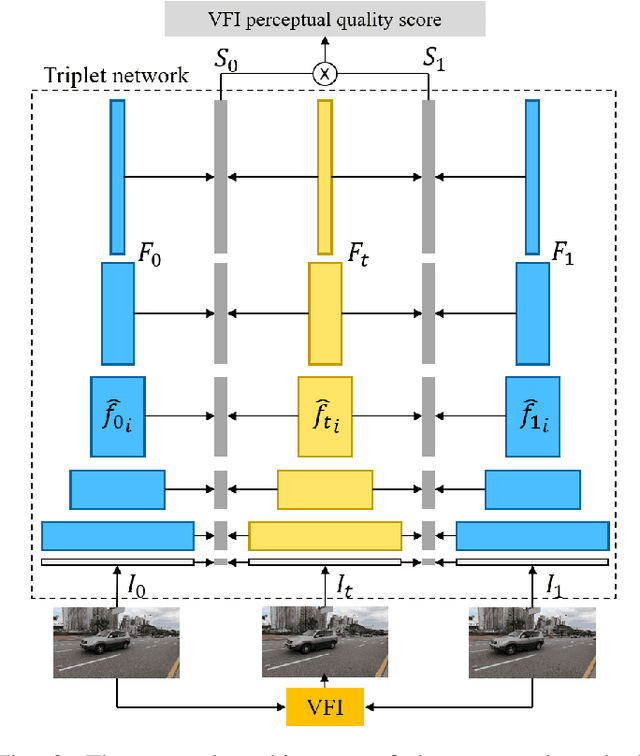
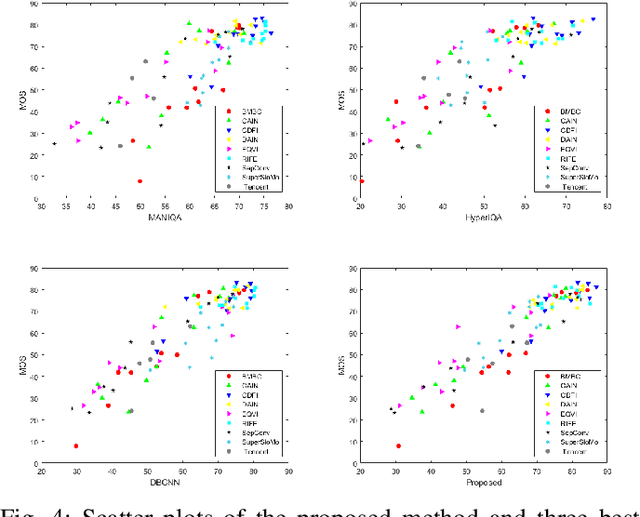
The quality of frames is significant for both research and application of video frame interpolation (VFI). In recent VFI studies, the methods of full-reference image quality assessment have generally been used to evaluate the quality of VFI frames. However, high frame rate reference videos, necessities for the full-reference methods, are difficult to obtain in most applications of VFI. To evaluate the quality of VFI frames without reference videos, a no-reference perceptual quality assessment method is proposed in this paper. This method is more compatible with VFI application and the evaluation scores from it are consistent with human subjective opinions. A new quality assessment dataset for VFI was constructed through subjective experiments firstly, to assess the opinion scores of interpolated frames. The dataset was created from triplets of frames extracted from high-quality videos using 9 state-of-the-art VFI algorithms. The proposed method evaluates the perceptual coherence of frames incorporating the original pair of VFI inputs. Specifically, the method applies a triplet network architecture, including three parallel feature pipelines, to extract the deep perceptual features of the interpolated frame as well as the original pair of frames. Coherence similarities of the two-way parallel features are jointly calculated and optimized as a perceptual metric. In the experiments, both full-reference and no-reference quality assessment methods were tested on the new quality dataset. The results show that the proposed method achieves the best performance among all compared quality assessment methods on the dataset.
YAYI 2: Multilingual Open-Source Large Language Models
Dec 22, 2023As the latest advancements in natural language processing, large language models (LLMs) have achieved human-level language understanding and generation abilities in many real-world tasks, and even have been regarded as a potential path to the artificial general intelligence. To better facilitate research on LLMs, many open-source LLMs, such as Llama 2 and Falcon, have recently been proposed and gained comparable performances to proprietary models. However, these models are primarily designed for English scenarios and exhibit poor performances in Chinese contexts. In this technical report, we propose YAYI 2, including both base and chat models, with 30 billion parameters. YAYI 2 is pre-trained from scratch on a multilingual corpus which contains 2.65 trillion tokens filtered by our pre-training data processing pipeline. The base model is aligned with human values through supervised fine-tuning with millions of instructions and reinforcement learning from human feedback. Extensive experiments on multiple benchmarks, such as MMLU and CMMLU, consistently demonstrate that the proposed YAYI 2 outperforms other similar sized open-source models.
The USTC-NERCSLIP Systems for the CHiME-7 DASR Challenge
Aug 28, 2023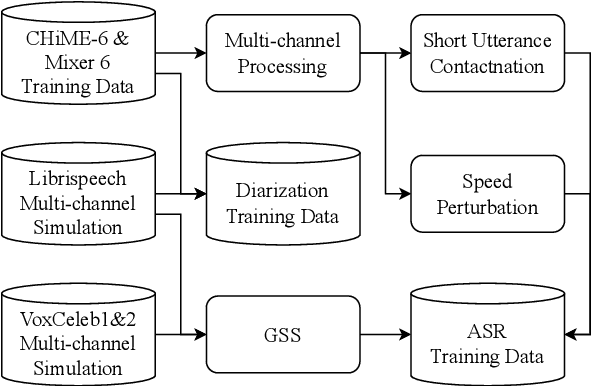
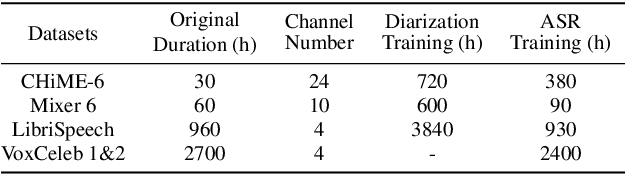
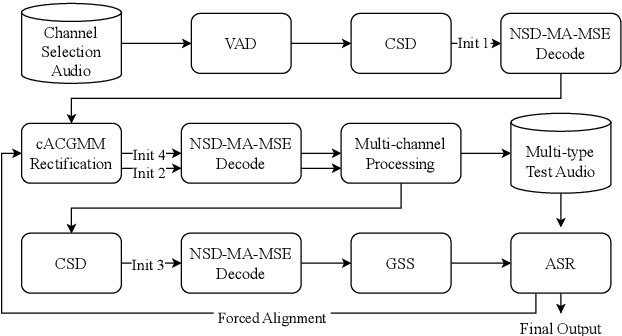
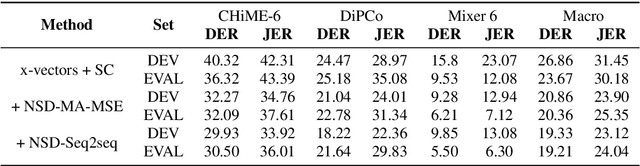
This technical report details our submission system to the CHiME-7 DASR Challenge, which focuses on speaker diarization and speech recognition under complex multi-speaker settings. Additionally, it also evaluates the efficiency of systems in handling diverse array devices. To address these issues, we implemented an end-to-end speaker diarization system and introduced a rectification strategy based on multi-channel spatial information. This approach significantly diminished the word error rates (WER). In terms of recognition, we utilized publicly available pre-trained models as the foundational models to train our end-to-end speech recognition models. Our system attained a macro-averaged diarization-attributed WER (DA-WER) of 22.4\% on the CHiME-7 development set, which signifies a relative improvement of 52.5\% over the official baseline system.
Reducing the gap between streaming and non-streaming Transducer-based ASR by adaptive two-stage knowledge distillation
Jun 27, 2023Transducer is one of the mainstream frameworks for streaming speech recognition. There is a performance gap between the streaming and non-streaming transducer models due to limited context. To reduce this gap, an effective way is to ensure that their hidden and output distributions are consistent, which can be achieved by hierarchical knowledge distillation. However, it is difficult to ensure the distribution consistency simultaneously because the learning of the output distribution depends on the hidden one. In this paper, we propose an adaptive two-stage knowledge distillation method consisting of hidden layer learning and output layer learning. In the former stage, we learn hidden representation with full context by applying mean square error loss function. In the latter stage, we design a power transformation based adaptive smoothness method to learn stable output distribution. It achieved 19\% relative reduction in word error rate, and a faster response for the first token compared with the original streaming model in LibriSpeech corpus.
Minimalist and High-Quality Panoramic Imaging with PSF-aware Transformers
Jun 22, 2023High-quality panoramic images with a Field of View (FoV) of 360-degree are essential for contemporary panoramic computer vision tasks. However, conventional imaging systems come with sophisticated lens designs and heavy optical components. This disqualifies their usage in many mobile and wearable applications where thin and portable, minimalist imaging systems are desired. In this paper, we propose a Panoramic Computational Imaging Engine (PCIE) to address minimalist and high-quality panoramic imaging. With less than three spherical lenses, a Minimalist Panoramic Imaging Prototype (MPIP) is constructed based on the design of the Panoramic Annular Lens (PAL), but with low-quality imaging results due to aberrations and small image plane size. We propose two pipelines, i.e. Aberration Correction (AC) and Super-Resolution and Aberration Correction (SR&AC), to solve the image quality problems of MPIP, with imaging sensors of small and large pixel size, respectively. To provide a universal network for the two pipelines, we leverage the information from the Point Spread Function (PSF) of the optical system and design a PSF-aware Aberration-image Recovery Transformer (PART), in which the self-attention calculation and feature extraction are guided via PSF-aware mechanisms. We train PART on synthetic image pairs from simulation and put forward the PALHQ dataset to fill the gap of real-world high-quality PAL images for low-level vision. A comprehensive variety of experiments on synthetic and real-world benchmarks demonstrates the impressive imaging results of PCIE and the effectiveness of plug-and-play PSF-aware mechanisms. We further deliver heuristic experimental findings for minimalist and high-quality panoramic imaging. Our dataset and code will be available at https://github.com/zju-jiangqi/PCIE-PART.
A Question-Answering Approach to Key Value Pair Extraction from Form-like Document Images
Apr 17, 2023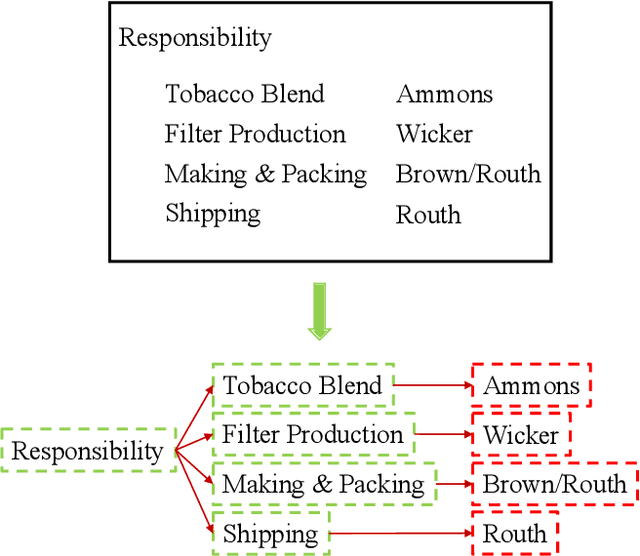
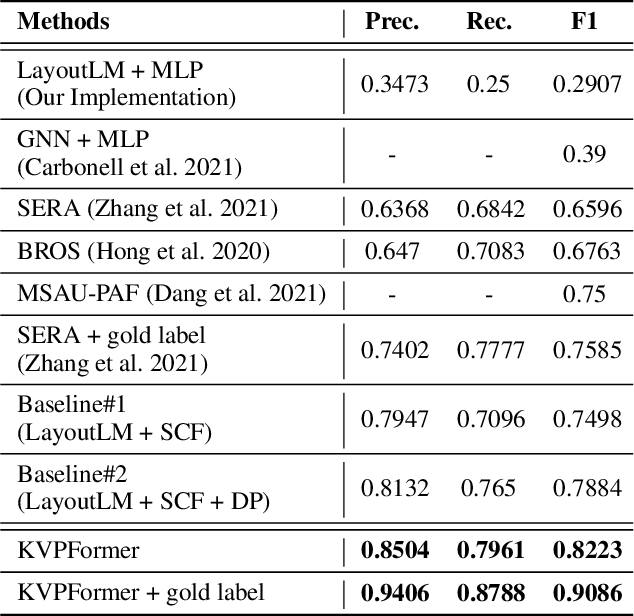
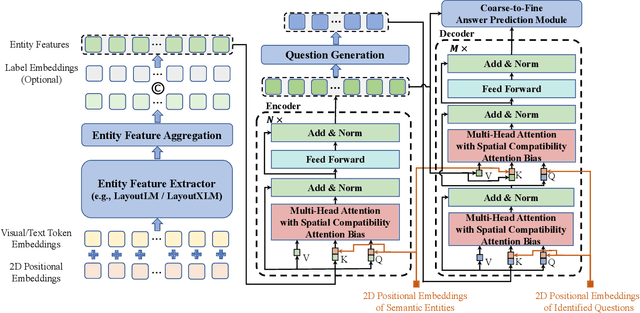
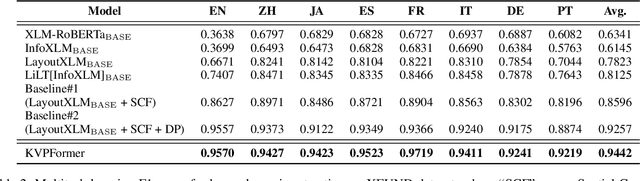
In this paper, we present a new question-answering (QA) based key-value pair extraction approach, called KVPFormer, to robustly extracting key-value relationships between entities from form-like document images. Specifically, KVPFormer first identifies key entities from all entities in an image with a Transformer encoder, then takes these key entities as \textbf{questions} and feeds them into a Transformer decoder to predict their corresponding \textbf{answers} (i.e., value entities) in parallel. To achieve higher answer prediction accuracy, we propose a coarse-to-fine answer prediction approach further, which first extracts multiple answer candidates for each identified question in the coarse stage and then selects the most likely one among these candidates in the fine stage. In this way, the learning difficulty of answer prediction can be effectively reduced so that the prediction accuracy can be improved. Moreover, we introduce a spatial compatibility attention bias into the self-attention/cross-attention mechanism for \Ours{} to better model the spatial interactions between entities. With these new techniques, our proposed \Ours{} achieves state-of-the-art results on FUNSD and XFUND datasets, outperforming the previous best-performing method by 7.2\% and 13.2\% in F1 score, respectively.
Robust Table Structure Recognition with Dynamic Queries Enhanced Detection Transformer
Mar 21, 2023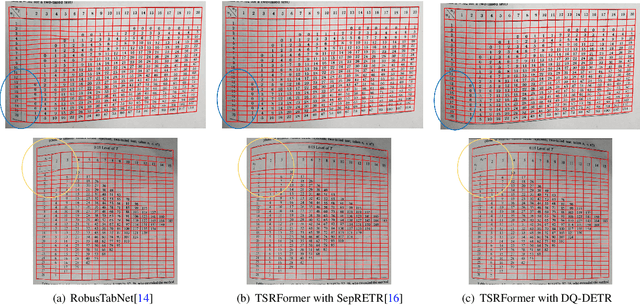
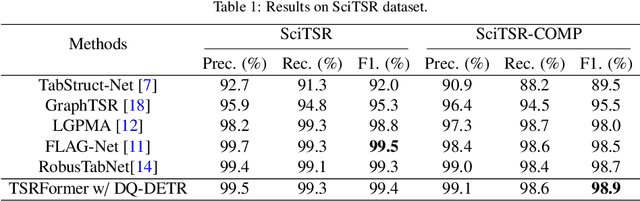
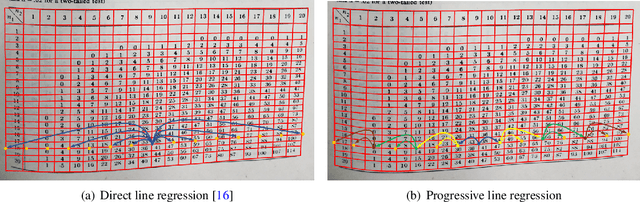
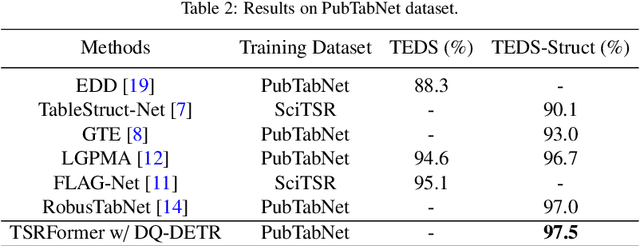
We present a new table structure recognition (TSR) approach, called TSRFormer, to robustly recognizing the structures of complex tables with geometrical distortions from various table images. Unlike previous methods, we formulate table separation line prediction as a line regression problem instead of an image segmentation problem and propose a new two-stage dynamic queries enhanced DETR based separation line regression approach, named DQ-DETR, to predict separation lines from table images directly. Compared to Vallina DETR, we propose three improvements in DQ-DETR to make the two-stage DETR framework work efficiently and effectively for the separation line prediction task: 1) A new query design, named Dynamic Query, to decouple single line query into separable point queries which could intuitively improve the localization accuracy for regression tasks; 2) A dynamic queries based progressive line regression approach to progressively regressing points on the line which further enhances localization accuracy for distorted tables; 3) A prior-enhanced matching strategy to solve the slow convergence issue of DETR. After separation line prediction, a simple relation network based cell merging module is used to recover spanning cells. With these new techniques, our TSRFormer achieves state-of-the-art performance on several benchmark datasets, including SciTSR, PubTabNet, WTW and FinTabNet. Furthermore, we have validated the robustness and high localization accuracy of our approach to tables with complex structures, borderless cells, large blank spaces, empty or spanning cells as well as distorted or even curved shapes on a more challenging real-world in-house dataset.
Improving Fast Auto-Focus with Event Polarity
Mar 15, 2023Fast and accurate auto-focus in adverse conditions remains an arduous task. The paper presents a polarity-based event camera auto-focus algorithm featuring high-speed, precise auto-focus in dark, dynamic scenes that conventional frame-based cameras cannot match. Specifically, the symmetrical relationship between the event polarities in focusing is investigated, and the event-based focus evaluation function is proposed based on the principles of the event cameras and the imaging model in the focusing process. Comprehensive experiments on the public EAD dataset show the robustness of the model. Furthermore, precise focus with less than one depth of focus is achieved within 0.004 seconds on our self-built high-speed focusing platform. The dataset and code will be made publicly available.