 Add to Chrome
 Add to Firefox
 Add to Edge
BronchoLumen: Analysis of recent YOLO-based architectures for real-time bronchial orifice detection in video bronchoscopy
May 12, 2026
Bronchoscopy is routinely conducted in pulmonary clinics and intensive care units, but navigating the complex branching of the respiratory tract remains challenging. This paper introduces BronchoLumen, a real-time YOLO-based system for detecting bronchial orifices in video bronchoscopy, aiming to assist navigation and CAD systems. The paper investigates if bronchial orifices can be robustly detected across image domains using state-of-the-art object detection and a limited set of public image data. The study includes the description and comparison of YOLOv8, a widely adopted architecture, and YOLOv12, a more recent architecture integrating attention-based modules to improve spatial reasoning. Both models are trained and tested solely on publicly available datasets comprising different image domains. A comparison of both models is conducted based on the common metrics mAP@0.5 and mAP@0.5:0.9 with the latter emphasizing localization accuracy. For YOLOv8 we obtained a mAP@0.5 of 0.91 on an in-domain and 0.68 on a cross-domain test set. YOLOv12 achieved 0.84 and 0.68 respectively with slightly better localization accuracy with mAP@0.5:0.9 of 0.48 and 0.26 compared to YOLOv8 with 0.45 and 0.25. Challenges like motion blur and low contrast occasionally entailed uncertainties but the system demonstrated overall robustness in most scenarios. BronchoLumen is an open-weight, YOLO-based solution for bronchial orifice detection offering high accuracy and efficiency across multiple image domains. While the more recent YOLOv12 achieves better localization accuracy, we observed a slightly worse precision. The models have been made publicly available to foster further research in bronchoscopy navigation.

The USTC-NERCSLIP Systems for The ICMC-ASR Challenge
Jul 02, 2024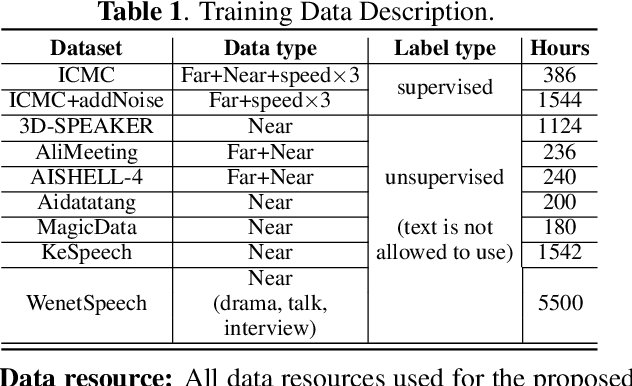
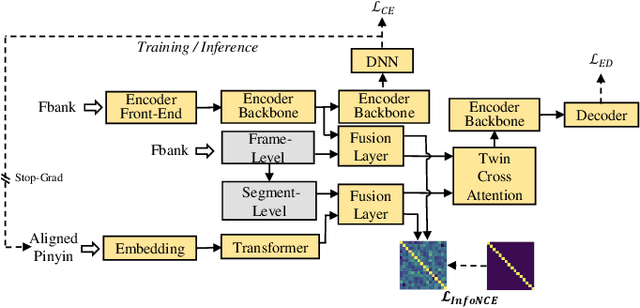
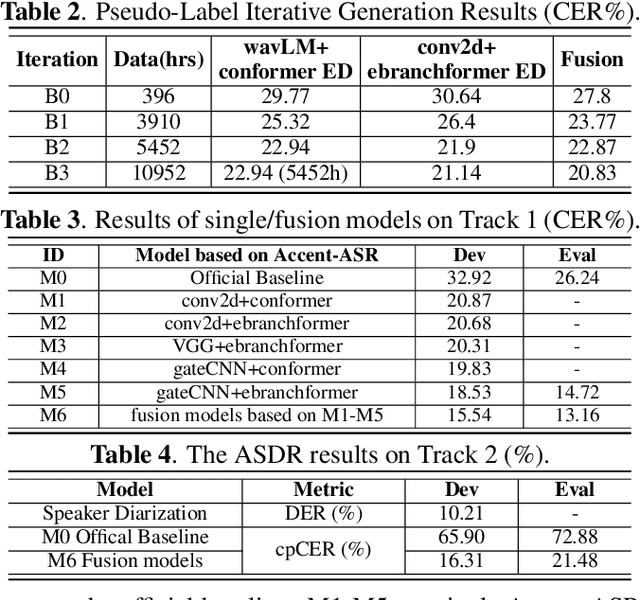
This report describes the submitted system to the In-Car Multi-Channel Automatic Speech Recognition (ICMC-ASR) challenge, which considers the ASR task with multi-speaker overlapping and Mandarin accent dynamics in the ICMC case. We implement the front-end speaker diarization using the self-supervised learning representation based multi-speaker embedding and beamforming using the speaker position, respectively. For ASR, we employ an iterative pseudo-label generation method based on fusion model to obtain text labels of unsupervised data. To mitigate the impact of accent, an Accent-ASR framework is proposed, which captures pronunciation-related accent features at a fine-grained level and linguistic information at a coarse-grained level. On the ICMC-ASR eval set, the proposed system achieves a CER of 13.16% on track 1 and a cpCER of 21.48% on track 2, which significantly outperforms the official baseline system and obtains the first rank on both tracks.
Reducing the gap between streaming and non-streaming Transducer-based ASR by adaptive two-stage knowledge distillation
Jun 27, 2023Transducer is one of the mainstream frameworks for streaming speech recognition. There is a performance gap between the streaming and non-streaming transducer models due to limited context. To reduce this gap, an effective way is to ensure that their hidden and output distributions are consistent, which can be achieved by hierarchical knowledge distillation. However, it is difficult to ensure the distribution consistency simultaneously because the learning of the output distribution depends on the hidden one. In this paper, we propose an adaptive two-stage knowledge distillation method consisting of hidden layer learning and output layer learning. In the former stage, we learn hidden representation with full context by applying mean square error loss function. In the latter stage, we design a power transformation based adaptive smoothness method to learn stable output distribution. It achieved 19\% relative reduction in word error rate, and a faster response for the first token compared with the original streaming model in LibriSpeech corpus.
MIPI 2023 Challenge on RGB+ToF Depth Completion: Methods and Results
Apr 27, 2023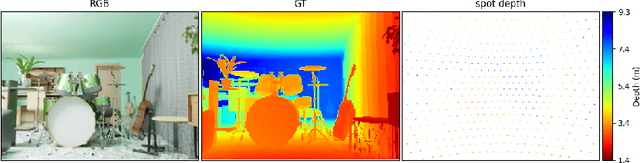

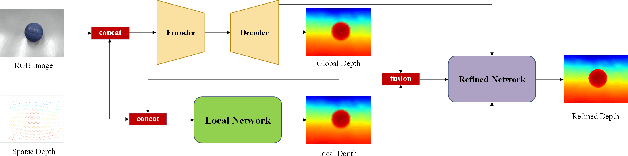
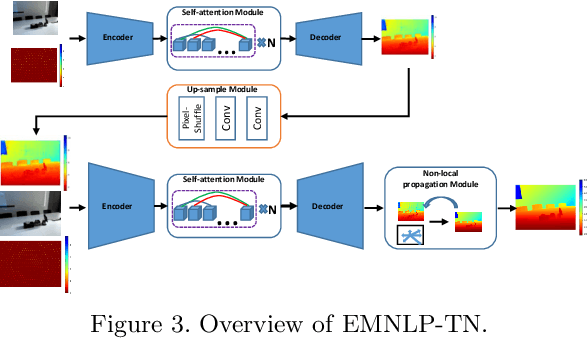
Depth completion from RGB images and sparse Time-of-Flight (ToF) measurements is an important problem in computer vision and robotics. While traditional methods for depth completion have relied on stereo vision or structured light techniques, recent advances in deep learning have enabled more accurate and efficient completion of depth maps from RGB images and sparse ToF measurements. To evaluate the performance of different depth completion methods, we organized an RGB+sparse ToF depth completion competition. The competition aimed to encourage research in this area by providing a standardized dataset and evaluation metrics to compare the accuracy of different approaches. In this report, we present the results of the competition and analyze the strengths and weaknesses of the top-performing methods. We also discuss the implications of our findings for future research in RGB+sparse ToF depth completion. We hope that this competition and report will help to advance the state-of-the-art in this important area of research. More details of this challenge and the link to the dataset can be found at https://mipi-challenge.org/MIPI2023.