 Add to Chrome
 Add to Firefox
 Add to Edge
Visualizing Uncertainty: Spatial Maps of Missing and Conflicting Evidence in Deep Learning
Jun 14, 2026
Understanding when and why deep neural networks are uncertain is crucial for deploying reliable machine learning systems in safety-critical domains. While existing uncertainty quantification methods provide scalar measures of model confidence, they offer limited insight into which spatial regions of an input contribute to different types of uncertainty. We propose a novel visualization framework, Uncertainty Activation Map (UAM), that combines Evidential Deep Learning (EDL) with Full-Gradient Class Activation Mapping (FullGrad) to generate interpretable spatial uncertainty activation maps. Our approach distinguishes between two fundamental types of uncertainty: vacuity, representing lack of evidence, and dissonance, capturing conflicting evidence between competing hypotheses. By leveraging the complete gradient decomposition property of FullGrad and the principled uncertainty quantification of Subjective Logic, our method produces theoretically grounded visualizations that highlight specific image regions responsible for model uncertainty. With this framework, vacuity and dissonance activation maps are generated by computing belief-weighted attributions, enabling identification of where models lack knowledge versus where they encounter ambiguous evidence. Extensive evaluations across multiple benchmark datasets demonstrate that the proposed framework effectively addresses the critical gap between uncertainty quantification and explainability, providing intuitive visual feedback to assess model reliability in complex visual recognition tasks.

Preliminary Insights in Chronos Frequency Data Understanding and Reconstruction
May 07, 2026This paper presents a preliminary analysis of the ability of Chronos foundation model to process and internally represent frequency domain information. Foundation models that process time-series data offer practitioners a unified architecture capable of learning generic temporal representations across diverse tasks and domains, reducing the need for task-specific feature engineering and enabling transfer across signal modalities. Despite their growing adoption, the extent to which such models encode fundamental signal properties remains insufficiently characterised. We address this gap by analysing Chronos under controlled conditions, starting from the simplest class of signals: discrete sinusoids generated at fixed frequencies. Using lightweight online minimum description length probes applied to the decoder architecture, we test for the presence and separability of frequency information in the model's internal representations. The results provide insight into how frequential content is captured across the frequency spectrum and highlight regimes in which representation quality may degrade or require particular care. These findings offer practical guidance for users of Chronos in signal processing and information fusion contexts, and contribute to ongoing efforts to improve the interpretability and evaluation of foundation models for temporal data.
Towards Causally Interpretable Wi-Fi CSI-Based Human Activity Recognition with Discrete Latent Compression and LTL Rule Extraction
Apr 24, 2026We address Human Activity Recognition (HAR) utilizing Wi-Fi Channel State Information (CSI) under the joint requirements of causal interpretability, symbolic controllability, and direct operation on high-dimensional raw signals. Deep neural models achieve strong predictive performance on CSI-based HAR (CHAR), yet rely on continuous latent representations that are opaque and difficult to modify; purely symbolic approaches, in contrast, cannot process raw CSI streams. We propose a fully automatic and strictly decoupled pipeline in which CSI magnitude windows are compressed by a categorical variational autoencoder with Gumbel-Softmax latent variables under a capacity-controlled objective, yielding a compact discrete representation. The encoder is then frozen and used as a deterministic mapping to one-hot latent trajectories. Causal discovery is performed on these trajectories to estimate class-conditional temporal dependency graphs. Statistically supported lagged dependencies are translated into Linear Temporal Logic (LTL) rules, producing a fully symbolic and deterministic classifier based solely on rule evaluation and aggregation, without any learned discriminative head. Because rules are defined over discrete latent variables, antenna-specific rule sets can in principle be combined at the symbolic level, enabling structured multi-antenna fusion without retraining the encoder. Results from CHAR Latent Temporal Rule Extraction (CHARL-TRE) indicate competitive performance while preserving explicit temporal and causal structure, showing that deterministic symbolic classification grounded in unsupervised discrete latent representations constitutes a viable alternative to end-to-end black-box models for wireless HAR.
X-MAP: eXplainable Misclassification Analysis and Profiling for Spam and Phishing Detection
Feb 17, 2026Misclassifications in spam and phishing detection are very harmful, as false negatives expose users to attacks while false positives degrade trust. Existing uncertainty-based detectors can flag potential errors, but possibly be deceived and offer limited interpretability. This paper presents X-MAP, an eXplainable Misclassification Analysis and Profilling framework that reveals topic-level semantic patterns behind model failures. X-MAP combines SHAP-based feature attributions with non-negative matrix factorization to build interpretable topic profiles for reliably classified spam/phishing and legitimate messages, and measures each message's deviation from these profiles using Jensen-Shannon divergence. Experiments on SMS and phishing datasets show that misclassified messages exhibit at least two times larger divergence than correctly classified ones. As a detector, X-MAP achieves up to 0.98 AUROC and lowers the false-rejection rate at 95% TRR to 0.089 on positive predictions. When used as a repair layer on base detectors, it recovers up to 97% of falsely rejected correct predictions with moderate leakage. These results demonstrate X-MAP's effectiveness and interpretability for improving spam and phishing detection.
Risk-aware Classification via Uncertainty Quantification
Dec 04, 2024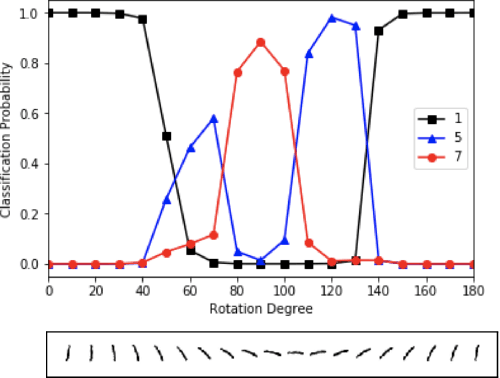
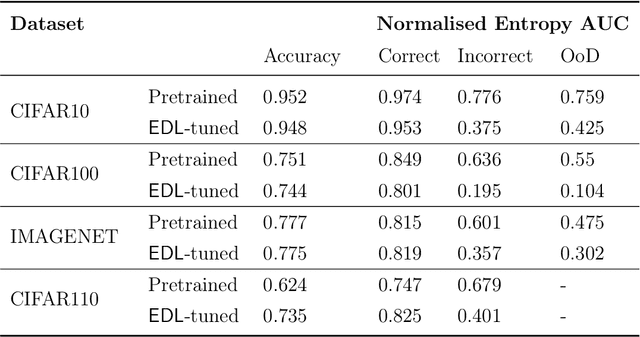
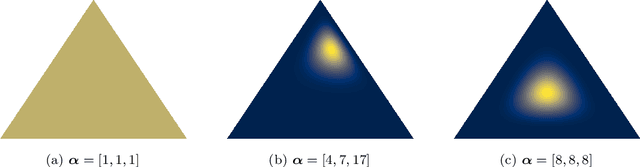
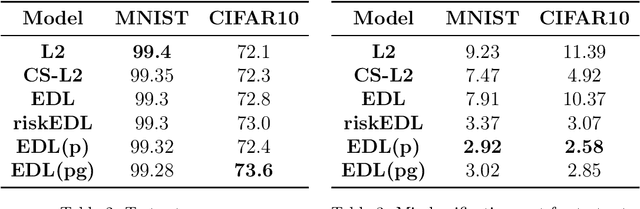
Autonomous and semi-autonomous systems are using deep learning models to improve decision-making. However, deep classifiers can be overly confident in their incorrect predictions, a major issue especially in safety-critical domains. The present study introduces three foundational desiderata for developing real-world risk-aware classification systems. Expanding upon the previously proposed Evidential Deep Learning (EDL), we demonstrate the unity between these principles and EDL's operational attributes. We then augment EDL empowering autonomous agents to exercise discretion during structured decision-making when uncertainty and risks are inherent. We rigorously examine empirical scenarios to substantiate these theoretical innovations. In contrast to existing risk-aware classifiers, our proposed methodologies consistently exhibit superior performance, underscoring their transformative potential in risk-conscious classification strategies.
Neuro-Symbolic Fusion of Wi-Fi Sensing Data for Passive Radar with Inter-Modal Knowledge Transfer
Jul 01, 2024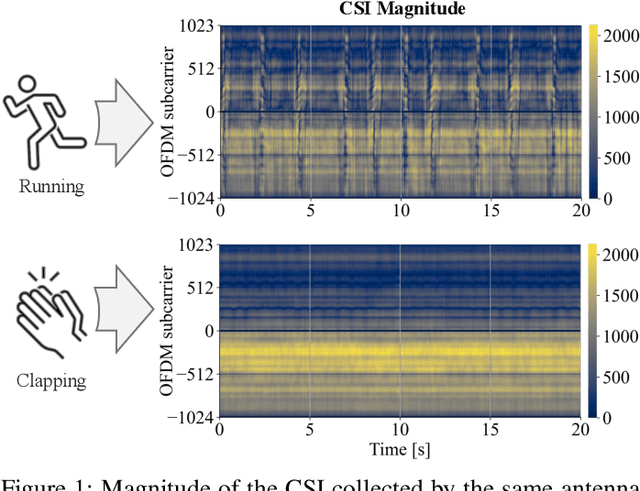
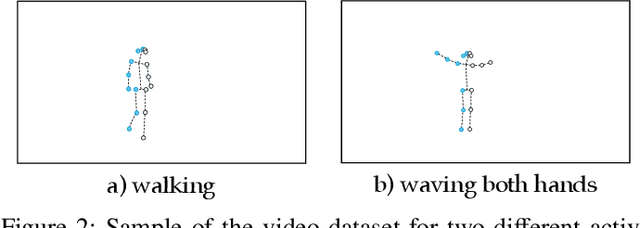
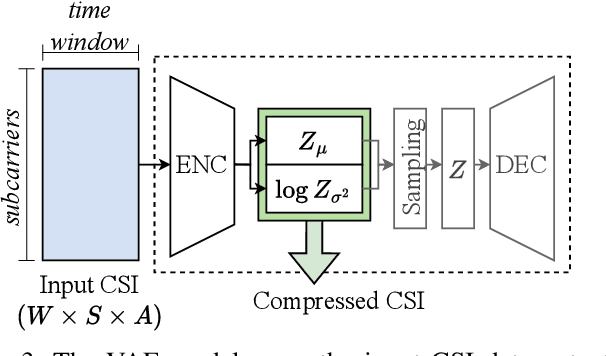
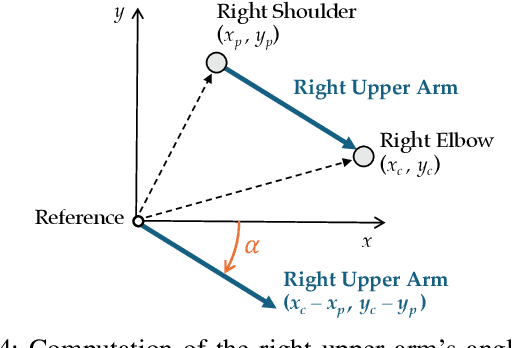
Wi-Fi devices, akin to passive radars, can discern human activities within indoor settings due to the human body's interaction with electromagnetic signals. Current Wi-Fi sensing applications predominantly employ data-driven learning techniques to associate the fluctuations in the physical properties of the communication channel with the human activity causing them. However, these techniques often lack the desired flexibility and transparency. This paper introduces DeepProbHAR, a neuro-symbolic architecture for Wi-Fi sensing, providing initial evidence that Wi-Fi signals can differentiate between simple movements, such as leg or arm movements, which are integral to human activities like running or walking. The neuro-symbolic approach affords gathering such evidence without needing additional specialised data collection or labelling. The training of DeepProbHAR is facilitated by declarative domain knowledge obtained from a camera feed and by fusing signals from various antennas of the Wi-Fi receivers. DeepProbHAR achieves results comparable to the state-of-the-art in human activity recognition. Moreover, as a by-product of the learning process, DeepProbHAR generates specialised classifiers for simple movements that match the accuracy of models trained on finely labelled datasets, which would be particularly costly.
Accurate Passive Radar via an Uncertainty-Aware Fusion of Wi-Fi Sensing Data
Jul 01, 2024Wi-Fi devices can effectively be used as passive radar systems that sense what happens in the surroundings and can even discern human activity. We propose, for the first time, a principled architecture which employs Variational Auto-Encoders for estimating a latent distribution responsible for generating the data, and Evidential Deep Learning for its ability to sense out-of-distribution activities. We verify that the fused data processed by different antennas of the same Wi-Fi receiver results in increased accuracy of human activity recognition compared with the most recent benchmarks, while still being informative when facing out-of-distribution samples and enabling semantic interpretation of latent variables in terms of physical phenomena. The results of this paper are a first contribution toward the ultimate goal of providing a flexible, semantic characterisation of black-swan events, i.e., events for which we have limited to no training data.
Hyper Evidential Deep Learning to Quantify Composite Classification Uncertainty
Apr 17, 2024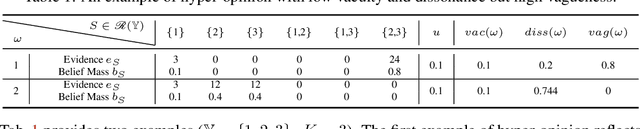
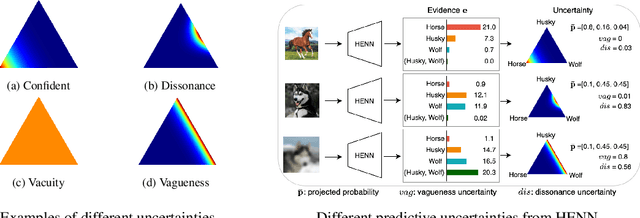
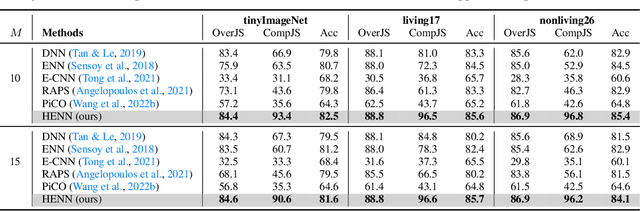
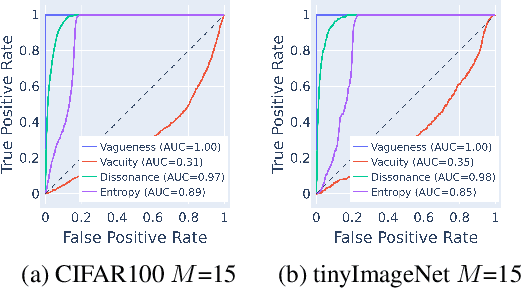
Deep neural networks (DNNs) have been shown to perform well on exclusive, multi-class classification tasks. However, when different classes have similar visual features, it becomes challenging for human annotators to differentiate them. This scenario necessitates the use of composite class labels. In this paper, we propose a novel framework called Hyper-Evidential Neural Network (HENN) that explicitly models predictive uncertainty due to composite class labels in training data in the context of the belief theory called Subjective Logic (SL). By placing a grouped Dirichlet distribution on the class probabilities, we treat predictions of a neural network as parameters of hyper-subjective opinions and learn the network that collects both single and composite evidence leading to these hyper-opinions by a deterministic DNN from data. We introduce a new uncertainty type called vagueness originally designed for hyper-opinions in SL to quantify composite classification uncertainty for DNNs. Our results demonstrate that HENN outperforms its state-of-the-art counterparts based on four image datasets. The code and datasets are available at: https://github.com/Hugo101/HyperEvidentialNN.
GDTM: An Indoor Geospatial Tracking Dataset with Distributed Multimodal Sensors
Feb 21, 2024
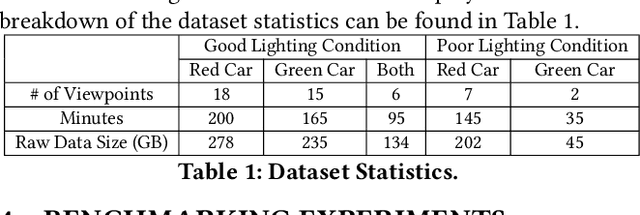
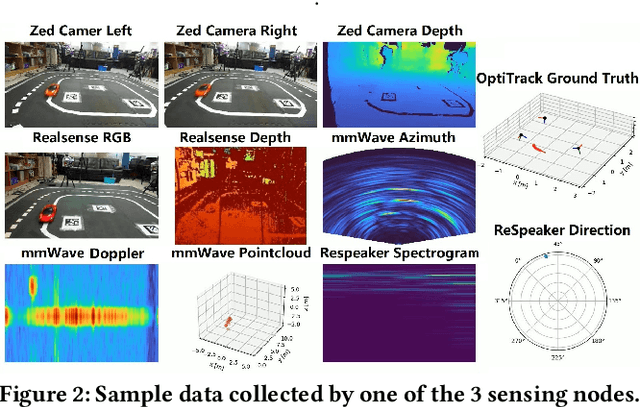
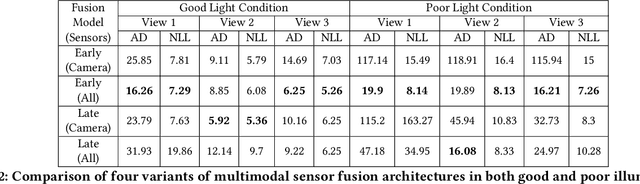
Constantly locating moving objects, i.e., geospatial tracking, is essential for autonomous building infrastructure. Accurate and robust geospatial tracking often leverages multimodal sensor fusion algorithms, which require large datasets with time-aligned, synchronized data from various sensor types. However, such datasets are not readily available. Hence, we propose GDTM, a nine-hour dataset for multimodal object tracking with distributed multimodal sensors and reconfigurable sensor node placements. Our dataset enables the exploration of several research problems, such as optimizing architectures for processing multimodal data, and investigating models' robustness to adverse sensing conditions and sensor placement variances. A GitHub repository containing the code, sample data, and checkpoints of this work is available at https://github.com/nesl/GDTM.
Knowledge from Uncertainty in Evidential Deep Learning
Oct 19, 2023This work reveals an evidential signal that emerges from the uncertainty value in Evidential Deep Learning (EDL). EDL is one example of a class of uncertainty-aware deep learning approaches designed to provide confidence (or epistemic uncertainty) about the current test sample. In particular for computer vision and bidirectional encoder large language models, the `evidential signal' arising from the Dirichlet strength in EDL can, in some cases, discriminate between classes, which is particularly strong when using large language models. We hypothesise that the KL regularisation term causes EDL to couple aleatoric and epistemic uncertainty. In this paper, we empirically investigate the correlations between misclassification and evaluated uncertainty, and show that EDL's `evidential signal' is due to misclassification bias. We critically evaluate EDL with other Dirichlet-based approaches, namely Generative Evidential Neural Networks (EDL-GEN) and Prior Networks, and show theoretically and empirically the differences between these loss functions. We conclude that EDL's coupling of uncertainty arises from these differences due to the use (or lack) of out-of-distribution samples during training.