 Add to Chrome
 Add to Firefox
 Add to Edge
X-MAP: eXplainable Misclassification Analysis and Profiling for Spam and Phishing Detection
Feb 17, 2026
Misclassifications in spam and phishing detection are very harmful, as false negatives expose users to attacks while false positives degrade trust. Existing uncertainty-based detectors can flag potential errors, but possibly be deceived and offer limited interpretability. This paper presents X-MAP, an eXplainable Misclassification Analysis and Profilling framework that reveals topic-level semantic patterns behind model failures. X-MAP combines SHAP-based feature attributions with non-negative matrix factorization to build interpretable topic profiles for reliably classified spam/phishing and legitimate messages, and measures each message's deviation from these profiles using Jensen-Shannon divergence. Experiments on SMS and phishing datasets show that misclassified messages exhibit at least two times larger divergence than correctly classified ones. As a detector, X-MAP achieves up to 0.98 AUROC and lowers the false-rejection rate at 95% TRR to 0.089 on positive predictions. When used as a repair layer on base detectors, it recovers up to 97% of falsely rejected correct predictions with moderate leakage. These results demonstrate X-MAP's effectiveness and interpretability for improving spam and phishing detection.

Hyper Evidential Deep Learning to Quantify Composite Classification Uncertainty
Apr 17, 2024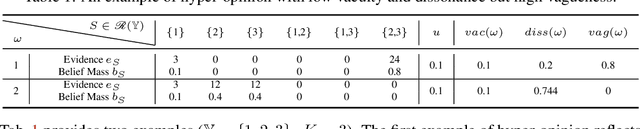
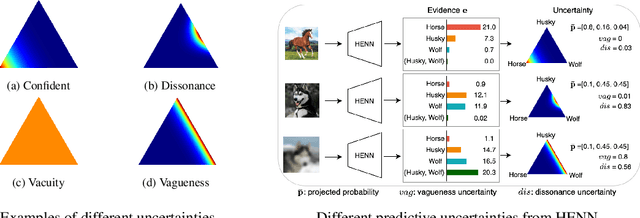
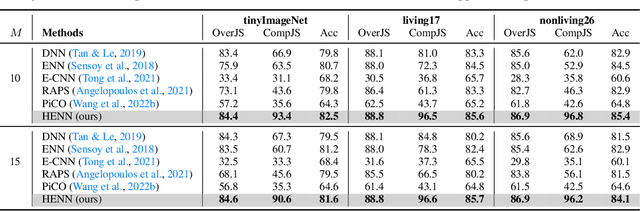
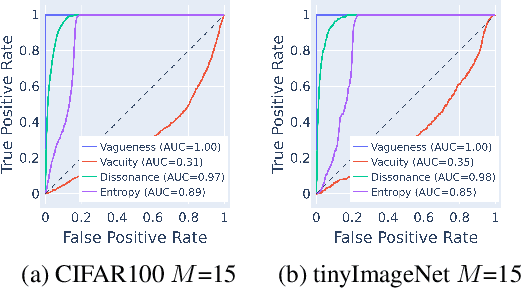
Deep neural networks (DNNs) have been shown to perform well on exclusive, multi-class classification tasks. However, when different classes have similar visual features, it becomes challenging for human annotators to differentiate them. This scenario necessitates the use of composite class labels. In this paper, we propose a novel framework called Hyper-Evidential Neural Network (HENN) that explicitly models predictive uncertainty due to composite class labels in training data in the context of the belief theory called Subjective Logic (SL). By placing a grouped Dirichlet distribution on the class probabilities, we treat predictions of a neural network as parameters of hyper-subjective opinions and learn the network that collects both single and composite evidence leading to these hyper-opinions by a deterministic DNN from data. We introduce a new uncertainty type called vagueness originally designed for hyper-opinions in SL to quantify composite classification uncertainty for DNNs. Our results demonstrate that HENN outperforms its state-of-the-art counterparts based on four image datasets. The code and datasets are available at: https://github.com/Hugo101/HyperEvidentialNN.