 Add to Chrome
 Add to Firefox
 Add to Edge
TS-Skill: A Benchmark for Evaluating Analytical Skills in Time-Series Question Answering
May 23, 2026
Large language models (LLMs) and time-series language models (TSLMs) are increasingly applied to time-series question answering (TSQA). Unlike text-only QA, TSQA requires models to ground answers in temporal signals whose patterns may occur at different scales, specific time locations, or across separated intervals. However, existing benchmarks are typically organized by task types or high-level reasoning categories, making it difficult to diagnose the underlying signal-level capabilities driving model performance. We introduce TS-Skill, a controlled benchmark for evaluating three composable analytical skills in TSQA: temporal scale selection (SK1), temporal localization (SK2), and cross-interval integration (SK3). TS-Skill provides timestamp-aware questions, broad domain coverage, and human-validated QA quality. To construct the benchmark at scale, we develop SKEvol, a skill-guided agentic framework that combines domain-aware time-series seed generation, skill-controlled question generation, metadata- and code-assisted answer construction, multi-phase signal-grounded verification, and human-in-the-loop curation. Experiments on ten state-of-the-art LLMs and TSLMs reveal substantial and uneven capability gaps across SK1-SK3. In particular, SK3 remains consistently challenging for non-agent models, whereas tool-augmented agents show a selective advantage on standalone SK3. These findings demonstrate that skill-level evaluation can uncover temporal reasoning failures that are obscured by aggregate TSQA scores.

Preliminary Insights in Chronos Frequency Data Understanding and Reconstruction
May 07, 2026This paper presents a preliminary analysis of the ability of Chronos foundation model to process and internally represent frequency domain information. Foundation models that process time-series data offer practitioners a unified architecture capable of learning generic temporal representations across diverse tasks and domains, reducing the need for task-specific feature engineering and enabling transfer across signal modalities. Despite their growing adoption, the extent to which such models encode fundamental signal properties remains insufficiently characterised. We address this gap by analysing Chronos under controlled conditions, starting from the simplest class of signals: discrete sinusoids generated at fixed frequencies. Using lightweight online minimum description length probes applied to the decoder architecture, we test for the presence and separability of frequency information in the model's internal representations. The results provide insight into how frequential content is captured across the frequency spectrum and highlight regimes in which representation quality may degrade or require particular care. These findings offer practical guidance for users of Chronos in signal processing and information fusion contexts, and contribute to ongoing efforts to improve the interpretability and evaluation of foundation models for temporal data.
Towards Causally Interpretable Wi-Fi CSI-Based Human Activity Recognition with Discrete Latent Compression and LTL Rule Extraction
Apr 24, 2026We address Human Activity Recognition (HAR) utilizing Wi-Fi Channel State Information (CSI) under the joint requirements of causal interpretability, symbolic controllability, and direct operation on high-dimensional raw signals. Deep neural models achieve strong predictive performance on CSI-based HAR (CHAR), yet rely on continuous latent representations that are opaque and difficult to modify; purely symbolic approaches, in contrast, cannot process raw CSI streams. We propose a fully automatic and strictly decoupled pipeline in which CSI magnitude windows are compressed by a categorical variational autoencoder with Gumbel-Softmax latent variables under a capacity-controlled objective, yielding a compact discrete representation. The encoder is then frozen and used as a deterministic mapping to one-hot latent trajectories. Causal discovery is performed on these trajectories to estimate class-conditional temporal dependency graphs. Statistically supported lagged dependencies are translated into Linear Temporal Logic (LTL) rules, producing a fully symbolic and deterministic classifier based solely on rule evaluation and aggregation, without any learned discriminative head. Because rules are defined over discrete latent variables, antenna-specific rule sets can in principle be combined at the symbolic level, enabling structured multi-antenna fusion without retraining the encoder. Results from CHAR Latent Temporal Rule Extraction (CHARL-TRE) indicate competitive performance while preserving explicit temporal and causal structure, showing that deterministic symbolic classification grounded in unsupervised discrete latent representations constitutes a viable alternative to end-to-end black-box models for wireless HAR.
Tracking without Seeing: Geospatial Inference using Encrypted Traffic from Distributed Nodes
Mar 29, 2026Accurate observation of dynamic environments traditionally relies on synthesizing raw, signal-level information from multiple distributed sensors. This work investigates an alternative approach: performing geospatial inference using only encrypted packet-level information, without access to the raw sensory data. We further explore how this indirect information can be fused with directly available sensory data to extend overall inference capabilities. We introduce GraySense, a learning-based framework that performs geospatial object tracking by analyzing encrypted wireless video transmission traffic, such as packet sizes, from cameras with inaccessible streams. GraySense leverages the inherent relationship between scene dynamics and transmitted packet sizes to infer object motion. The framework consists of two stages: (1) a Packet Grouping module that identifies frame boundaries and estimates frame sizes from encrypted network traffic, and (2) a Tracker module, based on a Transformer encoder with a recurrent state, which fuses indirect packet-based inputs with optional direct camera-based inputs to estimate the object's position. Extensive experiments with realistic videos from the CARLA simulator and emulated networks under varying conditions show that GraySense achieves 2.33 meters tracking error (Euclidean distance) without raw signal access, within the dimensions of tracked objects (4.61m x 1.93m). To our knowledge, this capability has not been previously demonstrated, expanding the use of latent signals for sensing.
UniFi: Combining Irregularly Sampled CSI from Diverse Communication Packets and Frequency Bands for Wi-Fi Sensing
Dec 14, 2025Existing Wi-Fi sensing systems rely on injecting high-rate probing packets to extract channel state information (CSI), leading to communication degradation and poor deployability. Although Integrated Sensing and Communication (ISAC) is a promising direction, existing solutions still rely on auxiliary packet injection because they exploit only CSI from data frames. We present UniFi, the first Wi-Fi-based ISAC framework that fully eliminates intrusive packet injection by directly exploiting irregularly sampled CSI from diverse communication packets across multiple frequency bands. UniFi integrates a CSI sanitization pipeline to harmonize heterogeneous packets and remove burst-induced redundancy, together with a time-aware attention model that learns directly from non-uniform CSI sequences without resampling. We further introduce CommCSI-HAR, the first dataset with irregularly sampled CSI from real-world dual-band communication traffic. Extensive evaluations on this dataset and four public benchmarks show that UniFi achieves state-of-the-art accuracy with a compact model size, while fully preserving communication throughput.
Toward Foundation Models for Online Complex Event Detection in CPS-IoT: A Case Study
Mar 15, 2025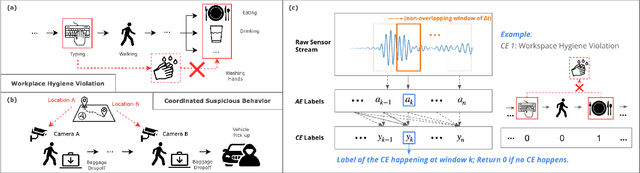
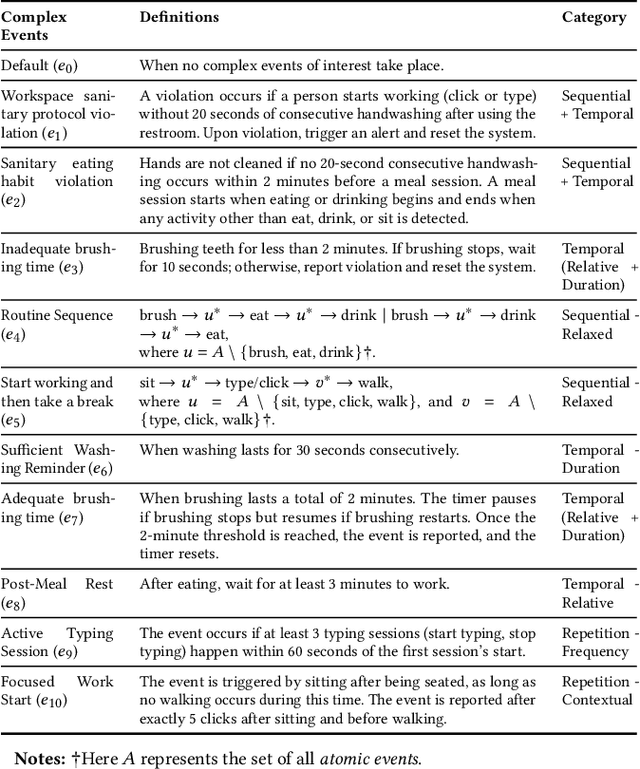
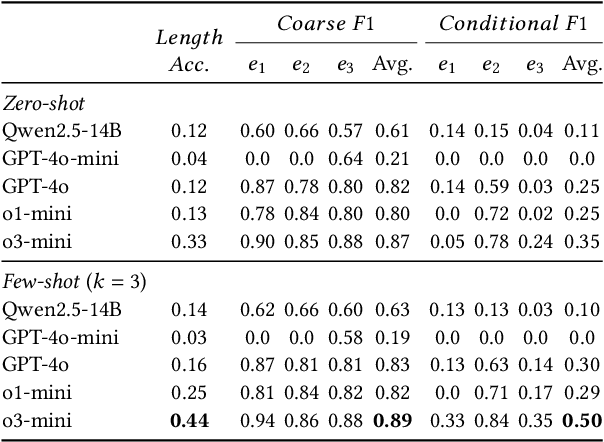
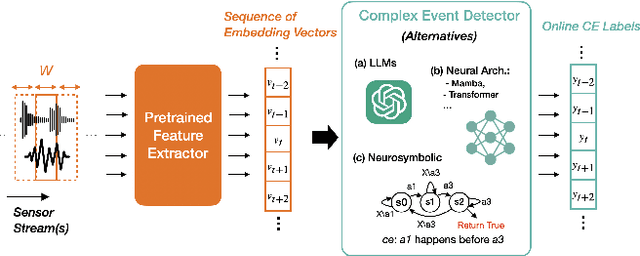
Complex events (CEs) play a crucial role in CPS-IoT applications, enabling high-level decision-making in domains such as smart monitoring and autonomous systems. However, most existing models focus on short-span perception tasks, lacking the long-term reasoning required for CE detection. CEs consist of sequences of short-time atomic events (AEs) governed by spatiotemporal dependencies. Detecting them is difficult due to long, noisy sensor data and the challenge of filtering out irrelevant AEs while capturing meaningful patterns. This work explores CE detection as a case study for CPS-IoT foundation models capable of long-term reasoning. We evaluate three approaches: (1) leveraging large language models (LLMs), (2) employing various neural architectures that learn CE rules from data, and (3) adopting a neurosymbolic approach that integrates neural models with symbolic engines embedding human knowledge. Our results show that the state-space model, Mamba, which belongs to the second category, outperforms all methods in accuracy and generalization to longer, unseen sensor traces. These findings suggest that state-space models could be a strong backbone for CPS-IoT foundation models for long-span reasoning tasks.
NARCE: A Mamba-Based Neural Algorithmic Reasoner Framework for Online Complex Event Detection
Feb 11, 2025Current machine learning models excel in short-span perception tasks but struggle to derive high-level insights from long-term observation, a capability central to understanding complex events (CEs). CEs, defined as sequences of short-term atomic events (AEs) governed by spatiotemporal rules, are challenging to detect online due to the need to extract meaningful patterns from long and noisy sensor data while ignoring irrelevant events. We hypothesize that state-based methods are well-suited for CE detection, as they capture event progression through state transitions without requiring long-term memory. Baseline experiments validate this, demonstrating that the state-space model Mamba outperforms existing architectures. However, Mamba's reliance on extensive labeled data, which are difficult to obtain, motivates our second hypothesis: decoupling CE rule learning from noisy sensor data can reduce data requirements. To address this, we propose NARCE, a framework that combines Neural Algorithmic Reasoning (NAR) to split the task into two components: (i) learning CE rules independently of sensor data using synthetic concept traces generated by LLMs and (ii) mapping sensor inputs to these rules via an adapter. Our results show that NARCE outperforms baselines in accuracy, generalization to unseen and longer sensor data, and data efficiency, significantly reducing annotation costs while advancing robust CE detection.