 Add to Chrome
 Add to Firefox
 Add to Edge
SSL-GMMVC: Interpretable Voice Conversion via Locally Linear GMM Transforms in Self-Supervised Representation Space
Jun 09, 2026
We introduce SSL-GMMVC, an interpretable voice conversion method in self-supervised speech space. The method models paired source-target features with a Gaussian mixture model and performs conversion as a posterior-weighted sum of affine transforms. This yields locally linear transformations that adapt to heterogeneous feature-space structure while remaining analytically tractable. Through objective and subjective evaluations, we show that SSL-GMMVC improves speaker similarity with comparable intelligibility and naturalness, and that even a constrained covariance variant surpasses a deep learning baseline as the number of mixture components increases. Further analyses link component selection to phonetic structure and reveal interpretable scaling and rotation in the learned transforms. These findings highlight SSL-GMMVC as an effective, analyzable framework for voice conversion.

Leveraging Soft Distributions of SSL-Derived Discrete Speech Tokens for Downstream Inference
Jun 05, 2026Discrete speech tokens obtained from self-supervised learning (SSL) models provide efficient data compression while maintaining strong performance, and have been widely used as intermediate representations in various tasks. However, discretization inevitably causes information loss, leading to degraded performance compared with continuous SSL features. In this work, we propose to apply soft token assignment only during downstream inference. This approach preserves the efficiency of hard discretization during training while enhancing the expressiveness of the tokens at inference. The proposed method outperforms conventional hard assignment on both ASR and speech synthesis tasks, and exhibits particularly strong generalizability to out-of-domain data. For ASR of non-native speech, it even surpasses models using continuous SSL features. Moreover, analysis of the resulting representations shows they align more accurately with phonemes compared with conventional hard assignment.
Prosodic ABX: A Language-Agnostic Method for Measuring Prosodic Contrast in Speech Representations
Apr 02, 2026Speech representations from self-supervised speech models (S3Ms) are known to be sensitive to phonemic contrasts, but their sensitivity to prosodic contrasts has not been directly measured. The ABX discrimination task has been used to measure phonemic contrast in S3M representations via minimal pairs. We introduce prosodic ABX, an extension of this framework to evaluate prosodic contrast with only a handful of examples and no explicit labels. Also, we build and release a dataset of English and Japanese minimal pairs and use it along with a Mandarin dataset to evaluate contrast in English stress, Japanese pitch accent, and Mandarin tone. Finally, we show that model and layer rankings are often preserved across several experimental conditions, making it practical for low-resource settings.
Kanade: A Simple Disentangled Tokenizer for Spoken Language Modeling
Jan 31, 2026A good language model starts with a good tokenizer. Tokenization is especially important for speech modeling, which must handle continuous signals that mix linguistic and non-linguistic information. A speech tokenizer should extract phonetics and prosody, suppress linguistically irrelevant information like speaker identity, and enable high-quality synthesis. We present Kanade, a single-layer disentangled speech tokenizer that realizes this ideal. Kanade separates out acoustic constants to create a single stream of tokens that captures rich phonetics and prosody. It does so without the need for auxiliary methods that existing disentangled codecs often rely on. Experiments show that Kanade achieves state-of-the-art speaker disentanglement and lexical availability, while maintaining excellent reconstruction quality.
Re:Member: Emotional Question Generation from Personal Memories
Oct 21, 2025We present Re:Member, a system that explores how emotionally expressive, memory-grounded interaction can support more engaging second language (L2) learning. By drawing on users' personal videos and generating stylized spoken questions in the target language, Re:Member is designed to encourage affective recall and conversational engagement. The system aligns emotional tone with visual context, using expressive speech styles such as whispers or late-night tones to evoke specific moods. It combines WhisperX-based transcript alignment, 3-frame visual sampling, and Style-BERT-VITS2 for emotional synthesis within a modular generation pipeline. Designed as a stylized interaction probe, Re:Member highlights the role of affect and personal media in learner-centered educational technologies.
A Perception-Based L2 Speech Intelligibility Indicator: Leveraging a Rater's Shadowing and Sequence-to-sequence Voice Conversion
May 30, 2025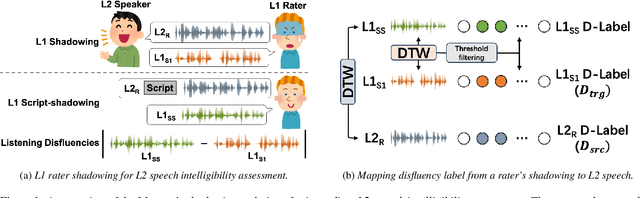
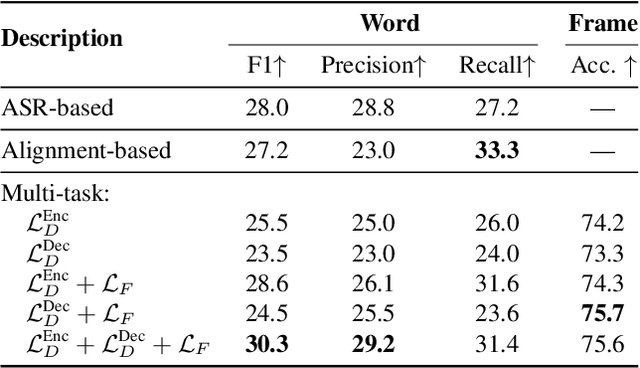
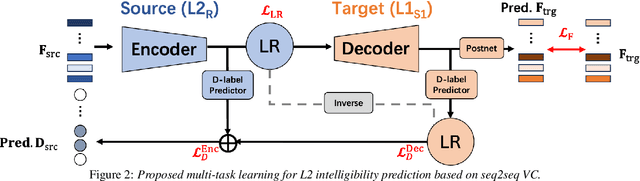
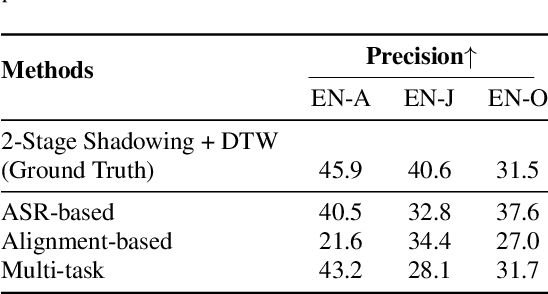
Evaluating L2 speech intelligibility is crucial for effective computer-assisted language learning (CALL). Conventional ASR-based methods often focus on native-likeness, which may fail to capture the actual intelligibility perceived by human listeners. In contrast, our work introduces a novel, perception based L2 speech intelligibility indicator that leverages a native rater's shadowing data within a sequence-to-sequence (seq2seq) voice conversion framework. By integrating an alignment mechanism and acoustic feature reconstruction, our approach simulates the auditory perception of native listeners, identifying segments in L2 speech that are likely to cause comprehension difficulties. Both objective and subjective evaluations indicate that our method aligns more closely with native judgments than traditional ASR-based metrics, offering a promising new direction for CALL systems in a global, multilingual contexts.
Prosodically Enhanced Foreign Accent Simulation by Discrete Token-based Resynthesis Only with Native Speech Corpora
May 22, 2025Recently, a method for synthesizing foreign-accented speech only with native speech data using discrete tokens obtained from self-supervised learning (SSL) models was proposed. Considering limited availability of accented speech data, this method is expected to make it much easier to simulate foreign accents. By using the synthesized accented speech as listening materials for humans or training data for automatic speech recognition (ASR), both of them will acquire higher robustness against foreign accents. However, the previous method has a fatal flaw that it cannot reproduce duration-related accents. Durational accents are commonly seen when L2 speakers, whose native language has syllable-timed or mora-timed rhythm, speak stress-timed languages, such as English. In this paper, we integrate duration modification to the previous method to simulate foreign accents more accurately. Experiments show that the proposed method successfully replicates durational accents seen in real L2 speech.
Discrete Tokens Exhibit Interlanguage Speech Intelligibility Benefit: an Analytical Study Towards Accent-robust ASR Only with Native Speech Data
May 22, 2025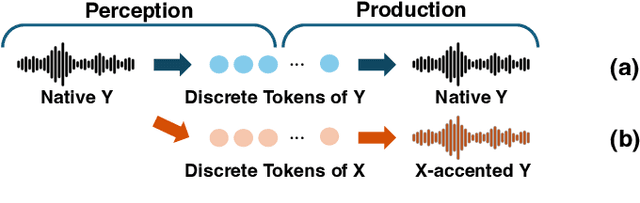
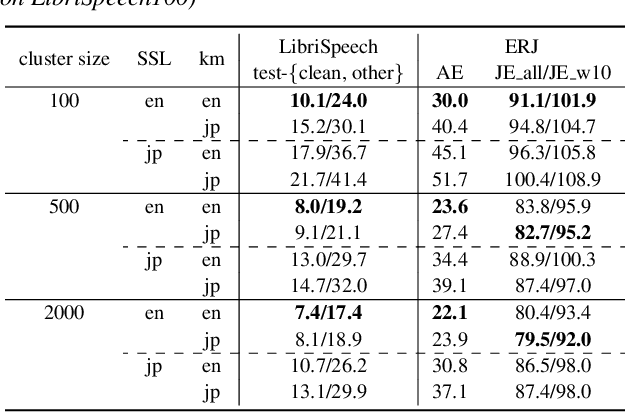
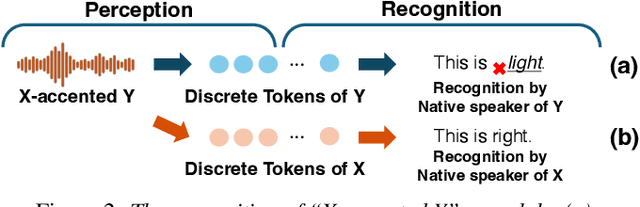
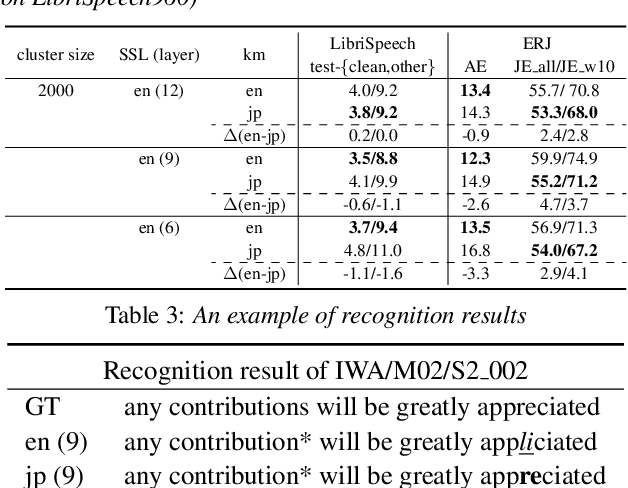
In this study, we gained insight that contributes to achieving accent-robust ASR using only native speech data. In human perception of non-native speech, the phenomenon known as "interlanguage speech intelligibility benefit" (ISIB) is observed, where non-native listeners who share the native language with the speaker understand the speech better compared even to native listeners. Based on the idea that discrete tokens extracted from self-supervised learning (SSL) models represent the human perception of speech, we conducted an analytical study on the robustness of discrete token-based ASR to non-native speech, varying the language used for training the tokenization, which is viewed as a technical implementation of ISIB. The results showed that ISIB actually occurred in the discrete token-based ASR. Since our approach relies only on native speech data to simulate the behavior of human perception, it is expected to be applicable to a wide range of accents for which speech data is scarce.
Analytic Study of Text-Free Speech Synthesis for Raw Audio using a Self-Supervised Learning Model
Dec 04, 2024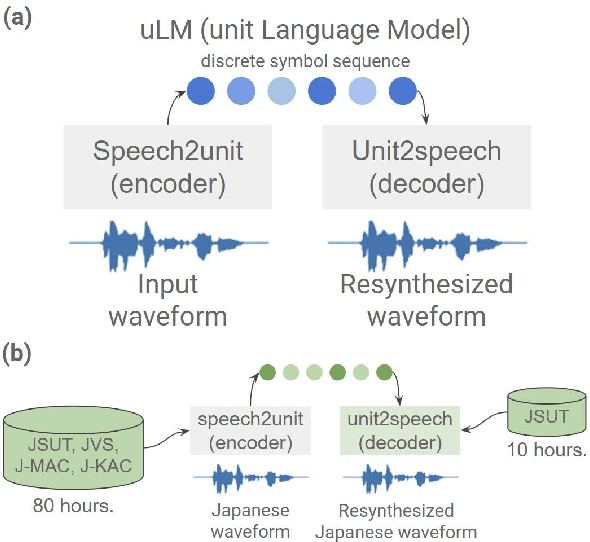
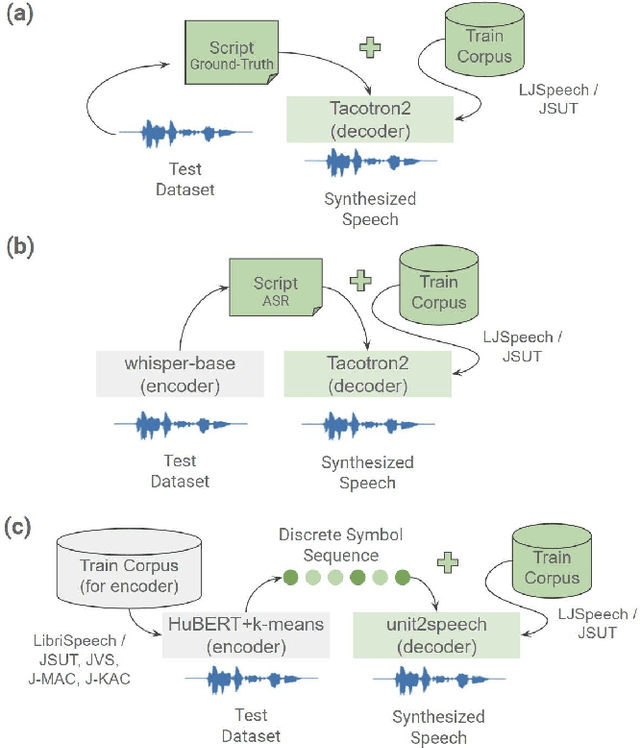
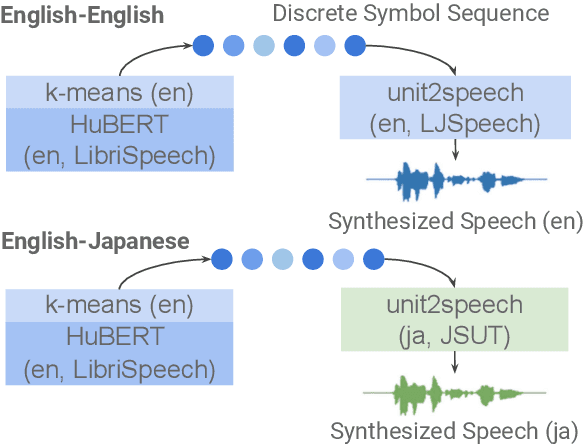

We examine the text-free speech representations of raw audio obtained from a self-supervised learning (SSL) model by analyzing the synthesized speech using the SSL representations instead of conventional text representations. Since raw audio does not have paired speech representations as transcribed texts do, obtaining speech representations from unpaired speech is crucial for augmenting available datasets for speech synthesis. Specifically, the proposed speech synthesis is conducted using discrete symbol representations from the SSL model in comparison with text representations, and analytical examinations of the synthesized speech have been carried out. The results empirically show that using text representations is advantageous for preserving semantic information, while using discrete symbol representations is superior for preserving acoustic content, including prosodic and intonational information.
A Pilot Study of Applying Sequence-to-Sequence Voice Conversion to Evaluate the Intelligibility of L2 Speech Using a Native Speaker's Shadowings
Oct 03, 2024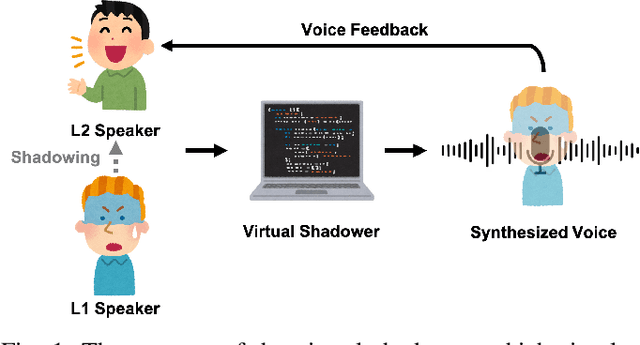


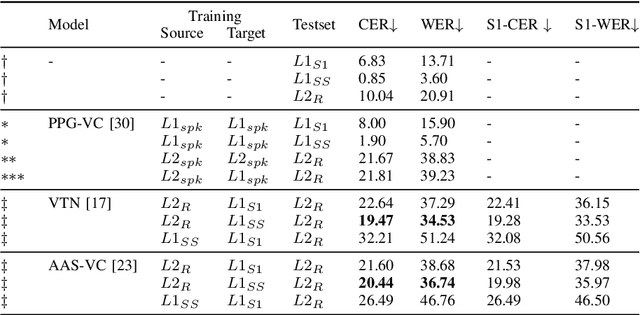
Utterances by L2 speakers can be unintelligible due to mispronunciation and improper prosody. In computer-aided language learning systems, textual feedback is often provided using a speech recognition engine. However, an ideal form of feedback for L2 speakers should be so fine-grained that it enables them to detect and diagnose unintelligible parts of L2 speakers' utterances. Inspired by language teachers who correct students' pronunciation through a voice-to-voice process, this pilot study utilizes a unique semi-parallel dataset composed of non-native speakers' (L2) reading aloud, shadowing of native speakers (L1) and their script-shadowing utterances. We explore the technical possibility of replicating the process of an L1 speaker's shadowing L2 speech using Voice Conversion techniques, to create a virtual shadower system. Experimental results demonstrate the feasibility of the VC system in simulating L1's shadowing behavior. The output of the virtual shadower system shows a reasonable similarity to the real L1 shadowing utterances in both linguistic and acoustic aspects.