 Add to Chrome
 Add to Firefox
 Add to Edge
Understanding Multilingual Medical ASR Adaptation Through Layer-Wise Analysis
Aug 19, 2026
Medical automatic speech recognition (MedASR) requires adaptation to specialised terminology, limited annotated clinical data, and multilingual use cases. Although large-scale pretrained ASR models such as Whisper achieve strong generalisation, their behaviour after medical and multilingual adaptation remains insufficiently understood beyond word error rate (WER). This paper investigates how multilingual medical adaptation reshapes the internal representations of Whisper models through layer-wise encoder analysis. We compare zero-shot decoding, English-only fine-tuning, German-only diagnostic fine-tuning, two-stage EN->EN+DE continuation, and direct EN+DE fine-tuning across Whisper model sizes. Fine-tuning substantially improves MedASR performance, but the best model depends on the adaptation setting: Whisper-Medium gives the lowest English WER (7.72%) and the lowest combined EN+DE WER under direct EN+DE training (26.30%); German-only Whisper-Large-v3 gives the lowest German WER (44.96%), but as a within-corpus diagnostic on 86 single-speaker training utterances rather than robust generalisation. Layer-wise analysis of the two-stage Whisper-Small trajectory shows that English medical fine-tuning produces the dominant encoder shift, whereas multilingual continuation largely preserves the adapted representation space. Domain and language information remain highly recoverable across layers, while linearly recoverable error-predictive cues weaken as WER improves.

Motor, Cognitive, or Corpus? What Survives Cross-Lingual Transfer in Speech-Based Parkinsons Disease Detection
Aug 13, 2026Self-supervised learning (SSL) speech representations achieve strong performance for Parkinson's disease (PD) detection within individual corpora. However, it remains unclear whether these models capture disease-related characteristics or exploit dataset-specific confounds, particularly since most SSL backbones are pretrained exclusively on healthy speech. To investigate this question, we perform a layer-wise analysis of nine SSL speech backbones using a low-capacity logistic regression probe across three languages. We structure the evaluation as multiple scenarios that progressively introduce distribution shifts in participant identity, recording conditions, language, and pathology. Our results reveal two key findings. First, layer selection is highly corpus-dependent: the optimal representation layer is determined primarily by the source dataset rather than by the SSL architecture itself. Second, the transferred discriminative signal lacks pathological specificity: classifiers trained to detect PD assign similarly high probabilities to both PD and dementia speech in the target corpus. These results highlight critical limitations that must be addressed before speech-based pathology recognition models can be reliably deployed in clinical settings.
Structured Phonological Representations for Audio-Articulatory rtMRI Speech Classification
Aug 10, 2026Real-time MRI makes it possible to observe vocal-tract articulation during speech, but mapping these articulatory patterns to phonetic and phonological categories remains challenging. We investigate whether PhonoQ, an audio-based model trained to recognize structured phonological features, provides useful information for audio--articulatory modeling. Specifically, we extract representations from PhonoQ's Conformer module, whose training is shaped by supervision for manner, place, voicing, and vowel features. Using articulatory contours with synchronized audio-derived features, we compare WavLM-large and HuBERT-large baselines with models that incorporate PhonoQ-derived representations. Across unseen-speech and unseen-subject settings, these features improve macro-F1 for phonological targets including manner, place, voicing, vowel height, and vowel backness, and also improve fine-grained 39-phoneme classification. In a contour-only inference setting, audio-derived teacher supervision yields modest but consistent gains over contour-only training, indicating that phonological information from synchronized audio can be partially transferred to articulatory models. Finally, posterior analyses show interpretable surface-sensitive patterns consistent with flapping-like /t/ realizations, /t/-/r/ retraction or affrication, and nasal place assimilation.
Multilingual Phonological Feature Recognition with Self-Supervised Speech Models
May 25, 2026Phonological features provide a language-general and linguistically grounded representation of speech. We present PhonoQ-2.0, a multilingual frame-level phonological feature recognizer built on self-supervised speech models. The system directly predicts a structured 22-dimensional feature vector per frame encoding manner, vowel quality, place, and voicing, instead of deriving features from phoneme outputs. To ensure phonologically coherent predictions, we introduce a manner-conditioned gating mechanism that activates valid feature groups. Evaluated across multiple languages and corpora, PhonoQ-2.0 achieves an average macro-F1 of 91.3% in-domain and 88.9% out-of-domain. Compared to a strong CTC phoneme baseline, it delivers consistent gains of +8.8 F1 in-domain and +8.6 out-of-domain on average. In unseen-language evaluation, PhonoQ-2.0 improves macro-F1 from 66.9% to 73.6% (+6.7 on average), with gains of up to +10.8 points.
Adapting Self-Supervised Speech Representations for Cross-lingual Dysarthria Detection in Parkinson's Disease
Mar 23, 2026The limited availability of dysarthric speech data makes cross-lingual detection an important but challenging problem. A key difficulty is that speech representations often encode language-dependent structure that can confound dysarthria detection. We propose a representation-level language shift (LS) that aligns source-language self-supervised speech representations with the target-language distribution using centroid-based vector adaptation estimated from healthy-control speech. We evaluate the approach on oral DDK recordings from Parkinson's disease speech datasets in Czech, German, and Spanish under both cross-lingual and multilingual settings. LS substantially improves sensitivity and F1 in cross-lingual settings, while yielding smaller but consistent gains in multilingual settings. Representation analysis further shows that LS reduces language identity in the embedding space, supporting the interpretation that LS removes language-dependent structure.
Self-Supervised Speech Representations Preserve Speech Characteristics while Anonymizing Voices
Apr 04, 2022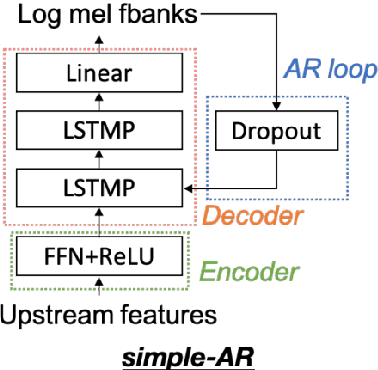
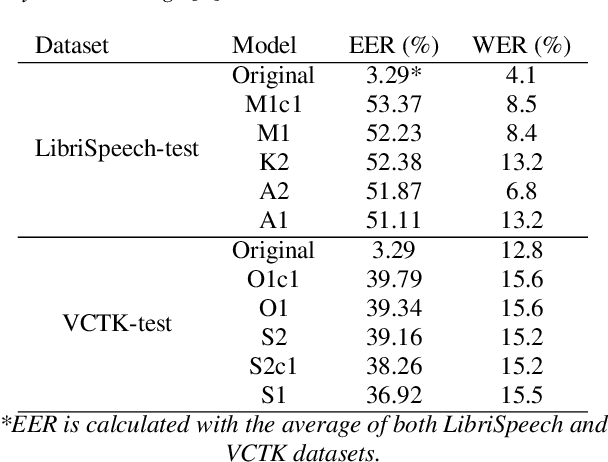

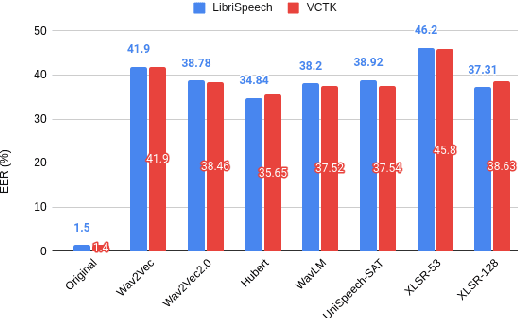
Collecting speech data is an important step in training speech recognition systems and other speech-based machine learning models. However, the issue of privacy protection is an increasing concern that must be addressed. The current study investigates the use of voice conversion as a method for anonymizing voices. In particular, we train several voice conversion models using self-supervised speech representations including Wav2Vec2.0, Hubert and UniSpeech. Converted voices retain a low word error rate within 1% of the original voice. Equal error rate increases from 1.52% to 46.24% on the LibriSpeech test set and from 3.75% to 45.84% on speakers from the VCTK corpus which signifies degraded performance on speaker verification. Lastly, we conduct experiments on dysarthric speech data to show that speech features relevant to articulation, prosody, phonation and phonology can be extracted from anonymized voices for discriminating between healthy and pathological speech.
Cross-lingual Self-Supervised Speech Representations for Improved Dysarthric Speech Recognition
Apr 04, 2022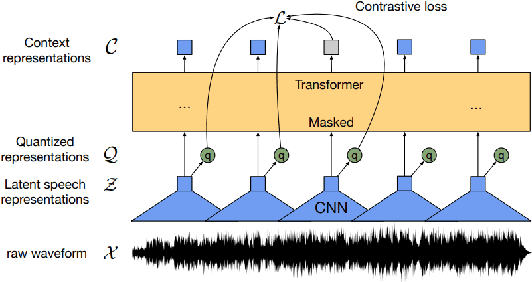
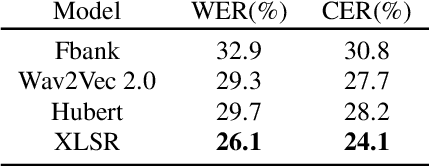
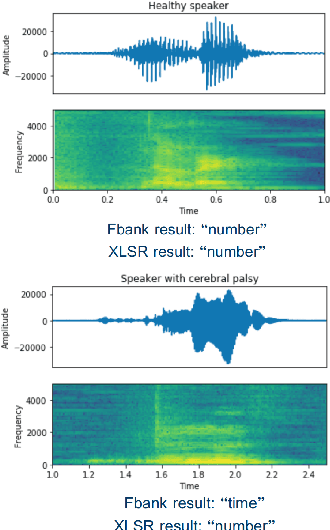
State-of-the-art automatic speech recognition (ASR) systems perform well on healthy speech. However, the performance on impaired speech still remains an issue. The current study explores the usefulness of using Wav2Vec self-supervised speech representations as features for training an ASR system for dysarthric speech. Dysarthric speech recognition is particularly difficult as several aspects of speech such as articulation, prosody and phonation can be impaired. Specifically, we train an acoustic model with features extracted from Wav2Vec, Hubert, and the cross-lingual XLSR model. Results suggest that speech representations pretrained on large unlabelled data can improve word error rate (WER) performance. In particular, features from the multilingual model led to lower WERs than filterbanks (Fbank) or models trained on a single language. Improvements were observed in English speakers with cerebral palsy caused dysarthria (UASpeech corpus), Spanish speakers with Parkinsonian dysarthria (PC-GITA corpus) and Italian speakers with paralysis-based dysarthria (EasyCall corpus). Compared to using Fbank features, XLSR-based features reduced WERs by 6.8%, 22.0%, and 7.0% for the UASpeech, PC-GITA, and EasyCall corpus, respectively.
SliTraNet: Automatic Detection of Slide Transitions in Lecture Videos using Convolutional Neural Networks
Feb 07, 2022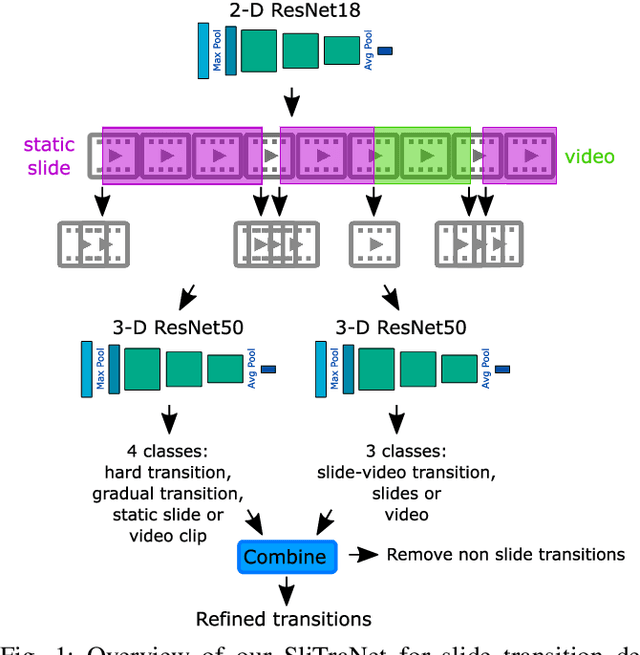
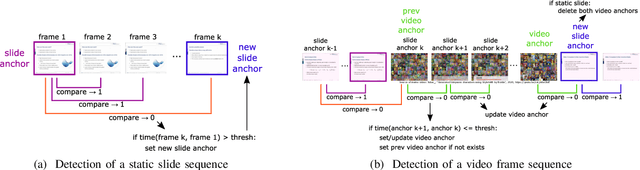
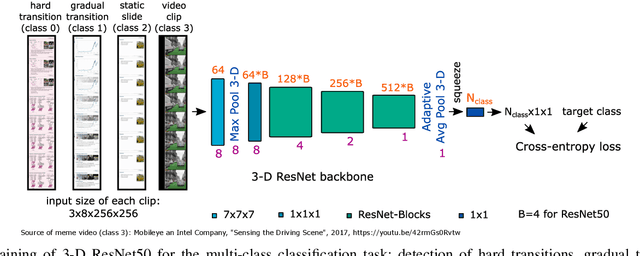
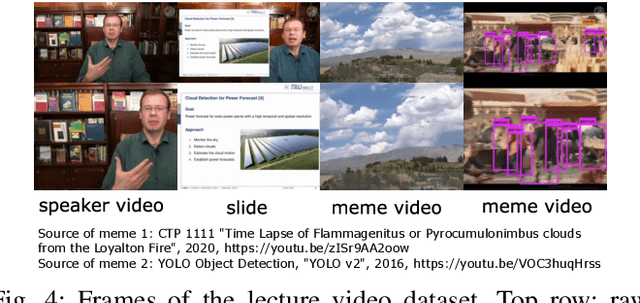
With the increasing number of online learning material in the web, search for specific content in lecture videos can be time consuming. Therefore, automatic slide extraction from the lecture videos can be helpful to give a brief overview of the main content and to support the students in their studies. For this task, we propose a deep learning method to detect slide transitions in lectures videos. We first process each frame of the video by a heuristic-based approach using a 2-D convolutional neural network to predict transition candidates. Then, we increase the complexity by employing two 3-D convolutional neural networks to refine the transition candidates. Evaluation results demonstrate the effectiveness of our method in finding slide transitions.