 Add to Chrome
 Add to Firefox
 Add to Edge
Agentic Real2Sim: Physics-based World Modeling with Vision-Language Agents
Jul 21, 2026
Real-to-sim conversion for robotic interaction with objects remains labor-intensive because it requires more than visual reconstruction: a streamlined real2sim process must recover scene geometries and object states, infer physical parameters, and assemble actors, objects, cameras, poses, and trajectories into a runnable physical simulation. Today this process still depends on manual tuning of visual foundation models, mesh cleanup, coordinate-frame alignment, and brittle workflow glue across visual perception tools and simulators. We introduce \textit{Agentic Real2Sim}, a framework for generalized physical world modeling with vision-language agents, converting a real-world recording of object-robot interaction into a simulatable episodic twin which preserves observations, geometries, robot interactions, and object states. We evaluate Agentic Real2Sim on rigid-object manipulation, deformable-object interaction, and humanoid motion scenes, spanning domains that are usually handled by separate Real2Sim pipelines, marking a first step toward scalable conversion. The framework's agentic decisions can be driven by an open-weight VLM backend at a small fraction of the cost of frontier models, while attaining comparable conversion success rate. We aim to use the resulting real-world-aligned twins for downstream robotics tasks, specifically policy learning and evaluation. The project site is available at https://ericchen321.github.io/agentic_real2sim.github.io/.

EpochX: Building the Infrastructure for an Emergent Agent Civilization
Mar 28, 2026General-purpose technologies reshape economies less by improving individual tools than by enabling new ways to organize production and coordination. We believe AI agents are approaching a similar inflection point: as foundation models make broad task execution and tool use increasingly accessible, the binding constraint shifts from raw capability to how work is delegated, verified, and rewarded at scale. We introduce EpochX, a credits-native marketplace infrastructure for human-agent production networks. EpochX treats humans and agents as peer participants who can post tasks or claim them. Claimed tasks can be decomposed into subtasks and executed through an explicit delivery workflow with verification and acceptance. Crucially, EpochX is designed so that each completed transaction can produce reusable ecosystem assets, including skills, workflows, execution traces, and distilled experience. These assets are stored with explicit dependency structure, enabling retrieval, composition, and cumulative improvement over time. EpochX also introduces a native credit mechanism to make participation economically viable under real compute costs. Credits lock task bounties, budget delegation, settle rewards upon acceptance, and compensate creators when verified assets are reused. By formalizing the end-to-end transaction model together with its asset and incentive layers, EpochX reframes agentic AI as an organizational design problem: building infrastructures where verifiable work leaves persistent, reusable artifacts, and where value flows support durable human-agent collaboration.
QuantaAlpha: An Evolutionary Framework for LLM-Driven Alpha Mining
Feb 06, 2026Financial markets are noisy and non-stationary, making alpha mining highly sensitive to noise in backtesting results and sudden market regime shifts. While recent agentic frameworks improve alpha mining automation, they often lack controllable multi-round search and reliable reuse of validated experience. To address these challenges, we propose QuantaAlpha, an evolutionary alpha mining framework that treats each end-to-end mining run as a trajectory and improves factors through trajectory-level mutation and crossover operations. QuantaAlpha localizes suboptimal steps in each trajectory for targeted revision and recombines complementary high-reward segments to reuse effective patterns, enabling structured exploration and refinement across mining iterations. During factor generation, QuantaAlpha enforces semantic consistency across the hypothesis, factor expression, and executable code, while constraining the complexity and redundancy of the generated factor to mitigate crowding. Extensive experiments on the China Securities Index 300 (CSI 300) demonstrate consistent gains over strong baseline models and prior agentic systems. When utilizing GPT-5.2, QuantaAlpha achieves an Information Coefficient (IC) of 0.1501, with an Annualized Rate of Return (ARR) of 27.75% and a Maximum Drawdown (MDD) of 7.98%. Moreover, factors mined on CSI 300 transfer effectively to the China Securities Index 500 (CSI 500) and the Standard & Poor's 500 Index (S&P 500), delivering 160% and 137% cumulative excess return over four years, respectively, which indicates strong robustness of QuantaAlpha under market distribution shifts.
Spider-Sense: Intrinsic Risk Sensing for Efficient Agent Defense with Hierarchical Adaptive Screening
Feb 05, 2026As large language models (LLMs) evolve into autonomous agents, their real-world applicability has expanded significantly, accompanied by new security challenges. Most existing agent defense mechanisms adopt a mandatory checking paradigm, in which security validation is forcibly triggered at predefined stages of the agent lifecycle. In this work, we argue that effective agent security should be intrinsic and selective rather than architecturally decoupled and mandatory. We propose Spider-Sense framework, an event-driven defense framework based on Intrinsic Risk Sensing (IRS), which allows agents to maintain latent vigilance and trigger defenses only upon risk perception. Once triggered, the Spider-Sense invokes a hierarchical defence mechanism that trades off efficiency and precision: it resolves known patterns via lightweight similarity matching while escalating ambiguous cases to deep internal reasoning, thereby eliminating reliance on external models. To facilitate rigorous evaluation, we introduce S$^2$Bench, a lifecycle-aware benchmark featuring realistic tool execution and multi-stage attacks. Extensive experiments demonstrate that Spider-Sense achieves competitive or superior defense performance, attaining the lowest Attack Success Rate (ASR) and False Positive Rate (FPR), with only a marginal latency overhead of 8.3\%.
MemGovern: Enhancing Code Agents through Learning from Governed Human Experiences
Jan 13, 2026While autonomous software engineering (SWE) agents are reshaping programming paradigms, they currently suffer from a "closed-world" limitation: they attempt to fix bugs from scratch or solely using local context, ignoring the immense historical human experience available on platforms like GitHub. Accessing this open-world experience is hindered by the unstructured and fragmented nature of real-world issue-tracking data. In this paper, we introduce MemGovern, a framework designed to govern and transform raw GitHub data into actionable experiential memory for agents. MemGovern employs experience governance to convert human experience into agent-friendly experience cards and introduces an agentic experience search strategy that enables logic-driven retrieval of human expertise. By producing 135K governed experience cards, MemGovern achieves a significant performance boost, improving resolution rates on the SWE-bench Verified by 4.65%. As a plug-in approach, MemGovern provides a solution for agent-friendly memory infrastructure.
Watching, Reasoning, and Searching: A Video Deep Research Benchmark on Open Web for Agentic Video Reasoning
Jan 11, 2026In real-world video question answering scenarios, videos often provide only localized visual cues, while verifiable answers are distributed across the open web; models therefore need to jointly perform cross-frame clue extraction, iterative retrieval, and multi-hop reasoning-based verification. To bridge this gap, we construct the first video deep research benchmark, VideoDR. VideoDR centers on video-conditioned open-domain video question answering, requiring cross-frame visual anchor extraction, interactive web retrieval, and multi-hop reasoning over joint video-web evidence; through rigorous human annotation and quality control, we obtain high-quality video deep research samples spanning six semantic domains. We evaluate multiple closed-source and open-source multimodal large language models under both the Workflow and Agentic paradigms, and the results show that Agentic is not consistently superior to Workflow: its gains depend on a model's ability to maintain the initial video anchors over long retrieval chains. Further analysis indicates that goal drift and long-horizon consistency are the core bottlenecks. In sum, VideoDR provides a systematic benchmark for studying video agents in open-web settings and reveals the key challenges for next-generation video deep research agents.
Dynamic Pyramid Network for Efficient Multimodal Large Language Model
Mar 26, 2025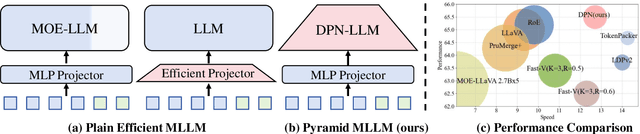
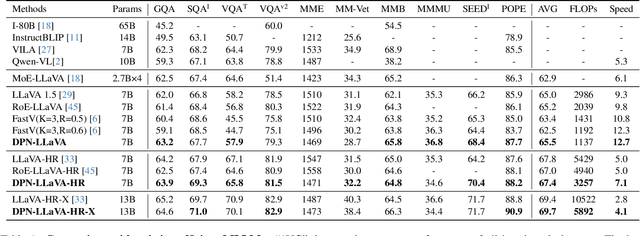
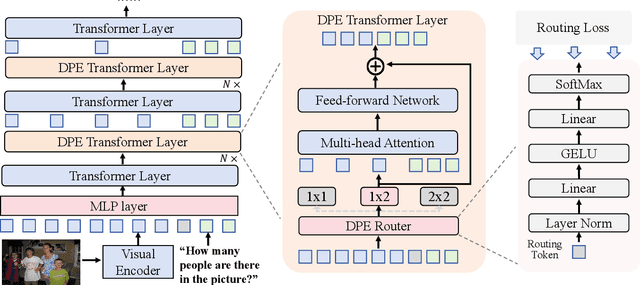
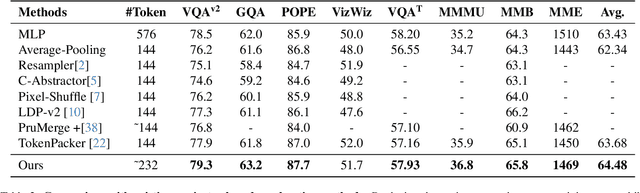
Multimodal large language models (MLLMs) have demonstrated impressive performance in various vision-language (VL) tasks, but their expensive computations still limit the real-world application. To address this issue, recent efforts aim to compress the visual features to save the computational costs of MLLMs. However, direct visual compression methods, e.g. efficient projectors, inevitably destroy the visual semantics in MLLM, especially in difficult samples. To overcome this shortcoming, we propose a novel dynamic pyramid network (DPN) for efficient MLLMs. Specifically, DPN formulates MLLM as a hierarchical structure where visual features are gradually compressed with increasing depth. In this case, even with a high compression ratio, fine-grained visual information can still be perceived in shallow layers. To maximize the benefit of DPN, we further propose an innovative Dynamic Pooling Experts (DPE) that can dynamically choose the optimal visual compression rate according to input features. With this design, harder samples will be assigned larger computations, thus preserving the model performance. To validate our approach, we conduct extensive experiments on two popular MLLMs and ten benchmarks. Experimental results show that DPN can save up to 56% average FLOPs on LLaVA while further achieving +0.74% performance gains. Besides, the generalization ability of DPN is also validated on the existing high-resolution MLLM called LLaVA-HR. Our source codes are anonymously released at https://github.com/aihao2000/DPN-LLaVA.
End-to-End Hybrid Refractive-Diffractive Lens Design with Differentiable Ray-Wave Model
Jun 02, 2024



Hybrid refractive-diffractive lenses combine the light efficiency of refractive lenses with the information encoding power of diffractive optical elements (DOE), showing great potential as the next generation of imaging systems. However, accurately simulating such hybrid designs is generally difficult, and in particular, there are no existing differentiable image formation models for hybrid lenses with sufficient accuracy. In this work, we propose a new hybrid ray-tracing and wave-propagation (ray-wave) model for accurate simulation of both optical aberrations and diffractive phase modulation, where the DOE is placed between the last refractive surface and the image sensor, i.e. away from the Fourier plane that is often used as a DOE position. The proposed ray-wave model is fully differentiable, enabling gradient back-propagation for end-to-end co-design of refractive-diffractive lens optimization and the image reconstruction network. We validate the accuracy of the proposed model by comparing the simulated point spread functions (PSFs) with theoretical results, as well as simulation experiments that show our model to be more accurate than solutions implemented in commercial software packages like Zemax. We demonstrate the effectiveness of the proposed model through real-world experiments and show significant improvements in both aberration correction and extended depth-of-field (EDoF) imaging. We believe the proposed model will motivate further investigation into a wide range of applications in computational imaging, computational photography, and advanced optical design. Code will be released upon publication.
Towards an Automatic AI Agent for Reaction Condition Recommendation in Chemical Synthesis
Nov 28, 2023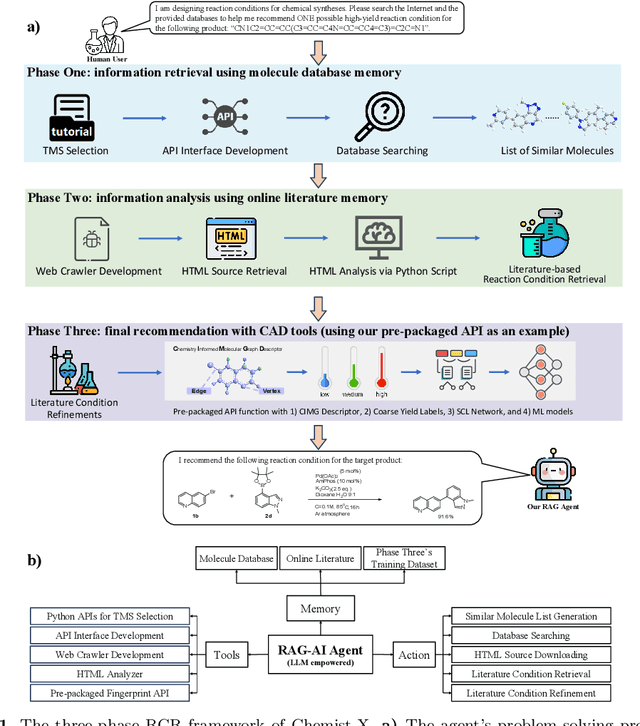
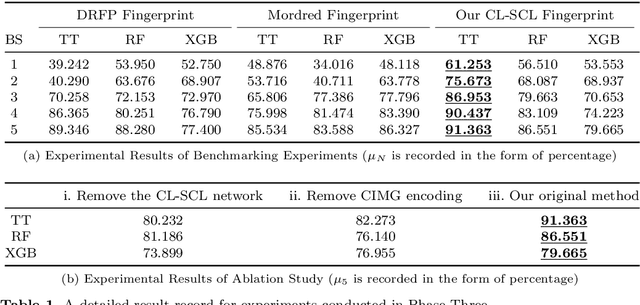
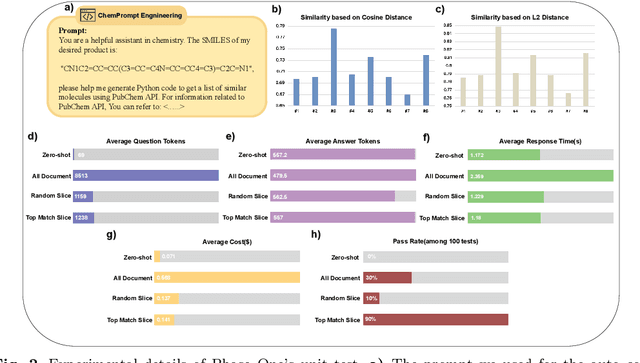
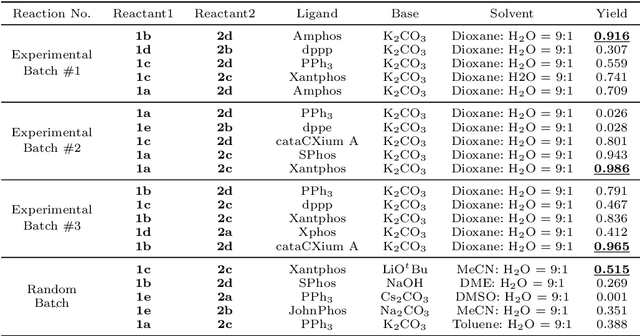
Artificial intelligence (AI) for reaction condition optimization has become an important topic in the pharmaceutical industry, given that a data-driven AI model can assist drug discovery and accelerate reaction design. However, existing AI models lack the chemical insights and real-time knowledge acquisition abilities of experienced human chemists. This paper proposes a Large Language Model (LLM) empowered AI agent to bridge this gap. We put forth a novel three-phase paradigm and applied advanced intelligence-enhancement methods like in-context learning and multi-LLM debate so that the AI agent can borrow human insight and update its knowledge by searching the latest chemical literature. Additionally, we introduce a novel Coarse-label Contrastive Learning (CCL) based chemical fingerprint that greatly enhances the agent's performance in optimizing the reaction condition. With the above efforts, the proposed AI agent can autonomously generate the optimal reaction condition recommendation without any human interaction. Further, the agent is highly professional in terms of chemical reactions. It demonstrates close-to-human performance and strong generalization capability in both dry-lab and wet-lab experiments. As the first attempt in the chemical AI agent, this work goes a step further in the field of "AI for chemistry" and opens up new possibilities for computer-aided synthesis planning.