 Add to Chrome
 Add to Firefox
 Add to Edge
LLMSurgeon: Diagnosing Data Mixture of Large Language Models
May 28, 2026
The pretraining data mixture of Large Language Models (LLMs) constitutes their "digital DNA", shaping model behaviors, capabilities, and failure modes. Yet this composition is rarely disclosed, making post-hoc auditing of data combination or provenance difficult. In this work, we formalize $\textbf{Data Mixture Surgery (DMS)}$: given only generated text from a target LLM, estimate the domain-level distribution of its pretraining corpus under a predefined taxonomy. We propose $\textbf{LLMSurgeon}$, a strong framework that casts DMS as an inverse problem under the label-shift assumption. Rather than directly aggregating classifier outputs, LLMSurgeon estimates a calibrated $\textit{soft}$ confusion matrix and solves a constrained inverse problem to correct systematic domain confusion and recover the latent mixture prior. To evaluate, we introduce $\textbf{LLMScan}$, a recipe-verifiable evaluation suite built from open-source LLMs with transparent pretraining mixtures. Across LLMScan, LLMSurgeon recovers domain mixtures with high fidelity under fixed protocols. Our work presents a practical, post-hoc approach for auditing the digital DNA of foundation models without access to their training data.

Language-Pretraining-Induced Bias: A Strong Foundation for General Vision Tasks
Apr 02, 2026The ratio of outlier parameters in language pre-training models and vision pre-training models differs significantly, making cross-modality (language and vision) inherently more challenging than cross-domain adaptation. As a result, many prior studies have focused on cross-domain transfer rather than attempting to bridge language and vision modalities, assuming that language pre-trained models are unsuitable for downstream visual tasks due to disparate parameter spaces. Contrary to this assumption, we show that adding a bridge training stage as a modality adaptation learner can effectively align Large Language Model (LLM) parameters with vision tasks. Specifically, we propose a simple yet powerful solution random label bridge training that requires no manual labeling and helps LLM parameters adapt to vision foundation tasks. Moreover, our findings reveal that partial bridge training is often advantageous, as certain layers in LLMs exhibit strong foundational properties that remain beneficial even without fine-tuning for visual tasks. This surprising discovery opens up new avenues for leveraging language pre-trained parameters directly within vision models and highlights the potential of partial bridge training as a practical pathway to cross-modality adaptation.
Pushing the Frontier of Black-Box LVLM Attacks via Fine-Grained Detail Targeting
Feb 19, 2026Black-box adversarial attacks on Large Vision-Language Models (LVLMs) are challenging due to missing gradients and complex multimodal boundaries. While prior state-of-the-art transfer-based approaches like M-Attack perform well using local crop-level matching between source and target images, we find this induces high-variance, nearly orthogonal gradients across iterations, violating coherent local alignment and destabilizing optimization. We attribute this to (i) ViT translation sensitivity that yields spike-like gradients and (ii) structural asymmetry between source and target crops. We reformulate local matching as an asymmetric expectation over source transformations and target semantics, and build a gradient-denoising upgrade to M-Attack. On the source side, Multi-Crop Alignment (MCA) averages gradients from multiple independently sampled local views per iteration to reduce variance. On the target side, Auxiliary Target Alignment (ATA) replaces aggressive target augmentation with a small auxiliary set from a semantically correlated distribution, producing a smoother, lower-variance target manifold. We further reinterpret momentum as Patch Momentum, replaying historical crop gradients; combined with a refined patch-size ensemble (PE+), this strengthens transferable directions. Together these modules form M-Attack-V2, a simple, modular enhancement over M-Attack that substantially improves transfer-based black-box attacks on frontier LVLMs: boosting success rates on Claude-4.0 from 8% to 30%, Gemini-2.5-Pro from 83% to 97%, and GPT-5 from 98% to 100%, outperforming prior black-box LVLM attacks. Code and data are publicly available at: https://github.com/vila-lab/M-Attack-V2.
Next-Gen CAPTCHAs: Leveraging the Cognitive Gap for Scalable and Diverse GUI-Agent Defense
Feb 09, 2026The rapid evolution of GUI-enabled agents has rendered traditional CAPTCHAs obsolete. While previous benchmarks like OpenCaptchaWorld established a baseline for evaluating multimodal agents, recent advancements in reasoning-heavy models, such as Gemini3-Pro-High and GPT-5.2-Xhigh have effectively collapsed this security barrier, achieving pass rates as high as 90% on complex logic puzzles like "Bingo". In response, we introduce Next-Gen CAPTCHAs, a scalable defense framework designed to secure the next-generation web against the advanced agents. Unlike static datasets, our benchmark is built upon a robust data generation pipeline, allowing for large-scale and easily scalable evaluations, notably, for backend-supported types, our system is capable of generating effectively unbounded CAPTCHA instances. We exploit the persistent human-agent "Cognitive Gap" in interactive perception, memory, decision-making, and action. By engineering dynamic tasks that require adaptive intuition rather than granular planning, we re-establish a robust distinction between biological users and artificial agents, offering a scalable and diverse defense mechanism for the agentic era.
Open CaptchaWorld: A Comprehensive Web-based Platform for Testing and Benchmarking Multimodal LLM Agents
May 30, 2025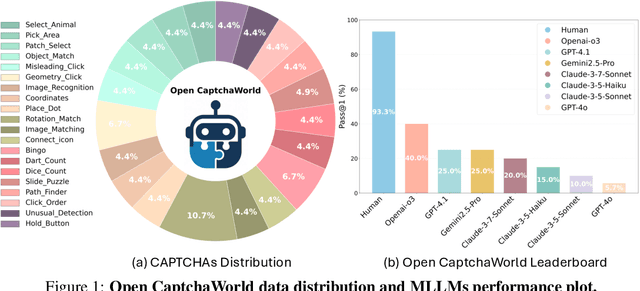
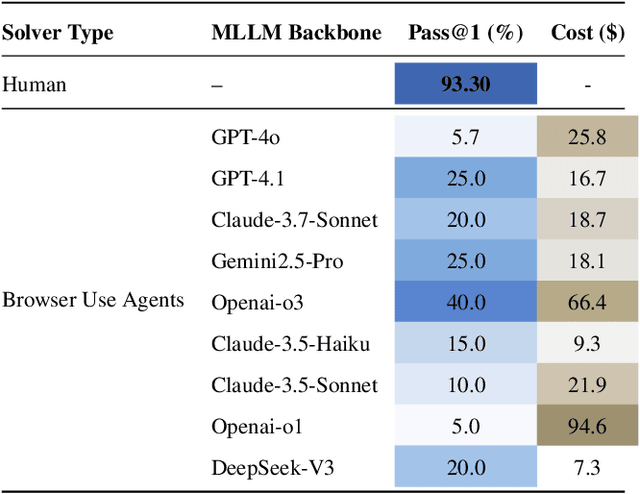
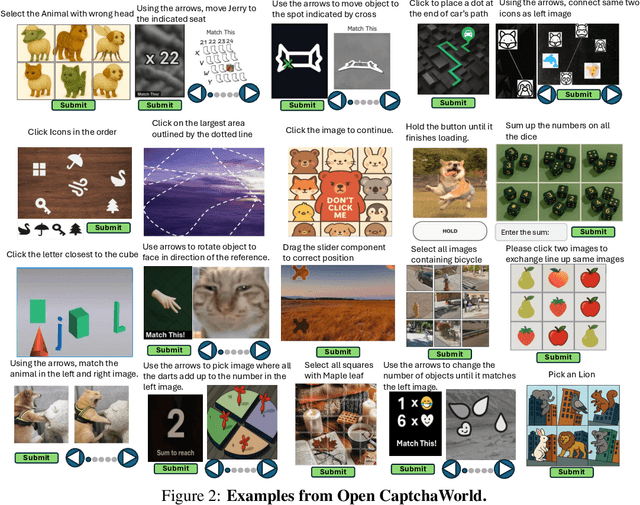
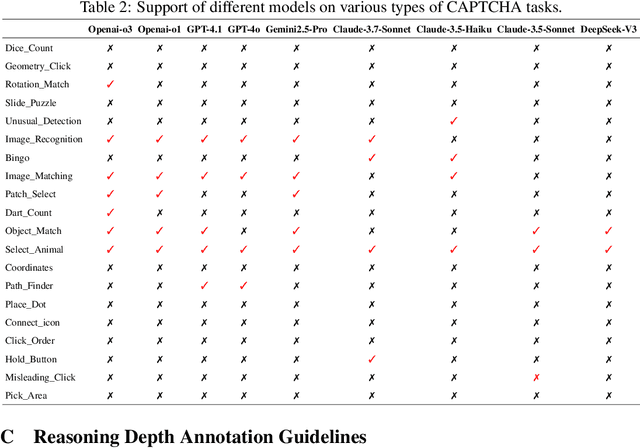
CAPTCHAs have been a critical bottleneck for deploying web agents in real-world applications, often blocking them from completing end-to-end automation tasks. While modern multimodal LLM agents have demonstrated impressive performance in static perception tasks, their ability to handle interactive, multi-step reasoning challenges like CAPTCHAs is largely untested. To address this gap, we introduce Open CaptchaWorld, the first web-based benchmark and platform specifically designed to evaluate the visual reasoning and interaction capabilities of MLLM-powered agents through diverse and dynamic CAPTCHA puzzles. Our benchmark spans 20 modern CAPTCHA types, totaling 225 CAPTCHAs, annotated with a new metric we propose: CAPTCHA Reasoning Depth, which quantifies the number of cognitive and motor steps required to solve each puzzle. Experimental results show that humans consistently achieve near-perfect scores, state-of-the-art MLLM agents struggle significantly, with success rates at most 40.0% by Browser-Use Openai-o3, far below human-level performance, 93.3%. This highlights Open CaptchaWorld as a vital benchmark for diagnosing the limits of current multimodal agents and guiding the development of more robust multimodal reasoning systems. Code and Data are available at this https URL.
Dynamic Pyramid Network for Efficient Multimodal Large Language Model
Mar 26, 2025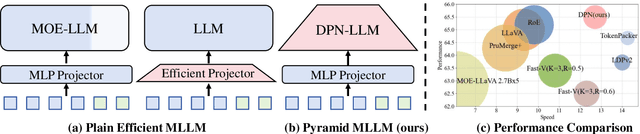
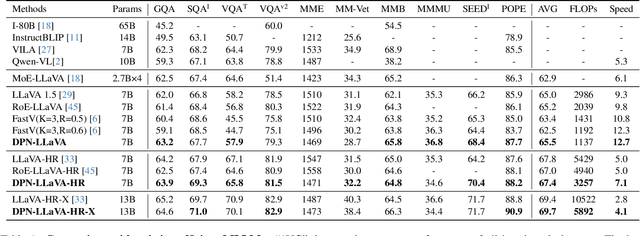
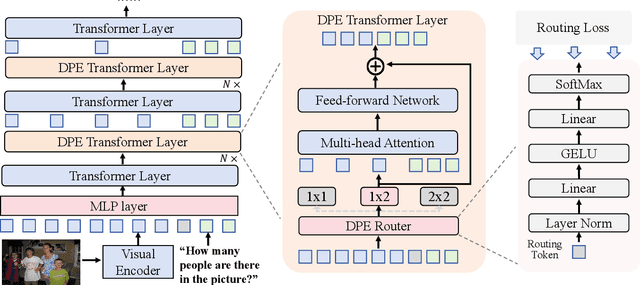
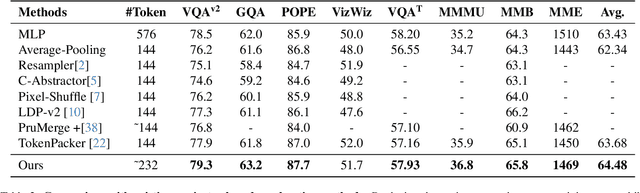
Multimodal large language models (MLLMs) have demonstrated impressive performance in various vision-language (VL) tasks, but their expensive computations still limit the real-world application. To address this issue, recent efforts aim to compress the visual features to save the computational costs of MLLMs. However, direct visual compression methods, e.g. efficient projectors, inevitably destroy the visual semantics in MLLM, especially in difficult samples. To overcome this shortcoming, we propose a novel dynamic pyramid network (DPN) for efficient MLLMs. Specifically, DPN formulates MLLM as a hierarchical structure where visual features are gradually compressed with increasing depth. In this case, even with a high compression ratio, fine-grained visual information can still be perceived in shallow layers. To maximize the benefit of DPN, we further propose an innovative Dynamic Pooling Experts (DPE) that can dynamically choose the optimal visual compression rate according to input features. With this design, harder samples will be assigned larger computations, thus preserving the model performance. To validate our approach, we conduct extensive experiments on two popular MLLMs and ten benchmarks. Experimental results show that DPN can save up to 56% average FLOPs on LLaVA while further achieving +0.74% performance gains. Besides, the generalization ability of DPN is also validated on the existing high-resolution MLLM called LLaVA-HR. Our source codes are anonymously released at https://github.com/aihao2000/DPN-LLaVA.
Dataset Distillation via Committee Voting
Jan 13, 2025Dataset distillation aims to synthesize a smaller, representative dataset that preserves the essential properties of the original data, enabling efficient model training with reduced computational resources. Prior work has primarily focused on improving the alignment or matching process between original and synthetic data, or on enhancing the efficiency of distilling large datasets. In this work, we introduce ${\bf C}$ommittee ${\bf V}$oting for ${\bf D}$ataset ${\bf D}$istillation (CV-DD), a novel and orthogonal approach that leverages the collective wisdom of multiple models or experts to create high-quality distilled datasets. We start by showing how to establish a strong baseline that already achieves state-of-the-art accuracy through leveraging recent advancements and thoughtful adjustments in model design and optimization processes. By integrating distributions and predictions from a committee of models while generating high-quality soft labels, our method captures a wider spectrum of data features, reduces model-specific biases and the adverse effects of distribution shifts, leading to significant improvements in generalization. This voting-based strategy not only promotes diversity and robustness within the distilled dataset but also significantly reduces overfitting, resulting in improved performance on post-eval tasks. Extensive experiments across various datasets and IPCs (images per class) demonstrate that Committee Voting leads to more reliable and adaptable distilled data compared to single/multi-model distillation methods, demonstrating its potential for efficient and accurate dataset distillation. Code is available at: https://github.com/Jiacheng8/CV-DD.
$γ-$MoD: Exploring Mixture-of-Depth Adaptation for Multimodal Large Language Models
Oct 17, 2024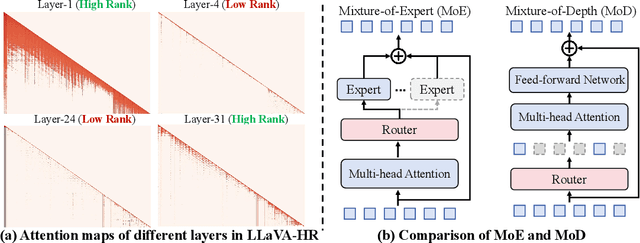
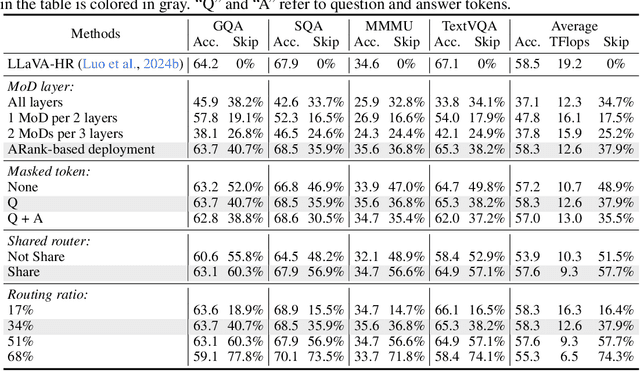


Despite the significant progress in multimodal large language models (MLLMs), their high computational cost remains a barrier to real-world deployment. Inspired by the mixture of depths (MoDs) in natural language processing, we aim to address this limitation from the perspective of ``activated tokens''. Our key insight is that if most tokens are redundant for the layer computation, then can be skipped directly via the MoD layer. However, directly converting the dense layers of MLLMs to MoD layers leads to substantial performance degradation. To address this issue, we propose an innovative MoD adaptation strategy for existing MLLMs called $\gamma$-MoD. In $\gamma$-MoD, a novel metric is proposed to guide the deployment of MoDs in the MLLM, namely rank of attention maps (ARank). Through ARank, we can effectively identify which layer is redundant and should be replaced with the MoD layer. Based on ARank, we further propose two novel designs to maximize the computational sparsity of MLLM while maintaining its performance, namely shared vision-language router and masked routing learning. With these designs, more than 90% dense layers of the MLLM can be effectively converted to the MoD ones. To validate our method, we apply it to three popular MLLMs, and conduct extensive experiments on 9 benchmark datasets. Experimental results not only validate the significant efficiency benefit of $\gamma$-MoD to existing MLLMs but also confirm its generalization ability on various MLLMs. For example, with a minor performance drop, i.e., -1.5%, $\gamma$-MoD can reduce the training and inference time of LLaVA-HR by 31.0% and 53.2%, respectively.