 Add to Chrome
 Add to Firefox
 Add to Edge
A$_3$B$_2$: Adaptive Asymmetric Adapter for Alleviating Branch Bias in Vision-Language Image Classification with Few-Shot Learning
May 13, 2026
Efficient transfer learning methods for large-scale vision-language models ($e.g.$, CLIP) enable strong few-shot transfer, yet existing adaptation methods follow a fixed fine-tuning paradigm that implicitly assumes a uniform importance of the image and text branches, which has not been systematically studied in image classification. Through extensive analysis, we reveal a Branch Bias issue in vision-language image classification: adapting the image encoder does not always improve performance under out-of-distribution settings. Motivated by this observation, we propose A$_3$B$_2$, an Adaptive Asymmetric Adapter that alleviates Branch Bias in few-shot learning. A$_3$B$_2$ introduces Uncertainty-Aware Adapter Dampening (UAAD), which automatically suppresses image-branch adaptation when prediction uncertainty is high, enabling soft and data-driven control without manual intervention. Architecturally, A$_3$B$_2$ adopts a lightweight asymmetric design inspired by mixture-of-experts with Load Balancing Regularization. Extensive experiments on three few-shot image classification tasks across 11 datasets demonstrate that A$_3$B$_2$ consistently outperforms 11 competitive prompt- and adapter-based baselines.

InfiCoEvalChain: A Blockchain-Based Decentralized Framework for Collaborative LLM Evaluation
Feb 09, 2026The rapid advancement of large language models (LLMs) demands increasingly reliable evaluation, yet current centralized evaluation suffers from opacity, overfitting, and hardware-induced variance. Our empirical analysis reveals an alarming inconsistency in existing evaluations: the standard deviation across ten repeated runs of a single model on HumanEval (1.67) actually exceeds the performance gap among the top-10 models on the official leaderboard (0.91), rendering current rankings statistically precarious. To mitigate these instabilities, we propose a decentralized evaluation framework that enables hardware and parameter diversity through large-scale benchmarking across heterogeneous compute nodes. By leveraging the blockchain-based protocol, the framework incentivizes global contributors to act as independent validators, using a robust reward system to ensure evaluation integrity and discourage dishonest participation. This collective verification transforms evaluation from a "centralized black box" into a "decentralized endorsement" where multi-party consensus and diverse inference environments yield a more stable, representative metric. Experimental results demonstrate that the decentralized evaluation framework reduces the standard deviation across ten runs on the same model to 0.28. This significant improvement over conventional frameworks ensures higher statistical confidence in model rankings. We have completely implemented this platform and will soon release it to the community.
MergePipe: A Budget-Aware Parameter Management System for Scalable LLM Merging
Feb 05, 2026Large language model (LLM) merging has become a key technique in modern LLM development pipelines, enabling the integration of multiple task- or domain-specific expert models without retraining. However, as the number of experts grows, existing merging implementations treat model parameters as unstructured files and execute merges in a stateless, one-shot manner, leading to excessive disk I/O, redundant parameter scans, and poor scalability. In this paper, we present \textbf{MergePipe}, a parameter management system for scalable LLM merging. MergePipe is the first system that treats LLM merging as a data management and execution problem, and introduces a catalog-driven abstraction over model parameters, merge plans, and execution lineage. At its core, MergePipe employs a cost-aware planner that explicitly models expert parameter I/O and enforces user-specified I/O budgets, followed by a streaming execution engine that materializes merged models under transactional guarantees. Our key insight is that while base model reads and output writes are unavoidable, expert parameter reads dominate merge cost and constitute the primary optimization target. By making expert access budget-aware throughout planning and execution, MergePipe mitigates the $O(K)$ I/O growth of naive pipelines and achieves predictable scaling behavior. Experiments show that MergePipe reduces total I/O by up to an order of magnitude and delivers up to $11\times$ end-to-end speedups (up to 90\% wall-time reduction) over state-of-the-art LLM merging pipelines.
AccKV: Towards Efficient Audio-Video LLMs Inference via Adaptive-Focusing and Cross-Calibration KV Cache Optimization
Nov 14, 2025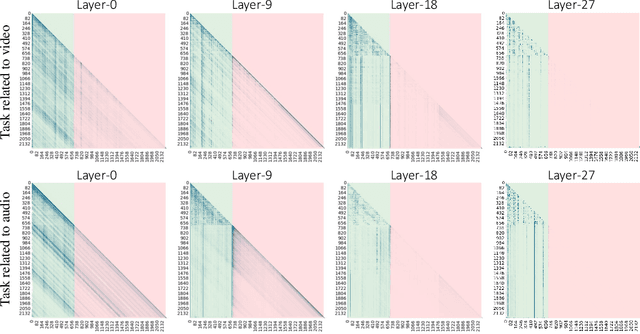
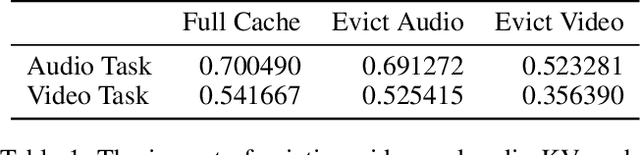
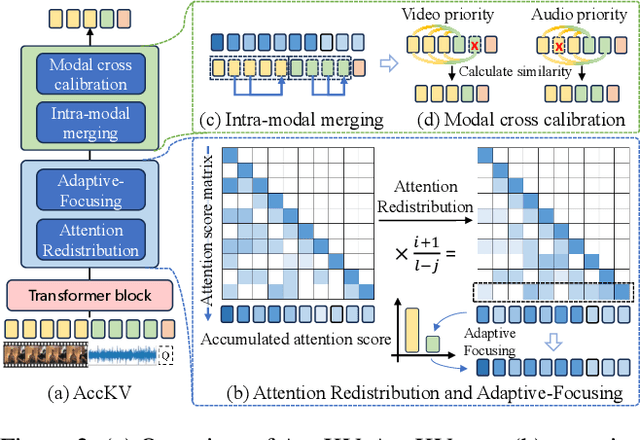
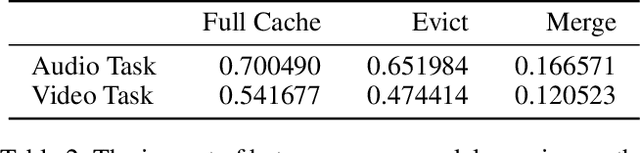
Recent advancements in Audio-Video Large Language Models (AV-LLMs) have enhanced their capabilities in tasks like audio-visual question answering and multimodal dialog systems. Video and audio introduce an extended temporal dimension, resulting in a larger key-value (KV) cache compared to static image embedding. A naive optimization strategy is to selectively focus on and retain KV caches of audio or video based on task. However, in the experiment, we observed that the attention of AV-LLMs to various modalities in the high layers is not strictly dependent on the task. In higher layers, the attention of AV-LLMs shifts more towards the video modality. In addition, we also found that directly integrating temporal KV of audio and spatial-temporal KV of video may lead to information confusion and significant performance degradation of AV-LLMs. If audio and video are processed indiscriminately, it may also lead to excessive compression or reservation of a certain modality, thereby disrupting the alignment between modalities. To address these challenges, we propose AccKV, an Adaptive-Focusing and Cross-Calibration KV cache optimization framework designed specifically for efficient AV-LLMs inference. Our method is based on layer adaptive focusing technology, selectively focusing on key modalities according to the characteristics of different layers, and enhances the recognition of heavy hitter tokens through attention redistribution. In addition, we propose a Cross-Calibration technique that first integrates inefficient KV caches within the audio and video modalities, and then aligns low-priority modalities with high-priority modalities to selectively evict KV cache of low-priority modalities. The experimental results show that AccKV can significantly improve the computational efficiency of AV-LLMs while maintaining accuracy.
MergeNet: Knowledge Migration across Heterogeneous Models, Tasks, and Modalities
Apr 20, 2024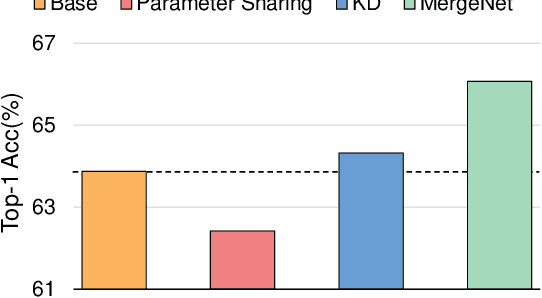
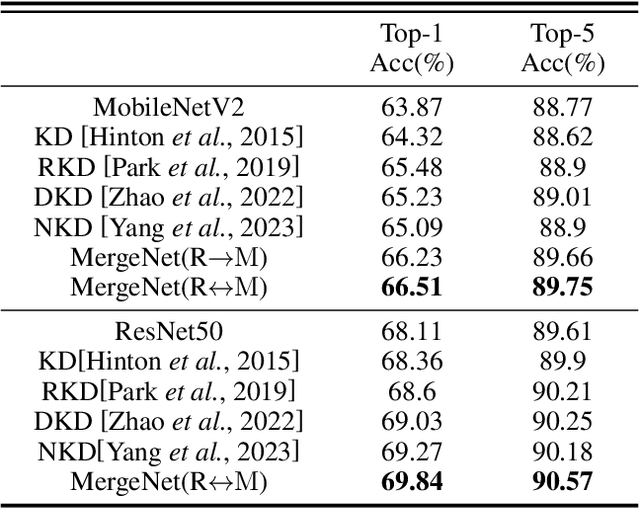
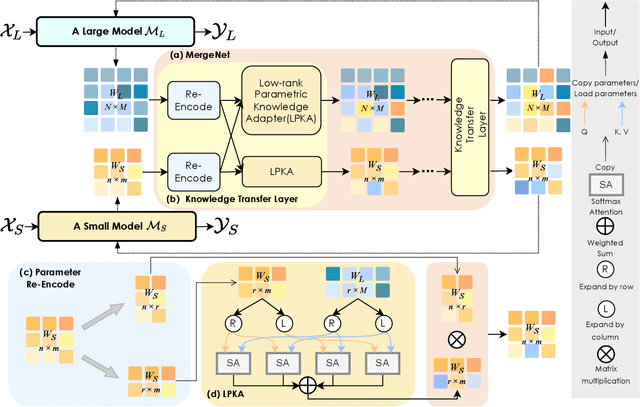
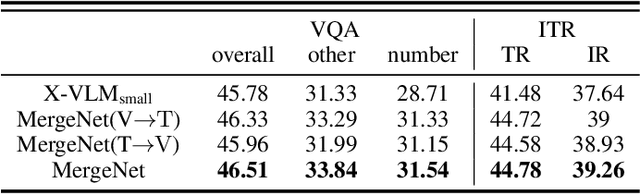
In this study, we focus on heterogeneous knowledge transfer across entirely different model architectures, tasks, and modalities. Existing knowledge transfer methods (e.g., backbone sharing, knowledge distillation) often hinge on shared elements within model structures or task-specific features/labels, limiting transfers to complex model types or tasks. To overcome these challenges, we present MergeNet, which learns to bridge the gap of parameter spaces of heterogeneous models, facilitating the direct interaction, extraction, and application of knowledge within these parameter spaces. The core mechanism of MergeNet lies in the parameter adapter, which operates by querying the source model's low-rank parameters and adeptly learning to identify and map parameters into the target model. MergeNet is learned alongside both models, allowing our framework to dynamically transfer and adapt knowledge relevant to the current stage, including the training trajectory knowledge of the source model. Extensive experiments on heterogeneous knowledge transfer demonstrate significant improvements in challenging settings, where representative approaches may falter or prove less applicable.