 Add to Chrome
 Add to Firefox
 Add to Edge
A$_3$B$_2$: Adaptive Asymmetric Adapter for Alleviating Branch Bias in Vision-Language Image Classification with Few-Shot Learning
May 13, 2026
Efficient transfer learning methods for large-scale vision-language models ($e.g.$, CLIP) enable strong few-shot transfer, yet existing adaptation methods follow a fixed fine-tuning paradigm that implicitly assumes a uniform importance of the image and text branches, which has not been systematically studied in image classification. Through extensive analysis, we reveal a Branch Bias issue in vision-language image classification: adapting the image encoder does not always improve performance under out-of-distribution settings. Motivated by this observation, we propose A$_3$B$_2$, an Adaptive Asymmetric Adapter that alleviates Branch Bias in few-shot learning. A$_3$B$_2$ introduces Uncertainty-Aware Adapter Dampening (UAAD), which automatically suppresses image-branch adaptation when prediction uncertainty is high, enabling soft and data-driven control without manual intervention. Architecturally, A$_3$B$_2$ adopts a lightweight asymmetric design inspired by mixture-of-experts with Load Balancing Regularization. Extensive experiments on three few-shot image classification tasks across 11 datasets demonstrate that A$_3$B$_2$ consistently outperforms 11 competitive prompt- and adapter-based baselines.

SARe: Structure-Aware Large-Scale 3D Fragment Reassembly
Mar 23, 20263D fragment reassembly aims to recover the rigid poses of unordered fragment point clouds or meshes in a common object coordinate system to reconstruct the complete shape. The problem becomes particularly challenging as the number of fragments grows, since the target shape is unknown and fragments provide weak semantic cues. Existing end-to-end approaches are prone to cascading failures due to unreliable contact reasoning, most notably inaccurate fragment adjacencies. To address this, we propose Structure-Aware Reassembly (SARe), a generative framework with SARe-Gen for Euclidean-space assembly generation and SARe-Refine for inference-time refinement, with explicit contact modeling. SARe-Gen jointly predicts fracture-surface token probabilities and an inter-fragment contact graph to localize contact regions and infer candidate adjacencies. It adopts a query-point-based conditioning scheme and extracts aligned local geometric tokens at query locations from a frozen geometry encoder, yielding queryable structural representations without additional structural pretraining. We further introduce an inference-time refinement stage, SARe-Refine. By verifying candidate contact edges with geometric-consistency checks, it selects reliable substructures and resamples the remaining uncertain regions while keeping verified parts fixed, leading to more stable and consistent assemblies in the many-fragment regime. We evaluate SARe across three settings, including synthetic fractures, simulated fractures from scanned real objects, and real physically fractured scans. The results demonstrate state-of-the-art performance, with more graceful degradation and higher success rates as the fragment count increases in challenging large-scale reassembly.
Beyond Student: An Asymmetric Network for Neural Network Inheritance
Feb 11, 2026Knowledge Distillation (KD) has emerged as a powerful technique for model compression, enabling lightweight student networks to benefit from the performance of redundant teacher networks. However, the inherent capacity gap often limits the performance of student networks. Inspired by the expressiveness of pretrained teacher networks, a compelling research question arises: is there a type of network that can not only inherit the teacher's structure but also maximize the inheritance of its knowledge? Furthermore, how does the performance of such an inheriting network compare to that of student networks, all benefiting from the same teacher network? To further explore this question, we propose InherNet, a neural network inheritance method that performs asymmetric low-rank decomposition on the teacher's weights and reconstructs a lightweight yet expressive network without significant architectural disruption. By leveraging Singular Value Decomposition (SVD) for initialization to ensure the inheritance of principal knowledge, InherNet effectively balances depth, width, and compression efficiency. Experimental results across unimodal and multimodal tasks demonstrate that InherNet achieves higher performance compared to student networks of similar parameter sizes. Our findings reveal a promising direction for future research in efficient model compression beyond traditional distillation.
AccKV: Towards Efficient Audio-Video LLMs Inference via Adaptive-Focusing and Cross-Calibration KV Cache Optimization
Nov 14, 2025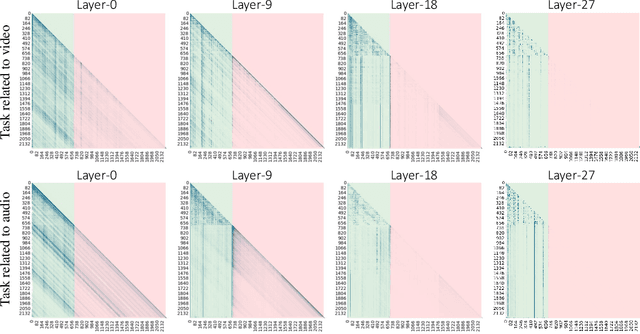
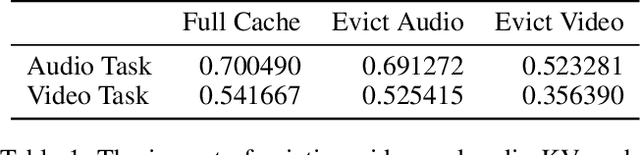
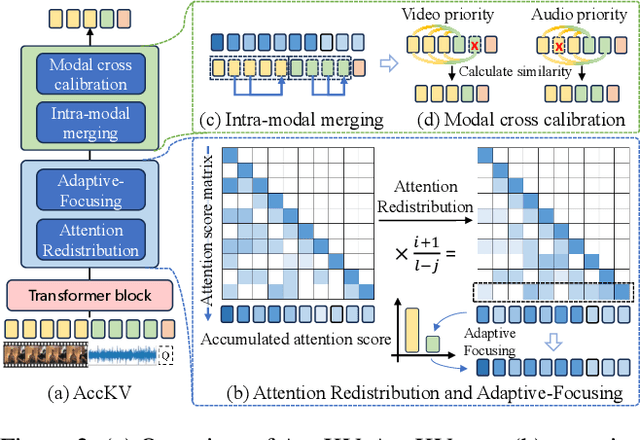
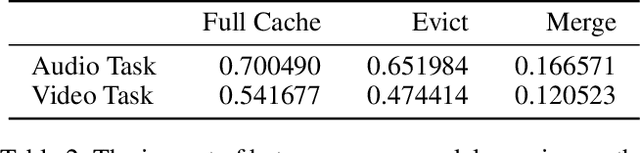
Recent advancements in Audio-Video Large Language Models (AV-LLMs) have enhanced their capabilities in tasks like audio-visual question answering and multimodal dialog systems. Video and audio introduce an extended temporal dimension, resulting in a larger key-value (KV) cache compared to static image embedding. A naive optimization strategy is to selectively focus on and retain KV caches of audio or video based on task. However, in the experiment, we observed that the attention of AV-LLMs to various modalities in the high layers is not strictly dependent on the task. In higher layers, the attention of AV-LLMs shifts more towards the video modality. In addition, we also found that directly integrating temporal KV of audio and spatial-temporal KV of video may lead to information confusion and significant performance degradation of AV-LLMs. If audio and video are processed indiscriminately, it may also lead to excessive compression or reservation of a certain modality, thereby disrupting the alignment between modalities. To address these challenges, we propose AccKV, an Adaptive-Focusing and Cross-Calibration KV cache optimization framework designed specifically for efficient AV-LLMs inference. Our method is based on layer adaptive focusing technology, selectively focusing on key modalities according to the characteristics of different layers, and enhances the recognition of heavy hitter tokens through attention redistribution. In addition, we propose a Cross-Calibration technique that first integrates inefficient KV caches within the audio and video modalities, and then aligns low-priority modalities with high-priority modalities to selectively evict KV cache of low-priority modalities. The experimental results show that AccKV can significantly improve the computational efficiency of AV-LLMs while maintaining accuracy.
FedCFA: Alleviating Simpson's Paradox in Model Aggregation with Counterfactual Federated Learning
Dec 25, 2024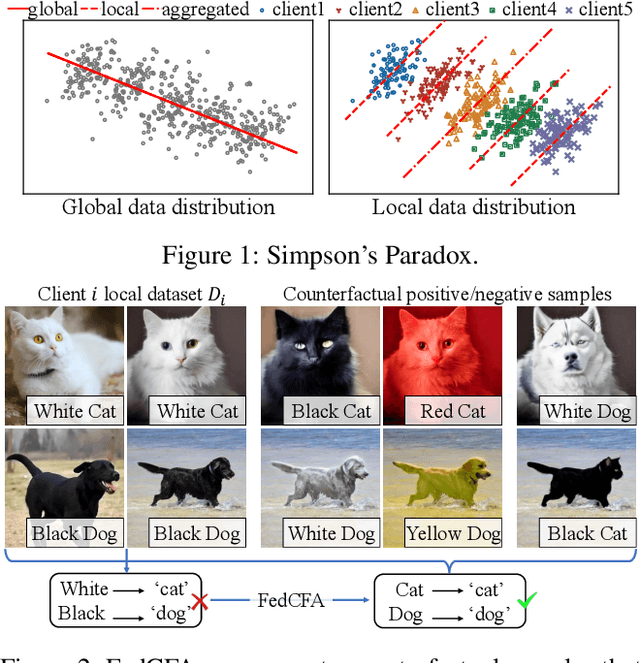
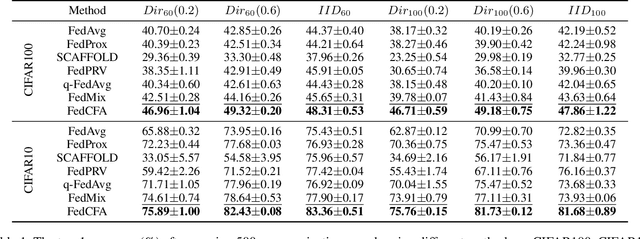
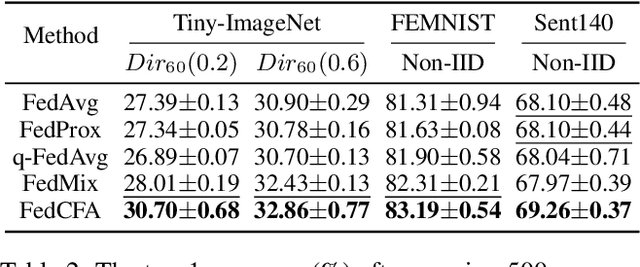
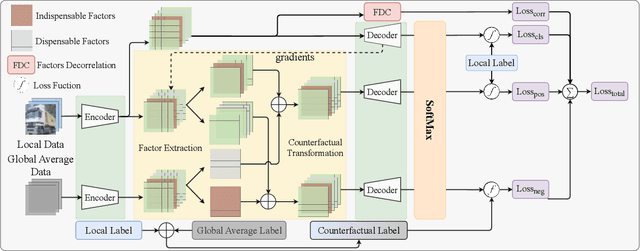
Federated learning (FL) is a promising technology for data privacy and distributed optimization, but it suffers from data imbalance and heterogeneity among clients. Existing FL methods try to solve the problems by aligning client with server model or by correcting client model with control variables. These methods excel on IID and general Non-IID data but perform mediocrely in Simpson's Paradox scenarios. Simpson's Paradox refers to the phenomenon that the trend observed on the global dataset disappears or reverses on a subset, which may lead to the fact that global model obtained through aggregation in FL does not accurately reflect the distribution of global data. Thus, we propose FedCFA, a novel FL framework employing counterfactual learning to generate counterfactual samples by replacing local data critical factors with global average data, aligning local data distributions with the global and mitigating Simpson's Paradox effects. In addition, to improve the quality of counterfactual samples, we introduce factor decorrelation (FDC) loss to reduce the correlation among features and thus improve the independence of extracted factors. We conduct extensive experiments on six datasets and verify that our method outperforms other FL methods in terms of efficiency and global model accuracy under limited communication rounds.
GaussianTalker: Speaker-specific Talking Head Synthesis via 3D Gaussian Splatting
Apr 28, 2024


Recent works on audio-driven talking head synthesis using Neural Radiance Fields (NeRF) have achieved impressive results. However, due to inadequate pose and expression control caused by NeRF implicit representation, these methods still have some limitations, such as unsynchronized or unnatural lip movements, and visual jitter and artifacts. In this paper, we propose GaussianTalker, a novel method for audio-driven talking head synthesis based on 3D Gaussian Splatting. With the explicit representation property of 3D Gaussians, intuitive control of the facial motion is achieved by binding Gaussians to 3D facial models. GaussianTalker consists of two modules, Speaker-specific Motion Translator and Dynamic Gaussian Renderer. Speaker-specific Motion Translator achieves accurate lip movements specific to the target speaker through universalized audio feature extraction and customized lip motion generation. Dynamic Gaussian Renderer introduces Speaker-specific BlendShapes to enhance facial detail representation via a latent pose, delivering stable and realistic rendered videos. Extensive experimental results suggest that GaussianTalker outperforms existing state-of-the-art methods in talking head synthesis, delivering precise lip synchronization and exceptional visual quality. Our method achieves rendering speeds of 130 FPS on NVIDIA RTX4090 GPU, significantly exceeding the threshold for real-time rendering performance, and can potentially be deployed on other hardware platforms.