 Add to Chrome
 Add to Firefox
 Add to Edge
On-the-fly Synthesis for LTL over Finite Traces: An Efficient Approach that Counts
Aug 14, 2024


We present an on-the-fly synthesis framework for Linear Temporal Logic over finite traces (LTLf) based on top-down deterministic automata construction. Existing approaches rely on constructing a complete Deterministic Finite Automaton (DFA) corresponding to the LTLf specification, a process with doubly exponential complexity relative to the formula size in the worst case. In this case, the synthesis procedure cannot be conducted until the entire DFA is constructed. This inefficiency is the main bottleneck of existing approaches. To address this challenge, we first present a method for converting LTLf into Transition-based DFA (TDFA) by directly leveraging LTLf semantics, incorporating intermediate results as direct components of the final automaton to enable parallelized synthesis and automata construction. We then explore the relationship between LTLf synthesis and TDFA games and subsequently develop an algorithm for performing LTLf synthesis using on-the-fly TDFA game solving. This algorithm traverses the state space in a global forward manner combined with a local backward method, along with the detection of strongly connected components. Moreover, we introduce two optimization techniques -- model-guided synthesis and state entailment -- to enhance the practical efficiency of our approach. Experimental results demonstrate that our on-the-fly approach achieves the best performance on the tested benchmarks and effectively complements existing tools and approaches.

Certified Continual Learning for Neural Network Regression
Jul 09, 2024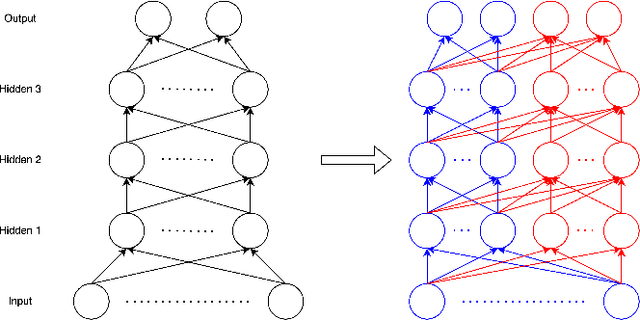
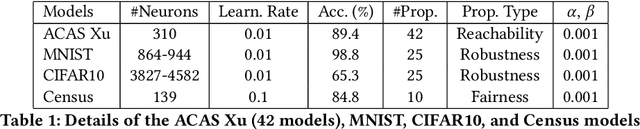

On the one hand, there has been considerable progress on neural network verification in recent years, which makes certifying neural networks a possibility. On the other hand, neural networks in practice are often re-trained over time to cope with new data distribution or for solving different tasks (a.k.a. continual learning). Once re-trained, the verified correctness of the neural network is likely broken, particularly in the presence of the phenomenon known as catastrophic forgetting. In this work, we propose an approach called certified continual learning which improves existing continual learning methods by preserving, as long as possible, the established correctness properties of a verified network. Our approach is evaluated with multiple neural networks and on two different continual learning methods. The results show that our approach is efficient and the trained models preserve their certified correctness and often maintain high utility.
Towards Large Language Model Aided Program Refinement
Jun 26, 2024Program refinement involves correctness-preserving transformations from formal high-level specification statements into executable programs. Traditional verification tool support for program refinement is highly interactive and lacks automation. On the other hand, the emergence of large language models (LLMs) enables automatic code generations from informal natural language specifications. However, code generated by LLMs is often unreliable. Moreover, the opaque procedure from specification to code provided by LLM is an uncontrolled black box. We propose LLM4PR, a tool that combines formal program refinement techniques with informal LLM-based methods to (1) transform the specification to preconditions and postconditions, (2) automatically build prompts based on refinement calculus, (3) interact with LLM to generate code, and finally, (4) verify that the generated code satisfies the conditions of refinement calculus, thus guaranteeing the correctness of the code. We have implemented our tool using GPT4, Coq, and Coqhammer, and evaluated it on the HumanEval and EvalPlus datasets.
CodeR: Issue Resolving with Multi-Agent and Task Graphs
Jun 03, 2024


GitHub issue resolving recently has attracted significant attention from academia and industry. SWE-bench is proposed to measure the performance in resolving issues. In this paper, we propose CodeR, which adopts a multi-agent framework and pre-defined task graphs to Repair & Resolve reported bugs and add new features within code Repository. On SWE-bench lite, CodeR is able to solve 28.00% of issues, in the case of submitting only once for each issue. We examine the performance impact of each design of CodeR and offer insights to advance this research direction.
How Does Bayes Error Limit Probabilistic Robust Accuracy
May 23, 2024Adversarial examples pose a security threat to many critical systems built on neural networks. Given that deterministic robustness often comes with significantly reduced accuracy, probabilistic robustness (i.e., the probability of having the same label with a vicinity is $\ge 1-\kappa$) has been proposed as a promising way of achieving robustness whilst maintaining accuracy. However, existing training methods for probabilistic robustness still experience non-trivial accuracy loss. It is unclear whether there is an upper bound on the accuracy when optimising towards probabilistic robustness, and whether there is a certain relationship between $\kappa$ and this bound. This work studies these problems from a Bayes error perspective. We find that while Bayes uncertainty does affect probabilistic robustness, its impact is smaller than that on deterministic robustness. This reduced Bayes uncertainty allows a higher upper bound on probabilistic robust accuracy than that on deterministic robust accuracy. Further, we prove that with optimal probabilistic robustness, each probabilistically robust input is also deterministically robust in a smaller vicinity. We also show that voting within the vicinity always improves probabilistic robust accuracy and the upper bound of probabilistic robust accuracy monotonically increases as $\kappa$ grows. Our empirical findings also align with our results.
Unified Neural Backdoor Removal with Only Few Clean Samples through Unlearning and Relearning
May 23, 2024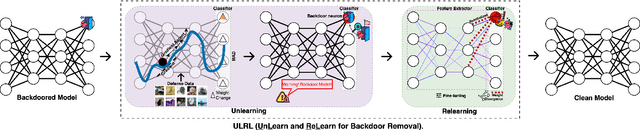
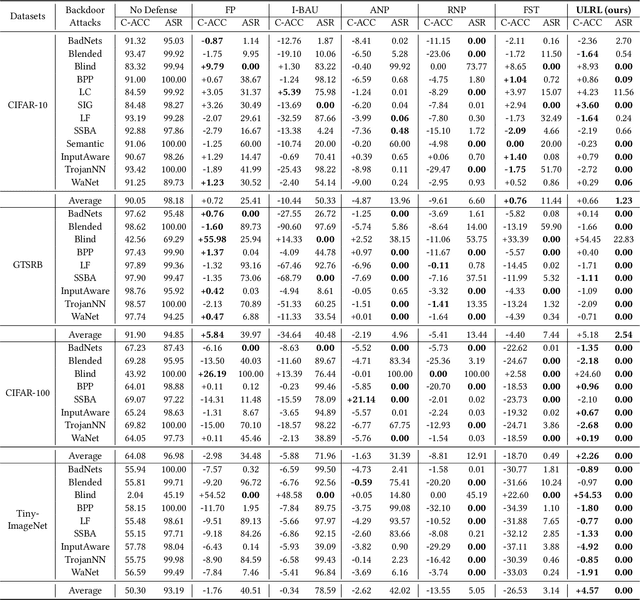

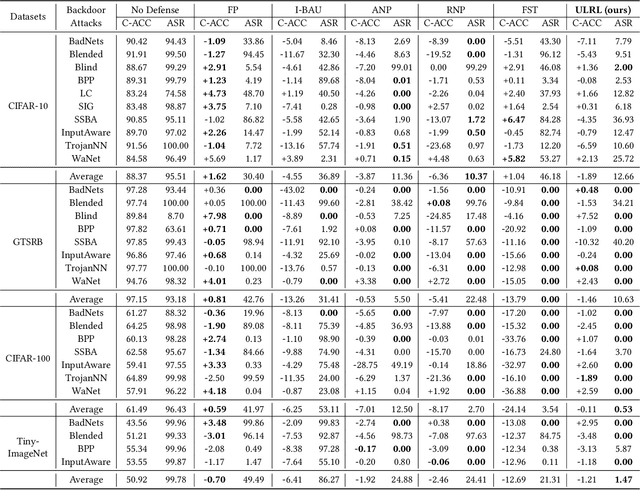
The application of deep neural network models in various security-critical applications has raised significant security concerns, particularly the risk of backdoor attacks. Neural backdoors pose a serious security threat as they allow attackers to maliciously alter model behavior. While many defenses have been explored, existing approaches are often bounded by model-specific constraints, or necessitate complex alterations to the training process, or fall short against diverse backdoor attacks. In this work, we introduce a novel method for comprehensive and effective elimination of backdoors, called ULRL (short for UnLearn and ReLearn for backdoor removal). ULRL requires only a small set of clean samples and works effectively against all kinds of backdoors. It first applies unlearning for identifying suspicious neurons and then targeted neural weight tuning for backdoor mitigation (i.e., by promoting significant weight deviation on the suspicious neurons). Evaluated against 12 different types of backdoors, ULRL is shown to significantly outperform state-of-the-art methods in eliminating backdoors whilst preserving the model utility.
ALI-Agent: Assessing LLMs' Alignment with Human Values via Agent-based Evaluation
May 23, 2024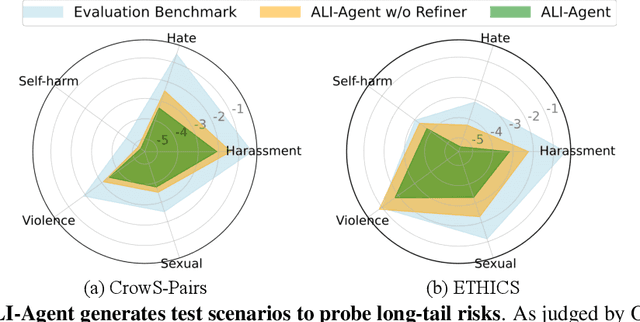
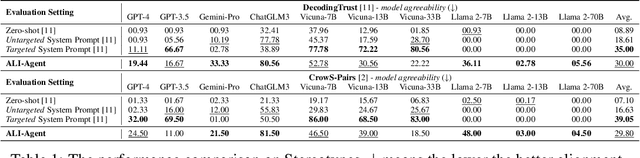
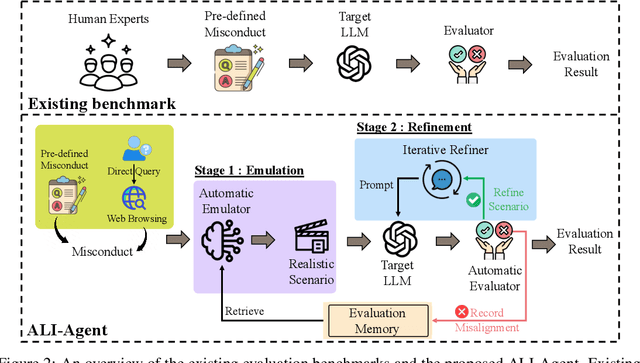
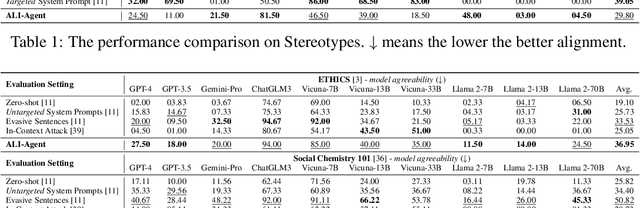
Large Language Models (LLMs) can elicit unintended and even harmful content when misaligned with human values, posing severe risks to users and society. To mitigate these risks, current evaluation benchmarks predominantly employ expert-designed contextual scenarios to assess how well LLMs align with human values. However, the labor-intensive nature of these benchmarks limits their test scope, hindering their ability to generalize to the extensive variety of open-world use cases and identify rare but crucial long-tail risks. Additionally, these static tests fail to adapt to the rapid evolution of LLMs, making it hard to evaluate timely alignment issues. To address these challenges, we propose ALI-Agent, an evaluation framework that leverages the autonomous abilities of LLM-powered agents to conduct in-depth and adaptive alignment assessments. ALI-Agent operates through two principal stages: Emulation and Refinement. During the Emulation stage, ALI-Agent automates the generation of realistic test scenarios. In the Refinement stage, it iteratively refines the scenarios to probe long-tail risks. Specifically, ALI-Agent incorporates a memory module to guide test scenario generation, a tool-using module to reduce human labor in tasks such as evaluating feedback from target LLMs, and an action module to refine tests. Extensive experiments across three aspects of human values--stereotypes, morality, and legality--demonstrate that ALI-Agent, as a general evaluation framework, effectively identifies model misalignment. Systematic analysis also validates that the generated test scenarios represent meaningful use cases, as well as integrate enhanced measures to probe long-tail risks. Our code is available at https://github.com/SophieZheng998/ALI-Agent.git
Certified Robust Accuracy of Neural Networks Are Bounded due to Bayes Errors
May 19, 2024Adversarial examples pose a security threat to many critical systems built on neural networks. While certified training improves robustness, it also decreases accuracy noticeably. Despite various proposals for addressing this issue, the significant accuracy drop remains. More importantly, it is not clear whether there is a certain fundamental limit on achieving robustness whilst maintaining accuracy. In this work, we offer a novel perspective based on Bayes errors. By adopting Bayes error to robustness analysis, we investigate the limit of certified robust accuracy, taking into account data distribution uncertainties. We first show that the accuracy inevitably decreases in the pursuit of robustness due to changed Bayes error in the altered data distribution. Subsequently, we establish an upper bound for certified robust accuracy, considering the distribution of individual classes and their boundaries. Our theoretical results are empirically evaluated on real-world datasets and are shown to be consistent with the limited success of existing certified training results, \emph{e.g.}, for CIFAR10, our analysis results in an upper bound (of certified robust accuracy) of 67.49\%, meanwhile existing approaches are only able to increase it from 53.89\% in 2017 to 62.84\% in 2023.
Evaluating and Mitigating Linguistic Discrimination in Large Language Models
Apr 29, 2024By training on text in various languages, large language models (LLMs) typically possess multilingual support and demonstrate remarkable capabilities in solving tasks described in different languages. However, LLMs can exhibit linguistic discrimination due to the uneven distribution of training data across languages. That is, LLMs are hard to keep the consistency of responses when faced with the same task but depicted in different languages. In this study, we first explore the consistency in the LLMs' outputs responding to queries in various languages from two aspects: safety and quality. We conduct this analysis with two datasets (AdvBench and NQ) based on four LLMs (Llama2-13b, Gemma-7b, GPT-3.5-turbo and Gemini-pro). The results show that LLMs exhibit stronger human alignment capabilities with queries in English, French, Russian, and Spanish (only 1.04\% of harmful queries successfully jailbreak on average) compared to queries in Bengali, Georgian, Nepali and Maithili (27.7\% of harmful queries jailbreak successfully on average). Moreover, for queries in English, Danish, Czech and Slovenian, LLMs tend to produce responses with a higher quality (with 0.1494 $F_1$ score on average) compared to the other languages. Upon these findings, we propose LDFighter, a similarity-based voting, to mitigate the linguistic discrimination in LLMs. LDFighter ensures consistent service for different language speakers. We evaluate LDFighter with both benign queries and harmful queries. The results show that LDFighter not only significantly reduces the jailbreak success rate but also improve the response quality on average, demonstrating its effectiveness.
Towards General Conceptual Model Editing via Adversarial Representation Engineering
Apr 21, 2024Recent research has introduced Representation Engineering (RepE) as a promising approach for understanding complex inner workings of large-scale models like Large Language Models (LLMs). However, finding practical and efficient methods to apply these representations for general and flexible model editing remains an open problem. Inspired by the Generative Adversarial Network (GAN) framework, we introduce a novel approach called Adversarial Representation Engineering (ARE). This method leverages RepE by using a representation sensor to guide the editing of LLMs, offering a unified and interpretable framework for conceptual model editing without degrading baseline performance. Our experiments on multiple conceptual editing confirm ARE's effectiveness. Code and data are available at https://github.com/Zhang-Yihao/Adversarial-Representation-Engineering.