 Add to Chrome
 Add to Firefox
 Add to Edge
Anthropogenic Regional Adaptation in Multimodal Vision-Language Model
Apr 13, 2026
While the field of vision-language (VL) has achieved remarkable success in integrating visual and textual information across multiple languages and domains, there is still no dedicated framework for assessing human-centric alignment in vision-language systems. We offer two contributions to address this gap. First, we introduce Anthropogenic Regional Adaptation: a novel paradigm that aims to optimize model relevance to specific regional contexts while ensuring the retention of global generalization capabilities. Second, we present a simple, but effective adaptation method named Geographical-generalization-made-easy (GG-EZ), which utilizes regional data filtering and model merging. Through comprehensive experiments on 3 VL architectures: large vision-language models, text-to-image diffusion models, and vision-language embedding models, and a case study in Southeast Asia (SEA) regional adaptation, we demonstrate the importance of Anthropogenic Regional Adaptation and the effectiveness of GG-EZ, showing 5-15% gains in cultural relevance metrics across SEA while maintaining over 98% of global performance and even occasionally surpassing it. Our findings establish Anthropogenic Regional Alignment as a foundational paradigm towards applicability of multimodal vision-language models in diverse regions and demonstrate a simple-yet-effective baseline method that optimizes regional value alignment while preserving global generalization.

Evaluating LLM-Generated Lessons from the Language Learning Students' Perspective: A Short Case Study on Duolingo
Mar 19, 2026Popular language learning applications such as Duolingo use large language models (LLMs) to generate lessons for its users. Most lessons focus on general real-world scenarios such as greetings, ordering food, or asking directions, with limited support for profession-specific contexts. This gap can hinder learners from achieving professional-level fluency, which we define as the ability to communicate comfortably various work-related and domain-specific information in the target language. We surveyed five employees from a multinational company in the Philippines on their experiences with Duolingo. Results show that respondents encountered general scenarios more frequently than work-related ones, and that the former are relatable and effective in building foundational grammar, vocabulary, and cultural knowledge. The latter helps bridge the gap toward professional fluency as it contains domain-specific vocabulary. Each participant suggested lesson scenarios that diverge in contexts hen analyzed in aggregate. With this understanding, we propose that language learning applications should generate lessons that adapt to an individual's needs through personalized, domain specific lesson scenarios while maintaining foundational support through general, relatable lesson scenarios.
I'm Not Reading All of That: Understanding Software Engineers' Level of Cognitive Engagement with Agentic Coding Assistants
Mar 15, 2026Over-reliance on AI systems can undermine users' critical thinking and promote complacency, a risk intensified by the emergence of agentic AI systems that operate with minimal human involvement. In software engineering, agentic coding assistants are rapidly becoming embedded in everyday development workflows. Since software engineers create systems deployed across diverse and high-stakes real-world contexts, these assistants must function not merely as autonomous task performers but as Tools for Thought that actively support human reasoning and sensemaking. We conducted a formative study examining software engineers' cognitive engagement and sensemaking processes when working with an agentic coding assistant. Our findings reveal that cognitive engagement consistently declines as tasks progress, and that current agentic coding assistants' designs provide limited affordances for reflection, verification, and meaning-making. Based on these findings, e identify concrete design opportunities leveraging richer interaction modalities and cognitive-forcing mechanisms to sustain engagement and promote deeper thinking in AI-assisted programming.
A Gamified Evaluation and Recruitment Platform for Low Resource Language Machine Translation Systems
Jun 13, 2025Human evaluators provide necessary contributions in evaluating large language models. In the context of Machine Translation (MT) systems for low-resource languages (LRLs), this is made even more apparent since popular automated metrics tend to be string-based, and therefore do not provide a full picture of the nuances of the behavior of the system. Human evaluators, when equipped with the necessary expertise of the language, will be able to test for adequacy, fluency, and other important metrics. However, the low resource nature of the language means that both datasets and evaluators are in short supply. This presents the following conundrum: How can developers of MT systems for these LRLs find adequate human evaluators and datasets? This paper first presents a comprehensive review of existing evaluation procedures, with the objective of producing a design proposal for a platform that addresses the resource gap in terms of datasets and evaluators in developing MT systems. The result is a design for a recruitment and gamified evaluation platform for developers of MT systems. Challenges are also discussed in terms of evaluating this platform, as well as its possible applications in the wider scope of Natural Language Processing (NLP) research.
Crowdsource, Crawl, or Generate? Creating SEA-VL, a Multicultural Vision-Language Dataset for Southeast Asia
Mar 10, 2025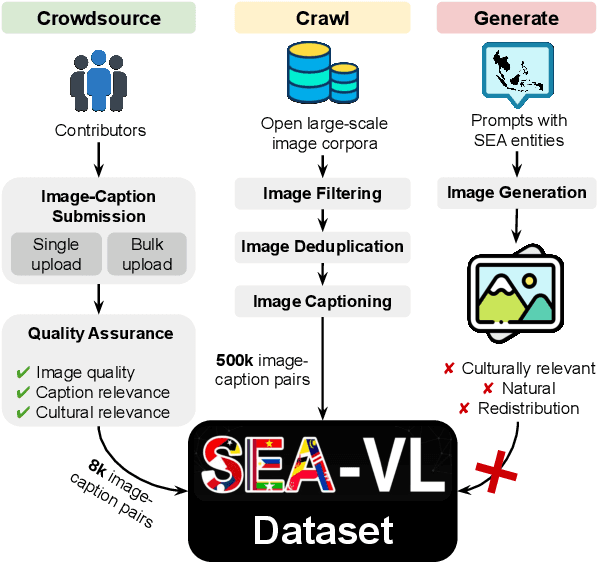
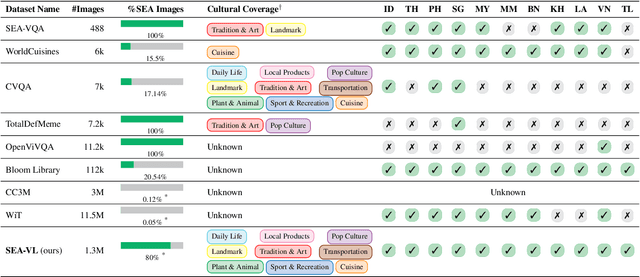
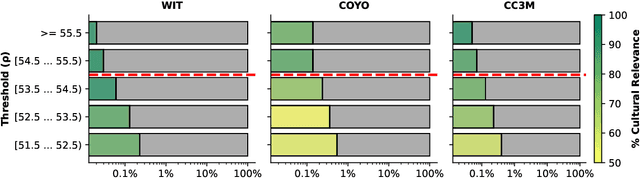
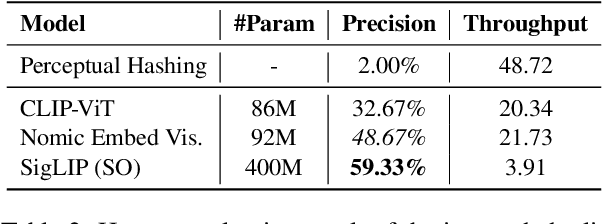
Southeast Asia (SEA) is a region of extraordinary linguistic and cultural diversity, yet it remains significantly underrepresented in vision-language (VL) research. This often results in artificial intelligence (AI) models that fail to capture SEA cultural nuances. To fill this gap, we present SEA-VL, an open-source initiative dedicated to developing high-quality, culturally relevant data for SEA languages. By involving contributors from SEA countries, SEA-VL aims to ensure better cultural relevance and diversity, fostering greater inclusivity of underrepresented languages in VL research. Beyond crowdsourcing, our initiative goes one step further in the exploration of the automatic collection of culturally relevant images through crawling and image generation. First, we find that image crawling achieves approximately ~85% cultural relevance while being more cost- and time-efficient than crowdsourcing. Second, despite the substantial progress in generative vision models, synthetic images remain unreliable in accurately reflecting SEA cultures. The generated images often fail to reflect the nuanced traditions and cultural contexts of the region. Collectively, we gather 1.28M SEA culturally-relevant images, more than 50 times larger than other existing datasets. Through SEA-VL, we aim to bridge the representation gap in SEA, fostering the development of more inclusive AI systems that authentically represent diverse cultures across SEA.