 Add to Chrome
 Add to Firefox
 Add to Edge
SemEval-2026 Task 7: Everyday Knowledge Across Diverse Languages and Cultures
May 04, 2026
We present our shared task on evaluating the adaptability of LLMs and NLP systems across multiple languages and cultures. The task data consist of an extended version of our manually constructed BLEnD benchmark (Myung et al. 2024), covering more than 30 language-culture pairs, predominantly representing low-resource languages spoken across multiple continents. As the task is designed strictly for evaluation, participants were not permitted to use the data for training, fine-tuning, few-shot learning, or any other form of model modification. Our task includes two tracks: (a) Short-Answer Questions (SAQ) and (b) Multiple-Choice Questions (MCQ). Participants were required to predict labels and were allowed to submit any NLP system and adopt diverse modelling strategies, provided that the benchmark was used solely for evaluation. The task attracted more than 140 registered participants, and we received final submissions from 62 teams, along with 19 system description papers. We report the results and present an analysis of the best-performing systems and the most commonly adopted approaches. Furthermore, we discuss shared insights into open questions and challenges related to evaluation, misalignment, and methodological perspectives on model behaviour in low-resource languages and for under-represented cultures.

Why are all LLMs Obsessed with Japanese Culture? On the Hidden Cultural and Regional Biases of LLMs
Apr 23, 2026LLMs have been showing limitations when it comes to cultural coverage and competence, and in some cases show regional biases such as amplifying Western and Anglocentric viewpoints. While there have been works analysing the cultural capabilities of LLMs, there has not been specific work on highlighting LLM regional preferences when it comes to cultural-related questions. In this work, we propose a new dataset based on a comprehensive taxonomy of Culture-Related Open Questions (CROQ). The results show that, contrary to previous cultural bias work, LLMs show a clear tendency towards countries such as Japan. Moveover, our results show that when prompting in languages such as English or other high-resource ones, LLMs tend to provide more diverse outputs and show less inclinations towards answering questions highlighting countries for which the input language is an official language. Finally, we also investigate at which point of LLM training this cultural bias emerges, with our results suggesting that the first clear signs appear after supervised fine-tuning, and not during pre-training.
Sensitive Content Classification in Social Media: A Holistic Resource and Evaluation
Nov 29, 2024


The detection of sensitive content in large datasets is crucial for ensuring that shared and analysed data is free from harmful material. However, current moderation tools, such as external APIs, suffer from limitations in customisation, accuracy across diverse sensitive categories, and privacy concerns. Additionally, existing datasets and open-source models focus predominantly on toxic language, leaving gaps in detecting other sensitive categories such as substance abuse or self-harm. In this paper, we put forward a unified dataset tailored for social media content moderation across six sensitive categories: conflictual language, profanity, sexually explicit material, drug-related content, self-harm, and spam. By collecting and annotating data with consistent retrieval strategies and guidelines, we address the shortcomings of previous focalised research. Our analysis demonstrates that fine-tuning large language models (LLMs) on this novel dataset yields significant improvements in detection performance compared to open off-the-shelf models such as LLaMA, and even proprietary OpenAI models, which underperform by 10-15% overall. This limitation is even more pronounced on popular moderation APIs, which cannot be easily tailored to specific sensitive content categories, among others.
BLEnD: A Benchmark for LLMs on Everyday Knowledge in Diverse Cultures and Languages
Jun 14, 2024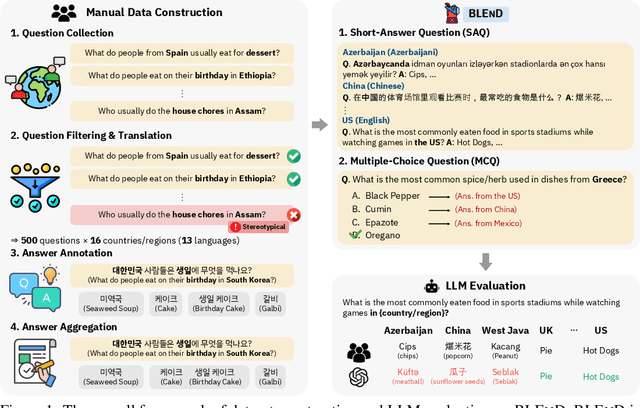
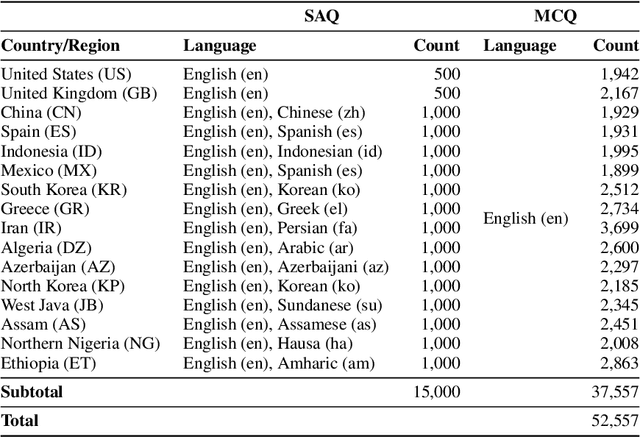
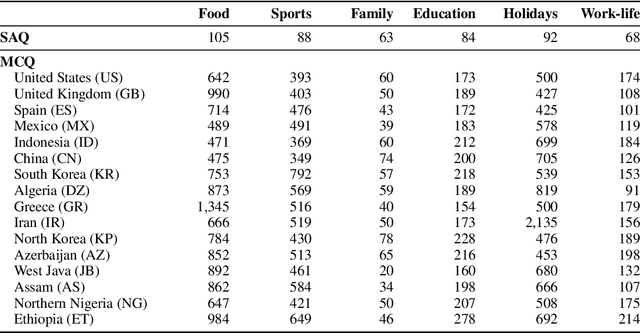
Large language models (LLMs) often lack culture-specific knowledge of daily life, especially across diverse regions and non-English languages. Existing benchmarks for evaluating LLMs' cultural sensitivities are limited to a single language or collected from online sources such as Wikipedia, which do not reflect the mundane everyday lifestyles of diverse regions. That is, information about the food people eat for their birthday celebrations, spices they typically use, musical instruments youngsters play, or the sports they practice in school is common cultural knowledge but uncommon in easily collected online sources, especially for underrepresented cultures. To address this issue, we introduce BLEnD, a hand-crafted benchmark designed to evaluate LLMs' everyday knowledge across diverse cultures and languages. BLEnD comprises 52.6k question-answer pairs from 16 countries/regions, in 13 different languages, including low-resource ones such as Amharic, Assamese, Azerbaijani, Hausa, and Sundanese. We construct the benchmark to include two formats of questions: short-answer and multiple-choice. We show that LLMs perform better for cultures that are highly represented online, with a maximum 57.34% difference in GPT-4, the best-performing model, in the short-answer format. For cultures represented by mid-to-high-resource languages, LLMs perform better in their local languages, but for cultures represented by low-resource languages, LLMs perform better in English than the local languages. We make our dataset publicly available at: https://github.com/nlee0212/BLEnD.