 Add to Chrome
 Add to Firefox
 Add to Edge
(Im)Paired Programming: Coding Agents Improve Productivity but Harm Understanding
Jul 29, 2026
Coding agents (e.g., Cursor) improve developer productivity by optimizing task completion, but shifting users from writing code to prompting and reviewing may harm their understanding, impeding oversight, learning, and communication. To probe this, we have 54 students create a website with one of two AI systems: an agent that edits user code; or a chatbot where users write code alone or adapt generic code snippets. We test understanding via comprehension questions and a task where users extend their code without agents, showing: (1) While agents aid initial task completion, they harm users' code comprehension and thus do not prepare users to extend their code; (2) Low-effort agent interaction types, like copy+paste prompts and auto-accepted edits, are linked with lower comprehension; and (3) Despite self-reported weaker understanding, users still prefer coding agents because they are quick and easy to use. While users stay in the loop for coding workflows, understanding should not be forgotten. Towards this goal, we distill our analyses into future research directions for coding agent developers: dissuading low-effort prompting, creating readable code, and promoting active engagement.

It Matters How You Say It: Exploring Rhetorical Patterns for AI-Assisted Information Evaluation
Jul 20, 2026Prior work on AI-assisted information evaluation has largely focused on what AI systems communicate, comparing explanation types and formats, with responses predominantly cast in directive rhetoric where the system delivers a verdict and the user passively accepts it. While debate-style interactions have recently shown promise in prompting critical evaluation over deference, the rhetorical patterns that structure AI responses and how they might induce reflection, uncertainty, or independent reasoning remain largely unexamined. To address this, we investigated eight rhetorical patterns known to induce contemplation: Intentional Misleading, Interpretive Alternative, Scaffold Explanation, Triggering Distrust, Information Distortion, Alternative Framing, Socratic Questioning, and an Oracle baseline. Through a within-subject study with n=98 participants on a hint-on-demand fact verification task, we observed preliminary evidence that Scaffold Explanation were associated with the highest accuracy gains, and encouraging deeper reflection. Surprisingly, the adversarial conditions also improved accuracy modestly. Participants preferred Alternative Framing most and Interpretive Alternative least, largely due to the latter's perceived time cost. We discuss the implications of designing conversational agents with varied rhetorical styles and the trade-offs among user performance, satisfaction, and contemplation.
DRACULA: Hunting for the Actions Users Want Deep Research Agents to Execute
Apr 26, 2026Scientific Deep Research (DR) agents answer user queries by synthesizing research papers into multi-section reports. User feedback can improve their utility, but existing protocols only score the final report, making it hard to study and learn which intermediate actions DR agents should take to improve reports. We collect DRACULA, the first dataset with user feedback on intermediate actions for DR. Over five weeks, nineteen expert CS researchers ask queries to a DR system that proposes actions (e.g., "Add a section on datasets"). Our users select actions they prefer, then judge whether an output report applied their selections successfully, yielding 8,103 action preferences and 5,230 execution judgments. After confirming a DR agent can execute DRACULA's actions, we study the predictability of user-preferred actions via simulation-how well LLMs predict the actions users select-a step toward learning to generate useful actions. We discover: (1) LLM judges initially struggle to predict action selections, but improve most when using a user's full selection history, rather than self-reported or extrapolated user context signals; (2) Users' selections for the same query differ based on unstated goals, bottlenecking simulation and motivating affordances that let users steer reports; and (3) Our simulation results inform an online intervention that generates new actions based on the user's past interactions, which users pick most often in follow-up studies. Overall, while work extensively studies execution, DRACULA reveals a key challenge is deciding which actions to execute in the first place. We open-source DRACULA's study design, user feedback, and simulation tasks to spur future work on action feedback for long-horizon agents.
AUDITA: A New Dataset to Audit Humans vs. AI Skill at Audio QA
Apr 23, 2026Existing audio question answering benchmarks largely emphasize sound event classification or caption-grounded queries, often enabling models to succeed through shortcut strategies, short-duration cues, lexical priors, dataset-specific biases, or even bypassing audio via metadata and captions rather than genuine reasoning Thus, we present AUDITA (Audio Understanding from Diverse Internet Trivia Authors), a large-scale, real-world benchmark to rigorously evaluate audio reasoning beyond surface-level acoustic recognition. AUDITA comprises carefully curated, human-authored trivia questions grounded in real-world audio, designed to stress robust auditory reasoning through challenging distractors and long-range temporal dependencies, using probing queries that cannot be answered from isolated text or sound cues alone. Human average accuracy of 32.13% shows both the challenge of the task while demonstrating meaningful comprehension of the audio. In stark contrast, state of-the-art audio question answering models perform poorly, with average accuracy below 8.86%. Beyond raw accuracy, we apply Item Response Theory (IRT) to estimate latent proficiency, question difficulty, and expose systematic deficiencies of the models and data.
Language Models Don't Know What You Want: Evaluating Personalization in Deep Research Needs Real Users
Mar 17, 2026Deep Research (DR) tools (e.g. OpenAI DR) help researchers cope with ballooning publishing counts. Such tools can synthesize scientific papers to answer researchers' queries, but lack understanding of their users. We change that in MyScholarQA (MySQA), a personalized DR tool that: 1) infers a profile of a user's research interests; 2) proposes personalized actions for a user's input query; and 3) writes a multi-section report for the query that follows user-approved actions. We first test MySQA with NLP's standard protocol: we design a benchmark of synthetic users and LLM judges, where MySQA beats baselines in citation metrics and personalized action-following. However, we suspect this process does not cover all aspects of personalized DR users value, so we interview users in an online version of MySQA to unmask them. We reveal nine nuanced errors of personalized DR undetectable by our LLM judges, and we study qualitative feedback to form lessons for future DR design. In all, we argue for a pillar of personalization that easy-to-use LLM judges can lead NLP to overlook: real progress in personalization is only possible with real users.
BenchMarker: An Education-Inspired Toolkit for Highlighting Flaws in Multiple-Choice Benchmarks
Feb 05, 2026Multiple-choice question answering (MCQA) is standard in NLP, but benchmarks lack rigorous quality control. We present BenchMarker, an education-inspired toolkit using LLM judges to flag three common MCQ flaws: 1) contamination - items appearing exactly online; 2) shortcuts - cues in the choices that enable guessing; and 3) writing errors - structural/grammatical issues based on a 19-rule education rubric. We validate BenchMarker with human annotations, then run the tool to audit 12 benchmarks, revealing: 2) contaminated MCQs tend to inflate accuracy, while writing errors tend to lower it and change rankings beyond random; and 3) prior benchmark repairs address their targeted issues (i.e., lowering accuracy with LLM-written distractors), but inadvertently add new flaws (i.e. implausible distractors, many correct answers). Overall, flaws in MCQs degrade NLP evaluation, but education research offers a path forward. We release BenchMarker to bridge the fields and improve MCQA benchmark design.
Semantically-Aware Rewards for Open-Ended R1 Training in Free-Form Generation
Jun 18, 2025Evaluating open-ended long-form generation is challenging because it is hard to define what clearly separates good from bad outputs. Existing methods often miss key aspects like coherence, style, or relevance, or are biased by pretraining data, making open-ended long-form evaluation an underexplored problem. To address this gap, we propose PrefBERT, a scoring model for evaluating open-ended long-form generation in GRPO and guiding its training with distinct rewards for good and bad outputs. Trained on two response evaluation datasets with diverse long-form styles and Likert-rated quality, PrefBERT effectively supports GRPO by offering better semantic reward feedback than traditional metrics ROUGE-L and BERTScore do. Through comprehensive evaluations, including LLM-as-a-judge, human ratings, and qualitative analysis, we show that PrefBERT, trained on multi-sentence and paragraph-length responses, remains reliable across varied long passages and aligns well with the verifiable rewards GRPO needs. Human evaluations confirm that using PrefBERT as the reward signal to train policy models yields responses better aligned with human preferences than those trained with traditional metrics. Our code is available at https://github.com/zli12321/long_form_rl.
VideoHallu: Evaluating and Mitigating Multi-modal Hallucinations for Synthetic Videos
May 02, 2025Synthetic video generation with foundation models has gained attention for its realism and wide applications. While these models produce high-quality frames, they often fail to respect common sense and physical laws, resulting in abnormal content. Existing metrics like VideoScore emphasize general quality but ignore such violations and lack interpretability. A more insightful approach is using multi-modal large language models (MLLMs) as interpretable evaluators, as seen in FactScore. Yet, MLLMs' ability to detect abnormalities in synthetic videos remains underexplored. To address this, we introduce VideoHallu, a benchmark featuring synthetic videos from models like Veo2, Sora, and Kling, paired with expert-designed QA tasks solvable via human-level reasoning across various categories. We assess several SoTA MLLMs, including GPT-4o, Gemini-2.5-Pro, Qwen-2.5-VL, and newer models like Video-R1 and VideoChat-R1. Despite strong real-world performance on MVBench and MovieChat, these models still hallucinate on basic commonsense and physics tasks in synthetic settings, underscoring the challenge of hallucination. We further fine-tune SoTA MLLMs using Group Relative Policy Optimization (GRPO) on real and synthetic commonsense/physics data. Results show notable accuracy gains, especially with counterexample integration, advancing MLLMs' reasoning capabilities. Our data is available at https://github.com/zli12321/VideoHallu.
Large Language Models Are Effective Human Annotation Assistants, But Not Good Independent Annotators
Mar 09, 2025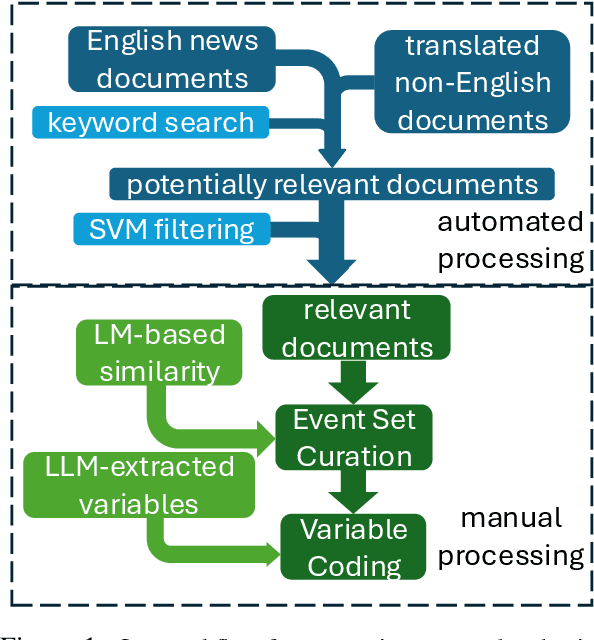
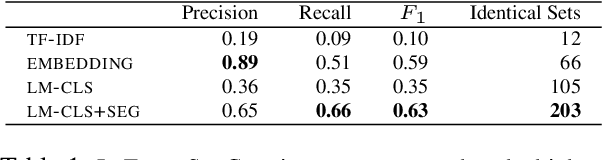
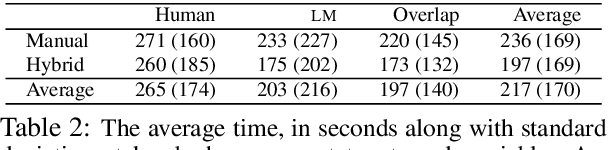
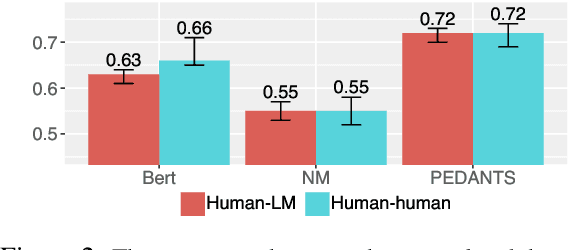
Event annotation is important for identifying market changes, monitoring breaking news, and understanding sociological trends. Although expert annotators set the gold standards, human coding is expensive and inefficient. Unlike information extraction experiments that focus on single contexts, we evaluate a holistic workflow that removes irrelevant documents, merges documents about the same event, and annotates the events. Although LLM-based automated annotations are better than traditional TF-IDF-based methods or Event Set Curation, they are still not reliable annotators compared to human experts. However, adding LLMs to assist experts for Event Set Curation can reduce the time and mental effort required for Variable Annotation. When using LLMs to extract event variables to assist expert annotators, they agree more with the extracted variables than fully automated LLMs for annotation.
GRACE: A Granular Benchmark for Evaluating Model Calibration against Human Calibration
Feb 27, 2025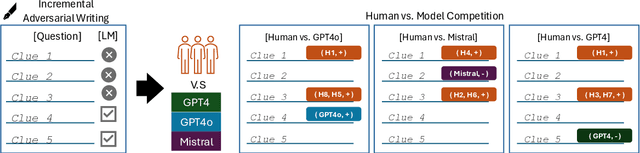
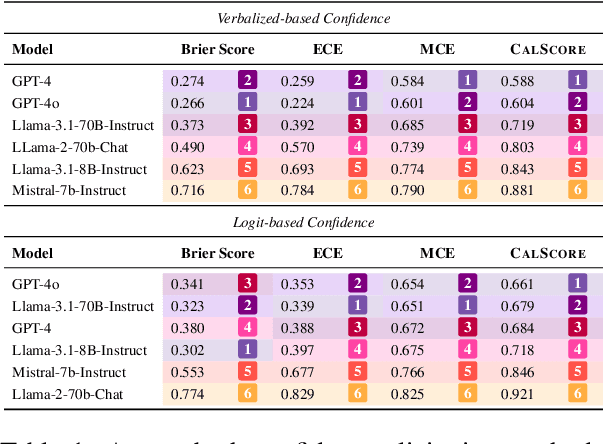
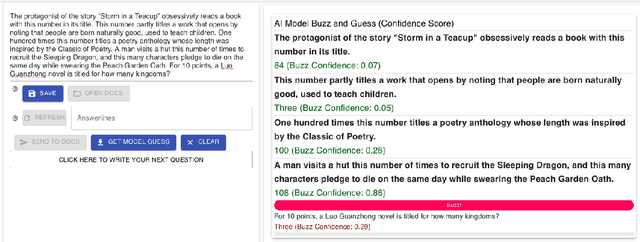
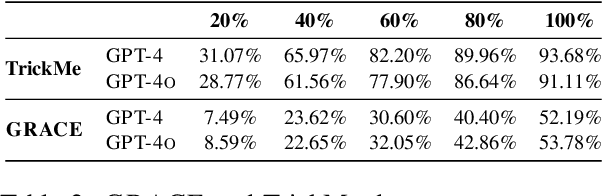
Language models are often miscalibrated, leading to confidently incorrect answers. We introduce GRACE, a benchmark for language model calibration that incorporates comparison with human calibration. GRACE consists of question-answer pairs, in which each question contains a series of clues that gradually become easier, all leading to the same answer; models must answer correctly as early as possible as the clues are revealed. This setting permits granular measurement of model calibration based on how early, accurately, and confidently a model answers. After collecting these questions, we host live human vs. model competitions to gather 1,749 data points on human and model teams' timing, accuracy, and confidence. We propose a metric, CalScore, that uses GRACE to analyze model calibration errors and identify types of model miscalibration that differ from human behavior. We find that although humans are less accurate than models, humans are generally better calibrated. Since state-of-the-art models struggle on GRACE, it effectively evaluates progress on improving model calibration.