 Add to Chrome
 Add to Firefox
 Add to Edge
AUDITA: A New Dataset to Audit Humans vs. AI Skill at Audio QA
Apr 23, 2026
Existing audio question answering benchmarks largely emphasize sound event classification or caption-grounded queries, often enabling models to succeed through shortcut strategies, short-duration cues, lexical priors, dataset-specific biases, or even bypassing audio via metadata and captions rather than genuine reasoning Thus, we present AUDITA (Audio Understanding from Diverse Internet Trivia Authors), a large-scale, real-world benchmark to rigorously evaluate audio reasoning beyond surface-level acoustic recognition. AUDITA comprises carefully curated, human-authored trivia questions grounded in real-world audio, designed to stress robust auditory reasoning through challenging distractors and long-range temporal dependencies, using probing queries that cannot be answered from isolated text or sound cues alone. Human average accuracy of 32.13% shows both the challenge of the task while demonstrating meaningful comprehension of the audio. In stark contrast, state of-the-art audio question answering models perform poorly, with average accuracy below 8.86%. Beyond raw accuracy, we apply Item Response Theory (IRT) to estimate latent proficiency, question difficulty, and expose systematic deficiencies of the models and data.

Navigating Dialectal Bias and Ethical Complexities in Levantine Arabic Hate Speech Detection
Dec 14, 2024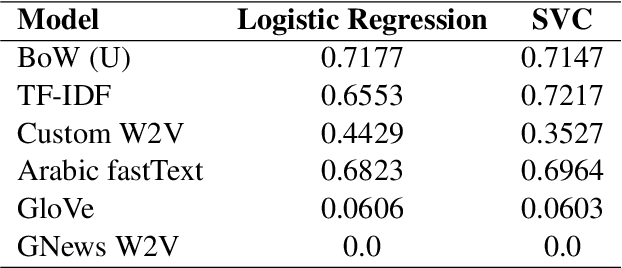
Social media platforms have become central to global communication, yet they also facilitate the spread of hate speech. For underrepresented dialects like Levantine Arabic, detecting hate speech presents unique cultural, ethical, and linguistic challenges. This paper explores the complex sociopolitical and linguistic landscape of Levantine Arabic and critically examines the limitations of current datasets used in hate speech detection. We highlight the scarcity of publicly available, diverse datasets and analyze the consequences of dialectal bias within existing resources. By emphasizing the need for culturally and contextually informed natural language processing (NLP) tools, we advocate for a more nuanced and inclusive approach to hate speech detection in the Arab world.