 Add to Chrome
 Add to Firefox
 Add to Edge
Filling in the Mechanisms: How do LMs Learn Filler-Gap Dependencies under Developmental Constraints?
Apr 15, 2026
For humans, filler-gap dependencies require a shared representation across different syntactic constructions. Although causal analyses suggest this may also be true for LLMs (Boguraev et al., 2025), it is still unclear if such a representation also exists for language models trained on developmentally feasible quantities of data. We applied Distributed Alignment Search (DAS, Geiger et al. (2024)) to LMs trained on varying amounts of data from the BabyLM challenge (Warstadt et al., 2023), to evaluate whether representations of filler-gap dependencies transfer between wh-questions and topicalization, which greatly vary in terms of their input frequency. Our results suggest shared, yet item-sensitive mechanisms may develop with limited training data. More importantly, LMs still require far more data than humans to learn comparable generalizations, highlighting the need for language-specific biases in models of language acquisition.

BenchMarker: An Education-Inspired Toolkit for Highlighting Flaws in Multiple-Choice Benchmarks
Feb 05, 2026Multiple-choice question answering (MCQA) is standard in NLP, but benchmarks lack rigorous quality control. We present BenchMarker, an education-inspired toolkit using LLM judges to flag three common MCQ flaws: 1) contamination - items appearing exactly online; 2) shortcuts - cues in the choices that enable guessing; and 3) writing errors - structural/grammatical issues based on a 19-rule education rubric. We validate BenchMarker with human annotations, then run the tool to audit 12 benchmarks, revealing: 2) contaminated MCQs tend to inflate accuracy, while writing errors tend to lower it and change rankings beyond random; and 3) prior benchmark repairs address their targeted issues (i.e., lowering accuracy with LLM-written distractors), but inadvertently add new flaws (i.e. implausible distractors, many correct answers). Overall, flaws in MCQs degrade NLP evaluation, but education research offers a path forward. We release BenchMarker to bridge the fields and improve MCQA benchmark design.
Test-Time Reasoners Are Strategic Multiple-Choice Test-Takers
Oct 09, 2025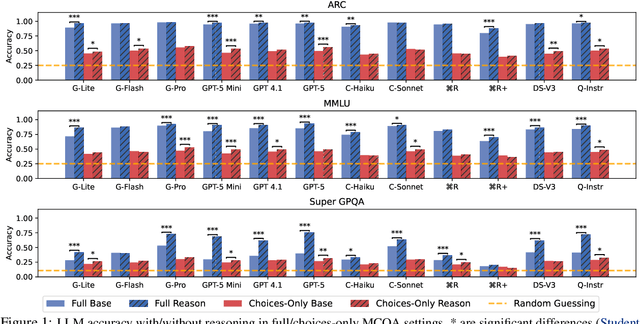
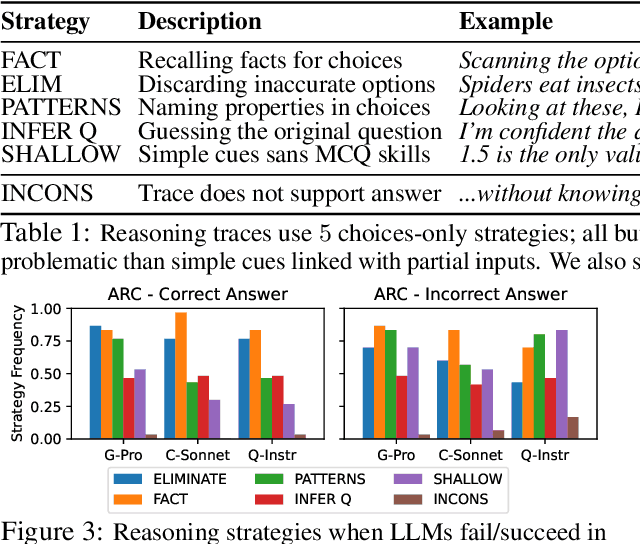
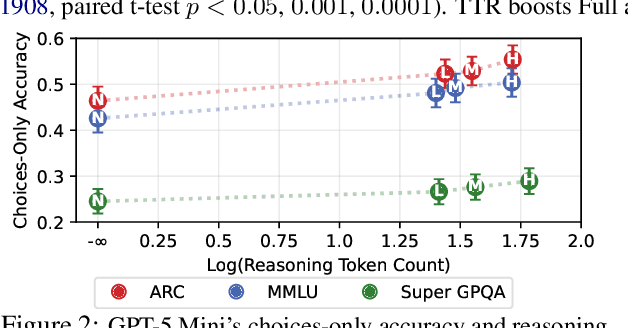
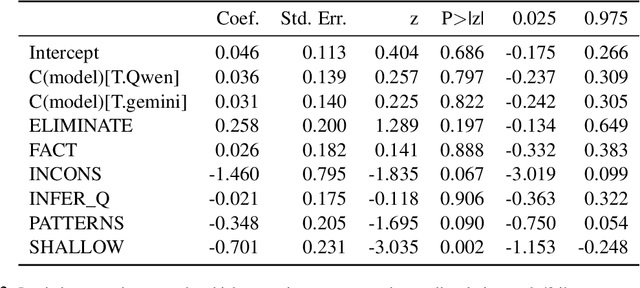
Large language models (LLMs) now give reasoning before answering, excelling in tasks like multiple-choice question answering (MCQA). Yet, a concern is that LLMs do not solve MCQs as intended, as work finds LLMs sans reasoning succeed in MCQA without using the question, i.e., choices-only. Such partial-input success is often deemed problematic, but reasoning traces could reveal if these strategies are truly shallow in choices-only settings. To study these strategies, reasoning LLMs solve MCQs in full and choices-only inputs; test-time reasoning often boosts accuracy on full and in choices-only half the time. While possibly due to shallow shortcuts, choices-only success is barely affected by the length of reasoning traces, and after finding traces pass faithfulness tests, we show they use less problematic strategies like inferring missing questions. In all, we challenge claims that partial-input success is always a flaw, so we discuss how reasoning traces could separate problematic data from less problematic reasoning.