 Add to Chrome
 Add to Firefox
 Add to Edge
Humanly: A Configurable and Traceable Environment for Human-AI Collaborative Writing
Jul 23, 2026
Teachers, conference chairs, and public readers all judge writing from limited evidence, seeing only a finished document and not the process that produced it. Final text alone cannot reveal whether a document was produced through human typing, AI generation, or mixed human-AI collaboration. Existing process-tracking tools help, but many are tied to host-document histories, provide coarse activity records, and offer limited control over the writing environment. Humanly is a writing platform that makes the writing process itself the evidence. Users configure writing environments for personal documents or assigned tasks and draft in a workspace that records writing activity and in-platform AI assistance. Humanly can package a completed session into a sealed writing certificate with configuration-aware anomaly behavior review. It can support writing scenarios such as course assignments, peer review, and personal certification. Our user study shows that Humanly is helpful across roles, and a red-teaming study shows that the Humanly Typing Detector distinguishes human hand typing from automated typing.

Pluralis v0.1: Towards a Multicultural, Multimodal, Multilingual Benchmark for AI Risk and Reliability
Jul 07, 2026Current AI safety evaluation and benchmarking frameworks predominantly rely on Western-centric culture-agnostic defaults that mask critical regional laws, socio-linguistic nuances, and cultural taboos, leaving Vision-Language Models (VLMs) vulnerable in global deployments. We introduce Pluralis v0.1: a novel multimodal, multi-regional, and multilingual dataset built from a culture-first perspective. Spanning 6,448 prompts across six Asia-Pacific countries (Bangladesh, India, Korea, Pakistan, Singapore, Taiwan) and eight languages, Pluralis diverges from prior work by natively sourcing localized safety hazards rather than adapting Western datasets. Crucially, it introduces a multimodal evaluation paradigm: user text (e.g., "Should I gift this?") and an image referring to "this" (e.g., a clock) - both innocuous in isolation, but synergistically triggering specific legal or cultural violations. Pluralis disentangles universal safety violations from localized cultural appropriateness, establishing the latter as a first-class evaluation axis. To operationalize this, we present Judge-Pluralis, an agreement-gated LLM-as-a-Judge ensemble trained on examples classified in an empirically derived cultural taxonomy. Observing VLM behavior on a subset of the Pluralis surfaces recurring, locale-specific failure modes such as image misidentifications with downstream harm, missed item-context-locale interactions, and inadequate refusals. These failure modes vary systematically across locales and languages, exposing blind spots that globally averaged metrics conceal. Ultimately, Pluralis is not presented as a solved evaluation framework for cultural alignment, but rather as a first step and catalyst for future innovation. We call upon the research community to utilize this foundation to advance the science of multilingual, multicultural evaluation to better support AI cultural alignment globally.
Stop Automating Peer Review Without Rigorous Evaluation
May 04, 2026Large language models offer a tempting solution to address the peer review crisis. This position paper argues that today's AI systems should not be used to produce paper reviews. We ground this position in an empirical comparison of human- versus AI-generated ICLR 2026 reviews and an evaluation of the effect of automated paper rewriting on different AI reviewers. We identify two critical issues: 1) AI reviewers exhibit a hivemind effect of excessive agreement within and across papers that reduces perspective diversity. 2) AI review scores are trivially gameable through paper laundering: prompting an LLM to rewrite a paper could significantly increase the scores from AI reviewers, demonstrating that LLM reviewers are easy to game through stylistic changes rather than scientific results. However, non-gameability and review diversity are necessary but not sufficient conditions for automation. We argue that addressing the peer review crisis requires a science of peer review automation -- not general-purpose LLMs deployed without rigorous evaluation.
* Accepted at ICML 2026 (Spotlight)
SWE-chat: Coding Agent Interactions From Real Users in the Wild
Apr 22, 2026AI coding agents are being adopted at scale, yet we lack empirical evidence on how people actually use them and how much of their output is useful in practice. We present SWE-chat, the first large-scale dataset of real coding agent sessions collected from open-source developers in the wild. The dataset currently contains 6,000 sessions, comprising more than 63,000 user prompts and 355,000 agent tool calls. SWE-chat is a living dataset; our collection pipeline automatically and continually discovers and processes sessions from public repositories. Leveraging SWE-chat, we provide an initial empirical characterization of real-world coding agent usage and failure modes. We find that coding patterns are bimodal: in 41% of sessions, agents author virtually all committed code ("vibe coding"), while in 23%, humans write all code themselves. Despite rapidly improving capabilities, coding agents remain inefficient in natural settings. Just 44% of all agent-produced code survives into user commits, and agent-written code introduces more security vulnerabilities than code authored by humans. Furthermore, users push back against agent outputs -- through corrections, failure reports, and interruptions -- in 44% of all turns. By capturing complete interaction traces with human vs. agent code authorship attribution, SWE-chat provides an empirical foundation for moving beyond curated benchmarks towards an evidence-based understanding of how AI agents perform in real developer workflows.
GoogleTrendArchive: A Year-Long Archive of Real-Time Web Search Trends Worldwide
Mar 23, 2026GoogleTrendArchive is a comprehensive archive of Google Trending Now data spanning over one year (from November 28, 2024 to January 3, 2026) across 125 countries and 1,358 locations. Unlike Google Trends, which requires specifying search terms in advance, Trending Now captures search queries experiencing real-time surges, offering a way to inductively discover trending patterns across regions for studying collective attention dynamics. However, Google does not provide historical access to this data beyond seven days. Our dataset addresses this gap by presenting an archive of Trending Now data. The dataset contains over 7.6 million trend episodes. Each record includes the trend identifier, search volume bucket, precise timestamps, duration, geographic location, and related query clusters. This dataset, among other, enables systematic studies of information diffusion patterns, cross-cultural attention dynamics, crisis responses, and the temporal evolution of collective information-seeking at a global scale. The comprehensive geographic coverage facilitates fine-grained cross-country or cross-regional comparative analyses.
Auditing Google's AI Overviews and Featured Snippets: A Case Study on Baby Care and Pregnancy
Nov 17, 2025Google Search increasingly surfaces AI-generated content through features like AI Overviews (AIO) and Featured Snippets (FS), which users frequently rely on despite having no control over their presentation. Through a systematic algorithm audit of 1,508 real baby care and pregnancy-related queries, we evaluate the quality and consistency of these information displays. Our robust evaluation framework assesses multiple quality dimensions, including answer consistency, relevance, presence of medical safeguards, source categories, and sentiment alignment. Our results reveal concerning gaps in information consistency, with information in AIO and FS displayed on the same search result page being inconsistent with each other in 33% of cases. Despite high relevance scores, both features critically lack medical safeguards (present in just 11% of AIO and 7% of FS responses). While health and wellness websites dominate source categories for both, AIO and FS, FS also often link to commercial sources. These findings have important implications for public health information access and demonstrate the need for stronger quality controls in AI-mediated health information. Our methodology provides a transferable framework for auditing AI systems across high-stakes domains where information quality directly impacts user well-being.
Large Language Model Hacking: Quantifying the Hidden Risks of Using LLMs for Text Annotation
Sep 10, 2025Large language models (LLMs) are rapidly transforming social science research by enabling the automation of labor-intensive tasks like data annotation and text analysis. However, LLM outputs vary significantly depending on the implementation choices made by researchers (e.g., model selection, prompting strategy, or temperature settings). Such variation can introduce systematic biases and random errors, which propagate to downstream analyses and cause Type I, Type II, Type S, or Type M errors. We call this LLM hacking. We quantify the risk of LLM hacking by replicating 37 data annotation tasks from 21 published social science research studies with 18 different models. Analyzing 13 million LLM labels, we test 2,361 realistic hypotheses to measure how plausible researcher choices affect statistical conclusions. We find incorrect conclusions based on LLM-annotated data in approximately one in three hypotheses for state-of-the-art models, and in half the hypotheses for small language models. While our findings show that higher task performance and better general model capabilities reduce LLM hacking risk, even highly accurate models do not completely eliminate it. The risk of LLM hacking decreases as effect sizes increase, indicating the need for more rigorous verification of findings near significance thresholds. Our extensive analysis of LLM hacking mitigation techniques emphasizes the importance of human annotations in reducing false positive findings and improving model selection. Surprisingly, common regression estimator correction techniques are largely ineffective in reducing LLM hacking risk, as they heavily trade off Type I vs. Type II errors. Beyond accidental errors, we find that intentional LLM hacking is unacceptably simple. With few LLMs and just a handful of prompt paraphrases, anything can be presented as statistically significant.
Preventing Eviction-Caused Homelessness through ML-Informed Distribution of Rental Assistance
Mar 19, 2024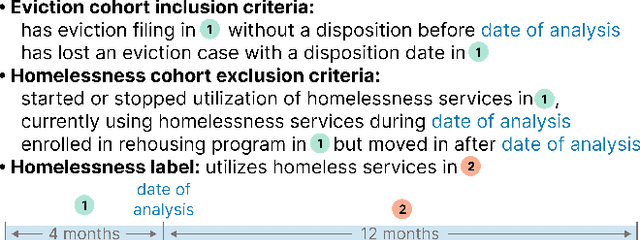
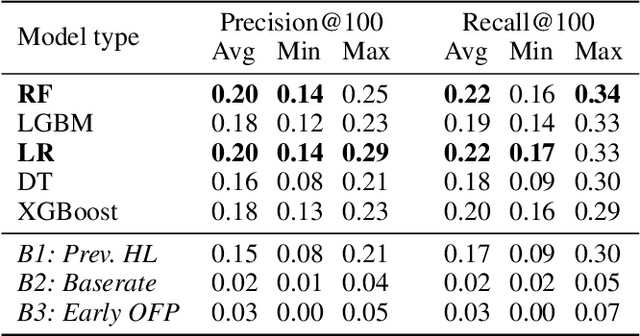
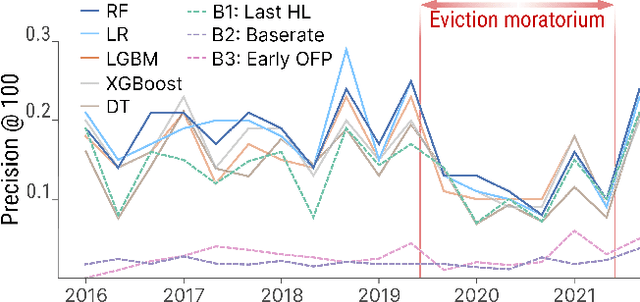
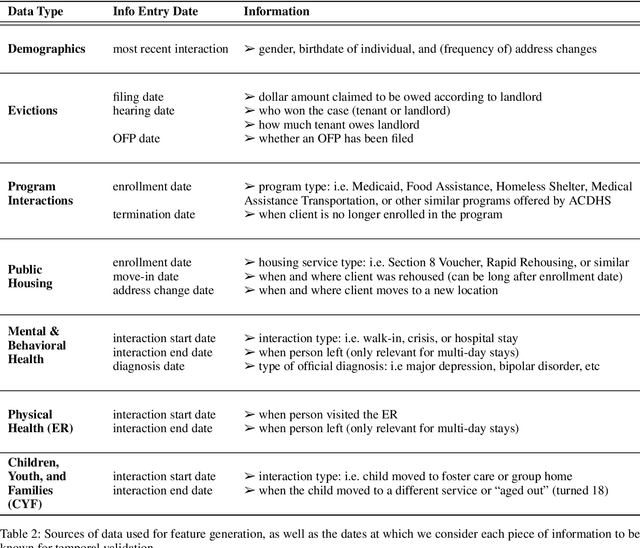
Rental assistance programs provide individuals with financial assistance to prevent housing instabilities caused by evictions and avert homelessness. Since these programs operate under resource constraints, they must decide who to prioritize. Typically, funding is distributed by a reactive or first-come-first serve allocation process that does not systematically consider risk of future homelessness. We partnered with Allegheny County, PA to explore a proactive allocation approach that prioritizes individuals facing eviction based on their risk of future homelessness. Our ML system that uses state and county administrative data to accurately identify individuals in need of support outperforms simpler prioritization approaches by at least 20% while being fair and equitable across race and gender. Furthermore, our approach would identify 28% of individuals who are overlooked by the current process and end up homeless. Beyond improvements to the rental assistance program in Allegheny County, this study can inform the development of evidence-based decision support tools in similar contexts, including lessons about data needs, model design, evaluation, and field validation.
On Prediction-Modelers and Decision-Makers: Why Fairness Requires More Than a Fair Prediction Model
Oct 09, 2023An implicit ambiguity in the field of prediction-based decision-making regards the relation between the concepts of prediction and decision. Much of the literature in the field tends to blur the boundaries between the two concepts and often simply speaks of 'fair prediction.' In this paper, we point out that a differentiation of these concepts is helpful when implementing algorithmic fairness. Even if fairness properties are related to the features of the used prediction model, what is more properly called 'fair' or 'unfair' is a decision system, not a prediction model. This is because fairness is about the consequences on human lives, created by a decision, not by a prediction. We clarify the distinction between the concepts of prediction and decision and show the different ways in which these two elements influence the final fairness properties of a prediction-based decision system. In addition to exploring this relationship conceptually and practically, we propose a framework that enables a better understanding and reasoning of the conceptual logic of creating fairness in prediction-based decision-making. In our framework, we specify different roles, namely the 'prediction-modeler' and the 'decision-maker,' and the information required from each of them for being able to implement fairness of the system. Our framework allows for deriving distinct responsibilities for both roles and discussing some insights related to ethical and legal requirements. Our contribution is twofold. First, we shift the focus from abstract algorithmic fairness to context-dependent decision-making, recognizing diverse actors with unique objectives and independent actions. Second, we provide a conceptual framework that can help structure prediction-based decision problems with respect to fairness issues, identify responsibilities, and implement fairness governance mechanisms in real-world scenarios.
A Classification of Feedback Loops and Their Relation to Biases in Automated Decision-Making Systems
May 10, 2023Prediction-based decision-making systems are becoming increasingly prevalent in various domains. Previous studies have demonstrated that such systems are vulnerable to runaway feedback loops, e.g., when police are repeatedly sent back to the same neighborhoods regardless of the actual rate of criminal activity, which exacerbate existing biases. In practice, the automated decisions have dynamic feedback effects on the system itself that can perpetuate over time, making it difficult for short-sighted design choices to control the system's evolution. While researchers started proposing longer-term solutions to prevent adverse outcomes (such as bias towards certain groups), these interventions largely depend on ad hoc modeling assumptions and a rigorous theoretical understanding of the feedback dynamics in ML-based decision-making systems is currently missing. In this paper, we use the language of dynamical systems theory, a branch of applied mathematics that deals with the analysis of the interconnection of systems with dynamic behaviors, to rigorously classify the different types of feedback loops in the ML-based decision-making pipeline. By reviewing existing scholarly work, we show that this classification covers many examples discussed in the algorithmic fairness community, thereby providing a unifying and principled framework to study feedback loops. By qualitative analysis, and through a simulation example of recommender systems, we show which specific types of ML biases are affected by each type of feedback loop. We find that the existence of feedback loops in the ML-based decision-making pipeline can perpetuate, reinforce, or even reduce ML biases.