 Add to Chrome
 Add to Firefox
 Add to Edge
DeltaServe: Host-Agnostic Co-Serving of Inference and Fine-Tuning for LLMs
Jul 30, 2026
LLM serving systems are provisioned for peak load to meet strict latency targets, leaving substantial GPU compute idle whenever traffic falls below peak. We present DeltaServe, a host-agnostic co-serving design that converts this idle inference capacity into LoRA fine-tuning throughput while preserving inference service-level objectives (SLOs). DeltaServe integrates with existing inference engines through a compact hook interface that requires only multi-LoRA batching support. It exploits the shared execution structure of inference prefill and LoRA fine-tuning forward passes, and uses an SLO-aware scheduler to admit and execute fine-tuning only when sufficient inference headroom is available. The scheduler is driven by a CUDA-graph-aware latency model calibrated offline and refined online. We integrate DeltaServe with vLLM, SGLang, and S-LoRA. On a production trace from Company X, DeltaServe on vLLM delivers 2.9x higher fine-tuning throughput than LLMStation at 100% inference SLO compliance, versus 85% for LLMStation. It also achieves 39% higher fine-tuning throughput than a baseline running vLLM+torchtune, using no additional hardware and maintaining full SLO compliance.

Pluralis v0.1: Towards a Multicultural, Multimodal, Multilingual Benchmark for AI Risk and Reliability
Jul 07, 2026Current AI safety evaluation and benchmarking frameworks predominantly rely on Western-centric culture-agnostic defaults that mask critical regional laws, socio-linguistic nuances, and cultural taboos, leaving Vision-Language Models (VLMs) vulnerable in global deployments. We introduce Pluralis v0.1: a novel multimodal, multi-regional, and multilingual dataset built from a culture-first perspective. Spanning 6,448 prompts across six Asia-Pacific countries (Bangladesh, India, Korea, Pakistan, Singapore, Taiwan) and eight languages, Pluralis diverges from prior work by natively sourcing localized safety hazards rather than adapting Western datasets. Crucially, it introduces a multimodal evaluation paradigm: user text (e.g., "Should I gift this?") and an image referring to "this" (e.g., a clock) - both innocuous in isolation, but synergistically triggering specific legal or cultural violations. Pluralis disentangles universal safety violations from localized cultural appropriateness, establishing the latter as a first-class evaluation axis. To operationalize this, we present Judge-Pluralis, an agreement-gated LLM-as-a-Judge ensemble trained on examples classified in an empirically derived cultural taxonomy. Observing VLM behavior on a subset of the Pluralis surfaces recurring, locale-specific failure modes such as image misidentifications with downstream harm, missed item-context-locale interactions, and inadequate refusals. These failure modes vary systematically across locales and languages, exposing blind spots that globally averaged metrics conceal. Ultimately, Pluralis is not presented as a solved evaluation framework for cultural alignment, but rather as a first step and catalyst for future innovation. We call upon the research community to utilize this foundation to advance the science of multilingual, multicultural evaluation to better support AI cultural alignment globally.
Reduced-Order Models: The Mother of World Models
Jul 03, 2026World models -- compressed latent representations of an environment that support action-conditioned prediction and planning -- are typically presented as a product of modern self-supervised learning. This paper argues that the functional anatomy of a world model was independently developed, deployed, and formally analyzed decades earlier in the model-order-reduction (MOR) and control literature, under different names and for a different purpose: the real-time operation of physical systems. We trace the anatomy across three communities. Low-dimensional models of turbulence built on proper orthogonal decomposition (POD) supplied latent dynamics learned from data of a chaotic environment; eigenface methods in early computer vision supplied the encoder-decoder half, including a primitive runtime validity check; and measurement-based POD frameworks for facility thermal control assembled the complete loop -- POD coefficients as latent state, parametric dependence on actuator setpoints as action conditioning, modal reconstruction as decoding, and, critically, a priori analytical error bounds as a verification layer that certified when the model's predictions could be trusted in closed loop. We then examine what each tradition possesses that the other lacks: MOR contributes verification, physical grounding, and extreme data efficiency; learned world models contribute nonlinear representation, transferability, and horizon. We argue that the outstanding obstacle to deploying world models in systems that cannot fail -- power, thermal, process control -- is not predictive fidelity but verifiability, and we outline a research agenda for physics-grounded, verifiable world models that unifies the two lineages.
Predictable GRPO: A Closed-Form Model of Training Dynamics
Jul 01, 2026We develop a first-principles reduced-order model of these dynamics. Under a single mean-field assumption that summarizes the policy by its expected reward, we reduce the GRPO update to a stochastically-forced damped oscillator whose mass, damping, and stiffness are fixed in closed form by the optimizer hyperparameters together with a single measured curvature scale -- momentum supplies the inertia, off-policy lag erodes the damping, and the group size enters, to leading order, as a noise temperature. The reduction has three consequences. First, it subsumes the empirical single-exponential saturation law as its overdamped limit, recasting the fitted plateau, timescale, and size exponent as the fixed point, inverse stiffness, and curvature-scaling exponent of the underlying potential, and adding, through the retained inertial term, the slow-start phase the single exponential cannot represent. Second, it yields predictions tied to independently measurable quantities rather than fitted ones: group-size invariance of the deterministic trajectory with a $1/G$ stationary fluctuation, a sharp stability threshold in the refresh interval, and an overdamped-to-oscillatory transition. Third, it furnishes diagnostics that separate failure modes a reward curve alone conflates -- reward hacking, advantage degeneracy, policy concentration, and dynamical instability. Across three models and two group sizes, the closed-form trajectory fits training reward to $R^2 \geq 0.91$ and the mean trajectory is group-size invariant to leading order -- on both the reward curve and out-of-distribution transfer to eight math benchmarks -- while the within-group reward spread retains a residual $G$-dependence that the leading-order temperature picture does not capture.
Croissant Baker: Metadata Generation for Discoverable, Governable, and Reusable ML Datasets
May 14, 2026Croissant has emerged as the metadata standard for machine learning datasets, providing a structured, JSON-LD-based format that makes dataset discovery, automated ingestion, and reproducible analysis machine-checkable across ML platforms. Adoption has accelerated, and NeurIPS now requires Croissant metadata in every submission to its dataset tracks. Yet in practice Croissant generation usually starts with uploading data to a public platform, a path infeasible for governed and large local repositories that hold much of the high-value data ML increasingly relies on. We release Croissant Baker, a local-first, open-source command-line tool that generates validated Croissant metadata directly from a dataset directory through a modular handler registry. We evaluate Croissant Baker on over 140 datasets, scaling to MIMIC-IV at 886 million rows and 374 Parquet files. On held-out comparisons against producer-authored or standards-derived ground truth, Croissant Baker reaches 97-100% agreement across multiple domains.
CR-Bench: Evaluating the Real-World Utility of AI Code Review Agents
Mar 10, 2026Recent advances in frontier large language models have enabled code review agents that operate in open-ended, reasoning-intensive settings. However, the lack of standardized benchmarks and granular evaluation protocols makes it difficult to assess behavior of code review agents beyond coarse success metrics, particularly for tasks where false positives are costly. To address this gap, we introduce CR-Bench, a benchmarking dataset, and CR-Evaluator, a fine-grained evaluation pipeline for code review agents. Using these tools, we conduct a preliminary study evaluating both a single-shot agent and a Reflexion-based agent across two frontier models. We find that code review agents can exhibit a low signal-to-noise ratio when designed to identify all hidden issues, obscuring true progress and developer productivity when measured solely by resolution rates. Our analysis identifies the hidden trade-off between issue resolution and spurious findings, revealing a frontier that constrains effective agent design. Together, CR-Bench and CR-Evaluator provide a timely foundation for studying and developing code review agents as LLM-based systems transition from controlled benchmarks to real-world software engineering workflows.
SWE-Tester: Training Open-Source LLMs for Issue Reproduction in Real-World Repositories
Jan 20, 2026Software testing is crucial for ensuring the correctness and reliability of software systems. Automated generation of issue reproduction tests from natural language issue descriptions enhances developer productivity by simplifying root cause analysis, promotes test-driven development -- "test first, write code later", and can be used for improving the effectiveness of automated issue resolution systems like coding agents. Existing methods proposed for this task predominantly rely on closed-source LLMs, with limited exploration of open models. To address this, we propose SWE-Tester -- a novel pipeline for training open-source LLMs to generate issue reproduction tests. First, we curate a high-quality training dataset of 41K instances from 2.6K open-source GitHub repositories and use it to train LLMs of varying sizes and families. The fine-tuned models achieve absolute improvements of up to 10\% in success rate and 21\% in change coverage on SWT-Bench Verified. Further analysis shows consistent improvements with increased inference-time compute, more data, and larger models. These results highlight the effectiveness of our framework for advancing open-source LLMs in this domain.
Action Shapley: A Training Data Selection Metric for World Model in Reinforcement Learning
Jan 15, 2026Numerous offline and model-based reinforcement learning systems incorporate world models to emulate the inherent environments. A world model is particularly important in scenarios where direct interactions with the real environment is costly, dangerous, or impractical. The efficacy and interpretability of such world models are notably contingent upon the quality of the underlying training data. In this context, we introduce Action Shapley as an agnostic metric for the judicious and unbiased selection of training data. To facilitate the computation of Action Shapley, we present a randomized dynamic algorithm specifically designed to mitigate the exponential complexity inherent in traditional Shapley value computations. Through empirical validation across five data-constrained real-world case studies, the algorithm demonstrates a computational efficiency improvement exceeding 80\% in comparison to conventional exponential time computations. Furthermore, our Action Shapley-based training data selection policy consistently outperforms ad-hoc training data selection.
Go-UT-Bench: A Fine-Tuning Dataset for LLM-Based Unit Test Generation in Go
Nov 14, 2025Training data imbalance poses a major challenge for code LLMs. Most available data heavily over represents raw opensource code while underrepresenting broader software engineering tasks, especially in low resource languages like Golang. As a result, models excel at code autocompletion but struggle with real world developer workflows such as unit test generation. To address this gap, we introduce GO UT Bench, a benchmark dataset of 5264 pairs of code and unit tests, drawn from 10 permissively licensed Golang repositories spanning diverse domain. We evaluate its effectiveness as a fine tuning dataset across two LLM families i.e. mixture of experts and dense decoders. Our results show that finetuned models outperform their base counterparts on more than 75% of benchmark tasks.
A Multi-Agent Framework for Stateful Inference-Time Search
Oct 08, 2025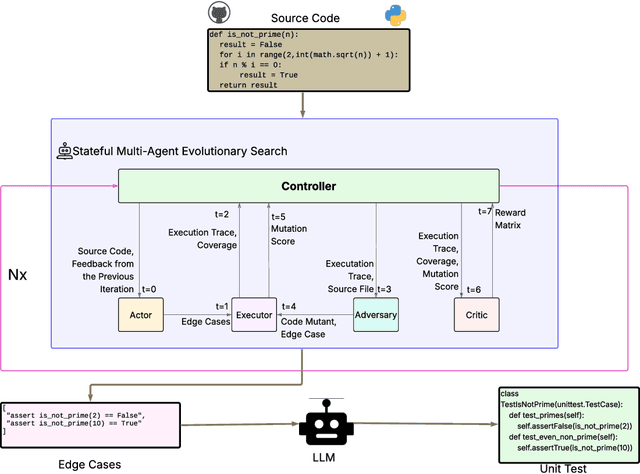

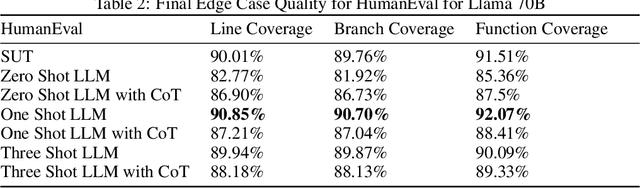
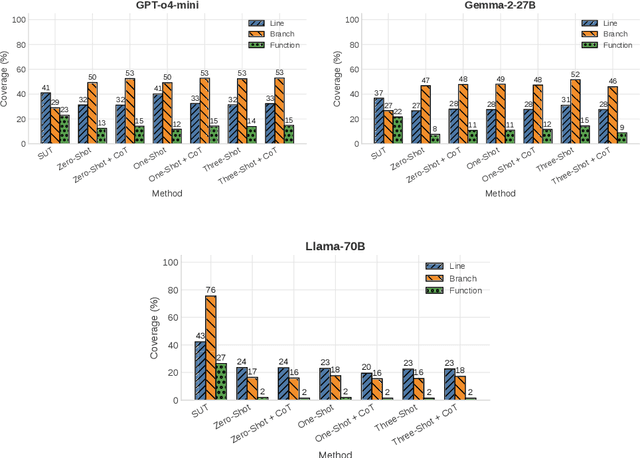
Recent work explores agentic inference-time techniques to perform structured, multi-step reasoning. However, stateless inference often struggles on multi-step tasks due to the absence of persistent state. Moreover, task-specific fine-tuning or instruction-tuning often achieve surface-level code generation but remain brittle on tasks requiring deeper reasoning and long-horizon dependencies. To address these limitations, we propose stateful multi-agent evolutionary search, a training-free framework that departs from prior stateless approaches by combining (i) persistent inference-time state, (ii) adversarial mutation, and (iii) evolutionary preservation. We demonstrate its effectiveness in automated unit test generation through the generation of edge cases. We generate robust edge cases using an evolutionary search process, where specialized agents sequentially propose, mutate, and score candidates. A controller maintains persistent state across generations, while evolutionary preservation ensures diversity and exploration across all possible cases. This yields a generalist agent capable of discovering robust, high-coverage edge cases across unseen codebases. Experiments show our stateful multi-agent inference framework achieves substantial gains in coverage over stateless single-step baselines, evaluated on prevalent unit-testing benchmarks such as HumanEval and TestGenEvalMini and using three diverse LLM families - Llama, Gemma, and GPT. These results indicate that combining persistent inference-time state with evolutionary search materially improves unit-test generation.