 Add to Chrome
 Add to Firefox
 Add to Edge
M$^3$R-Bench: A Unified Benchmark for Evidence-Grounded Multimodal Metaphor Understanding
Aug 06, 2026
Metaphor enables the understanding of abstract concepts through cross-domain mappings while conveying affective attitudes. In multimodal scenarios, visual and textual information jointly construct Target--Source mappings, requiring both conceptual understanding and cross-modal reasoning. However, existing benchmarks mainly evaluate metaphor understanding through isolated subtasks and lack evidence-grounded explanations, making it difficult to assess whether models establish mappings grounded in visual and textual cues.To address these limitations, we introduce M$^3$R-Bench, a unified and evidence-grounded benchmark containing 1,000 image--text instances with human-verified annotations. Guided by Conceptual Metaphor Theory and theories of nonliteral language understanding, M$^3$R-Bench provides joint annotations for metaphor occurrence, Target--Source mapping, sentiment, and stage-wise explanations following ``evidence identification--mapping establishment--sentiment inference.''Evaluations on M$^3$R-Bench reveal that existing models often overlook visual evidence, rely on superficial textual cues, and produce inaccurate Target--Source mappings, exposing a cross-modal evidence--mapping mismatch. To address this mismatch, we propose M$^3$R-Reasoner, which combines curriculum-based reasoning supervision with task-aware reinforcement learning to align model reasoning with metaphor interpretation. Experiments show that, with only an 8B-parameter backbone, M$^3$R-Reasoner outperforms larger proprietary MLLMs across four unified-task metrics and improves Visual Evidence and Sentiment Justification scores over GPT-5.5 by 28.45 and 30.11 points, respectively, while surpassing Claude-Sonnet-4.6 by 8.00 points in mean rubric score. The dataset and code are available at https://github.com/hongshi4/M3R-Bench.

MentalHospital: A Virtual Environment for Evaluating Psychiatric Clinical Encounters
Jul 09, 2026Large language models (LLMs) have shown strong performance on isolated psychiatric tasks, including dialogue, diagnosis, and treatment planning, yet existing benchmarks rarely simulate complete psychiatric clinical encounters. We introduce $\textbf{MentalHospital}$, a virtual evaluation environment for LLM-based psychiatric clinical encounters. MentalHospital instantiates the Subjective Interviewing, Objective Examination, Diagnostic Assessment, and Treatment Planning (S.O.A.P.) workflow, using skill-augmented standardized patients constructed from 1,193 de-identified psychiatric electronic health record (EHR) cases spanning all major ICD-11 categories and 76 disorders. Each encounter is assessed through a dual-track protocol that combines objective comparison against EHR-derived references with subjective assessment of clinical process quality. To scale specialist judgment, we develop $\textbf{MentalEval}$, five domain-specific evaluators covering communication empathy, interviewing professionalism, clinical-note quality, diagnostic rigor, and treatment appropriateness, trained with rubric-grounded SFT and expert-guided DPO. Survey responses from 22 clinicians support MentalHospital's clinical fidelity (3.88/5), while MentalEval achieves strong expert alignment with an average QWK of 0.944. Benchmarking shows that even the strongest LLM trails clinicians by 37.28 percentage points in objective psychiatric competence, with mental status assessment as a key bottleneck.
Lung-R1: A Knowledge Graph-Guided LLM for Pulmonary Diagnostic Reasoning
Jun 10, 2026Diagnosing pulmonary diseases requires integrating heterogeneous evidence amid phenotypic variability and cross-disease overlap. Although large language models (LLMs) have shown progress on pulmonary knowledge question answering (QA) and information-processing tasks, reliable pulmonary diagnosis requires patient-specific, relation-aware reasoning over electronic medical record (EMR) evidence rather than isolated knowledge recall. We define this gap between pulmonary knowledge and case-level diagnostic reasoning as the Pulmonary Knowledge-to-Diagnosis Gap. To address it, we introduce LungKG, the first structured pulmonary knowledge graph for diagnostic knowledge organization and record-grounded reasoning. LungKG contains 59,038 nodes and 164,308 edges across 15 entity types and 112 relation types, serving as both a reusable pulmonary knowledge resource and the foundation for LungKG-guided model adaptation. Built on LungKG, we propose Lung-R1, a LungKG-guided pulmonary LLM trained through KG-constrained reasoning-chain construction and KG-guided reinforcement learning. In a 20-system evaluation, Lung-R1-14B achieves state-of-the-art performance across Choice, Pulmonary-QA, and EMR Diagnosis, reaching an EMR Diagnosis score of 4.3583 and surpassing the strongest non-Lung-R1 baseline by 0.1476 points. These results demonstrate the value of LungKG-guided training for EMR-based pulmonary diagnosis.
ReasonTabQA: A Comprehensive Benchmark for Table Question Answering from Real World Industrial Scenarios
Jan 12, 2026Recent advancements in Large Language Models (LLMs) have significantly catalyzed table-based question answering (TableQA). However, existing TableQA benchmarks often overlook the intricacies of industrial scenarios, which are characterized by multi-table structures, nested headers, and massive scales. These environments demand robust table reasoning through deep structured inference, presenting a significant challenge that remains inadequately addressed by current methodologies. To bridge this gap, we present ReasonTabQA, a large-scale bilingual benchmark encompassing 1,932 tables across 30 industry domains such as energy and automotive. ReasonTabQA provides high-quality annotations for both final answers and explicit reasoning chains, supporting both thinking and no-thinking paradigms. Furthermore, we introduce TabCodeRL, a reinforcement learning method that leverages table-aware verifiable rewards to guide the generation of logical reasoning paths. Extensive experiments on ReasonTabQA and 4 TableQA datasets demonstrate that while TabCodeRL yields substantial performance gains on open-source LLMs, the persistent performance gap on ReasonTabQA underscores the inherent complexity of real-world industrial TableQA.
Benchmarking Multimodal RAG through a Chart-based Document Question-Answering Generation Framework
Feb 20, 2025Multimodal Retrieval-Augmented Generation (MRAG) enhances reasoning capabilities by integrating external knowledge. However, existing benchmarks primarily focus on simple image-text interactions, overlooking complex visual formats like charts that are prevalent in real-world applications. In this work, we introduce a novel task, Chart-based MRAG, to address this limitation. To semi-automatically generate high-quality evaluation samples, we propose CHARt-based document question-answering GEneration (CHARGE), a framework that produces evaluation data through structured keypoint extraction, crossmodal verification, and keypoint-based generation. By combining CHARGE with expert validation, we construct Chart-MRAG Bench, a comprehensive benchmark for chart-based MRAG evaluation, featuring 4,738 question-answering pairs across 8 domains from real-world documents. Our evaluation reveals three critical limitations in current approaches: (1) unified multimodal embedding retrieval methods struggles in chart-based scenarios, (2) even with ground-truth retrieval, state-of-the-art MLLMs achieve only 58.19% Correctness and 73.87% Coverage scores, and (3) MLLMs demonstrate consistent text-over-visual modality bias during Chart-based MRAG reasoning. The CHARGE and Chart-MRAG Bench are released at https://github.com/Nomothings/CHARGE.git.
Latent Distribution Decoupling: A Probabilistic Framework for Uncertainty-Aware Multimodal Emotion Recognition
Feb 19, 2025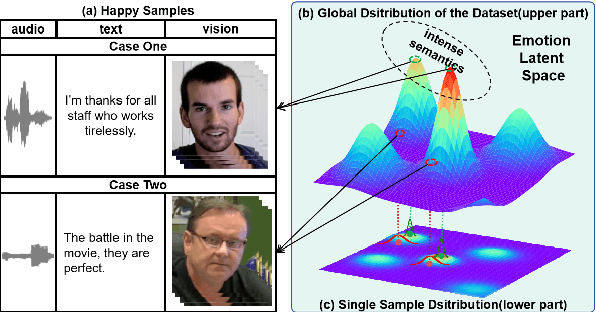
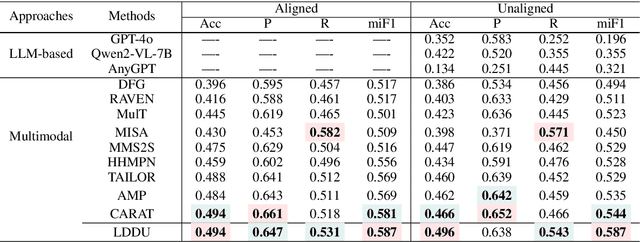
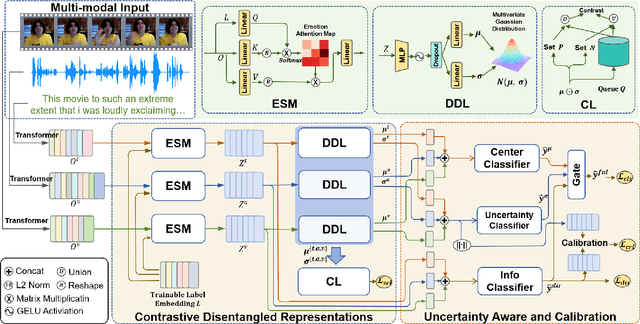
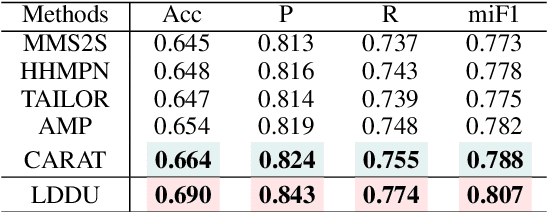
Multimodal multi-label emotion recognition (MMER) aims to identify the concurrent presence of multiple emotions in multimodal data. Existing studies primarily focus on improving fusion strategies and modeling modality-to-label dependencies. However, they often overlook the impact of \textbf{aleatoric uncertainty}, which is the inherent noise in the multimodal data and hinders the effectiveness of modality fusion by introducing ambiguity into feature representations. To address this issue and effectively model aleatoric uncertainty, this paper proposes Latent emotional Distribution Decomposition with Uncertainty perception (LDDU) framework from a novel perspective of latent emotional space probabilistic modeling. Specifically, we introduce a contrastive disentangled distribution mechanism within the emotion space to model the multimodal data, allowing for the extraction of semantic features and uncertainty. Furthermore, we design an uncertainty-aware fusion multimodal method that accounts for the dispersed distribution of uncertainty and integrates distribution information. Experimental results show that LDDU achieves state-of-the-art performance on the CMU-MOSEI and M$^3$ED datasets, highlighting the importance of uncertainty modeling in MMER. Code is available at https://github.com/201983290498/lddu\_mmer.git.