 Add to Chrome
 Add to Firefox
 Add to Edge
From Reconstruction to Decision: A Post-Encoder Plug-in Adapter for Curvilinear Segmentation
Jun 22, 2026
Curvilinear object segmentation, including vessels and cracks, is challenging due to extreme spatial sparsity and topological fragility, where small local errors can cause severe structural disconnections. Meanwhile, modern segmentation pipelines increasingly rely on strong but hard-to-modify foundation encoders whose heavy downsampling limits fine structural recovery. Motivated by this, we focus on the post-encoder stage and study two recurring and actionable failure modes: a reconstruction bottleneck in high-resolution feature restoration and a decision bottleneck in binarization. We present PEPA, a lightweight Post-Encoder Plug-in Adapter for 2D curvilinear segmentation pipelines with accessible decoder/head features and target, query, or class descriptors. PEPA couples (i) Target-Conditioned Snake Upsampling (TCSU), which uses target-conditioned continuous snake-like sampling to better recover thin and tortuous structures during upsampling, and (ii) Target-Adaptive Differentiable Thresholding (TADT), which predicts target-specific thresholds and optimizes a soft-threshold surrogate with explicit safeguards against trivial bias shifting. Under this post-encoder interface, PEPA can be attached to both prompt-based decoders and conventional dense predictors. Experiments on five medical and industrial benchmarks show that adding PEPA to frozen-encoder baselines yields consistent improvements, with gains in topological connectivity (clDice) typically exceeding those in region overlap (IoU), indicating improved structural continuity. With only $\sim$0.26M additional parameters, PEPA offers a practical post-encoder enhancement for structure-centric segmentation.

Latent Distribution Decoupling: A Probabilistic Framework for Uncertainty-Aware Multimodal Emotion Recognition
Feb 19, 2025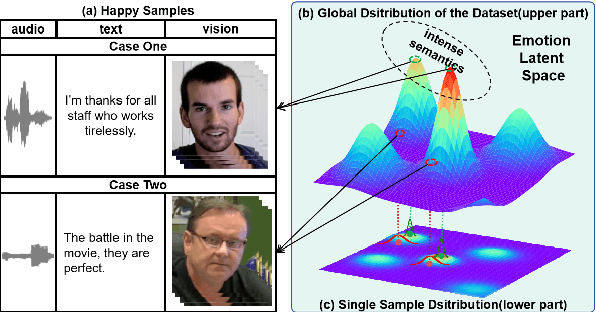
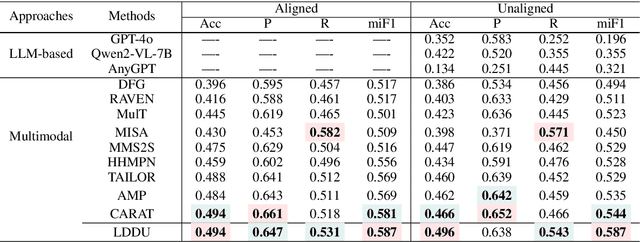
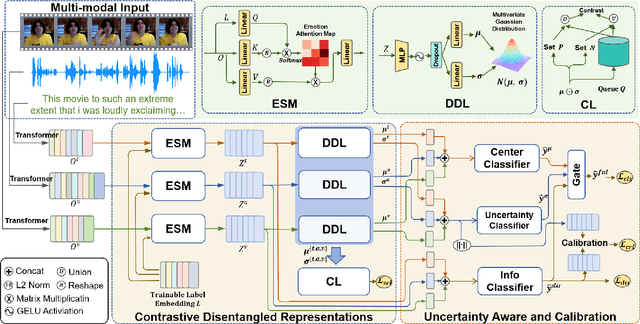
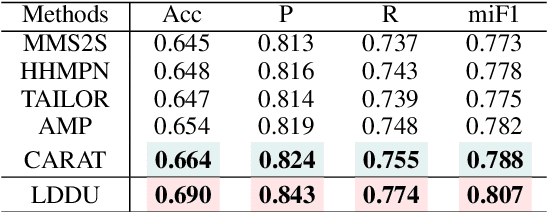
Multimodal multi-label emotion recognition (MMER) aims to identify the concurrent presence of multiple emotions in multimodal data. Existing studies primarily focus on improving fusion strategies and modeling modality-to-label dependencies. However, they often overlook the impact of \textbf{aleatoric uncertainty}, which is the inherent noise in the multimodal data and hinders the effectiveness of modality fusion by introducing ambiguity into feature representations. To address this issue and effectively model aleatoric uncertainty, this paper proposes Latent emotional Distribution Decomposition with Uncertainty perception (LDDU) framework from a novel perspective of latent emotional space probabilistic modeling. Specifically, we introduce a contrastive disentangled distribution mechanism within the emotion space to model the multimodal data, allowing for the extraction of semantic features and uncertainty. Furthermore, we design an uncertainty-aware fusion multimodal method that accounts for the dispersed distribution of uncertainty and integrates distribution information. Experimental results show that LDDU achieves state-of-the-art performance on the CMU-MOSEI and M$^3$ED datasets, highlighting the importance of uncertainty modeling in MMER. Code is available at https://github.com/201983290498/lddu\_mmer.git.
Enriching Information and Preserving Semantic Consistency in Expanding Curvilinear Object Segmentation Datasets
Jul 11, 2024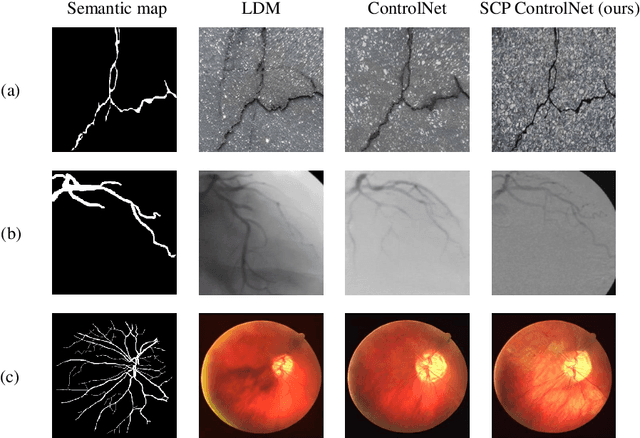
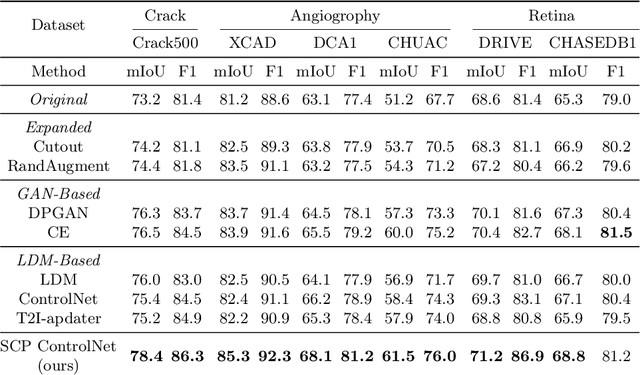
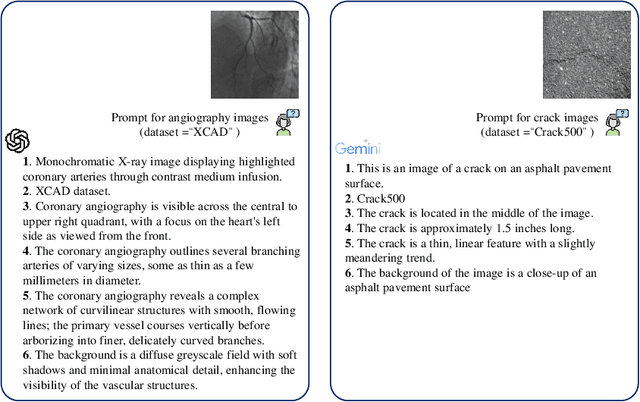
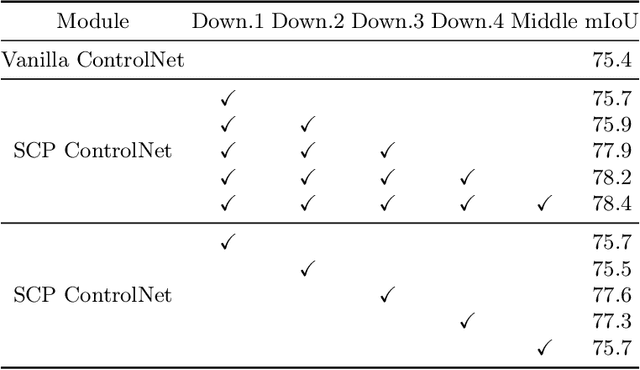
Curvilinear object segmentation plays a crucial role across various applications, yet datasets in this domain often suffer from small scale due to the high costs associated with data acquisition and annotation. To address these challenges, this paper introduces a novel approach for expanding curvilinear object segmentation datasets, focusing on enhancing the informativeness of generated data and the consistency between semantic maps and generated images. Our method enriches synthetic data informativeness by generating curvilinear objects through their multiple textual features. By combining textual features from each sample in original dataset, we obtain synthetic images that beyond the original dataset's distribution. This initiative necessitated the creation of the Curvilinear Object Segmentation based on Text Generation (COSTG) dataset. Designed to surpass the limitations of conventional datasets, COSTG incorporates not only standard semantic maps but also some textual descriptions of curvilinear object features. To ensure consistency between synthetic semantic maps and images, we introduce the Semantic Consistency Preserving ControlNet (SCP ControlNet). This involves an adaptation of ControlNet with Spatially-Adaptive Normalization (SPADE), allowing it to preserve semantic information that would typically be washed away in normalization layers. This modification facilitates more accurate semantic image synthesis. Experimental results demonstrate the efficacy of our approach across three types of curvilinear objects (angiography, crack and retina) and six public datasets (CHUAC, XCAD, DCA1, DRIVE, CHASEDB1 and Crack500). The synthetic data generated by our method not only expand the dataset, but also effectively improves the performance of other curvilinear object segmentation models. Source code and dataset are available at \url{https://github.com/tanlei0/COSTG}.