 Add to Chrome
 Add to Firefox
 Add to Edge
Who Should Lead Decoding Now? Tracking Reliable Trajectories for Ensembling Masked Diffusion Language Models
Jun 15, 2026
Masked Diffusion Language Models (MDLMs) have emerged as a distinct paradigm for sequence generation. As MDLMs become diverse in capabilities and knowledge coverage, an important question is how to combine their knowledge. Toward this, we first investigate the unique decoding dynamics of MDLMs. We find that successful generations exhibit stable confidence dynamics over answer-relevant positions, while unreliable trajectories can often be corrected by injecting promising intermediate states from other models. Guided by this observation, we propose $\textbf{TIE}$ ($\textbf{T}$rajectory-based $\textbf{I}$terative $\textbf{E}$nsembling), a knowledge fusion framework in which MDLMs iteratively identify reliable decoding trajectories and relay them across models. TIE tracks confidence dynamics over answer-relevant positions to determine which model currently follows a more reliable trajectory and selectively transfers partially denoised sequences across models. As the model on the more promising trajectory often changes across denoising steps, TIE allows different models to contribute complementary strengths at different stages of generation. Strong performance across diverse reasoning tasks, along with our analyses, suggests that TIE offers a practical approach to the underexplored problem of MDLM ensembling.

Integrating Multimodal Large Language Model Knowledge into Amodal Completion
Mar 30, 2026With the widespread adoption of autonomous vehicles and robotics, amodal completion, which reconstructs the occluded parts of people and objects in an image, has become increasingly crucial. Just as humans infer hidden regions based on prior experience and common sense, this task inherently requires physical knowledge about real-world entities. However, existing approaches either depend solely on the image generation ability of visual generative models, which lack such knowledge, or leverage it only during the segmentation stage, preventing it from explicitly guiding the completion process. To address this, we propose AmodalCG, a novel framework that harnesses the real-world knowledge of Multimodal Large Language Models (MLLMs) to guide amodal completion. Our framework first assesses the extent of occlusion to selectively invoke MLLM guidance only when the target object is heavily occluded. If guidance is required, the framework further incorporates MLLMs to reason about both the (1) extent and (2) content of the missing regions. Finally, a visual generative model integrates these guidance and iteratively refines imperfect completions that may arise from inaccurate MLLM guidance. Experimental results on various real-world images show impressive improvements compared to all existing works, suggesting MLLMs as a promising direction for addressing challenging amodal completion.
PruNeRF: Segment-Centric Dataset Pruning via 3D Spatial Consistency
Jun 02, 2024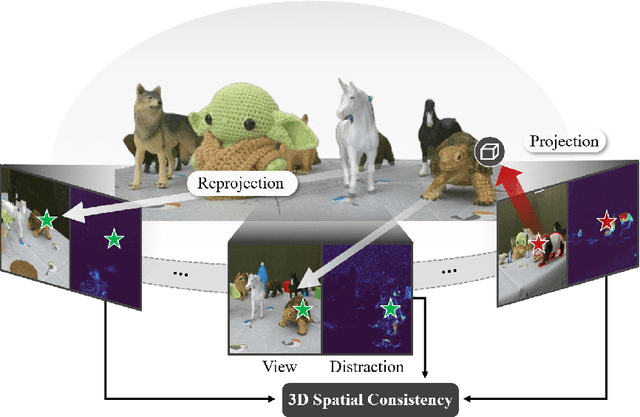
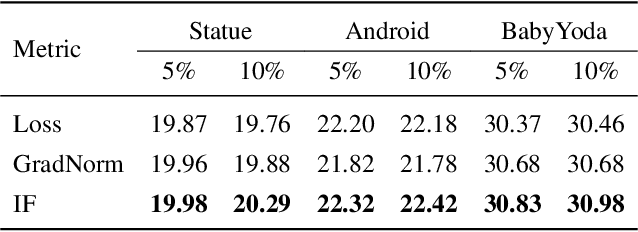
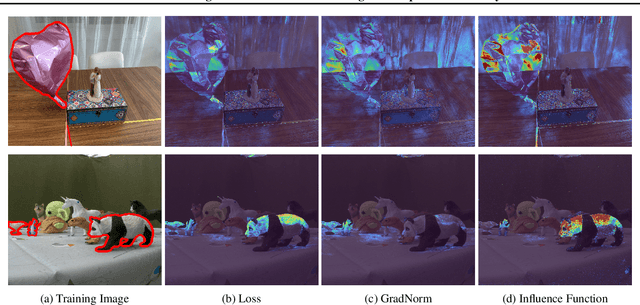
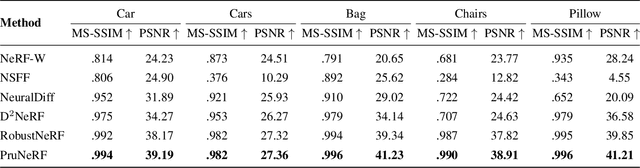
Neural Radiance Fields (NeRF) have shown remarkable performance in learning 3D scenes. However, NeRF exhibits vulnerability when confronted with distractors in the training images -- unexpected objects are present only within specific views, such as moving entities like pedestrians or birds. Excluding distractors during dataset construction is a straightforward solution, but without prior knowledge of their types and quantities, it becomes prohibitively expensive. In this paper, we propose PruNeRF, a segment-centric dataset pruning framework via 3D spatial consistency, that effectively identifies and prunes the distractors. We first examine existing metrics for measuring pixel-wise distraction and introduce Influence Functions for more accurate measurements. Then, we assess 3D spatial consistency using a depth-based reprojection technique to obtain 3D-aware distraction. Furthermore, we incorporate segmentation for pixel-to-segment refinement, enabling more precise identification. Our experiments on benchmark datasets demonstrate that PruNeRF consistently outperforms state-of-the-art methods in robustness against distractors.