 Add to Chrome
 Add to Firefox
 Add to Edge
WorldCam: Interactive Autoregressive 3D Gaming Worlds with Camera Pose as a Unifying Geometric Representation
Mar 17, 2026
Recent advances in video diffusion transformers have enabled interactive gaming world models that allow users to explore generated environments over extended horizons. However, existing approaches struggle with precise action control and long-horizon 3D consistency. Most prior works treat user actions as abstract conditioning signals, overlooking the fundamental geometric coupling between actions and the 3D world, whereby actions induce relative camera motions that accumulate into a global camera pose within a 3D world. In this paper, we establish camera pose as a unifying geometric representation to jointly ground immediate action control and long-term 3D consistency. First, we define a physics-based continuous action space and represent user inputs in the Lie algebra to derive precise 6-DoF camera poses, which are injected into the generative model via a camera embedder to ensure accurate action alignment. Second, we use global camera poses as spatial indices to retrieve relevant past observations, enabling geometrically consistent revisiting of locations during long-horizon navigation. To support this research, we introduce a large-scale dataset comprising 3,000 minutes of authentic human gameplay annotated with camera trajectories and textual descriptions. Extensive experiments show that our approach substantially outperforms state-of-the-art interactive gaming world models in action controllability, long-horizon visual quality, and 3D spatial consistency.

Grounding World Simulation Models in a Real-World Metropolis
Mar 16, 2026What if a world simulation model could render not an imagined environment but a city that actually exists? Prior generative world models synthesize visually plausible yet artificial environments by imagining all content. We present Seoul World Model (SWM), a city-scale world model grounded in the real city of Seoul. SWM anchors autoregressive video generation through retrieval-augmented conditioning on nearby street-view images. However, this design introduces several challenges, including temporal misalignment between retrieved references and the dynamic target scene, limited trajectory diversity and data sparsity from vehicle-mounted captures at sparse intervals. We address these challenges through cross-temporal pairing, a large-scale synthetic dataset enabling diverse camera trajectories, and a view interpolation pipeline that synthesizes coherent training videos from sparse street-view images. We further introduce a Virtual Lookahead Sink to stabilize long-horizon generation by continuously re-grounding each chunk to a retrieved image at a future location. We evaluate SWM against recent video world models across three cities: Seoul, Busan, and Ann Arbor. SWM outperforms existing methods in generating spatially faithful, temporally consistent, long-horizon videos grounded in actual urban environments over trajectories reaching hundreds of meters, while supporting diverse camera movements and text-prompted scenario variations.
APPLE: Attribute-Preserving Pseudo-Labeling for Diffusion-Based Face Swapping
Jan 21, 2026Face swapping aims to transfer the identity of a source face onto a target face while preserving target-specific attributes such as pose, expression, lighting, skin tone, and makeup. However, since real ground truth for face swapping is unavailable, achieving both accurate identity transfer and high-quality attribute preservation remains challenging. In addition, recent diffusion-based approaches attempt to improve visual fidelity through conditional inpainting on masked target images, but the masked condition removes crucial appearance cues of target, resulting in plausible yet misaligned attributes. To address these limitations, we propose APPLE (Attribute-Preserving Pseudo-Labeling), a diffusion-based teacher-student framework that enhances attribute fidelity through attribute-aware pseudo-label supervision. We reformulate face swapping as a conditional deblurring task to more faithfully preserve target-specific attributes such as lighting, skin tone, and makeup. In addition, we introduce an attribute-aware inversion scheme to further improve detailed attribute preservation. Through an elaborate attribute-preserving design for teacher learning, APPLE produces high-quality pseudo triplets that explicitly provide the student with direct face-swapping supervision. Overall, APPLE achieves state-of-the-art performance in terms of attribute preservation and identity transfer, producing more photorealistic and target-faithful results.
Pose-Diversified Augmentation with Diffusion Model for Person Re-Identification
Jun 23, 2024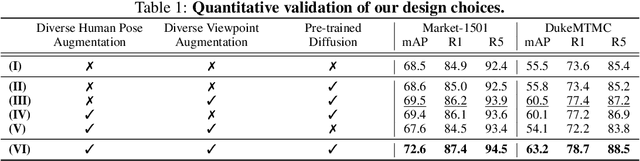
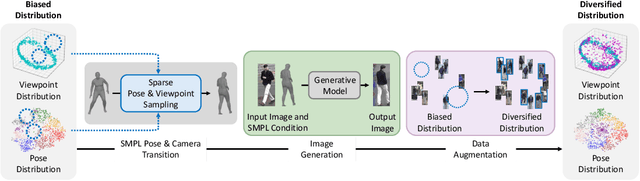
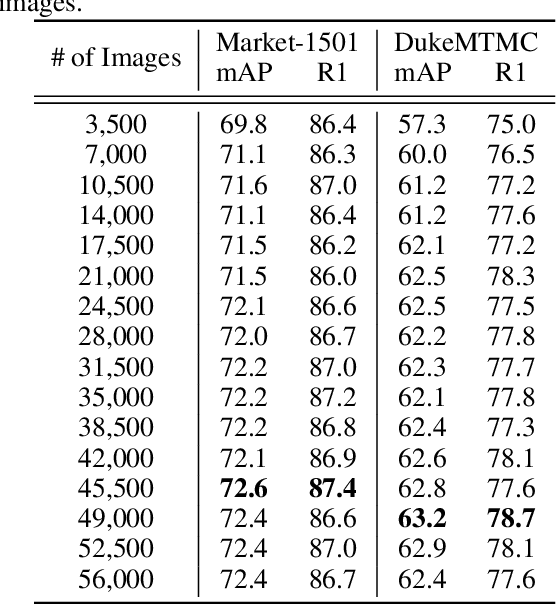
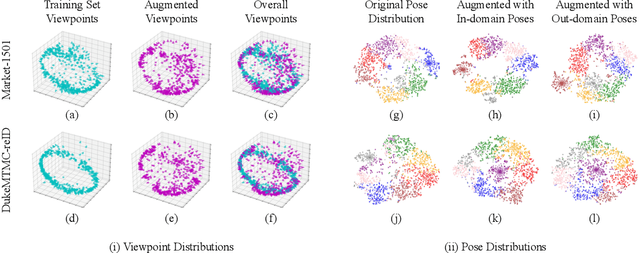
Person re-identification (Re-ID) often faces challenges due to variations in human poses and camera viewpoints, which significantly affect the appearance of individuals across images. Existing datasets frequently lack diversity and scalability in these aspects, hindering the generalization of Re-ID models to new camera systems. Previous methods have attempted to address these issues through data augmentation; however, they rely on human poses already present in the training dataset, failing to effectively reduce the human pose bias in the dataset. We propose Diff-ID, a novel data augmentation approach that incorporates sparse and underrepresented human pose and camera viewpoint examples into the training data, addressing the limited diversity in the original training data distribution. Our objective is to augment a training dataset that enables existing Re-ID models to learn features unbiased by human pose and camera viewpoint variations. To achieve this, we leverage the knowledge of pre-trained large-scale diffusion models. Using the SMPL model, we simultaneously capture both the desired human poses and camera viewpoints, enabling realistic human rendering. The depth information provided by the SMPL model indirectly conveys the camera viewpoints. By conditioning the diffusion model on both the human pose and camera viewpoint concurrently through the SMPL model, we generate realistic images with diverse human poses and camera viewpoints. Qualitative results demonstrate the effectiveness of our method in addressing human pose bias and enhancing the generalizability of Re-ID models compared to other data augmentation-based Re-ID approaches. The performance gains achieved by training Re-ID models on our offline augmented dataset highlight the potential of our proposed framework in improving the scalability and generalizability of person Re-ID models.