 Add to Chrome
 Add to Firefox
 Add to Edge
Lip Forcing: Few-Step Autoregressive Diffusion for Real-time Lip Synchronization
Jun 09, 2026
Diffusion-based lip synchronization models achieve strong visual quality and audio-visual alignment, but full-sequence bidirectional attention and many denoising steps make them impractical for real-time inference. We present Lip Forcing, to our knowledge the first autoregressive diffusion method for video-to-video (V2V) lip synchronization, which distills a 14B audio-conditioned bidirectional video diffusion teacher into causal students. At inference, the students generate each chunk in only two denoising steps without inference-time CFG, enabling real-time lip synchronization. A lip-sync-specific teacher-trajectory analysis reveals a CFG fidelity-sync tradeoff: no-CFG predictions favor reference fidelity, whereas CFG-guided predictions favor synchronization within a mid-trajectory band. Lip Forcing translates this finding into three analysis-derived components: Sync-Window DMD, a two-step inference schedule, and a SyncNet-based reward. We validate Lip Forcing at two student scales, both distilled from the 14B teacher. The 1.3B student crosses into real-time streaming at 31 FPS, $17.6\times$ faster than its same-scale bidirectional model. The 14B student, the largest diffusion model reported for V2V lip synchronization, runs $39.8\times$ faster than its teacher at comparable reference fidelity. Time-to-first-frame is sub-millisecond at both scales, far below every diffusion baseline.

WorldCam: Interactive Autoregressive 3D Gaming Worlds with Camera Pose as a Unifying Geometric Representation
Mar 17, 2026Recent advances in video diffusion transformers have enabled interactive gaming world models that allow users to explore generated environments over extended horizons. However, existing approaches struggle with precise action control and long-horizon 3D consistency. Most prior works treat user actions as abstract conditioning signals, overlooking the fundamental geometric coupling between actions and the 3D world, whereby actions induce relative camera motions that accumulate into a global camera pose within a 3D world. In this paper, we establish camera pose as a unifying geometric representation to jointly ground immediate action control and long-term 3D consistency. First, we define a physics-based continuous action space and represent user inputs in the Lie algebra to derive precise 6-DoF camera poses, which are injected into the generative model via a camera embedder to ensure accurate action alignment. Second, we use global camera poses as spatial indices to retrieve relevant past observations, enabling geometrically consistent revisiting of locations during long-horizon navigation. To support this research, we introduce a large-scale dataset comprising 3,000 minutes of authentic human gameplay annotated with camera trajectories and textual descriptions. Extensive experiments show that our approach substantially outperforms state-of-the-art interactive gaming world models in action controllability, long-horizon visual quality, and 3D spatial consistency.
Grounding World Simulation Models in a Real-World Metropolis
Mar 16, 2026What if a world simulation model could render not an imagined environment but a city that actually exists? Prior generative world models synthesize visually plausible yet artificial environments by imagining all content. We present Seoul World Model (SWM), a city-scale world model grounded in the real city of Seoul. SWM anchors autoregressive video generation through retrieval-augmented conditioning on nearby street-view images. However, this design introduces several challenges, including temporal misalignment between retrieved references and the dynamic target scene, limited trajectory diversity and data sparsity from vehicle-mounted captures at sparse intervals. We address these challenges through cross-temporal pairing, a large-scale synthetic dataset enabling diverse camera trajectories, and a view interpolation pipeline that synthesizes coherent training videos from sparse street-view images. We further introduce a Virtual Lookahead Sink to stabilize long-horizon generation by continuously re-grounding each chunk to a retrieved image at a future location. We evaluate SWM against recent video world models across three cities: Seoul, Busan, and Ann Arbor. SWM outperforms existing methods in generating spatially faithful, temporally consistent, long-horizon videos grounded in actual urban environments over trajectories reaching hundreds of meters, while supporting diverse camera movements and text-prompted scenario variations.
CORAL: Correspondence Alignment for Improved Virtual Try-On
Feb 19, 2026Existing methods for Virtual Try-On (VTON) often struggle to preserve fine garment details, especially in unpaired settings where accurate person-garment correspondence is required. These methods do not explicitly enforce person-garment alignment and fail to explain how correspondence emerges within Diffusion Transformers (DiTs). In this paper, we first analyze full 3D attention in DiT-based architecture and reveal that the person-garment correspondence critically depends on precise person-garment query-key matching within the full 3D attention. Building on this insight, we then introduce CORrespondence ALignment (CORAL), a DiT-based framework that explicitly aligns query-key matching with robust external correspondences. CORAL integrates two complementary components: a correspondence distillation loss that aligns reliable matches with person-garment attention, and an entropy minimization loss that sharpens the attention distribution. We further propose a VLM-based evaluation protocol to better reflect human preference. CORAL consistently improves over the baseline, enhancing both global shape transfer and local detail preservation. Extensive ablations validate our design choices.
Repurposing Video Diffusion Transformers for Robust Point Tracking
Dec 23, 2025Point tracking aims to localize corresponding points across video frames, serving as a fundamental task for 4D reconstruction, robotics, and video editing. Existing methods commonly rely on shallow convolutional backbones such as ResNet that process frames independently, lacking temporal coherence and producing unreliable matching costs under challenging conditions. Through systematic analysis, we find that video Diffusion Transformers (DiTs), pre-trained on large-scale real-world videos with spatio-temporal attention, inherently exhibit strong point tracking capability and robustly handle dynamic motions and frequent occlusions. We propose DiTracker, which adapts video DiTs through: (1) query-key attention matching, (2) lightweight LoRA tuning, and (3) cost fusion with a ResNet backbone. Despite training with 8 times smaller batch size, DiTracker achieves state-of-the-art performance on challenging ITTO benchmark and matches or outperforms state-of-the-art models on TAP-Vid benchmarks. Our work validates video DiT features as an effective and efficient foundation for point tracking.
MATRIX: Mask Track Alignment for Interaction-aware Video Generation
Oct 08, 2025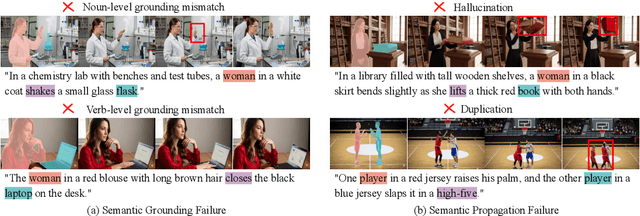
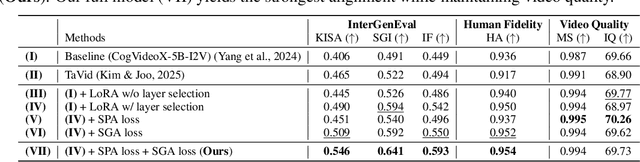
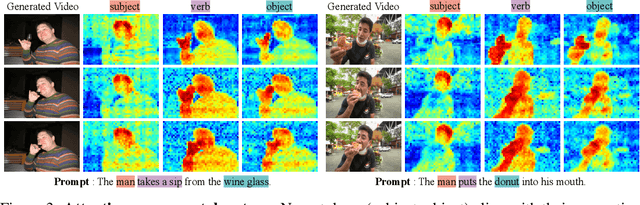
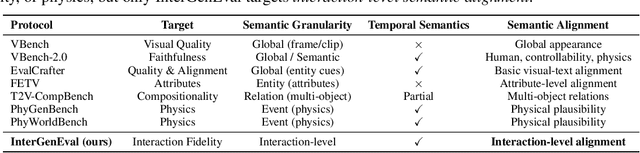
Video DiTs have advanced video generation, yet they still struggle to model multi-instance or subject-object interactions. This raises a key question: How do these models internally represent interactions? To answer this, we curate MATRIX-11K, a video dataset with interaction-aware captions and multi-instance mask tracks. Using this dataset, we conduct a systematic analysis that formalizes two perspectives of video DiTs: semantic grounding, via video-to-text attention, which evaluates whether noun and verb tokens capture instances and their relations; and semantic propagation, via video-to-video attention, which assesses whether instance bindings persist across frames. We find both effects concentrate in a small subset of interaction-dominant layers. Motivated by this, we introduce MATRIX, a simple and effective regularization that aligns attention in specific layers of video DiTs with multi-instance mask tracks from the MATRIX-11K dataset, enhancing both grounding and propagation. We further propose InterGenEval, an evaluation protocol for interaction-aware video generation. In experiments, MATRIX improves both interaction fidelity and semantic alignment while reducing drift and hallucination. Extensive ablations validate our design choices. Codes and weights will be released.
Vid-CamEdit: Video Camera Trajectory Editing with Generative Rendering from Estimated Geometry
Jun 16, 2025We introduce Vid-CamEdit, a novel framework for video camera trajectory editing, enabling the re-synthesis of monocular videos along user-defined camera paths. This task is challenging due to its ill-posed nature and the limited multi-view video data for training. Traditional reconstruction methods struggle with extreme trajectory changes, and existing generative models for dynamic novel view synthesis cannot handle in-the-wild videos. Our approach consists of two steps: estimating temporally consistent geometry, and generative rendering guided by this geometry. By integrating geometric priors, the generative model focuses on synthesizing realistic details where the estimated geometry is uncertain. We eliminate the need for extensive 4D training data through a factorized fine-tuning framework that separately trains spatial and temporal components using multi-view image and video data. Our method outperforms baselines in producing plausible videos from novel camera trajectories, especially in extreme extrapolation scenarios on real-world footage.
Appearance Matching Adapter for Exemplar-based Semantic Image Synthesis
Dec 04, 2024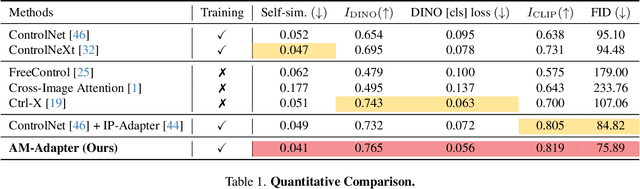
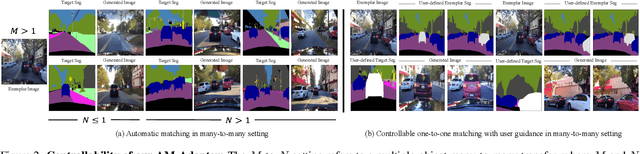
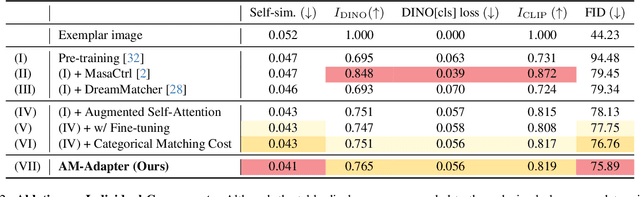

Exemplar-based semantic image synthesis aims to generate images aligned with given semantic content while preserving the appearance of an exemplar image. Conventional structure-guidance models, such as ControlNet, are limited in that they cannot directly utilize exemplar images as input, relying instead solely on text prompts to control appearance. Recent tuning-free approaches address this limitation by transferring local appearance from the exemplar image to the synthesized image through implicit cross-image matching in the augmented self-attention mechanism of pre-trained diffusion models. However, these methods face challenges when applied to content-rich scenes with significant geometric deformations, such as driving scenes. In this paper, we propose the Appearance Matching Adapter (AM-Adapter), a learnable framework that enhances cross-image matching within augmented self-attention by incorporating semantic information from segmentation maps. To effectively disentangle generation and matching processes, we adopt a stage-wise training approach. Initially, we train the structure-guidance and generation networks, followed by training the AM-Adapter while keeping the other networks frozen. During inference, we introduce an automated exemplar retrieval method to efficiently select exemplar image-segmentation pairs. Despite utilizing a limited number of learnable parameters, our method achieves state-of-the-art performance, excelling in both semantic alignment preservation and local appearance fidelity. Extensive ablation studies further validate our design choices. Code and pre-trained weights will be publicly available.: https://cvlab-kaist.github.io/AM-Adapter/
MoDiTalker: Motion-Disentangled Diffusion Model for High-Fidelity Talking Head Generation
Mar 28, 2024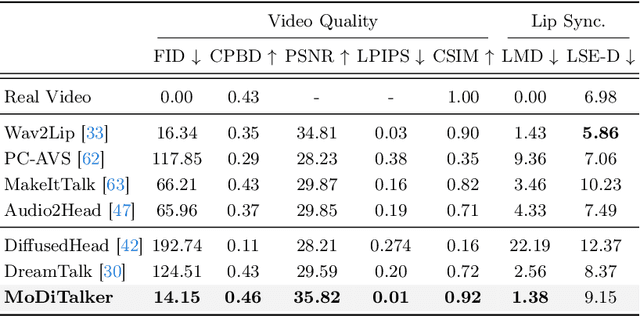
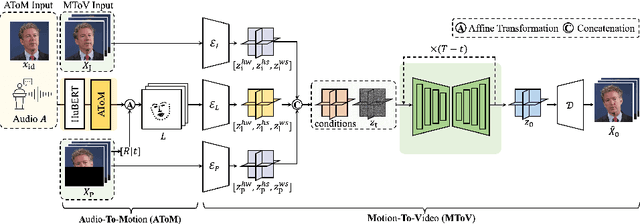
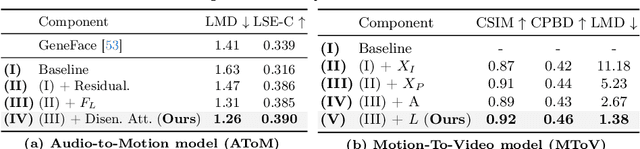
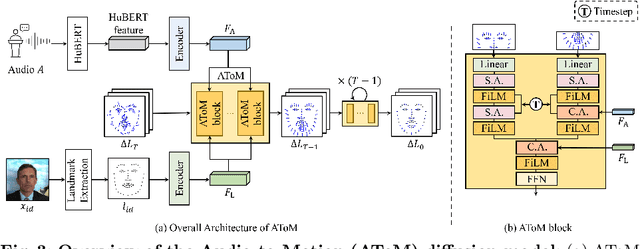
Conventional GAN-based models for talking head generation often suffer from limited quality and unstable training. Recent approaches based on diffusion models aimed to address these limitations and improve fidelity. However, they still face challenges, including extensive sampling times and difficulties in maintaining temporal consistency due to the high stochasticity of diffusion models. To overcome these challenges, we propose a novel motion-disentangled diffusion model for high-quality talking head generation, dubbed MoDiTalker. We introduce the two modules: audio-to-motion (AToM), designed to generate a synchronized lip motion from audio, and motion-to-video (MToV), designed to produce high-quality head video following the generated motion. AToM excels in capturing subtle lip movements by leveraging an audio attention mechanism. In addition, MToV enhances temporal consistency by leveraging an efficient tri-plane representation. Our experiments conducted on standard benchmarks demonstrate that our model achieves superior performance compared to existing models. We also provide comprehensive ablation studies and user study results.
DreamMatcher: Appearance Matching Self-Attention for Semantically-Consistent Text-to-Image Personalization
Feb 15, 2024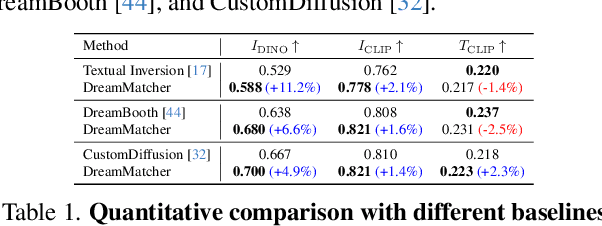
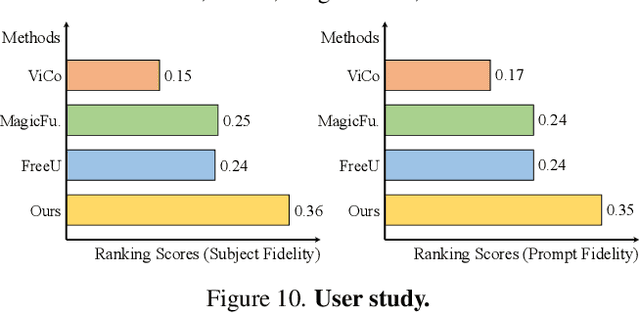
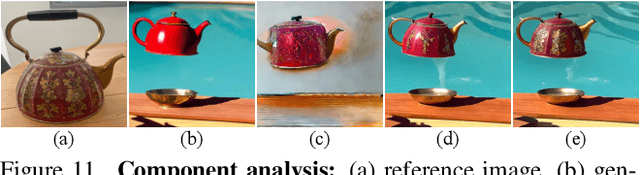
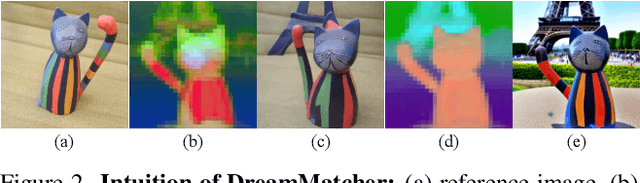
The objective of text-to-image (T2I) personalization is to customize a diffusion model to a user-provided reference concept, generating diverse images of the concept aligned with the target prompts. Conventional methods representing the reference concepts using unique text embeddings often fail to accurately mimic the appearance of the reference. To address this, one solution may be explicitly conditioning the reference images into the target denoising process, known as key-value replacement. However, prior works are constrained to local editing since they disrupt the structure path of the pre-trained T2I model. To overcome this, we propose a novel plug-in method, called DreamMatcher, which reformulates T2I personalization as semantic matching. Specifically, DreamMatcher replaces the target values with reference values aligned by semantic matching, while leaving the structure path unchanged to preserve the versatile capability of pre-trained T2I models for generating diverse structures. We also introduce a semantic-consistent masking strategy to isolate the personalized concept from irrelevant regions introduced by the target prompts. Compatible with existing T2I models, DreamMatcher shows significant improvements in complex scenarios. Intensive analyses demonstrate the effectiveness of our approach.