 Add to Chrome
 Add to Firefox
 Add to Edge
Is Personalized Modality Weighting Actually Personalized? A Controlled Audit of Per-User Weighting Claims in Multimodal Recommenders
Aug 06, 2026
Per-user modality weighting is deployed at billion-user scale in multimodal recommenders, through user modality-strength vectors, attention gates, meta-weight hypernetworks, and low-rank guided weights, each claiming a ranking gain from user-specific modality preference. Yet, to our knowledge, prior evaluations do not isolate a genuinely user-specific signal from a global modality weight plus model capacity. We audit this family with a two-contrast audit principle, reducing six implementations onto one shared collaborative backbone and measuring a utility gap (real-GM) against a single global modality weight and an identifiability gap (real-shuf) against an eval-time permutation of the user-weight binding. Across three independent short-video corpora, a single global weight already delivers nearly all of the content gain (+1.9/+3.6/+3.5pp over a no-modality baseline, p < .001). Making the weight per-user adds no consistent utility: no implementation wins on all corpora and metrics, and the few positive gaps are small (<=0.9pp) and flip. The shuffle control is necessary but not sufficient, since real-shuf reaches +128% of the content gain for heads that simultaneously lose to the global weight. We trace this dissociation to gates reading the shared collaborative embedding: decoupling the gate input collapses the inflated real-shuf to near zero while the utility conclusion stands. A monotone signal-implant dose-response (capture AUROC rising from 0.57 to 0.89 and from 0.64 to 1.00) verifies the harness would detect user-specific structure if present, and every finding replicates on a fourth, cross-domain e-commerce corpus. We propose reporting real-GM alongside real-shuf as a minimum evidentiary standard for personalization claims.

PHKT:Personalized Dynamic Hypergraph-enhanced KAN-Transformer for Multi-behavior Sequential Recommendation
Jun 04, 2026In multi-behavior recommendation, auxiliary behaviors such as clicks, add-to-cart, and purchases can provide richer supervisory information for predicting target behaviors. Although existing graph and hypergraph methods are capable of modeling high-order relationships among users, items, and behaviors, they still have limitations in heterogeneous semantics, user-specific weighting, and sequence dependency modeling. While standard Transformers excel at sequence modeling, their shared feedforward mapping struggles to accommodate the differentiated requirements of heterogeneous latent patterns in multi-behavior scenarios. To address this, this paper proposes the Personalized Hypergraph-enhanced Kolmogorov-Arnold Network Transformer (PHKT). Specifically, we design a personalized dynamic hypergraph module that performs behavior-aware weighting of item similarities based on users' historical behavior sequences to capture user-specific heterogeneous high-order relationships. Meanwhile, a Transformer is used as the temporal backbone to model the evolution of short- and long-term preferences, and KAN is introduced to replace the traditional MLP in the feedforward network to enhance fine-grained modeling capability for nonlinear responses to different latent patterns. Experiments on three real datasets, Tmall, RetailRocket, and IJCAI, show that PHKT consistently outperforms nine strong baseline models across multiple evaluation metrics, demonstrating its effectiveness in multi-behavior preference modeling and target behavior prediction.
CaDRec: Contextualized and Debiased Recommender Model
Apr 10, 2024Recommender models aimed at mining users' behavioral patterns have raised great attention as one of the essential applications in daily life. Recent work on graph neural networks (GNNs) or debiasing methods has attained remarkable gains. However, they still suffer from (1) over-smoothing node embeddings caused by recursive convolutions with GNNs, and (2) the skewed distribution of interactions due to popularity and user-individual biases. This paper proposes a contextualized and debiased recommender model (CaDRec). To overcome the over-smoothing issue, we explore a novel hypergraph convolution operator that can select effective neighbors during convolution by introducing both structural context and sequential context. To tackle the skewed distribution, we propose two strategies for disentangling interactions: (1) modeling individual biases to learn unbiased item embeddings, and (2) incorporating item popularity with positional encoding. Moreover, we mathematically show that the imbalance of the gradients to update item embeddings exacerbates the popularity bias, thus adopting regularization and weighting schemes as solutions. Extensive experiments on four datasets demonstrate the superiority of the CaDRec against state-of-the-art (SOTA) methods. Our source code and data are released at https://github.com/WangXFng/CaDRec.
NFARec: A Negative Feedback-Aware Recommender Model
Apr 10, 2024Graph neural network (GNN)-based models have been extensively studied for recommendations, as they can extract high-order collaborative signals accurately which is required for high-quality recommender systems. However, they neglect the valuable information gained through negative feedback in two aspects: (1) different users might hold opposite feedback on the same item, which hampers optimal information propagation in GNNs, and (2) even when an item vastly deviates from users' preferences, they might still choose it and provide a negative rating. In this paper, we propose a negative feedback-aware recommender model (NFARec) that maximizes the leverage of negative feedback. To transfer information to multi-hop neighbors along an optimal path effectively, NFARec adopts a feedback-aware correlation that guides hypergraph convolutions (HGCs) to learn users' structural representations. Moreover, NFARec incorporates an auxiliary task - predicting the feedback sentiment polarity (i.e., positive or negative) of the next interaction - based on the Transformer Hawkes Process. The task is beneficial for understanding users by learning the sentiment expressed in their previous sequential feedback patterns and predicting future interactions. Extensive experiments demonstrate that NFARec outperforms competitive baselines. Our source code and data are released at https://github.com/WangXFng/NFARec.
TLSAN: Time-aware Long- and Short-term Attention Network for Next-item Recommendation
Mar 16, 2021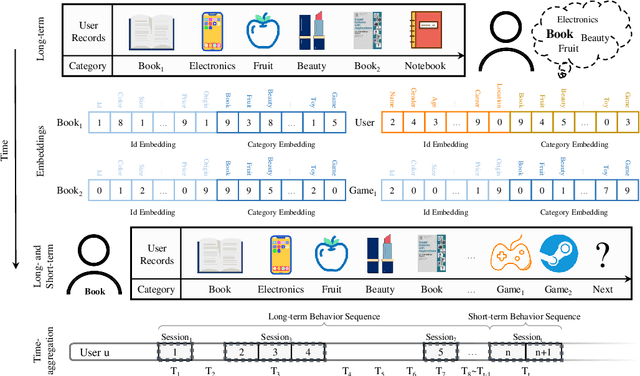
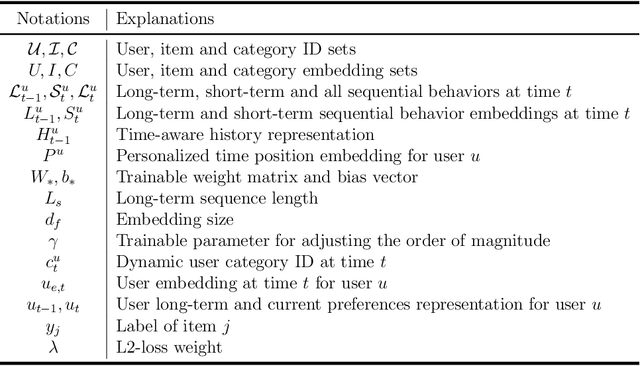
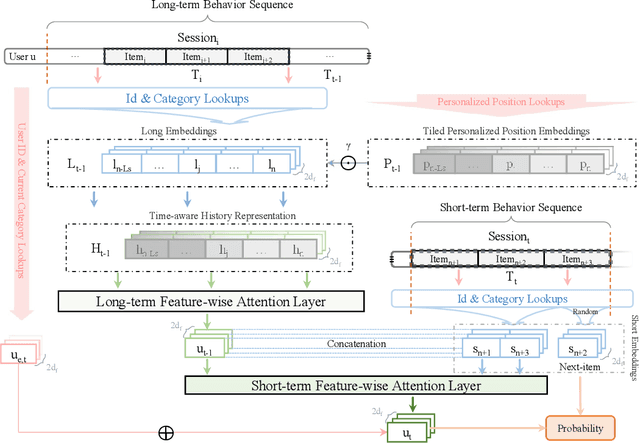
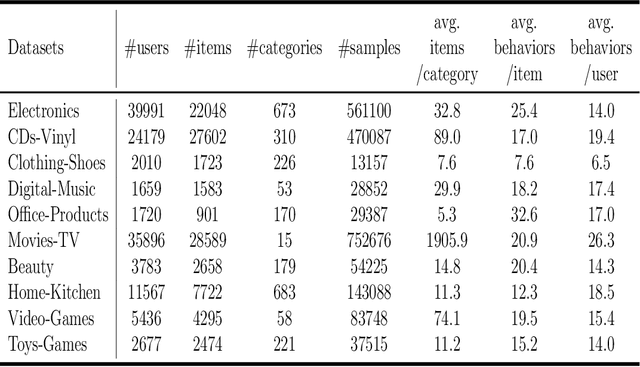
Recently, deep neural networks are widely applied in recommender systems for their effectiveness in capturing/modeling users' preferences. Especially, the attention mechanism in deep learning enables recommender systems to incorporate various features in an adaptive way. Specifically, as for the next item recommendation task, we have the following three observations: 1) users' sequential behavior records aggregate at time positions ("time-aggregation"), 2) users have personalized taste that is related to the "time-aggregation" phenomenon ("personalized time-aggregation"), and 3) users' short-term interests play an important role in the next item prediction/recommendation. In this paper, we propose a new Time-aware Long- and Short-term Attention Network (TLSAN) to address those observations mentioned above. Specifically, TLSAN consists of two main components. Firstly, TLSAN models "personalized time-aggregation" and learn user-specific temporal taste via trainable personalized time position embeddings with category-aware correlations in long-term behaviors. Secondly, long- and short-term feature-wise attention layers are proposed to effectively capture users' long- and short-term preferences for accurate recommendation. Especially, the attention mechanism enables TLSAN to utilize users' preferences in an adaptive way, and its usage in long- and short-term layers enhances TLSAN's ability of dealing with sparse interaction data. Extensive experiments are conducted on Amazon datasets from different fields (also with different size), and the results show that TLSAN outperforms state-of-the-art baselines in both capturing users' preferences and performing time-sensitive next-item recommendation.