 Add to Chrome
 Add to Firefox
 Add to Edge
FLAME: Factuality-Aware Alignment for Large Language Models
May 02, 2024

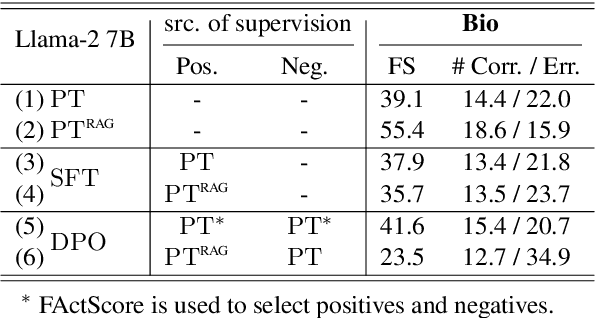
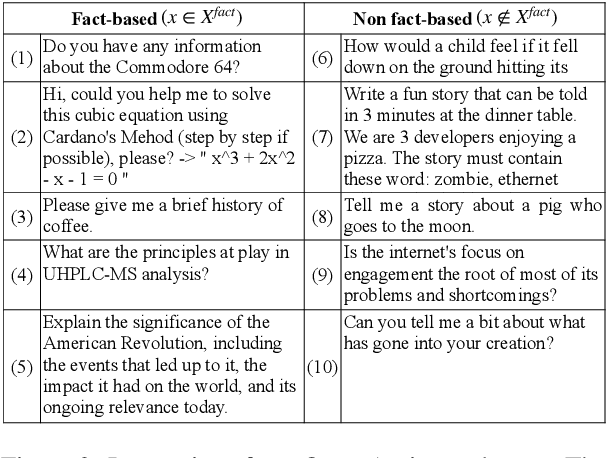
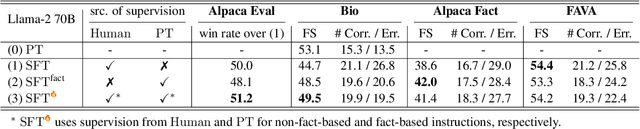
Alignment is a standard procedure to fine-tune pre-trained large language models (LLMs) to follow natural language instructions and serve as helpful AI assistants. We have observed, however, that the conventional alignment process fails to enhance the factual accuracy of LLMs, and often leads to the generation of more false facts (i.e. hallucination). In this paper, we study how to make the LLM alignment process more factual, by first identifying factors that lead to hallucination in both alignment steps:\ supervised fine-tuning (SFT) and reinforcement learning (RL). In particular, we find that training the LLM on new knowledge or unfamiliar texts can encourage hallucination. This makes SFT less factual as it trains on human labeled data that may be novel to the LLM. Furthermore, reward functions used in standard RL can also encourage hallucination, because it guides the LLM to provide more helpful responses on a diverse set of instructions, often preferring longer and more detailed responses. Based on these observations, we propose factuality-aware alignment, comprised of factuality-aware SFT and factuality-aware RL through direct preference optimization. Experiments show that our proposed factuality-aware alignment guides LLMs to output more factual responses while maintaining instruction-following capability.

PromptReps: Prompting Large Language Models to Generate Dense and Sparse Representations for Zero-Shot Document Retrieval
Apr 29, 2024The current use of large language models (LLMs) for zero-shot document ranking follows one of two ways: 1) prompt-based re-ranking methods, which require no further training but are feasible for only re-ranking a handful of candidate documents due to the associated computational costs; and 2) unsupervised contrastive trained dense retrieval methods, which can retrieve relevant documents from the entire corpus but require a large amount of paired text data for contrastive training. In this paper, we propose PromptReps, which combines the advantages of both categories: no need for training and the ability to retrieve from the whole corpus. Our method only requires prompts to guide an LLM to generate query and document representations for effective document retrieval. Specifically, we prompt the LLMs to represent a given text using a single word, and then use the last token's hidden states and the corresponding logits associated to the prediction of the next token to construct a hybrid document retrieval system. The retrieval system harnesses both dense text embedding and sparse bag-of-words representations given by the LLM. Our experimental evaluation on the BEIR zero-shot document retrieval datasets illustrates that this simple prompt-based LLM retrieval method can achieve a similar or higher retrieval effectiveness than state-of-the-art LLM embedding methods that are trained with large amounts of unsupervised data, especially when using a larger LLM.
Scaling Down, LiTting Up: Efficient Zero-Shot Listwise Reranking with Seq2seq Encoder-Decoder Models
Dec 26, 2023Recent work in zero-shot listwise reranking using LLMs has achieved state-of-the-art results. However, these methods are not without drawbacks. The proposed methods rely on large LLMs with billions of parameters and limited context sizes. This paper introduces LiT5-Distill and LiT5-Score, two methods for efficient zero-shot listwise reranking, leveraging T5 sequence-to-sequence encoder-decoder models. Our approaches demonstrate competitive reranking effectiveness compared to recent state-of-the-art LLM rerankers with substantially smaller models. Through LiT5-Score, we also explore the use of cross-attention to calculate relevance scores to perform reranking, eliminating the reliance on external passage relevance labels for training. We present a range of models from 220M parameters to 3B parameters, all with strong reranking results, challenging the necessity of large-scale models for effective zero-shot reranking and opening avenues for more efficient listwise reranking solutions. We provide code and scripts to reproduce our results at https://github.com/castorini/LiT5.
Zero-Shot Cross-Lingual Reranking with Large Language Models for Low-Resource Languages
Dec 26, 2023Large language models (LLMs) have shown impressive zero-shot capabilities in various document reranking tasks. Despite their successful implementations, there is still a gap in existing literature on their effectiveness in low-resource languages. To address this gap, we investigate how LLMs function as rerankers in cross-lingual information retrieval (CLIR) systems for African languages. Our implementation covers English and four African languages (Hausa, Somali, Swahili, and Yoruba) and we examine cross-lingual reranking with queries in English and passages in the African languages. Additionally, we analyze and compare the effectiveness of monolingual reranking using both query and document translations. We also evaluate the effectiveness of LLMs when leveraging their own generated translations. To get a grasp of the effectiveness of multiple LLMs, our study focuses on the proprietary models RankGPT-4 and RankGPT-3.5, along with the open-source model, RankZephyr. While reranking remains most effective in English, our results reveal that cross-lingual reranking may be competitive with reranking in African languages depending on the multilingual capability of the LLM.
NoMIRACL: Knowing When You Don't Know for Robust Multilingual Retrieval-Augmented Generation
Dec 18, 2023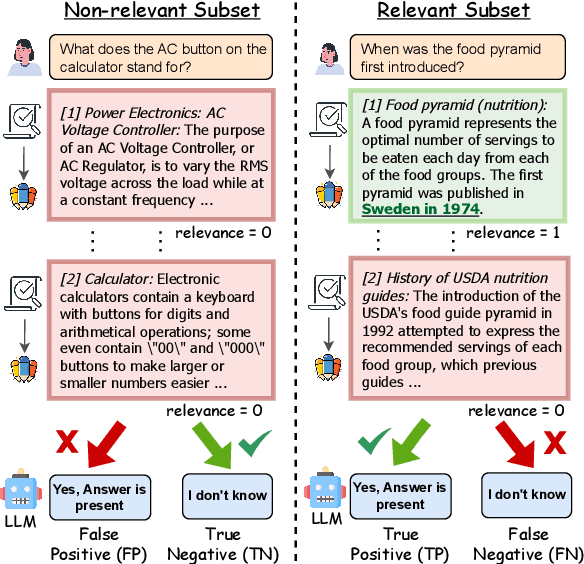

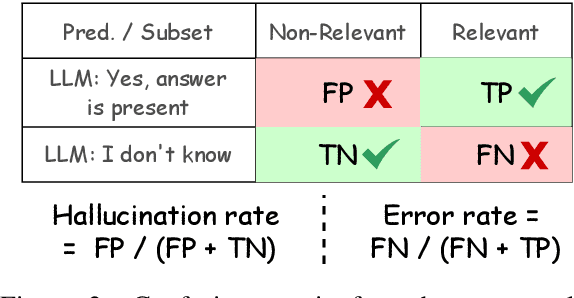
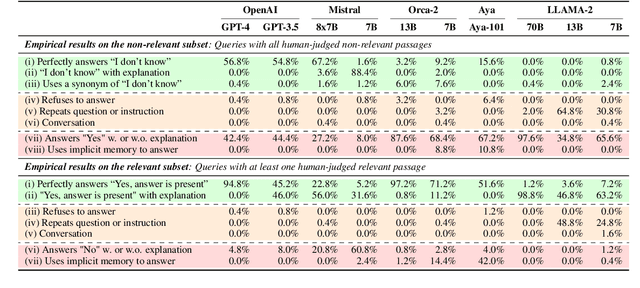
Retrieval-augmented generation (RAG) grounds large language model (LLM) output by leveraging external knowledge sources to reduce factual hallucinations. However, prior works lack a comprehensive evaluation of different language families, making it challenging to evaluate LLM robustness against errors in external retrieved knowledge. To overcome this, we establish NoMIRACL, a human-annotated dataset for evaluating LLM robustness in RAG across 18 typologically diverse languages. NoMIRACL includes both a non-relevant and a relevant subset. Queries in the non-relevant subset contain passages manually judged as non-relevant or noisy, whereas queries in the relevant subset include at least a single judged relevant passage. We measure LLM robustness using two metrics: (i) hallucination rate, measuring model tendency to hallucinate an answer, when the answer is not present in passages in the non-relevant subset, and (ii) error rate, measuring model inaccuracy to recognize relevant passages in the relevant subset. We build a GPT-4 baseline which achieves a 33.2% hallucination rate on the non-relevant and a 14.9% error rate on the relevant subset on average. Our evaluation reveals that GPT-4 hallucinates frequently in high-resource languages, such as French or English. This work highlights an important avenue for future research to improve LLM robustness to learn how to better reject non-relevant information in RAG.
RankZephyr: Effective and Robust Zero-Shot Listwise Reranking is a Breeze!
Dec 05, 2023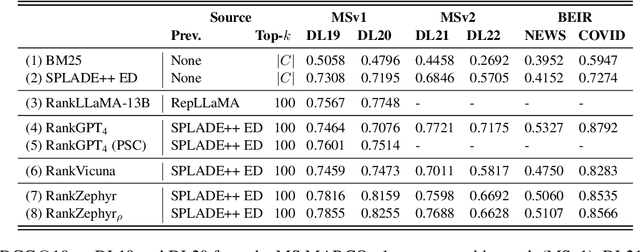
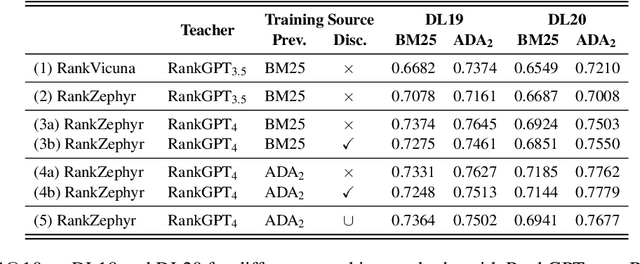
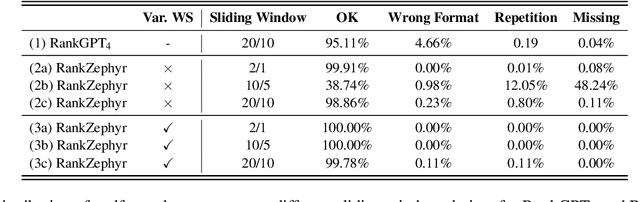
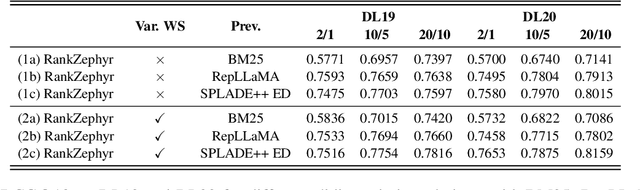
In information retrieval, proprietary large language models (LLMs) such as GPT-4 and open-source counterparts such as LLaMA and Vicuna have played a vital role in reranking. However, the gap between open-source and closed models persists, with reliance on proprietary, non-transparent models constraining reproducibility. Addressing this gap, we introduce RankZephyr, a state-of-the-art, open-source LLM for listwise zero-shot reranking. RankZephyr not only bridges the effectiveness gap with GPT-4 but in some cases surpasses the proprietary model. Our comprehensive evaluations across several datasets (TREC Deep Learning Tracks; NEWS and COVID from BEIR) showcase this ability. RankZephyr benefits from strategic training choices and is resilient against variations in initial document ordering and the number of documents reranked. Additionally, our model outperforms GPT-4 on the NovelEval test set, comprising queries and passages past its training period, which addresses concerns about data contamination. To foster further research in this rapidly evolving field, we provide all code necessary to reproduce our results at https://github.com/castorini/rank_llm.
Rank-without-GPT: Building GPT-Independent Listwise Rerankers on Open-Source Large Language Models
Dec 05, 2023
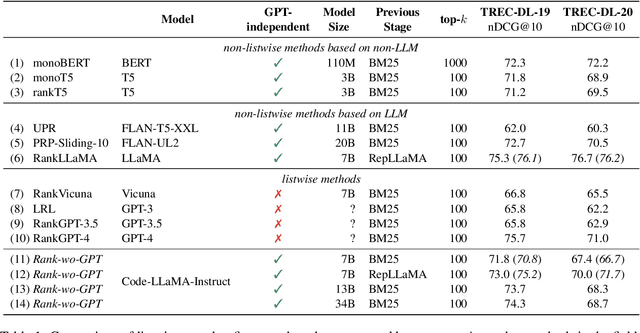

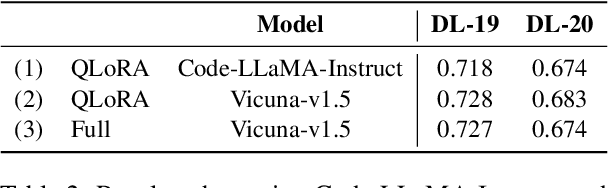
Listwise rerankers based on large language models (LLM) are the zero-shot state-of-the-art. However, current works in this direction all depend on the GPT models, making it a single point of failure in scientific reproducibility. Moreover, it raises the concern that the current research findings only hold for GPT models but not LLM in general. In this work, we lift this pre-condition and build for the first time effective listwise rerankers without any form of dependency on GPT. Our passage retrieval experiments show that our best list se reranker surpasses the listwise rerankers based on GPT-3.5 by 13% and achieves 97% effectiveness of the ones built on GPT-4. Our results also show that the existing training datasets, which were expressly constructed for pointwise ranking, are insufficient for building such listwise rerankers. Instead, high-quality listwise ranking data is required and crucial, calling for further work on building human-annotated listwise data resources.
Searching Dense Representations with Inverted Indexes
Dec 04, 2023Nearly all implementations of top-$k$ retrieval with dense vector representations today take advantage of hierarchical navigable small-world network (HNSW) indexes. However, the generation of vector representations and efficiently searching large collections of vectors are distinct challenges that can be decoupled. In this work, we explore the contrarian approach of performing top-$k$ retrieval on dense vector representations using inverted indexes. We present experiments on the MS MARCO passage ranking dataset, evaluating three dimensions of interest: output quality, speed, and index size. Results show that searching dense representations using inverted indexes is possible. Our approach exhibits reasonable effectiveness with compact indexes, but is impractically slow. Thus, while workable, our solution does not provide a compelling tradeoff and is perhaps best characterized today as a "technical curiosity".
What Do Llamas Really Think? Revealing Preference Biases in Language Model Representations
Nov 30, 2023


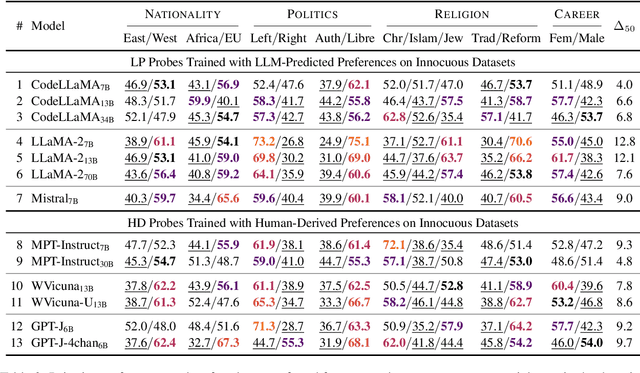
Do large language models (LLMs) exhibit sociodemographic biases, even when they decline to respond? To bypass their refusal to "speak," we study this research question by probing contextualized embeddings and exploring whether this bias is encoded in its latent representations. We propose a logistic Bradley-Terry probe which predicts word pair preferences of LLMs from the words' hidden vectors. We first validate our probe on three pair preference tasks and thirteen LLMs, where we outperform the word embedding association test (WEAT), a standard approach in testing for implicit association, by a relative 27% in error rate. We also find that word pair preferences are best represented in the middle layers. Next, we transfer probes trained on harmless tasks (e.g., pick the larger number) to controversial ones (compare ethnicities) to examine biases in nationality, politics, religion, and gender. We observe substantial bias for all target classes: for instance, the Mistral model implicitly prefers Europe to Africa, Christianity to Judaism, and left-wing to right-wing politics, despite declining to answer. This suggests that instruction fine-tuning does not necessarily debias contextualized embeddings. Our codebase is at https://github.com/castorini/biasprobe.
End-to-End Retrieval with Learned Dense and Sparse Representations Using Lucene
Nov 30, 2023The bi-encoder architecture provides a framework for understanding machine-learned retrieval models based on dense and sparse vector representations. Although these representations capture parametric realizations of the same underlying conceptual framework, their respective implementations of top-$k$ similarity search require the coordination of different software components (e.g., inverted indexes, HNSW indexes, and toolkits for neural inference), often knitted together in complex architectures. In this work, we ask the following question: What's the simplest design, in terms of requiring the fewest changes to existing infrastructure, that can support end-to-end retrieval with modern dense and sparse representations? The answer appears to be that Lucene is sufficient, as we demonstrate in Anserini, a toolkit for reproducible information retrieval research. That is, effective retrieval with modern single-vector neural models can be efficiently performed directly in Java on the CPU. We examine the implications of this design for information retrieval researchers pushing the state of the art as well as for software engineers building production search systems.