 Add to Chrome
 Add to Firefox
 Add to Edge
GaussianFormer: Scene as Gaussians for Vision-Based 3D Semantic Occupancy Prediction
May 27, 2024
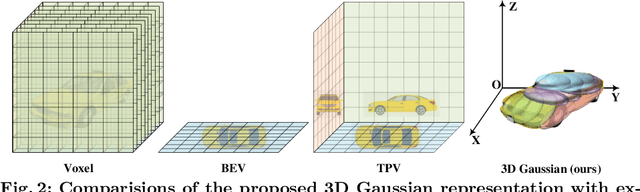

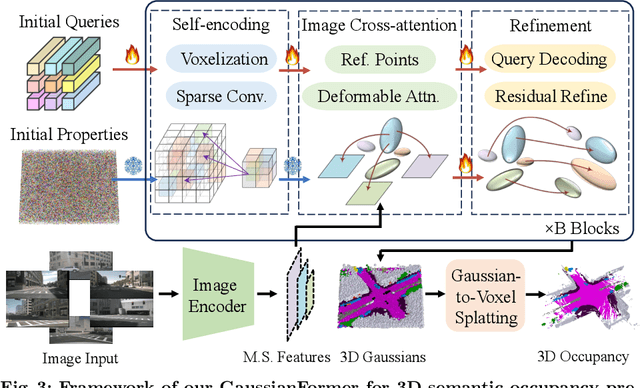

3D semantic occupancy prediction aims to obtain 3D fine-grained geometry and semantics of the surrounding scene and is an important task for the robustness of vision-centric autonomous driving. Most existing methods employ dense grids such as voxels as scene representations, which ignore the sparsity of occupancy and the diversity of object scales and thus lead to unbalanced allocation of resources. To address this, we propose an object-centric representation to describe 3D scenes with sparse 3D semantic Gaussians where each Gaussian represents a flexible region of interest and its semantic features. We aggregate information from images through the attention mechanism and iteratively refine the properties of 3D Gaussians including position, covariance, and semantics. We then propose an efficient Gaussian-to-voxel splatting method to generate 3D occupancy predictions, which only aggregates the neighboring Gaussians for a certain position. We conduct extensive experiments on the widely adopted nuScenes and KITTI-360 datasets. Experimental results demonstrate that GaussianFormer achieves comparable performance with state-of-the-art methods with only 17.8% - 24.8% of their memory consumption. Code is available at: https://github.com/huang-yh/GaussianFormer.

NeuroGauss4D-PCI: 4D Neural Fields and Gaussian Deformation Fields for Point Cloud Interpolation
May 23, 2024Point Cloud Interpolation confronts challenges from point sparsity, complex spatiotemporal dynamics, and the difficulty of deriving complete 3D point clouds from sparse temporal information. This paper presents NeuroGauss4D-PCI, which excels at modeling complex non-rigid deformations across varied dynamic scenes. The method begins with an iterative Gaussian cloud soft clustering module, offering structured temporal point cloud representations. The proposed temporal radial basis function Gaussian residual utilizes Gaussian parameter interpolation over time, enabling smooth parameter transitions and capturing temporal residuals of Gaussian distributions. Additionally, a 4D Gaussian deformation field tracks the evolution of these parameters, creating continuous spatiotemporal deformation fields. A 4D neural field transforms low-dimensional spatiotemporal coordinates ($x,y,z,t$) into a high-dimensional latent space. Finally, we adaptively and efficiently fuse the latent features from neural fields and the geometric features from Gaussian deformation fields. NeuroGauss4D-PCI outperforms existing methods in point cloud frame interpolation, delivering leading performance on both object-level (DHB) and large-scale autonomous driving datasets (NL-Drive), with scalability to auto-labeling and point cloud densification tasks. The source code is released at https://github.com/jiangchaokang/NeuroGauss4D-PCI.
Rethinking Overlooked Aspects in Vision-Language Models
May 20, 2024Recent advancements in large vision-language models (LVLMs), such as GPT4-V and LLaVA, have been substantial. LLaVA's modular architecture, in particular, offers a blend of simplicity and efficiency. Recent works mainly focus on introducing more pre-training and instruction tuning data to improve model's performance. This paper delves into the often-neglected aspects of data efficiency during pre-training and the selection process for instruction tuning datasets. Our research indicates that merely increasing the size of pre-training data does not guarantee improved performance and may, in fact, lead to its degradation. Furthermore, we have established a pipeline to pinpoint the most efficient instruction tuning (SFT) dataset, implying that not all SFT data utilized in existing studies are necessary. The primary objective of this paper is not to introduce a state-of-the-art model, but rather to serve as a roadmap for future research, aiming to optimize data usage during pre-training and fine-tuning processes to enhance the performance of vision-language models.
Boosting Large Language Models with Continual Learning for Aspect-based Sentiment Analysis
May 09, 2024Aspect-based sentiment analysis (ABSA) is an important subtask of sentiment analysis, which aims to extract the aspects and predict their sentiments. Most existing studies focus on improving the performance of the target domain by fine-tuning domain-specific models (trained on source domains) based on the target domain dataset. Few works propose continual learning tasks for ABSA, which aim to learn the target domain's ability while maintaining the history domains' abilities. In this paper, we propose a Large Language Model-based Continual Learning (\texttt{LLM-CL}) model for ABSA. First, we design a domain knowledge decoupling module to learn a domain-invariant adapter and separate domain-variant adapters dependently with an orthogonal constraint. Then, we introduce a domain knowledge warmup strategy to align the representation between domain-invariant and domain-variant knowledge. In the test phase, we index the corresponding domain-variant knowledge via domain positioning to not require each sample's domain ID. Extensive experiments over 19 datasets indicate that our \texttt{LLM-CL} model obtains new state-of-the-art performance.
Multi-level Shared Knowledge Guided Learning for Knowledge Graph Completion
May 08, 2024In the task of Knowledge Graph Completion (KGC), the existing datasets and their inherent subtasks carry a wealth of shared knowledge that can be utilized to enhance the representation of knowledge triplets and overall performance. However, no current studies specifically address the shared knowledge within KGC. To bridge this gap, we introduce a multi-level Shared Knowledge Guided learning method (SKG) that operates at both the dataset and task levels. On the dataset level, SKG-KGC broadens the original dataset by identifying shared features within entity sets via text summarization. On the task level, for the three typical KGC subtasks - head entity prediction, relation prediction, and tail entity prediction - we present an innovative multi-task learning architecture with dynamically adjusted loss weights. This approach allows the model to focus on more challenging and underperforming tasks, effectively mitigating the imbalance of knowledge sharing among subtasks. Experimental results demonstrate that SKG-KGC outperforms existing text-based methods significantly on three well-known datasets, with the most notable improvement on WN18RR.
Joint Estimation of Identity Verification and Relative Pose for Partial Fingerprints
May 07, 2024

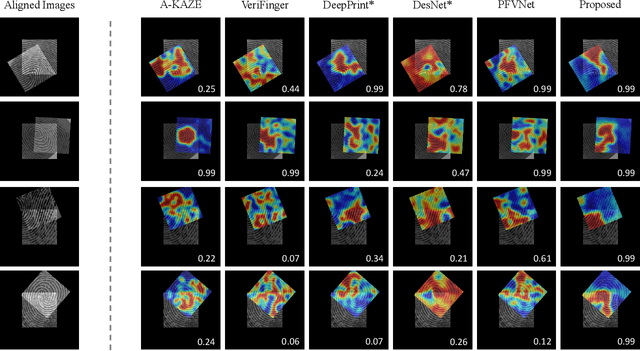

Currently, portable electronic devices are becoming more and more popular. For lightweight considerations, their fingerprint recognition modules usually use limited-size sensors. However, partial fingerprints have few matchable features, especially when there are differences in finger pressing posture or image quality, which makes partial fingerprint verification challenging. Most existing methods regard fingerprint position rectification and identity verification as independent tasks, ignoring the coupling relationship between them -- relative pose estimation typically relies on paired features as anchors, and authentication accuracy tends to improve with more precise pose alignment. Consequently, in this paper we propose a method that jointly estimates identity verification and relative pose for partial fingerprints, aiming to leverage their inherent correlation to improve each other. To achieve this, we propose a multi-task CNN (Convolutional Neural Network)-Transformer hybrid network, and design a pre-training task to enhance the feature extraction capability. Experiments on multiple public datasets (NIST SD14, FVC2002 DB1A & DB3A, FVC2004 DB1A & DB2A, FVC2006 DB1A) and an in-house dataset show that our method achieves state-of-the-art performance in both partial fingerprint verification and relative pose estimation, while being more efficient than previous methods.
Latent Fingerprint Matching via Dense Minutia Descriptor
May 02, 2024


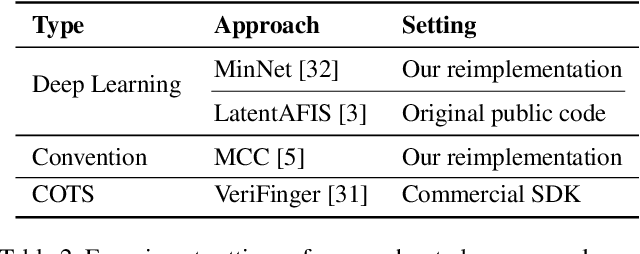
Latent fingerprint matching is a daunting task, primarily due to the poor quality of latent fingerprints. In this study, we propose a deep-learning based dense minutia descriptor (DMD) for latent fingerprint matching. A DMD is obtained by extracting the fingerprint patch aligned by its central minutia, capturing detailed minutia information and texture information. Our dense descriptor takes the form of a three-dimensional representation, with two dimensions associated with the original image plane and the other dimension representing the abstract features. Additionally, the extraction process outputs the fingerprint segmentation map, ensuring that the descriptor is only valid in the foreground region. The matching between two descriptors occurs in their overlapping regions, with a score normalization strategy to reduce the impact brought by the differences outside the valid area. Our descriptor achieves state-of-the-art performance on several latent fingerprint datasets. Overall, our DMD is more representative and interpretable compared to previous methods.
Sports Analysis and VR Viewing System Based on Player Tracking and Pose Estimation with Multimodal and Multiview Sensors
May 02, 2024
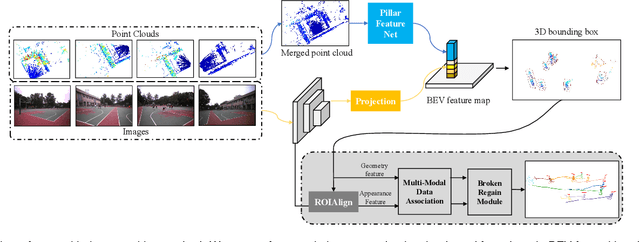
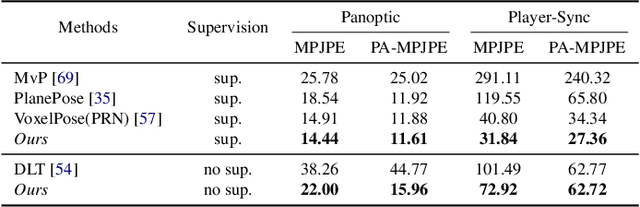
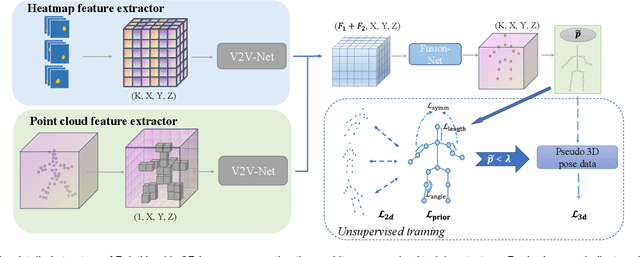
Sports analysis and viewing play a pivotal role in the current sports domain, offering significant value not only to coaches and athletes but also to fans and the media. In recent years, the rapid development of virtual reality (VR) and augmented reality (AR) technologies have introduced a new platform for watching games. Visualization of sports competitions in VR/AR represents a revolutionary technology, providing audiences with a novel immersive viewing experience. However, there is still a lack of related research in this area. In this work, we present for the first time a comprehensive system for sports competition analysis and real-time visualization on VR/AR platforms. First, we utilize multiview LiDARs and cameras to collect multimodal game data. Subsequently, we propose a framework for multi-player tracking and pose estimation based on a limited amount of supervised data, which extracts precise player positions and movements from point clouds and images. Moreover, we perform avatar modeling of players to obtain their 3D models. Ultimately, using these 3D player data, we conduct competition analysis and real-time visualization on VR/AR. Extensive quantitative experiments demonstrate the accuracy and robustness of our multi-player tracking and pose estimation framework. The visualization results showcase the immense potential of our sports visualization system on the domain of watching games on VR/AR devices. The multimodal competition dataset we collected and all related code will be released soon.
Pose-Specific 3D Fingerprint Unfolding
Apr 26, 2024In order to make 3D fingerprints compatible with traditional 2D flat fingerprints, a common practice is to unfold the 3D fingerprint into a 2D rolled fingerprint, which is then matched with the flat fingerprints by traditional 2D fingerprint recognition algorithms. The problem with this method is that there may be large elastic deformation between the unfolded rolled fingerprint and flat fingerprint, which affects the recognition rate. In this paper, we propose a pose-specific 3D fingerprint unfolding algorithm to unfold the 3D fingerprint using the same pose as the flat fingerprint. Our experiments show that the proposed unfolding algorithm improves the compatibility between 3D fingerprint and flat fingerprint and thus leads to higher genuine matching scores.
Direct Regression of Distortion Field from a Single Fingerprint Image
Apr 26, 2024Skin distortion is a long standing challenge in fingerprint matching, which causes false non-matches. Previous studies have shown that the recognition rate can be improved by estimating the distortion field from a distorted fingerprint and then rectifying it into a normal fingerprint. However, existing rectification methods are based on principal component representation of distortion fields, which is not accurate and are very sensitive to finger pose. In this paper, we propose a rectification method where a self-reference based network is utilized to directly estimate the dense distortion field of distorted fingerprint instead of its low dimensional representation. This method can output accurate distortion fields of distorted fingerprints with various finger poses. Considering the limited number and variety of distorted fingerprints in the existing public dataset, we collected more distorted fingerprints with diverse finger poses and distortion patterns as a new database. Experimental results demonstrate that our proposed method achieves the state-of-the-art rectification performance in terms of distortion field estimation and rectified fingerprint matching.