 Add to Chrome
 Add to Firefox
 Add to Edge
UoU: A Universal Fingerprint Foundation Model Based on Large-Scale Unsupervised Learning
Jun 16, 2026
Fingerprint recognition is still dominated by task-specific pipelines, where enhancement, structural parsing, alignment, and matching are optimized in isolation. Although effective in narrow settings, this design limits representation reuse across sensors, qualities, and downstream applications. We therefore present UoU, short for ``a \textbf{U}niversal fingerprint foundation model based \textbf{o}n large-scale \textbf{U}nsupervised learning,'' which reframes fingerprint feature extraction as a domain-specific foundation-model problem. UoU is organized around a multi-level representation hierarchy spanning image restoration, structural fields, semantic tokens, point-level biometric entities, and compact global descriptors. Its training recipe combines a supervised cold start on precise annotations, large-scale weakly supervised refinement, and large-scale unsupervised consolidation, with the latter two stages iterated during large-scale training so that weak supervision broadens semantic coverage while unsupervised learning stabilizes correspondences, invariances, and representation geometry. Rather than treating fingerprint imagery as generic texture, UoU exploits domain-specific symmetries and intermediate structure, including orientation flow, periodic ridge patterns, sparse biometric entities, and spatial equivariance. The framework is intentionally architecture-agnostic: while the present study includes an initial transformer-based structured-prediction instantiation, the broader design supports multi-task learning, scalable model configurations, and downstream specialization for matching, alignment, enhancement, registration, and related fingerprint applications. This paper presents the technical motivation, system design, and validation protocol of UoU, and part of the baseline implementation is publicly available at https://github.com/XiongjunGuan/UoU.

Toward the Whole Picture: Accumulative Fingerprint Mapping and Reconstruction for Small-Area Mobile Sensors
Jun 14, 2026Small-area fingerprint sensing on mobile devices creates a fundamental mismatch between acquisition and recognition: each touch captures only a tiny, pose-varying local patch, while reliable biometric matching ultimately requires a stable and sufficiently complete fingerprint representation. Existing pipelines largely cope with this mismatch by treating repeated touches as independent partial templates, which leads to repeated registration, repeated matching, and no guarantee of adequate global coverage. In this paper, we advocate a different formulation, namely \emph{accumulative fingerprint mapping and reconstruction} for small-area mobile sensing. Rather than matching every partial patch separately, the proposed perspective converts a sequence of local observations into a unified fingerprint state that is progressively refined as new touches arrive and can be matched only once after consolidation. As a concrete baseline, we present a classical pipeline that performs patch-wise structural feature extraction, feature-level registration and fusion, fingerprint map construction, and phase-based ridge reconstruction. More importantly, we position this baseline within a broader mobile fingerprint framework that integrates structured token learning, two-stage pose reasoning, and diffusion-based generative reconstruction. This viewpoint reframes mobile fingerprint recognition from multi-capture multi-match processing to accumulative map building, state refinement, and one-shot matching, offering a principled route toward efficient, pose-robust, and deployment-friendly biometrics for small-area mobile platforms. The baseline implementation has been publicly released at https://github.com/XiongjunGuan/FpReconstruction.
Identity-Consistent Multi-Pose Generation of Contactless Fingerprints
May 05, 2026Contactless fingerprint recognition has gained increasing attention due to its advantages in hygiene and acquisition flexibility. However, the absence of physical contact constraints introduces severe nonlinear geometric distortions caused by free finger poses in 3D space, resulting in a substantial cross-modal domain gap between contactless and conventional contact-based fingerprints. Existing solutions largely rely on explicit geometric correction or image enhancement, which are fragile under extreme pose variations. In this paper, we propose Identity-Consistent Multi-Pose Generation of Contactless Fingerprints (IMPOSE), a physics-inspired framework that synthesizes identity-preserving, multi-pose contactless fingerprint samples to empower recognition models. IMPOSE consists of three stages: (1) rolled fingerprint identity generation via latent diffusion with discrete codebook representations, (2) cross-modal translation from rolled to contactless modality guided by Sauvola-based local adaptive binarization as an identity anchor, and (3) physics-based multi-pose simulation through 3D finger model texture mapping and projection. The generated samples maintain strict identity consistency at the ridge topology level and spatial alignment with standard fingerprint coordinate space. Extensive experiments on the UWA and PolyU CL2CB databases demonstrate that fine-tuning fixed-length dense descriptors (FDD) with IMPOSE-synthesized data achieves state-of-the-art cross-modal matching, reducing EER to 8.74% on UWA and 2.26% on PolyU CL2CB. Synthetic data also yields consistent gains across mainstream representations including DeepPrint and AFRNet, and the hybrid strategy combining synthetic and real data achieves the best overall results. The code and generated samples are available at https://github.com/Yu-Yy/IMPOSE.
Four Eyes Are Better Than Two: Harnessing the Collaborative Potential of Large Models via Differentiated Thinking and Complementary Ensembles
May 22, 2025In this paper, we present the runner-up solution for the Ego4D EgoSchema Challenge at CVPR 2025 (Confirmed on May 20, 2025). Inspired by the success of large models, we evaluate and leverage leading accessible multimodal large models and adapt them to video understanding tasks via few-shot learning and model ensemble strategies. Specifically, diversified prompt styles and process paradigms are systematically explored and evaluated to effectively guide the attention of large models, fully unleashing their powerful generalization and adaptability abilities. Experimental results demonstrate that, with our carefully designed approach, directly utilizing an individual multimodal model already outperforms the previous state-of-the-art (SOTA) method which includes several additional processes. Besides, an additional stage is further introduced that facilitates the cooperation and ensemble of periodic results, which achieves impressive performance improvements. We hope this work serves as a valuable reference for the practical application of large models and inspires future research in the field.
Fixed-Length Dense Fingerprint Representation
May 06, 2025Fixed-length fingerprint representations, which map each fingerprint to a compact and fixed-size feature vector, are computationally efficient and well-suited for large-scale matching. However, designing a robust representation that effectively handles diverse fingerprint modalities, pose variations, and noise interference remains a significant challenge. In this work, we propose a fixed-length dense descriptor of fingerprints, and introduce FLARE-a fingerprint matching framework that integrates the Fixed-Length dense descriptor with pose-based Alignment and Robust Enhancement. This fixed-length representation employs a three-dimensional dense descriptor to effectively capture spatial relationships among fingerprint ridge structures, enabling robust and locally discriminative representations. To ensure consistency within this dense feature space, FLARE incorporates pose-based alignment using complementary estimation methods, along with dual enhancement strategies that refine ridge clarity while preserving the original fingerprint modality. The proposed dense descriptor supports fixed-length representation while maintaining spatial correspondence, enabling fast and accurate similarity computation. Extensive experiments demonstrate that FLARE achieves superior performance across rolled, plain, latent, and contactless fingerprints, significantly outperforming existing methods in cross-modality and low-quality scenarios. Further analysis validates the effectiveness of the dense descriptor design, as well as the impact of alignment and enhancement modules on the accuracy of dense descriptor matching. Experimental results highlight the effectiveness and generalizability of FLARE as a unified and scalable solution for robust fingerprint representation and matching. The implementation and code will be publicly available at https://github.com/Yu-Yy/FLARE.
Finger Pose Estimation for Under-screen Fingerprint Sensor
May 05, 2025Two-dimensional pose estimation plays a crucial role in fingerprint recognition by facilitating global alignment and reduce pose-induced variations. However, existing methods are still unsatisfactory when handling with large angle or small area inputs. These limitations are particularly pronounced on fingerprints captured by under-screen fingerprint sensors in smartphones. In this paper, we present a novel dual-modal input based network for under-screen fingerprint pose estimation. Our approach effectively integrates two distinct yet complementary modalities: texture details extracted from ridge patches through the under-screen fingerprint sensor, and rough contours derived from capacitive images obtained via the touch screen. This collaborative integration endows our network with more comprehensive and discriminative information, substantially improving the accuracy and stability of pose estimation. A decoupled probability distribution prediction task is designed, instead of the traditional supervised forms of numerical regression or heatmap voting, to facilitate the training process. Additionally, we incorporate a Mixture of Experts (MoE) based feature fusion mechanism and a relationship driven cross-domain knowledge transfer strategy to further strengthen feature extraction and fusion capabilities. Extensive experiments are conducted on several public datasets and two private datasets. The results indicate that our method is significantly superior to previous state-of-the-art (SOTA) methods and remarkably boosts the recognition ability of fingerprint recognition algorithms. Our code is available at https://github.com/XiongjunGuan/DRACO.
Joint Estimation of Identity Verification and Relative Pose for Partial Fingerprints
May 07, 2024

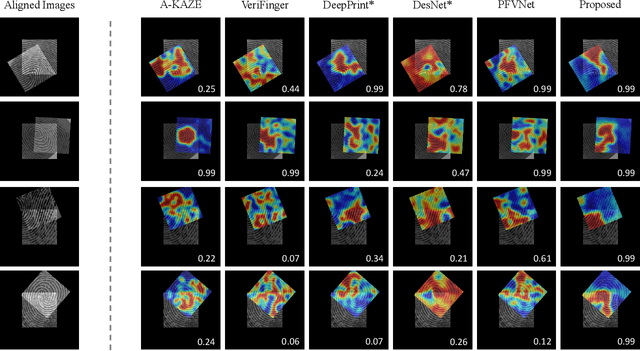

Currently, portable electronic devices are becoming more and more popular. For lightweight considerations, their fingerprint recognition modules usually use limited-size sensors. However, partial fingerprints have few matchable features, especially when there are differences in finger pressing posture or image quality, which makes partial fingerprint verification challenging. Most existing methods regard fingerprint position rectification and identity verification as independent tasks, ignoring the coupling relationship between them -- relative pose estimation typically relies on paired features as anchors, and authentication accuracy tends to improve with more precise pose alignment. Consequently, in this paper we propose a method that jointly estimates identity verification and relative pose for partial fingerprints, aiming to leverage their inherent correlation to improve each other. To achieve this, we propose a multi-task CNN (Convolutional Neural Network)-Transformer hybrid network, and design a pre-training task to enhance the feature extraction capability. Experiments on multiple public datasets (NIST SD14, FVC2002 DB1A & DB3A, FVC2004 DB1A & DB2A, FVC2006 DB1A) and an in-house dataset show that our method achieves state-of-the-art performance in both partial fingerprint verification and relative pose estimation, while being more efficient than previous methods.
Latent Fingerprint Matching via Dense Minutia Descriptor
May 02, 2024


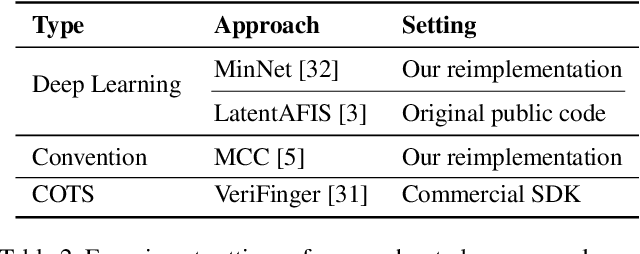
Latent fingerprint matching is a daunting task, primarily due to the poor quality of latent fingerprints. In this study, we propose a deep-learning based dense minutia descriptor (DMD) for latent fingerprint matching. A DMD is obtained by extracting the fingerprint patch aligned by its central minutia, capturing detailed minutia information and texture information. Our dense descriptor takes the form of a three-dimensional representation, with two dimensions associated with the original image plane and the other dimension representing the abstract features. Additionally, the extraction process outputs the fingerprint segmentation map, ensuring that the descriptor is only valid in the foreground region. The matching between two descriptors occurs in their overlapping regions, with a score normalization strategy to reduce the impact brought by the differences outside the valid area. Our descriptor achieves state-of-the-art performance on several latent fingerprint datasets. Overall, our DMD is more representative and interpretable compared to previous methods.
Direct Regression of Distortion Field from a Single Fingerprint Image
Apr 26, 2024Skin distortion is a long standing challenge in fingerprint matching, which causes false non-matches. Previous studies have shown that the recognition rate can be improved by estimating the distortion field from a distorted fingerprint and then rectifying it into a normal fingerprint. However, existing rectification methods are based on principal component representation of distortion fields, which is not accurate and are very sensitive to finger pose. In this paper, we propose a rectification method where a self-reference based network is utilized to directly estimate the dense distortion field of distorted fingerprint instead of its low dimensional representation. This method can output accurate distortion fields of distorted fingerprints with various finger poses. Considering the limited number and variety of distorted fingerprints in the existing public dataset, we collected more distorted fingerprints with diverse finger poses and distortion patterns as a new database. Experimental results demonstrate that our proposed method achieves the state-of-the-art rectification performance in terms of distortion field estimation and rectified fingerprint matching.
Regression of Dense Distortion Field from a Single Fingerprint Image
Apr 26, 2024Skin distortion is a long standing challenge in fingerprint matching, which causes false non-matches. Previous studies have shown that the recognition rate can be improved by estimating the distortion field from a distorted fingerprint and then rectifying it into a normal fingerprint. However, existing rectification methods are based on principal component representation of distortion fields, which is not accurate and are very sensitive to finger pose. In this paper, we propose a rectification method where a self-reference based network is utilized to directly estimate the dense distortion field of distorted fingerprint instead of its low dimensional representation. This method can output accurate distortion fields of distorted fingerprints with various finger poses and distortion patterns. We conducted experiments on FVC2004 DB1\_A, expanded Tsinghua Distorted Fingerprint database (with additional distorted fingerprints in diverse finger poses and distortion patterns) and a latent fingerprint database. Experimental results demonstrate that our proposed method achieves the state-of-the-art rectification performance in terms of distortion field estimation and rectified fingerprint matching.
* arXiv admin note: text overlap with arXiv:2404.17148