 Add to Chrome
 Add to Firefox
 Add to Edge
Ontology-Guided Evidence Path Inference for Multi-hop Knowledge Graph Question Answering
Jun 26, 2026
Knowledge graph question answering (KGQA) aims to answer natural-language questions by reasoning over structured facts. Existing multi-hop KGQA methods mainly rely on topic-centered expansion, which faces two key challenges: the search space rapidly grows with noisy mixed-type paths, and retrieved paths may fail to satisfy the semantic constraints of complex questions. To address these challenges, we propose OPI, an ontology-guided evidence path inference framework for multi-hop KGQA. OPI introduces a relation-centric ontology graph to capture the head-tail type constraints of relations, providing a compact interface for answer-side constraints. Based on this ontology graph, OPI first introduces a bidirectional retrieval mechanism by mapping the predicted answer type to compatible final-hop relations and combining topic-side prefix expansion with answer-side final-hop matching, thereby suppressing noisy mixed-type expansion. OPI further adopts an iterative refinement strategy to reassess retrieved paths and candidate answers under the question context, filtering type-compatible but question-irrelevant evidence for more reliable answer prediction. Experiments on WebQSP, CWQ, and MetaQA show that OPI substantially reduces the search space, improves Hit@1/F1 by 4.6/5.0 points on WebQSP and 8.9/3.3 points on CWQ over the strongest prior results, and achieves near-saturated Hit@1 on MetaQA with the retrieval module alone.

EffiQA: Efficient Question-Answering with Strategic Multi-Model Collaboration on Knowledge Graphs
Jun 03, 2024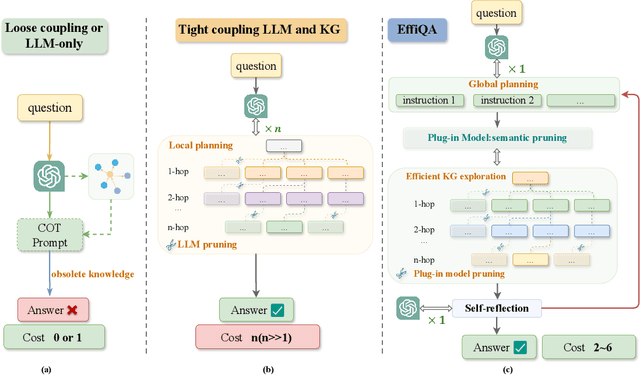
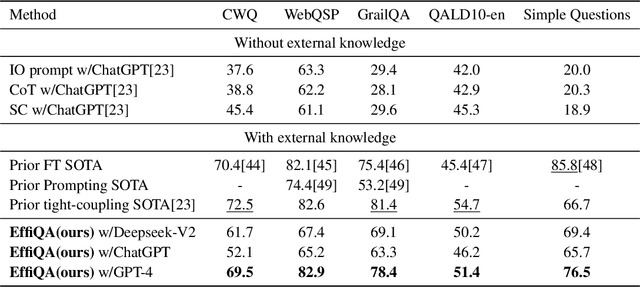
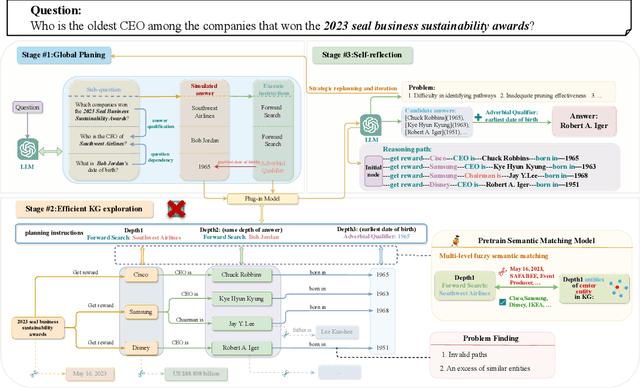
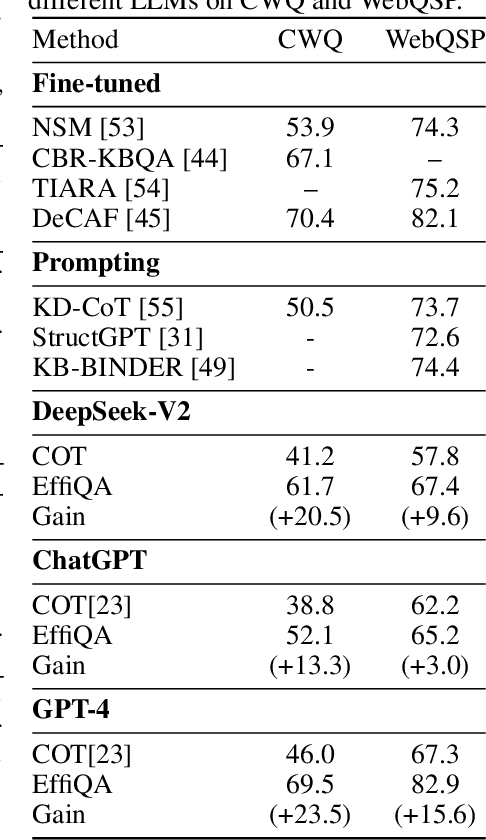
While large language models (LLMs) have shown remarkable capabilities in natural language processing, they struggle with complex, multi-step reasoning tasks involving knowledge graphs (KGs). Existing approaches that integrate LLMs and KGs either underutilize the reasoning abilities of LLMs or suffer from prohibitive computational costs due to tight coupling. To address these limitations, we propose a novel collaborative framework named EffiQA that can strike a balance between performance and efficiency via an iterative paradigm. EffiQA consists of three stages: global planning, efficient KG exploration, and self-reflection. Specifically, EffiQA leverages the commonsense capability of LLMs to explore potential reasoning pathways through global planning. Then, it offloads semantic pruning to a small plug-in model for efficient KG exploration. Finally, the exploration results are fed to LLMs for self-reflection to further improve the global planning and efficient KG exploration. Empirical evidence on multiple KBQA benchmarks shows EffiQA's effectiveness, achieving an optimal balance between reasoning accuracy and computational costs. We hope the proposed new framework will pave the way for efficient, knowledge-intensive querying by redefining the integration of LLMs and KGs, fostering future research on knowledge-based question answering.
Multi-level Shared Knowledge Guided Learning for Knowledge Graph Completion
May 08, 2024In the task of Knowledge Graph Completion (KGC), the existing datasets and their inherent subtasks carry a wealth of shared knowledge that can be utilized to enhance the representation of knowledge triplets and overall performance. However, no current studies specifically address the shared knowledge within KGC. To bridge this gap, we introduce a multi-level Shared Knowledge Guided learning method (SKG) that operates at both the dataset and task levels. On the dataset level, SKG-KGC broadens the original dataset by identifying shared features within entity sets via text summarization. On the task level, for the three typical KGC subtasks - head entity prediction, relation prediction, and tail entity prediction - we present an innovative multi-task learning architecture with dynamically adjusted loss weights. This approach allows the model to focus on more challenging and underperforming tasks, effectively mitigating the imbalance of knowledge sharing among subtasks. Experimental results demonstrate that SKG-KGC outperforms existing text-based methods significantly on three well-known datasets, with the most notable improvement on WN18RR.