 Add to Chrome
 Add to Firefox
 Add to Edge
MMA-Net: Multiple Morphology-Aware Network for Automated Cobb Angle Measurement
Sep 25, 2023
Scoliosis diagnosis and assessment depend largely on the measurement of the Cobb angle in spine X-ray images. With the emergence of deep learning techniques that employ landmark detection, tilt prediction, and spine segmentation, automated Cobb angle measurement has become increasingly popular. However, these methods encounter difficulties such as high noise sensitivity, intricate computational procedures, and exclusive reliance on a single type of morphological information. In this paper, we introduce the Multiple Morphology-Aware Network (MMA-Net), a novel framework that improves Cobb angle measurement accuracy by integrating multiple spine morphology as attention information. In the MMA-Net, we first feed spine X-ray images into the segmentation network to produce multiple morphological information (spine region, centerline, and boundary) and then concatenate the original X-ray image with the resulting segmentation maps as input for the regression module to perform precise Cobb angle measurement. Furthermore, we devise joint loss functions for our segmentation and regression network training, respectively. We evaluate our method on the AASCE challenge dataset and achieve superior performance with the SMAPE of 7.28% and the MAE of 3.18{\deg}, indicating a strong competitiveness compared to other outstanding methods. Consequently, we can offer clinicians automated, efficient, and reliable Cobb angle measurement.

Dynamic Frame Interpolation in Wavelet Domain
Sep 21, 2023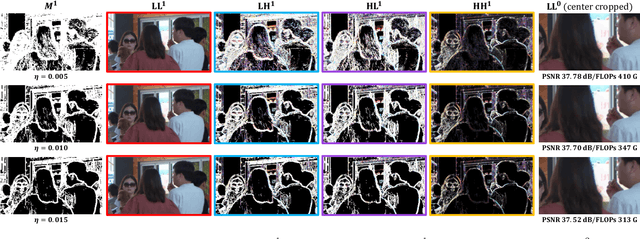
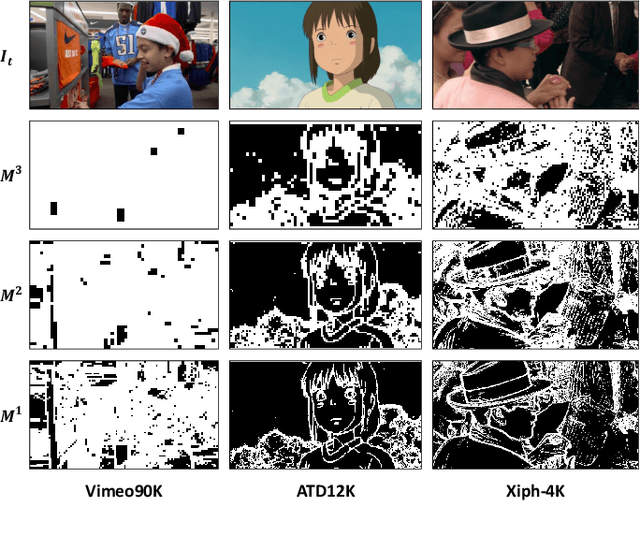
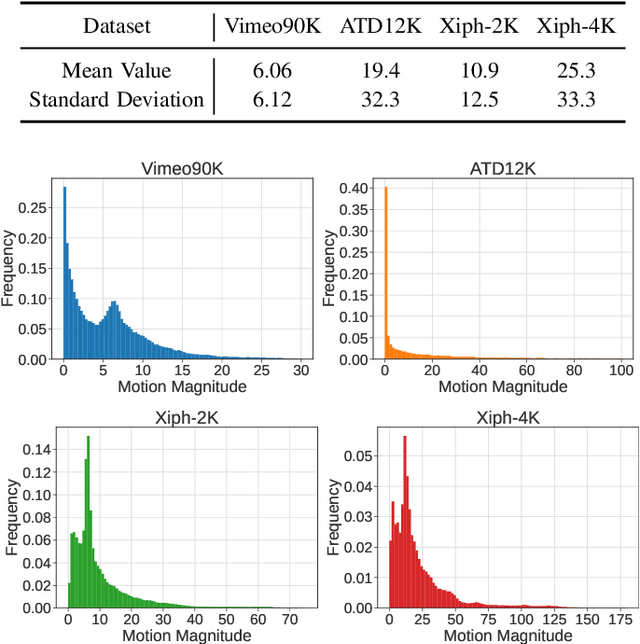
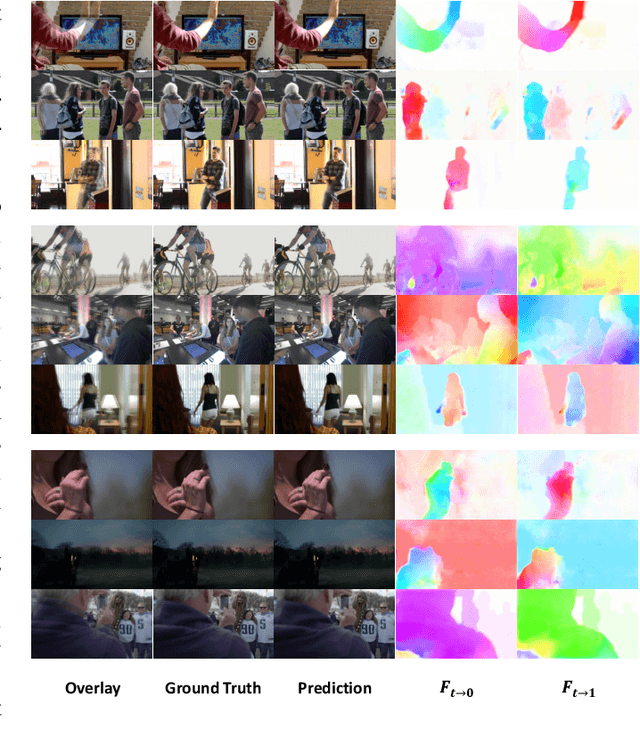
Video frame interpolation is an important low-level vision task, which can increase frame rate for more fluent visual experience. Existing methods have achieved great success by employing advanced motion models and synthesis networks. However, the spatial redundancy when synthesizing the target frame has not been fully explored, that can result in lots of inefficient computation. On the other hand, the computation compression degree in frame interpolation is highly dependent on both texture distribution and scene motion, which demands to understand the spatial-temporal information of each input frame pair for a better compression degree selection. In this work, we propose a novel two-stage frame interpolation framework termed WaveletVFI to address above problems. It first estimates intermediate optical flow with a lightweight motion perception network, and then a wavelet synthesis network uses flow aligned context features to predict multi-scale wavelet coefficients with sparse convolution for efficient target frame reconstruction, where the sparse valid masks that control computation in each scale are determined by a crucial threshold ratio. Instead of setting a fixed value like previous methods, we find that embedding a classifier in the motion perception network to learn a dynamic threshold for each sample can achieve more computation reduction with almost no loss of accuracy. On the common high resolution and animation frame interpolation benchmarks, proposed WaveletVFI can reduce computation up to 40% while maintaining similar accuracy, making it perform more efficiently against other state-of-the-arts. Code is available at https://github.com/ltkong218/WaveletVFI.
Towards Better Data Exploitation In Self-Supervised Monocular Depth Estimation
Sep 11, 2023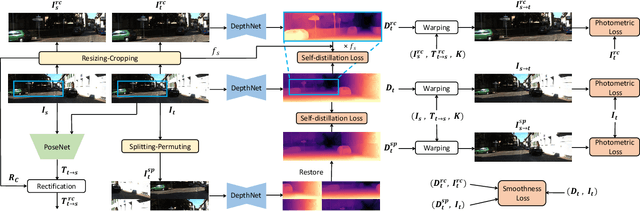
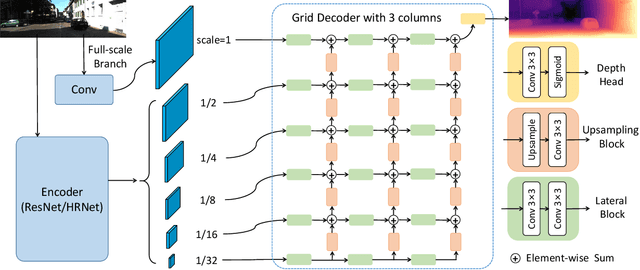
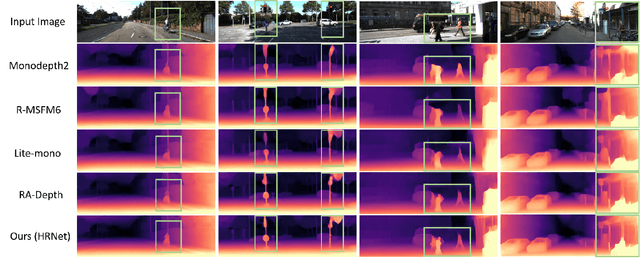
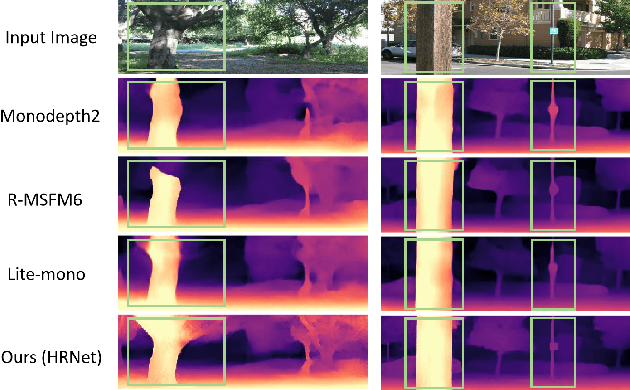
Depth estimation plays an important role in the robotic perception system. Self-supervised monocular paradigm has gained significant attention since it can free training from the reliance on depth annotations. Despite recent advancements, existing self-supervised methods still underutilize the available training data, limiting their generalization ability. In this paper, we take two data augmentation techniques, namely Resizing-Cropping and Splitting-Permuting, to fully exploit the potential of training datasets. Specifically, the original image and the generated two augmented images are fed into the training pipeline simultaneously and we leverage them to conduct self-distillation. Additionally, we introduce the detail-enhanced DepthNet with an extra full-scale branch in the encoder and a grid decoder to enhance the restoration of fine details in depth maps. Experimental results demonstrate our method can achieve state-of-the-art performance on the KITTI benchmark, with both raw ground truth and improved ground truth. Moreover, our models also show superior generalization performance when transferring to Make3D and NYUv2 datasets. Our codes are available at https://github.com/Sauf4896/BDEdepth.
Evaluation and Mitigation of Agnosia in Multimodal Large Language Models
Sep 07, 2023
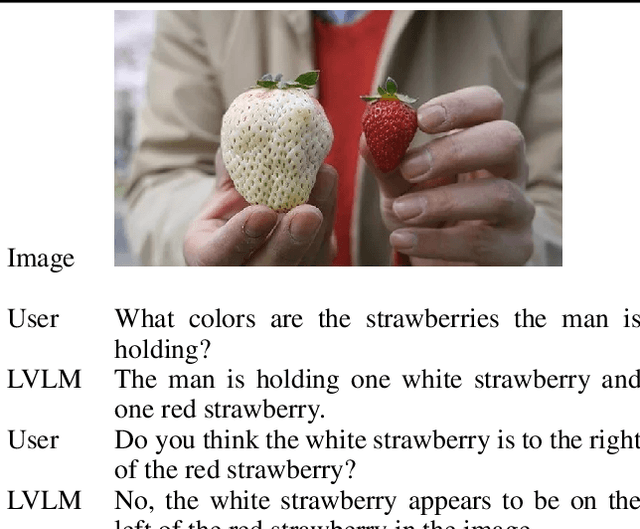
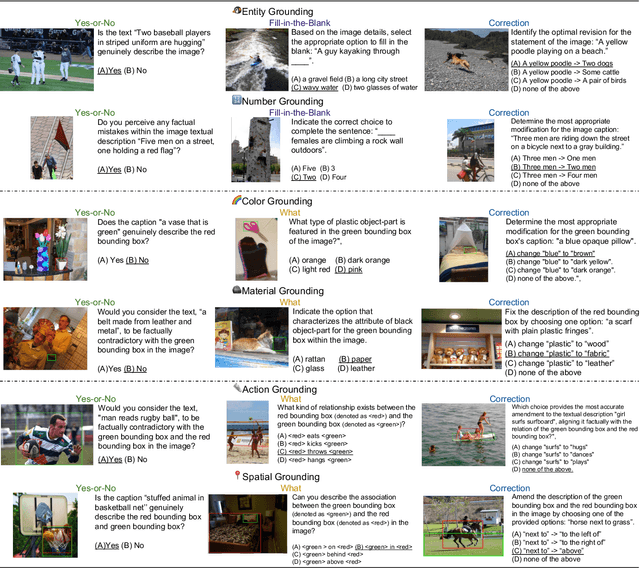
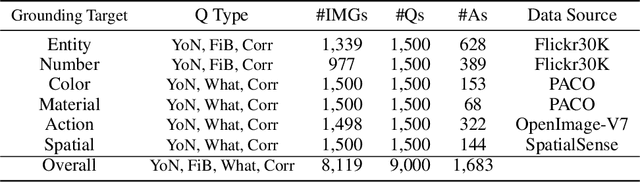
While Multimodal Large Language Models (MLLMs) are widely used for a variety of vision-language tasks, one observation is that they sometimes misinterpret visual inputs or fail to follow textual instructions even in straightforward cases, leading to irrelevant responses, mistakes, and ungrounded claims. This observation is analogous to a phenomenon in neuropsychology known as Agnosia, an inability to correctly process sensory modalities and recognize things (e.g., objects, colors, relations). In our study, we adapt this similar concept to define "agnosia in MLLMs", and our goal is to comprehensively evaluate and mitigate such agnosia in MLLMs. Inspired by the diagnosis and treatment process in neuropsychology, we propose a novel framework EMMA (Evaluation and Mitigation of Multimodal Agnosia). In EMMA, we develop an evaluation module that automatically creates fine-grained and diverse visual question answering examples to assess the extent of agnosia in MLLMs comprehensively. We also develop a mitigation module to reduce agnosia in MLLMs through multimodal instruction tuning on fine-grained conversations. To verify the effectiveness of our framework, we evaluate and analyze agnosia in seven state-of-the-art MLLMs using 9K test samples. The results reveal that most of them exhibit agnosia across various aspects and degrees. We further develop a fine-grained instruction set and tune MLLMs to mitigate agnosia, which led to notable improvement in accuracy.
Neural Network-Based Histologic Remission Prediction In Ulcerative Colitis
Aug 28, 2023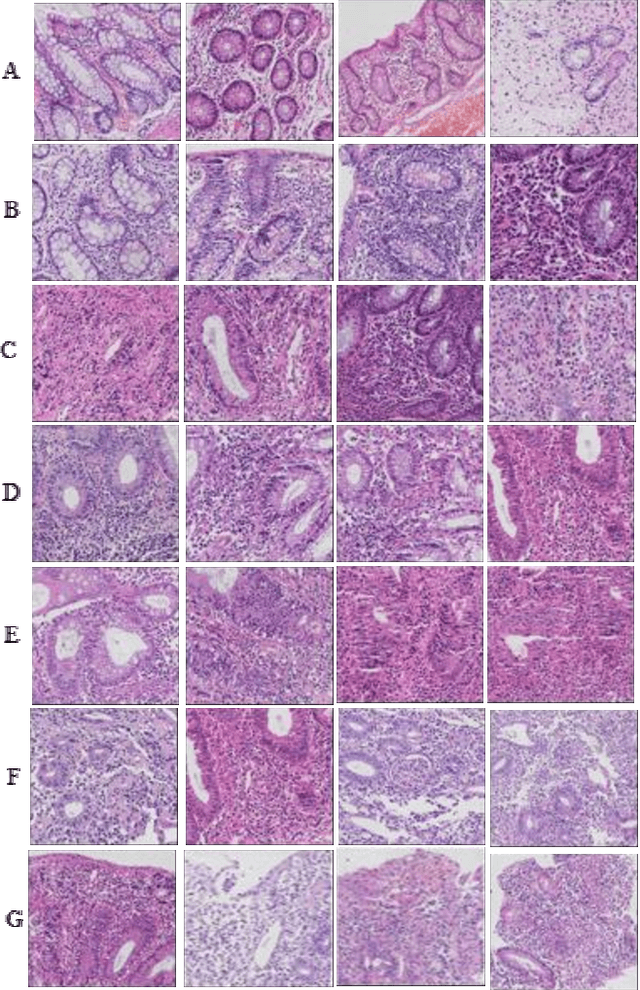
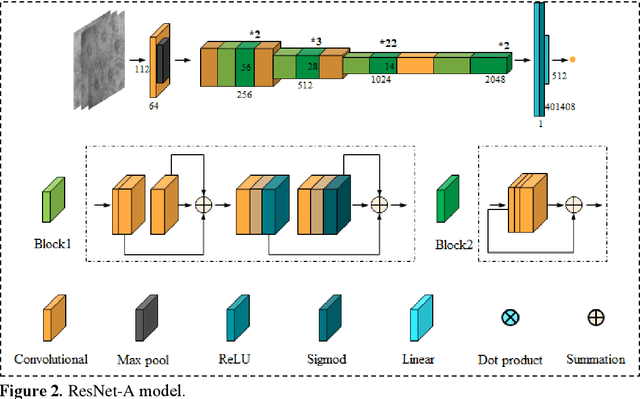
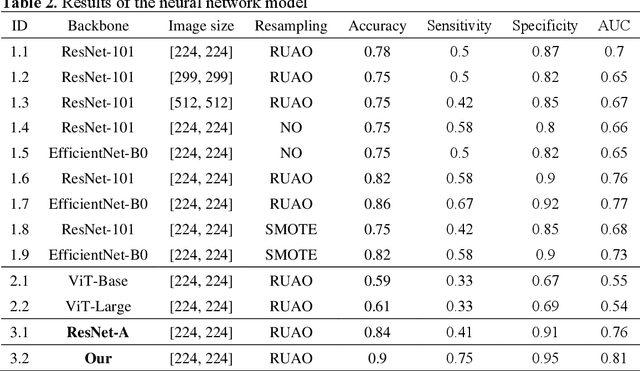
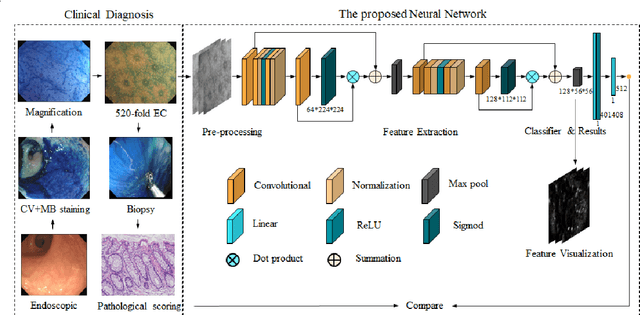
BACKGROUND & AIMS: Histological remission (HR) is advocated and considered as a new therapeutic target in ulcerative colitis (UC). Diagnosis of histologic remission currently relies on biopsy; during this process, patients are at risk for bleeding, infection, and post-biopsy fibrosis. In addition, histologic response scoring is complex and time-consuming, and there is heterogeneity among pathologists. Endocytoscopy (EC) is a novel ultra-high magnification endoscopic technique that can provide excellent in vivo assessment of glands. Based on the EC technique, we propose a neural network model that can assess histological disease activity in UC using EC images to address the above issues. The experiment results demonstrate that the proposed method can assist patients in precise treatment and prognostic assessment. METHODS: We construct a neural network model for UC evaluation. A total of 5105 images of 154 intestinal segments from 87 patients undergoing EC treatment at a center in China between March 2022 and March 2023 are scored according to the Geboes score. Subsequently, 103 intestinal segments are used as the training set, 16 intestinal segments are used as the validation set for neural network training, and the remaining 35 intestinal segments are used as the test set to measure the model performance together with the validation set. RESULTS: By treating HR as a negative category and histologic activity as a positive category, the proposed neural network model can achieve an accuracy of 0.9, a specificity of 0.95, a sensitivity of 0.75, and an area under the curve (AUC) of 0.81. CONCLUSION: We develop a specific neural network model that can distinguish histologic remission/activity in EC images of UC, which helps to accelerate clinical histological diagnosis. keywords: ulcerative colitis; Endocytoscopy; Geboes score; neural network.
ARTIST: ARTificial Intelligence for Simplified Text
Aug 25, 2023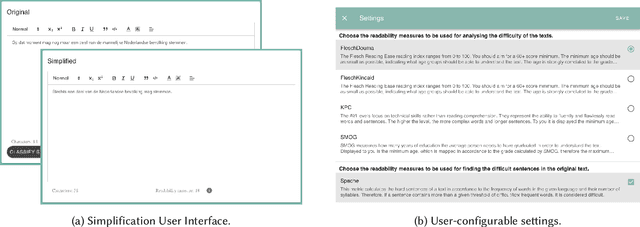
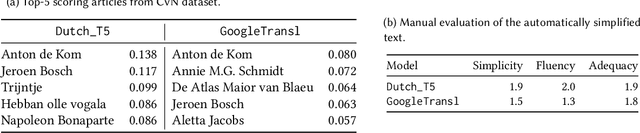
Complex text is a major barrier for many citizens when accessing public information and knowledge. While often done manually, Text Simplification is a key Natural Language Processing task that aims for reducing the linguistic complexity of a text while preserving the original meaning. Recent advances in Generative Artificial Intelligence (AI) have enabled automatic text simplification both on the lexical and syntactical levels. However, as applications often focus on English, little is understood about the effectiveness of Generative AI techniques on low-resource languages such as Dutch. For this reason, we carry out empirical studies to understand the benefits and limitations of applying generative technologies for text simplification and provide the following outcomes: 1) the design and implementation for a configurable text simplification pipeline that orchestrates state-of-the-art generative text simplification models, domain and reader adaptation, and visualisation modules; 2) insights and lessons learned, showing the strengths of automatic text simplification while exposing the challenges in handling cultural and commonsense knowledge. These outcomes represent a first step in the exploration of Dutch text simplification and shed light on future endeavours both for research and practice.
Neural Interactive Keypoint Detection
Aug 20, 2023This work proposes an end-to-end neural interactive keypoint detection framework named Click-Pose, which can significantly reduce more than 10 times labeling costs of 2D keypoint annotation compared with manual-only annotation. Click-Pose explores how user feedback can cooperate with a neural keypoint detector to correct the predicted keypoints in an interactive way for a faster and more effective annotation process. Specifically, we design the pose error modeling strategy that inputs the ground truth pose combined with four typical pose errors into the decoder and trains the model to reconstruct the correct poses, which enhances the self-correction ability of the model. Then, we attach an interactive human-feedback loop that allows receiving users' clicks to correct one or several predicted keypoints and iteratively utilizes the decoder to update all other keypoints with a minimum number of clicks (NoC) for efficient annotation. We validate Click-Pose in in-domain, out-of-domain scenes, and a new task of keypoint adaptation. For annotation, Click-Pose only needs 1.97 and 6.45 NoC@95 (at precision 95%) on COCO and Human-Art, reducing 31.4% and 36.3% efforts than the SOTA model (ViTPose) with manual correction, respectively. Besides, without user clicks, Click-Pose surpasses the previous end-to-end model by 1.4 AP on COCO and 3.0 AP on Human-Art. The code is available at https://github.com/IDEA-Research/Click-Pose.
Tackling Vision Language Tasks Through Learning Inner Monologues
Aug 19, 2023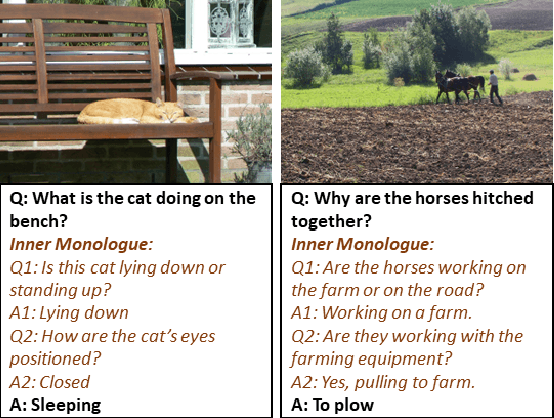
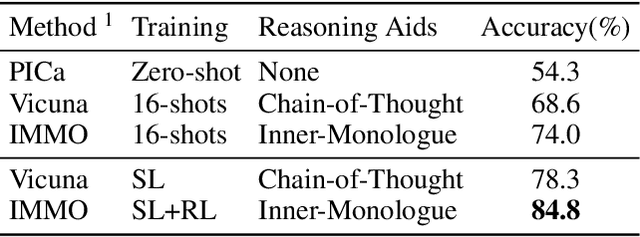
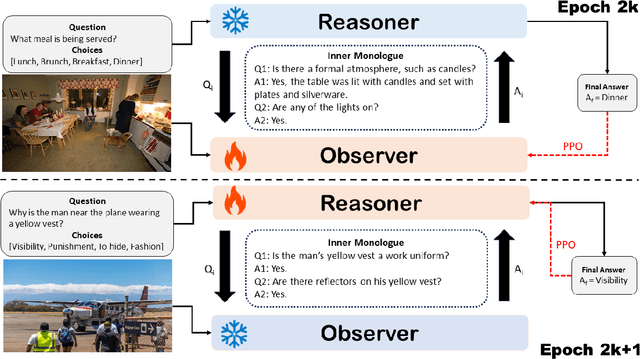
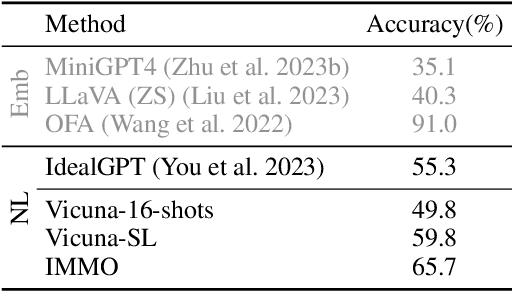
Visual language tasks require AI models to comprehend and reason with both visual and textual content. Driven by the power of Large Language Models (LLMs), two prominent methods have emerged: (1) the hybrid integration between LLMs and Vision-Language Models (VLMs), where visual inputs are firstly converted into language descriptions by VLMs, serving as inputs for LLMs to generate final answer(s); (2) visual feature alignment in language space, where visual inputs are encoded as embeddings and projected to LLMs' language space via further supervised fine-tuning. The first approach provides light training costs and interpretability but is hard to be optimized in an end-to-end fashion. The second approach presents decent performance, but feature alignment usually requires large amounts of training data and lacks interpretability. To tackle this dilemma, we propose a novel approach, Inner Monologue Multi-Modal Optimization (IMMO), to solve complex vision language problems by simulating inner monologue processes, a cognitive process in which an individual engages in silent verbal communication with themselves. We enable LLMs and VLMs to interact through natural language conversation and propose to use a two-stage training process to learn how to do the inner monologue (self-asking questions and answering questions). IMMO is evaluated on two popular tasks and the results suggest by emulating the cognitive phenomenon of internal dialogue, our approach can enhance reasoning and explanation abilities, contributing to the more effective fusion of vision and language models. More importantly, instead of using predefined human-crafted monologues, IMMO learns this process within the deep learning models, promising wider applicability to many different AI problems beyond vision language tasks.
MC-DRE: Multi-Aspect Cross Integration for Drug Event/Entity Extraction
Aug 15, 2023Extracting meaningful drug-related information chunks, such as adverse drug events (ADE), is crucial for preventing morbidity and saving many lives. Most ADEs are reported via an unstructured conversation with the medical context, so applying a general entity recognition approach is not sufficient enough. In this paper, we propose a new multi-aspect cross-integration framework for drug entity/event detection by capturing and aligning different context/language/knowledge properties from drug-related documents. We first construct multi-aspect encoders to describe semantic, syntactic, and medical document contextual information by conducting those slot tagging tasks, main drug entity/event detection, part-of-speech tagging, and general medical named entity recognition. Then, each encoder conducts cross-integration with other contextual information in three ways: the key-value cross, attention cross, and feedforward cross, so the multi-encoders are integrated in depth. Our model outperforms all SOTA on two widely used tasks, flat entity detection and discontinuous event extraction.
Pick the Best Pre-trained Model: Towards Transferability Estimation for Medical Image Segmentation
Jul 22, 2023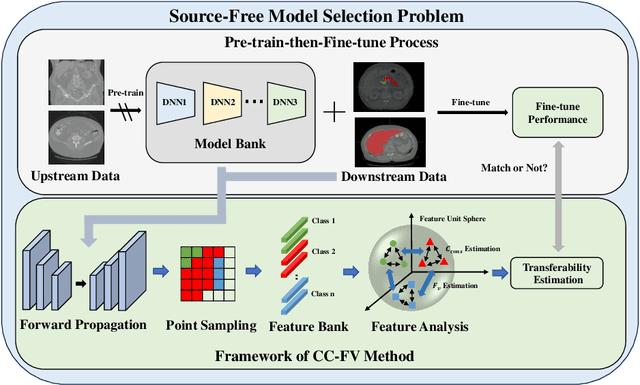
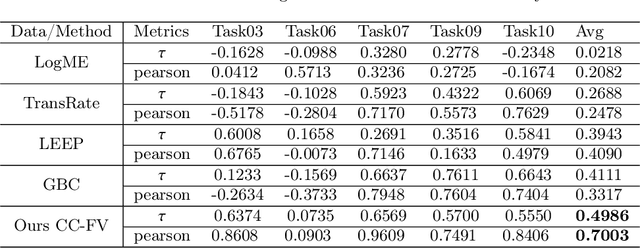
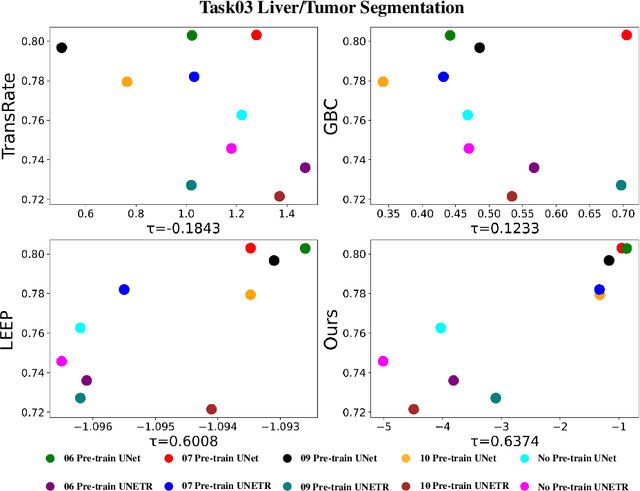
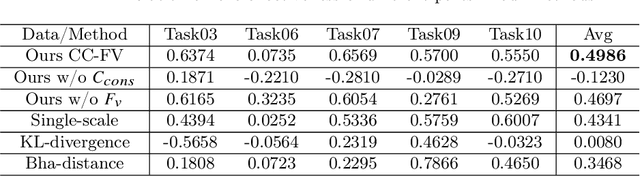
Transfer learning is a critical technique in training deep neural networks for the challenging medical image segmentation task that requires enormous resources. With the abundance of medical image data, many research institutions release models trained on various datasets that can form a huge pool of candidate source models to choose from. Hence, it's vital to estimate the source models' transferability (i.e., the ability to generalize across different downstream tasks) for proper and efficient model reuse. To make up for its deficiency when applying transfer learning to medical image segmentation, in this paper, we therefore propose a new Transferability Estimation (TE) method. We first analyze the drawbacks of using the existing TE algorithms for medical image segmentation and then design a source-free TE framework that considers both class consistency and feature variety for better estimation. Extensive experiments show that our method surpasses all current algorithms for transferability estimation in medical image segmentation. Code is available at https://github.com/EndoluminalSurgicalVision-IMR/CCFV