 Add to Chrome
 Add to Firefox
 Add to Edge
Ling and Ring 2.6 Technical Report: Efficient and Instant Agentic Intelligence at Trillion-Parameter Scale
Jun 13, 2026
Efficient and scalable agentic intelligence requires models that can deliver both low-latency responses and strong reasoning capabilities while remaining practical to train, serve, and deploy. In this report, we present Ling-2.6 and Ring-2.6, a family of models designed to address this challenge at scale. Ling-2.6 is optimized for instant response generation and high capability per output token, whereas Ring-2.6 is tailored for deeper reasoning and more advanced agentic workflows. Instead of training from scratch, we upgrade the Ling-2.0 base model through architectural migration pre-training and large-scale post-training. This upgrade is guided by a unified co-design of model architecture, optimization objectives, serving systems, and agent training environments, enabling improvements in both model capability and deployment efficiency. At the architectural level, we introduce a hybrid linear attention design that integrates Lightning Attention with MLA, improving the efficiency of long-context training and decoding. To further enhance token efficiency, we optimize capability per output token through Evolutionary Chain-of-Thought, Linguistic Unit Policy Optimization, bidirectional preference alignment, and shortest-correct-response distillation. For agentic capabilities, we propose KPop, a reinforcement learning framework designed to support stable training of Ring-2.6-1T on large-scale environment-grounded data. KPop improves training efficiency through asynchronous scheduling across coding, search, tool use, and workflow execution, enabling scalable learning from complex agent-environment interactions. Together, Ling-2.6 and Ring-2.6 provide a practical pathway toward efficient, scalable, and open agentic systems. We open-source all checkpoints in the 2.6 family to support further research and development in practical agentic intelligence.

How Far Has AI Come in Liver Fibrosis Staging? A Large-Scale Real-World Dataset and Benchmark
May 25, 2026Despite years of methodological progress, how far AI has come in liver fibrosis staging has never been systematically evaluated under the heterogeneous, multi-center conditions that define clinical practice. To address this gap, we introduce LiFS, a large-scale dataset and benchmark derived from the MICCAI 2025 CARE-Liver challenge, comprising 610 patients across multiple centers and scanners with multi-sequence MRI. To the best of our knowledge, LiFS is the first benchmark providing complete gadoxetic acid-enhanced sequences with histopathology-confirmed annotations from diverse real-world scanners. Through systematic evaluation of 9 independently developed methods selected from 96 registered teams against in-cohort radiologist reference results, our findings address how far current AI has progressed toward clinical-level liver fibrosis staging from three complementary perspectives. First, against radiologists, the best AI methods were broadly comparable to the senior radiologist and significantly exceeded the junior radiologist in selected settings, while median AI performance generally approached junior-radiologist levels. Second, from a data perspective, cross-center heterogeneity, label imbalance, and contrast-enhanced sequence variability emerge as the dominant challenges for AI methods. Third, from a technical perspective, methodological design choices, including spatial registration, input dimensionality, multi-modal fusion strategy, and backbone architecture, appear to modulate cross-center robustness, although no single choice alone closes the gap. Overall, LiFS provides a rigorous real-world benchmark for positioning the current state of AI in liver fibrosis staging and for enabling future research on the key challenges that limit clinically reliable deployment.
TubeMLLM: A Foundation Model for Topology Knowledge Exploration in Vessel-like Anatomy
Mar 10, 2026Modeling medical vessel-like anatomy is challenging due to its intricate topology and sensitivity to dataset shifts. Consequently, task-specific models often suffer from topological inconsistencies, including artificial disconnections and spurious merges. Motivated by the promise of multimodal large language models (MLLMs) for zero-shot generalization, we propose TubeMLLM, a unified foundation model that couples structured understanding with controllable generation for medical vessel-like anatomy. By integrating topological priors through explicit natural language prompting and aligning them with visual representations in a shared-attention architecture, TubeMLLM significantly enhances topology-aware perception. Furthermore, we construct TubeMData, a pionner multimodal benchmark comprising comprehensive topology-centric tasks, and introduce an adaptive loss weighting strategy to emphasize topology-critical regions during training. Extensive experiments on fifteen diverse datasets demonstrate our superiority. Quantitatively, TubeMLLM achieves state-of-the-art out-of-distribution performance, substantially reducing global topological discrepancies on color fundus photography (decreasing the $β_{0}$ number error from 37.42 to 8.58 compared to baselines). Notably, TubeMLLM exhibits exceptional zero-shot cross-modality transferring ability on unseen X-ray angiography, achieving a Dice score of 67.50% while significantly reducing the $β_{0}$ error to 1.21. TubeMLLM also maintains robustness against degradations such as blur, noise, and low resolution. Furthermore, in topology-aware understanding tasks, the model achieves 97.38% accuracy in evaluating mask topological quality, significantly outperforming standard vision-language baselines.
Long-Short Term Agents for Pure-Vision Bronchoscopy Robotic Autonomy
Mar 09, 2026Accurate intraoperative navigation is essential for robot-assisted endoluminal intervention, but remains difficult because of limited endoscopic field of view and dynamic artifacts. Existing navigation platforms often rely on external localization technologies, such as electromagnetic tracking or shape sensing, which increase hardware complexity and remain vulnerable to intraoperative anatomical mismatch. We present a vision-only autonomy framework that performs long-horizon bronchoscopic navigation using preoperative CT-derived virtual targets and live endoscopic video, without external tracking during navigation. The framework uses hierarchical long-short agents: a short-term reactive agent for continuous low-latency motion control, and a long-term strategic agent for decision support at anatomically ambiguous points. When their recommendations conflict, a world-model critic predicts future visual states for candidate actions and selects the action whose predicted state best matches the target view. We evaluated the system in a high-fidelity airway phantom, three ex vivo porcine lungs, and a live porcine model. The system reached all planned segmental targets in the phantom, maintained 80\% success to the eighth generation ex vivo, and achieved in vivo navigation performance comparable to the expert bronchoscopist. These results support the preclinical feasibility of sensor-free autonomous bronchoscopic navigation.
EndoSERV: A Vision-based Endoluminal Robot Navigation System
Mar 09, 2026Robot-assisted endoluminal procedures are increasingly used for early cancer intervention. However, the intricate, narrow and tortuous pathways within the luminal anatomy pose substantial difficulties for robot navigation. Vision-based navigation offers a promising solution, but existing localization approaches are error-prone due to tissue deformation, in vivo artifacts and a lack of distinctive landmarks for consistent localization. This paper presents a novel EndoSERV localization method to address these challenges. It includes two main parts, \textit{i.e.}, \textbf{SE}gment-to-structure and \textbf{R}eal-to-\textbf{V}irtual mapping, and hence the name. For long-range and complex luminal structures, we divide them into smaller sub-segments and estimate the odometry independently. To cater for label insufficiency, an efficient transfer technique maps real image features to the virtual domain to use virtual pose ground truth. The training phases of EndoSERV include an offline pretraining to extract texture-agnostic features, and an online phase that adapts to real-world conditions. Extensive experiments based on both public and clinical datasets have been performed to demonstrate the effectiveness of the method even without any real pose labels.
Liver Fibrosis Quantification and Analysis: The LiQA Dataset and Baseline Method
Dec 22, 2025Liver fibrosis represents a significant global health burden, necessitating accurate staging for effective clinical management. This report introduces the LiQA (Liver Fibrosis Quantification and Analysis) dataset, established as part of the CARE 2024 challenge. Comprising $440$ patients with multi-phase, multi-center MRI scans, the dataset is curated to benchmark algorithms for Liver Segmentation (LiSeg) and Liver Fibrosis Staging (LiFS) under complex real-world conditions, including domain shifts, missing modalities, and spatial misalignment. We further describe the challenge's top-performing methodology, which integrates a semi-supervised learning framework with external data for robust segmentation, and utilizes a multi-view consensus approach with Class Activation Map (CAM)-based regularization for staging. Evaluation of this baseline demonstrates that leveraging multi-source data and anatomical constraints significantly enhances model robustness in clinical settings.
TopoSculpt: Betti-Steered Topological Sculpting of 3D Fine-grained Tubular Shapes
Sep 04, 2025Medical tubular anatomical structures are inherently three-dimensional conduits with lumens, enclosing walls, and complex branching topologies. Accurate reconstruction of their geometry and topology is crucial for applications such as bronchoscopic navigation and cerebral arterial connectivity assessment. Existing methods often rely on voxel-wise overlap measures, which fail to capture topological correctness and completeness. Although topology-aware losses and persistent homology constraints have shown promise, they are usually applied patch-wise and cannot guarantee global preservation or correct geometric errors at inference. To address these limitations, we propose a novel TopoSculpt, a framework for topological refinement of 3D fine-grained tubular structures. TopoSculpt (i) adopts a holistic whole-region modeling strategy to capture full spatial context, (ii) first introduces a Topological Integrity Betti (TIB) constraint that jointly enforces Betti number priors and global integrity, and (iii) employs a curriculum refinement scheme with persistent homology to progressively correct errors from coarse to fine scales. Extensive experiments on challenging pulmonary airway and Circle of Willis datasets demonstrate substantial improvements in both geometry and topology. For instance, $\beta_{0}$ errors are reduced from 69.00 to 3.40 on the airway dataset and from 1.65 to 0.30 on the CoW dataset, with Tree length detected and branch detected rates improving by nearly 10\%. These results highlight the effectiveness of TopoSculpt in correcting critical topological errors and advancing the high-fidelity modeling of complex 3D tubular anatomy. The project homepage is available at: https://github.com/Puzzled-Hui/TopoSculpt.
Shape-aware Sampling Matters in the Modeling of Multi-Class Tubular Structures
Jun 14, 2025Accurate multi-class tubular modeling is critical for precise lesion localization and optimal treatment planning. Deep learning methods enable automated shape modeling by prioritizing volumetric overlap accuracy. However, the inherent complexity of fine-grained semantic tubular shapes is not fully emphasized by overlap accuracy, resulting in reduced topological preservation. To address this, we propose the Shapeaware Sampling (SAS), which optimizes patchsize allocation for online sampling and extracts a topology-preserved skeletal representation for the objective function. Fractal Dimension-based Patchsize (FDPS) is first introduced to quantify semantic tubular shape complexity through axis-specific fractal dimension analysis. Axes with higher fractal complexity are then sampled with smaller patchsizes to capture fine-grained features and resolve structural intricacies. In addition, Minimum Path-Cost Skeletonization (MPC-Skel) is employed to sample topologically consistent skeletal representations of semantic tubular shapes for skeleton-weighted objective functions. MPC-Skel reduces artifacts from conventional skeletonization methods and directs the focus to critical topological regions, enhancing tubular topology preservation. SAS is computationally efficient and easily integrable into optimization pipelines. Evaluation on two semantic tubular datasets showed consistent improvements in both volumetric overlap and topological integrity metrics.
Temporal Differential Fields for 4D Motion Modeling via Image-to-Video Synthesis
May 22, 2025Temporal modeling on regular respiration-induced motions is crucial to image-guided clinical applications. Existing methods cannot simulate temporal motions unless high-dose imaging scans including starting and ending frames exist simultaneously. However, in the preoperative data acquisition stage, the slight movement of patients may result in dynamic backgrounds between the first and last frames in a respiratory period. This additional deviation can hardly be removed by image registration, thus affecting the temporal modeling. To address that limitation, we pioneeringly simulate the regular motion process via the image-to-video (I2V) synthesis framework, which animates with the first frame to forecast future frames of a given length. Besides, to promote the temporal consistency of animated videos, we devise the Temporal Differential Diffusion Model to generate temporal differential fields, which measure the relative differential representations between adjacent frames. The prompt attention layer is devised for fine-grained differential fields, and the field augmented layer is adopted to better interact these fields with the I2V framework, promoting more accurate temporal variation of synthesized videos. Extensive results on ACDC cardiac and 4D Lung datasets reveal that our approach simulates 4D videos along the intrinsic motion trajectory, rivaling other competitive methods on perceptual similarity and temporal consistency. Codes will be available soon.
Multi-Class Segmentation of Aortic Branches and Zones in Computed Tomography Angiography: The AortaSeg24 Challenge
Feb 07, 2025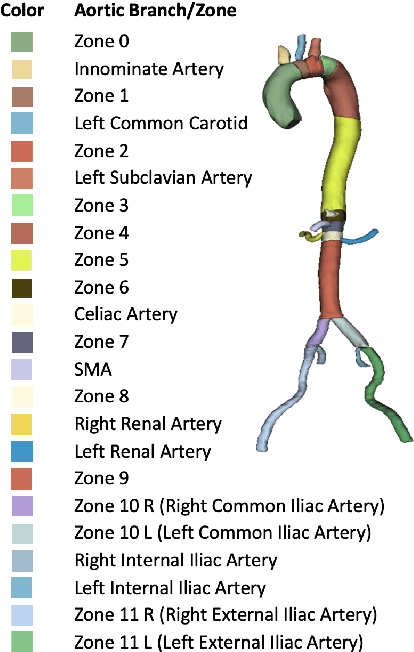
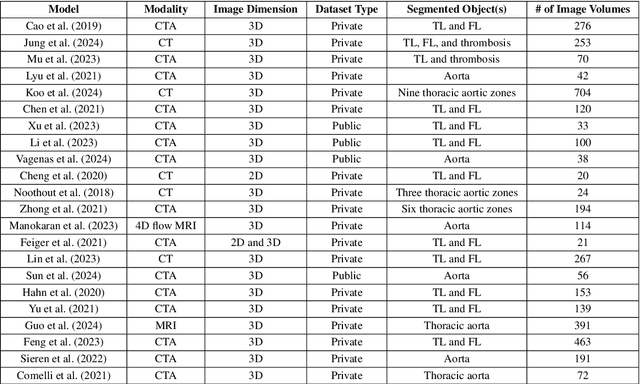
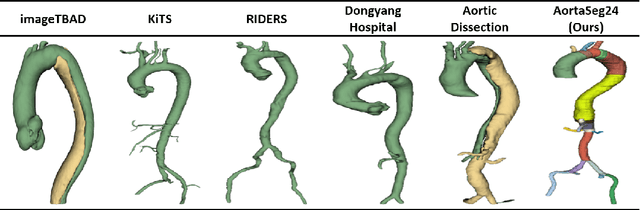
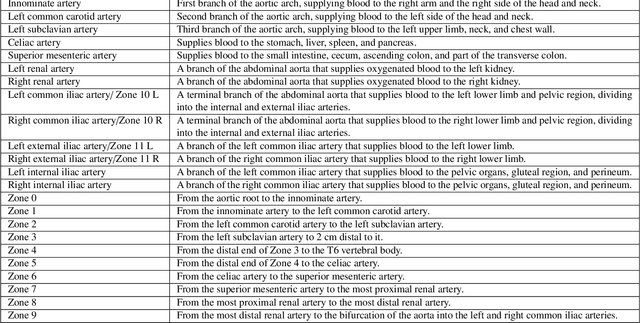
Multi-class segmentation of the aorta in computed tomography angiography (CTA) scans is essential for diagnosing and planning complex endovascular treatments for patients with aortic dissections. However, existing methods reduce aortic segmentation to a binary problem, limiting their ability to measure diameters across different branches and zones. Furthermore, no open-source dataset is currently available to support the development of multi-class aortic segmentation methods. To address this gap, we organized the AortaSeg24 MICCAI Challenge, introducing the first dataset of 100 CTA volumes annotated for 23 clinically relevant aortic branches and zones. This dataset was designed to facilitate both model development and validation. The challenge attracted 121 teams worldwide, with participants leveraging state-of-the-art frameworks such as nnU-Net and exploring novel techniques, including cascaded models, data augmentation strategies, and custom loss functions. We evaluated the submitted algorithms using the Dice Similarity Coefficient (DSC) and Normalized Surface Distance (NSD), highlighting the approaches adopted by the top five performing teams. This paper presents the challenge design, dataset details, evaluation metrics, and an in-depth analysis of the top-performing algorithms. The annotated dataset, evaluation code, and implementations of the leading methods are publicly available to support further research. All resources can be accessed at https://aortaseg24.grand-challenge.org.