 Add to Chrome
 Add to Firefox
 Add to Edge
When Life Gives You AI, Will You Turn It Into A Market for Lemons? Understanding How Information Asymmetries About AI System Capabilities Affect Market Outcomes and Adoption
Jan 29, 2026
AI consumer markets are characterized by severe buyer-supplier market asymmetries. Complex AI systems can appear highly accurate while making costly errors or embedding hidden defects. While there have been regulatory efforts surrounding different forms of disclosure, large information gaps remain. This paper provides the first experimental evidence on the important role of information asymmetries and disclosure designs in shaping user adoption of AI systems. We systematically vary the density of low-quality AI systems and the depth of disclosure requirements in a simulated AI product market to gauge how people react to the risk of accidentally relying on a low-quality AI system. Then, we compare participants' choices to a rational Bayesian model, analyzing the degree to which partial information disclosure can improve AI adoption. Our results underscore the deleterious effects of information asymmetries on AI adoption, but also highlight the potential of partial disclosure designs to improve the overall efficiency of human decision-making.

Incentive-Tuning: Understanding and Designing Incentives for Empirical Human-AI Decision-Making Studies
Jan 21, 2026AI has revolutionised decision-making across various fields. Yet human judgement remains paramount for high-stakes decision-making. This has fueled explorations of collaborative decision-making between humans and AI systems, aiming to leverage the strengths of both. To explore this dynamic, researchers conduct empirical studies, investigating how humans use AI assistance for decision-making and how this collaboration impacts results. A critical aspect of conducting these studies is the role of participants, often recruited through crowdsourcing platforms. The validity of these studies hinges on the behaviours of the participants, hence effective incentives that can potentially affect these behaviours are a key part of designing and executing these studies. In this work, we aim to address the critical role of incentive design for conducting empirical human-AI decision-making studies, focusing on understanding, designing, and documenting incentive schemes. Through a thematic review of existing research, we explored the current practices, challenges, and opportunities associated with incentive design for human-AI decision-making empirical studies. We identified recurring patterns, or themes, such as what comprises the components of an incentive scheme, how incentive schemes are manipulated by researchers, and the impact they can have on research outcomes. Leveraging the acquired understanding, we curated a set of guidelines to aid researchers in designing effective incentive schemes for their studies, called the Incentive-Tuning Framework, outlining how researchers can undertake, reflect on, and document the incentive design process. By advocating for a standardised yet flexible approach to incentive design and contributing valuable insights along with practical tools, we hope to pave the way for more reliable and generalizable knowledge in the field of human-AI decision-making.
From SERPs to Sound: How Search Engine Result Pages and AI-generated Podcasts Interact to Influence User Attitudes on Controversial Topics
Jan 16, 2026Compared to search engine result pages (SERPs), AI-generated podcasts represent a relatively new and relatively more passive modality of information consumption, delivering narratives in a naturally engaging format. As these two media increasingly converge in everyday information-seeking behavior, it is essential to explore how their interaction influences user attitudes, particularly in contexts involving controversial, value-laden, and often debated topics. Addressing this need, we aim to understand how information mediums of present-day SERPs and AI-generated podcasts interact to shape the opinions of users. To this end, through a controlled user study (N=483), we investigated user attitudinal effects of consuming information via SERPs and AI-generated podcasts, focusing on how the sequence and modality of exposure shape user opinions. A majority of users in our study corresponded to attitude change outcomes, and we found an effect of sequence on attitude change. Our results further revealed a role of viewpoint bias and the degree of topic controversiality in shaping attitude change, although we found no effect of individual moderators.
Know Your Users! Estimating User Domain Knowledge in Conversational Recommenders
Dec 15, 2025The ideal conversational recommender system (CRS) acts like a savvy salesperson, adapting its language and suggestions to each user's level of expertise. However, most current systems treat all users as experts, leading to frustrating and inefficient interactions when users are unfamiliar with a domain. Systems that can adapt their conversational strategies to a user's knowledge level stand to offer a much more natural and effective experience. To make a step toward such adaptive systems, we introduce a new task: estimating user domain knowledge from conversations, enabling a CRS to better understand user needs and personalize interactions. A key obstacle to developing such adaptive systems is the lack of suitable data; to our knowledge, no existing dataset captures the conversational behaviors of users with varying levels of domain knowledge. Furthermore, in most dialogue collection protocols, users are free to express their own preferences, which tends to concentrate on popular items and well-known features, offering little insight into how novices explore or learn about unfamiliar features. To address this, we design a game-based data collection protocol that elicits varied expressions of knowledge, release the resulting dataset, and provide an initial analysis to highlight its potential for future work on user-knowledge-aware CRS.
Should We Tailor the Talk? Understanding the Impact of Conversational Styles on Preference Elicitation in Conversational Recommender Systems
Apr 17, 2025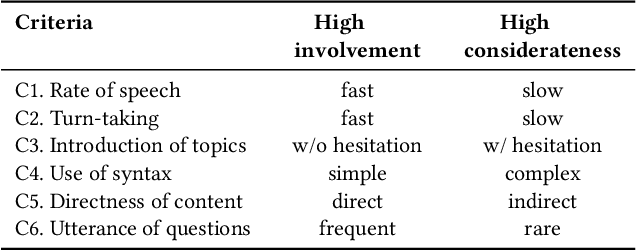
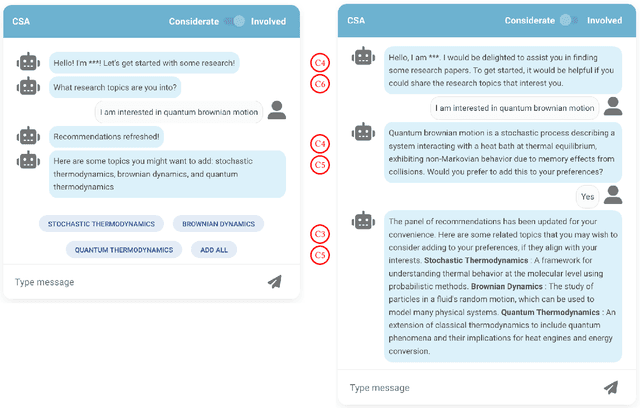
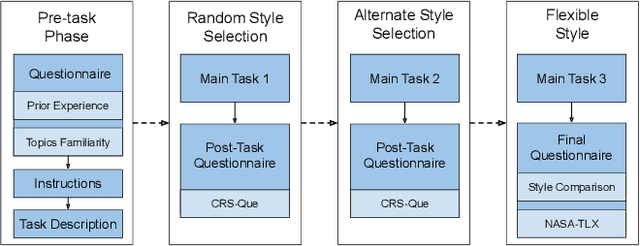

Conversational recommender systems (CRSs) provide users with an interactive means to express preferences and receive real-time personalized recommendations. The success of these systems is heavily influenced by the preference elicitation process. While existing research mainly focuses on what questions to ask during preference elicitation, there is a notable gap in understanding what role broader interaction patterns including tone, pacing, and level of proactiveness play in supporting users in completing a given task. This study investigates the impact of different conversational styles on preference elicitation, task performance, and user satisfaction with CRSs. We conducted a controlled experiment in the context of scientific literature recommendation, contrasting two distinct conversational styles, high involvement (fast paced, direct, and proactive with frequent prompts) and high considerateness (polite and accommodating, prioritizing clarity and user comfort) alongside a flexible experimental condition where users could switch between the two. Our results indicate that adapting conversational strategies based on user expertise and allowing flexibility between styles can enhance both user satisfaction and the effectiveness of recommendations in CRSs. Overall, our findings hold important implications for the design of future CRSs.
"Even explanations will not help in trusting [this] fundamentally biased system": A Predictive Policing Case-Study
Apr 15, 2025In today's society, where Artificial Intelligence (AI) has gained a vital role, concerns regarding user's trust have garnered significant attention. The use of AI systems in high-risk domains have often led users to either under-trust it, potentially causing inadequate reliance or over-trust it, resulting in over-compliance. Therefore, users must maintain an appropriate level of trust. Past research has indicated that explanations provided by AI systems can enhance user understanding of when to trust or not trust the system. However, the utility of presentation of different explanations forms still remains to be explored especially in high-risk domains. Therefore, this study explores the impact of different explanation types (text, visual, and hybrid) and user expertise (retired police officers and lay users) on establishing appropriate trust in AI-based predictive policing. While we observed that the hybrid form of explanations increased the subjective trust in AI for expert users, it did not led to better decision-making. Furthermore, no form of explanations helped build appropriate trust. The findings of our study emphasize the importance of re-evaluating the use of explanations to build [appropriate] trust in AI based systems especially when the system's use is questionable. Finally, we synthesize potential challenges and policy recommendations based on our results to design for appropriate trust in high-risk based AI-based systems.
Mind the Gap! Choice Independence in Using Multilingual LLMs for Persuasive Co-Writing Tasks in Different Languages
Feb 13, 2025Recent advances in generative AI have precipitated a proliferation of novel writing assistants. These systems typically rely on multilingual large language models (LLMs), providing globalized workers the ability to revise or create diverse forms of content in different languages. However, there is substantial evidence indicating that the performance of multilingual LLMs varies between languages. Users who employ writing assistance for multiple languages are therefore susceptible to disparate output quality. Importantly, recent research has shown that people tend to generalize algorithmic errors across independent tasks, violating the behavioral axiom of choice independence. In this paper, we analyze whether user utilization of novel writing assistants in a charity advertisement writing task is affected by the AI's performance in a second language. Furthermore, we quantify the extent to which these patterns translate into the persuasiveness of generated charity advertisements, as well as the role of peoples' beliefs about LLM utilization in their donation choices. Our results provide evidence that writers who engage with an LLM-based writing assistant violate choice independence, as prior exposure to a Spanish LLM reduces subsequent utilization of an English LLM. While these patterns do not affect the aggregate persuasiveness of the generated advertisements, people's beliefs about the source of an advertisement (human versus AI) do. In particular, Spanish-speaking female participants who believed that they read an AI-generated advertisement strongly adjusted their donation behavior downwards. Furthermore, people are generally not able to adequately differentiate between human-generated and LLM-generated ads. Our work has important implications for the design, development, integration, and adoption of multilingual LLMs as assistive agents -- particularly in writing tasks.
Plan-Then-Execute: An Empirical Study of User Trust and Team Performance When Using LLM Agents As A Daily Assistant
Feb 03, 2025

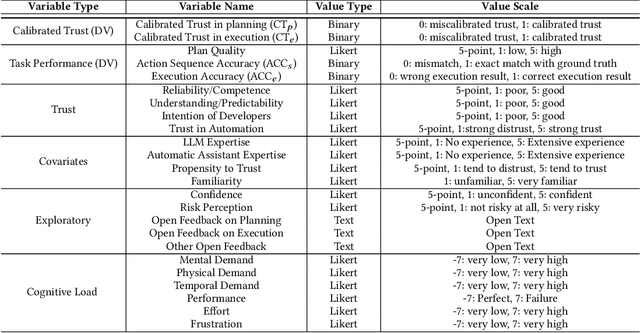

Since the explosion in popularity of ChatGPT, large language models (LLMs) have continued to impact our everyday lives. Equipped with external tools that are designed for a specific purpose (e.g., for flight booking or an alarm clock), LLM agents exercise an increasing capability to assist humans in their daily work. Although LLM agents have shown a promising blueprint as daily assistants, there is a limited understanding of how they can provide daily assistance based on planning and sequential decision making capabilities. We draw inspiration from recent work that has highlighted the value of 'LLM-modulo' setups in conjunction with humans-in-the-loop for planning tasks. We conducted an empirical study (N = 248) of LLM agents as daily assistants in six commonly occurring tasks with different levels of risk typically associated with them (e.g., flight ticket booking and credit card payments). To ensure user agency and control over the LLM agent, we adopted LLM agents in a plan-then-execute manner, wherein the agents conducted step-wise planning and step-by-step execution in a simulation environment. We analyzed how user involvement at each stage affects their trust and collaborative team performance. Our findings demonstrate that LLM agents can be a double-edged sword -- (1) they can work well when a high-quality plan and necessary user involvement in execution are available, and (2) users can easily mistrust the LLM agents with plans that seem plausible. We synthesized key insights for using LLM agents as daily assistants to calibrate user trust and achieve better overall task outcomes. Our work has important implications for the future design of daily assistants and human-AI collaboration with LLM agents.
Is Conversational XAI All You Need? Human-AI Decision Making With a Conversational XAI Assistant
Jan 29, 2025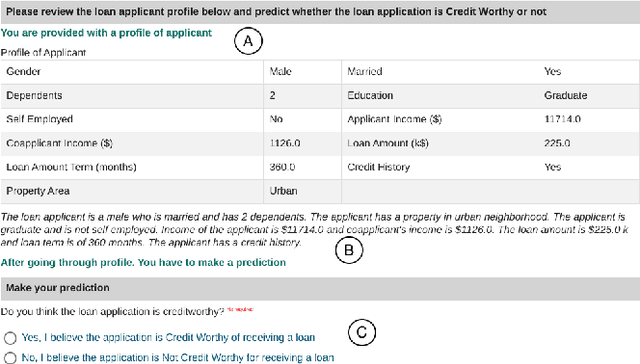



Explainable artificial intelligence (XAI) methods are being proposed to help interpret and understand how AI systems reach specific predictions. Inspired by prior work on conversational user interfaces, we argue that augmenting existing XAI methods with conversational user interfaces can increase user engagement and boost user understanding of the AI system. In this paper, we explored the impact of a conversational XAI interface on users' understanding of the AI system, their trust, and reliance on the AI system. In comparison to an XAI dashboard, we found that the conversational XAI interface can bring about a better understanding of the AI system among users and higher user trust. However, users of both the XAI dashboard and conversational XAI interfaces showed clear overreliance on the AI system. Enhanced conversations powered by large language model (LLM) agents amplified over-reliance. Based on our findings, we reason that the potential cause of such overreliance is the illusion of explanatory depth that is concomitant with both XAI interfaces. Our findings have important implications for designing effective conversational XAI interfaces to facilitate appropriate reliance and improve human-AI collaboration. Code can be found at https://github.com/delftcrowd/IUI2025_ConvXAI
Fine-Grained Appropriate Reliance: Human-AI Collaboration with a Multi-Step Transparent Decision Workflow for Complex Task Decomposition
Jan 19, 2025In recent years, the rapid development of AI systems has brought about the benefits of intelligent services but also concerns about security and reliability. By fostering appropriate user reliance on an AI system, both complementary team performance and reduced human workload can be achieved. Previous empirical studies have extensively analyzed the impact of factors ranging from task, system, and human behavior on user trust and appropriate reliance in the context of one-step decision making. However, user reliance on AI systems in tasks with complex semantics that require multi-step workflows remains under-explored. Inspired by recent work on task decomposition with large language models, we propose to investigate the impact of a novel Multi-Step Transparent (MST) decision workflow on user reliance behaviors. We conducted an empirical study (N = 233) of AI-assisted decision making in composite fact-checking tasks (i.e., fact-checking tasks that entail multiple sub-fact verification steps). Our findings demonstrate that human-AI collaboration with an MST decision workflow can outperform one-step collaboration in specific contexts (e.g., when advice from an AI system is misleading). Further analysis of the appropriate reliance at fine-grained levels indicates that an MST decision workflow can be effective when users demonstrate a relatively high consideration of the intermediate steps. Our work highlights that there is no one-size-fits-all decision workflow that can help obtain optimal human-AI collaboration. Our insights help deepen the understanding of the role of decision workflows in facilitating appropriate reliance. We synthesize important implications for designing effective means to facilitate appropriate reliance on AI systems in composite tasks, positioning opportunities for the human-centered AI and broader HCI communities.