 Add to Chrome
 Add to Firefox
 Add to Edge
Spectrum Prediction With Deep 3D Pyramid Vision Transformer Learning
Aug 15, 2024
In this paper, we propose a deep learning (DL)-based task-driven spectrum prediction framework, named DeepSPred. The DeepSPred comprises a feature encoder and a task predictor, where the encoder extracts spectrum usage pattern features, and the predictor configures different networks according to the task requirements to predict future spectrum. Based on the Deep- SPred, we first propose a novel 3D spectrum prediction method combining a flow processing strategy with 3D vision Transformer (ViT, i.e., Swin) and a pyramid to serve possible applications such as spectrum monitoring task, named 3D-SwinSTB. 3D-SwinSTB unique 3D Patch Merging ViT-to-3D ViT Patch Expanding and pyramid designs help the model accurately learn the potential correlation of the evolution of the spectrogram over time. Then, we propose a novel spectrum occupancy rate (SOR) method by redesigning a predictor consisting exclusively of 3D convolutional and linear layers to serve possible applications such as dynamic spectrum access (DSA) task, named 3D-SwinLinear. Unlike the 3D-SwinSTB output spectrogram, 3D-SwinLinear projects the spectrogram directly as the SOR. Finally, we employ transfer learning (TL) to ensure the applicability of our two methods to diverse spectrum services. The results show that our 3D-SwinSTB outperforms recent benchmarks by more than 5%, while our 3D-SwinLinear achieves a 90% accuracy, with a performance improvement exceeding 10%.

Towards Cross-View-Consistent Self-Supervised Surround Depth Estimation
Jul 04, 2024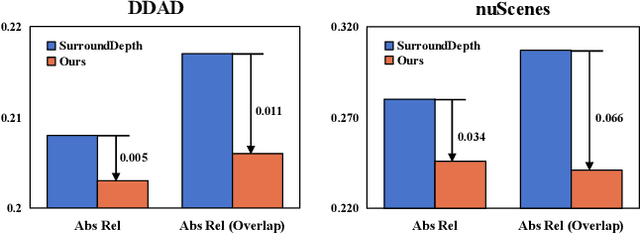
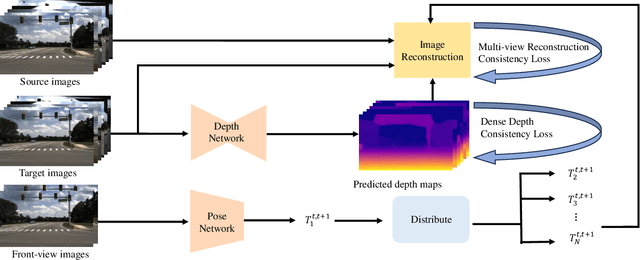
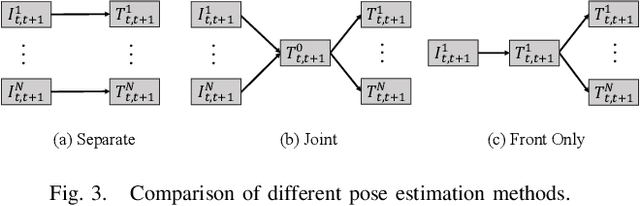
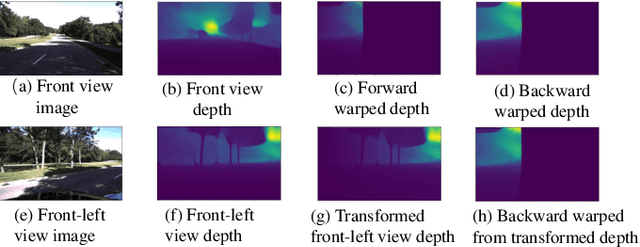
Depth estimation is a cornerstone for autonomous driving, yet acquiring per-pixel depth ground truth for supervised learning is challenging. Self-Supervised Surround Depth Estimation (SSSDE) from consecutive images offers an economical alternative. While previous SSSDE methods have proposed different mechanisms to fuse information across images, few of them explicitly consider the cross-view constraints, leading to inferior performance, particularly in overlapping regions. This paper proposes an efficient and consistent pose estimation design and two loss functions to enhance cross-view consistency for SSSDE. For pose estimation, we propose to use only front-view images to reduce training memory and sustain pose estimation consistency. The first loss function is the dense depth consistency loss, which penalizes the difference between predicted depths in overlapping regions. The second one is the multi-view reconstruction consistency loss, which aims to maintain consistency between reconstruction from spatial and spatial-temporal contexts. Additionally, we introduce a novel flipping augmentation to improve the performance further. Our techniques enable a simple neural model to achieve state-of-the-art performance on the DDAD and nuScenes datasets. Last but not least, our proposed techniques can be easily applied to other methods. The code will be made public.
CRUISE on Quantum Computing for Feature Selection in Recommender Systems
Jul 03, 2024Using Quantum Computers to solve problems in Recommender Systems that classical computers cannot address is a worthwhile research topic. In this paper, we use Quantum Annealers to address the feature selection problem in recommendation algorithms. This feature selection problem is a Quadratic Unconstrained Binary Optimization(QUBO) problem. By incorporating Counterfactual Analysis, we significantly improve the performance of the item-based KNN recommendation algorithm compared to using pure Mutual Information. Extensive experiments have demonstrated that the use of Counterfactual Analysis holds great promise for addressing such problems.
Self and Cross-Model Distillation for LLMs: Effective Methods for Refusal Pattern Alignment
Jun 17, 2024Large Language Models (LLMs) like OpenAI's GPT series, Anthropic's Claude, and Meta's LLaMa have shown remarkable capabilities in text generation. However, their susceptibility to toxic prompts presents significant security challenges. This paper investigates alignment techniques, including Supervised Fine-Tuning (SFT) and Reinforcement Learning from Human Feedback (RLHF), to mitigate these risks. We conduct an empirical study on refusal patterns across nine LLMs, revealing that models with uniform refusal patterns, such as Claude3, exhibit higher security. Based on these findings, we propose self-distilling and cross-model distilling methods to enhance LLM security. Our results show that these methods significantly improve refusal rates and reduce unsafe content, with cross-model distilling achieving refusal rates close to Claude3's 94.51%. These findings underscore the potential of distillation-based alignment in securing LLMs against toxic prompts.
Pulmonary Embolism Mortality Prediction Using Multimodal Learning Based on Computed Tomography Angiography and Clinical Data
Jun 03, 2024Purpose: Pulmonary embolism (PE) is a significant cause of mortality in the United States. The objective of this study is to implement deep learning (DL) models using Computed Tomography Pulmonary Angiography (CTPA), clinical data, and PE Severity Index (PESI) scores to predict PE mortality. Materials and Methods: 918 patients (median age 64 years, range 13-99 years, 52% female) with 3,978 CTPAs were identified via retrospective review across three institutions. To predict survival, an AI model was used to extract disease-related imaging features from CTPAs. Imaging features and/or clinical variables were then incorporated into DL models to predict survival outcomes. Four models were developed as follows: (1) using CTPA imaging features only; (2) using clinical variables only; (3) multimodal, integrating both CTPA and clinical variables; and (4) multimodal fused with calculated PESI score. Performance and contribution from each modality were evaluated using concordance index (c-index) and Net Reclassification Improvement, respectively. Performance was compared to PESI predictions using the Wilcoxon signed-rank test. Kaplan-Meier analysis was performed to stratify patients into high- and low-risk groups. Additional factor-risk analysis was conducted to account for right ventricular (RV) dysfunction. Results: For both data sets, the PESI-fused and multimodal models achieved higher c-indices than PESI alone. Following stratification of patients into high- and low-risk groups by multimodal and PESI-fused models, mortality outcomes differed significantly (both p<0.001). A strong correlation was found between high-risk grouping and RV dysfunction. Conclusions: Multiomic DL models incorporating CTPA features, clinical data, and PESI achieved higher c-indices than PESI alone for PE survival prediction.
An Information Compensation Framework for Zero-Shot Skeleton-based Action Recognition
Jun 02, 2024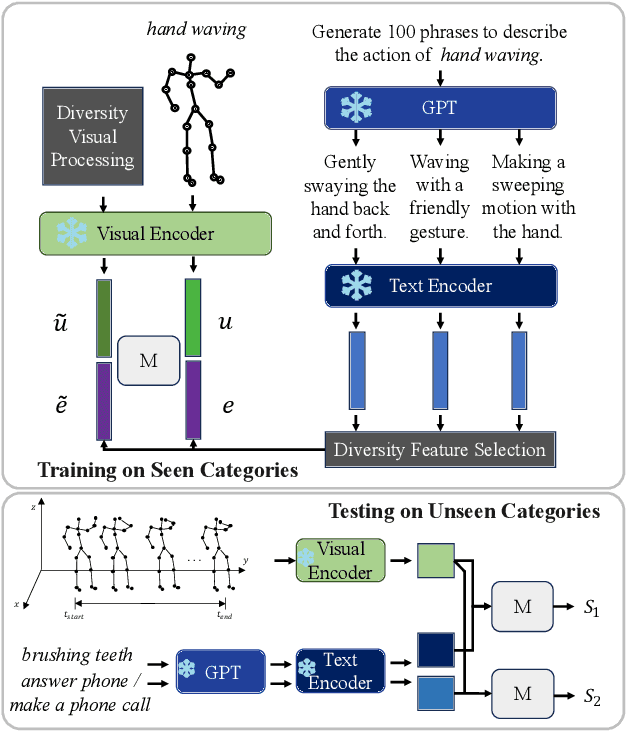
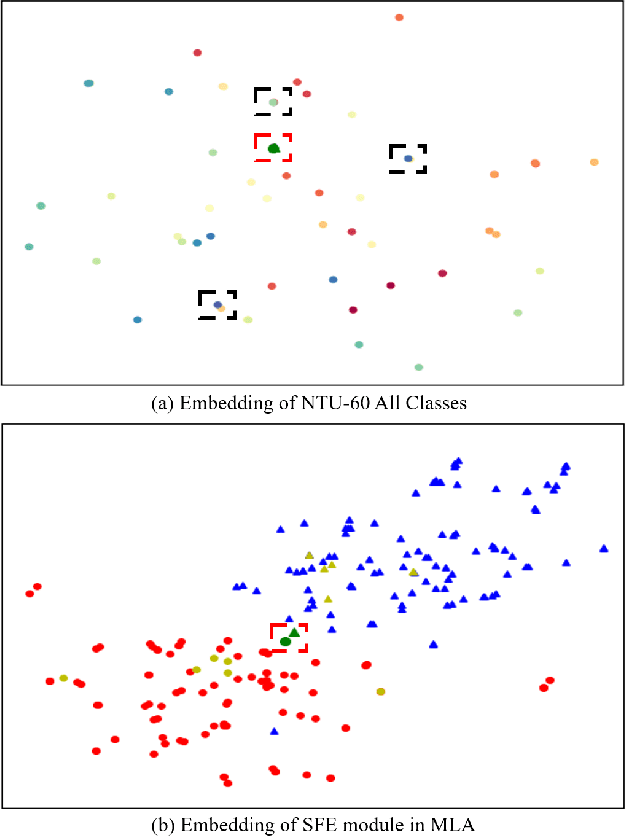


Zero-shot human skeleton-based action recognition aims to construct a model that can recognize actions outside the categories seen during training. Previous research has focused on aligning sequences' visual and semantic spatial distributions. However, these methods extract semantic features simply. They ignore that proper prompt design for rich and fine-grained action cues can provide robust representation space clustering. In order to alleviate the problem of insufficient information available for skeleton sequences, we design an information compensation learning framework from an information-theoretic perspective to improve zero-shot action recognition accuracy with a multi-granularity semantic interaction mechanism. Inspired by ensemble learning, we propose a multi-level alignment (MLA) approach to compensate information for action classes. MLA aligns multi-granularity embeddings with visual embedding through a multi-head scoring mechanism to distinguish semantically similar action names and visually similar actions. Furthermore, we introduce a new loss function sampling method to obtain a tight and robust representation. Finally, these multi-granularity semantic embeddings are synthesized to form a proper decision surface for classification. Significant action recognition performance is achieved when evaluated on the challenging NTU RGB+D, NTU RGB+D 120, and PKU-MMD benchmarks and validate that multi-granularity semantic features facilitate the differentiation of action clusters with similar visual features.
MindSemantix: Deciphering Brain Visual Experiences with a Brain-Language Model
May 29, 2024Deciphering the human visual experience through brain activities captured by fMRI represents a compelling and cutting-edge challenge in the field of neuroscience research. Compared to merely predicting the viewed image itself, decoding brain activity into meaningful captions provides a higher-level interpretation and summarization of visual information, which naturally enhances the application flexibility in real-world situations. In this work, we introduce MindSemantix, a novel multi-modal framework that enables LLMs to comprehend visually-evoked semantic content in brain activity. Our MindSemantix explores a more ideal brain captioning paradigm by weaving LLMs into brain activity analysis, crafting a seamless, end-to-end Brain-Language Model. To effectively capture semantic information from brain responses, we propose Brain-Text Transformer, utilizing a Brain Q-Former as its core architecture. It integrates a pre-trained brain encoder with a frozen LLM to achieve multi-modal alignment of brain-vision-language and establish a robust brain-language correspondence. To enhance the generalizability of neural representations, we pre-train our brain encoder on a large-scale, cross-subject fMRI dataset using self-supervised learning techniques. MindSemantix provides more feasibility to downstream brain decoding tasks such as stimulus reconstruction. Conditioned by MindSemantix captioning, our framework facilitates this process by integrating with advanced generative models like Stable Diffusion and excels in understanding brain visual perception. MindSemantix generates high-quality captions that are deeply rooted in the visual and semantic information derived from brain activity. This approach has demonstrated substantial quantitative improvements over prior art. Our code will be released.
Multi-Channel Multi-Step Spectrum Prediction Using Transformer and Stacked Bi-LSTM
May 29, 2024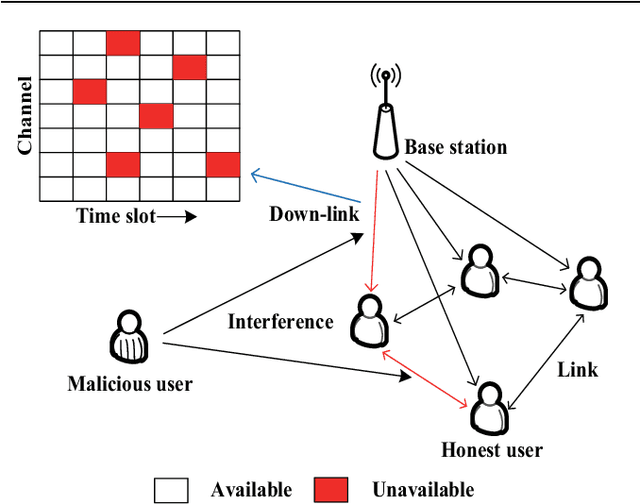
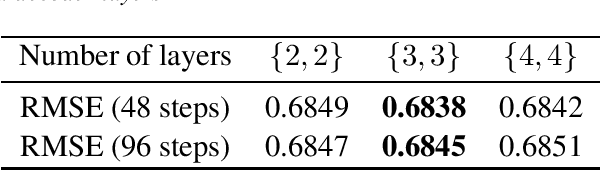
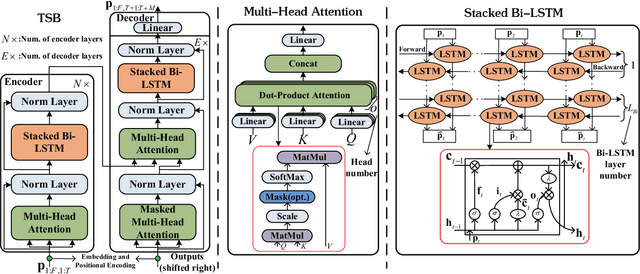

Spectrum prediction is considered as a key technology to assist spectrum decision. Despite the great efforts that have been put on the construction of spectrum prediction, achieving accurate spectrum prediction emphasizes the need for more advanced solutions. In this paper, we propose a new multichannel multi-step spectrum prediction method using Transformer and stacked bidirectional LSTM (Bi- LSTM), named TSB. Specifically, we use multi-head attention and stacked Bi-LSTM to build a new Transformer based on encoder-decoder architecture. The self-attention mechanism composed of multiple layers of multi-head attention can continuously attend to all positions of the multichannel spectrum sequences. The stacked Bi-LSTM can learn these focused coding features by multi-head attention layer by layer. The advantage of this fusion mode is that it can deeply capture the long-term dependence of multichannel spectrum data. We have conducted extensive experiments on a dataset generated by a real simulation platform. The results show that the proposed algorithm performs better than the baselines.
Multi-modality Regional Alignment Network for Covid X-Ray Survival Prediction and Report Generation
May 23, 2024In response to the worldwide COVID-19 pandemic, advanced automated technologies have emerged as valuable tools to aid healthcare professionals in managing an increased workload by improving radiology report generation and prognostic analysis. This study proposes Multi-modality Regional Alignment Network (MRANet), an explainable model for radiology report generation and survival prediction that focuses on high-risk regions. By learning spatial correlation in the detector, MRANet visually grounds region-specific descriptions, providing robust anatomical regions with a completion strategy. The visual features of each region are embedded using a novel survival attention mechanism, offering spatially and risk-aware features for sentence encoding while maintaining global coherence across tasks. A cross LLMs alignment is employed to enhance the image-to-text transfer process, resulting in sentences rich with clinical detail and improved explainability for radiologist. Multi-center experiments validate both MRANet's overall performance and each module's composition within the model, encouraging further advancements in radiology report generation research emphasizing clinical interpretation and trustworthiness in AI models applied to medical studies. The code is available at https://github.com/zzs95/MRANet.
High-dimensional multiple imputation (HDMI) for partially observed confounders including natural language processing-derived auxiliary covariates
May 17, 2024Multiple imputation (MI) models can be improved by including auxiliary covariates (AC), but their performance in high-dimensional data is not well understood. We aimed to develop and compare high-dimensional MI (HDMI) approaches using structured and natural language processing (NLP)-derived AC in studies with partially observed confounders. We conducted a plasmode simulation study using data from opioid vs. non-steroidal anti-inflammatory drug (NSAID) initiators (X) with observed serum creatinine labs (Z2) and time-to-acute kidney injury as outcome. We simulated 100 cohorts with a null treatment effect, including X, Z2, atrial fibrillation (U), and 13 other investigator-derived confounders (Z1) in the outcome generation. We then imposed missingness (MZ2) on 50% of Z2 measurements as a function of Z2 and U and created different HDMI candidate AC using structured and NLP-derived features. We mimicked scenarios where U was unobserved by omitting it from all AC candidate sets. Using LASSO, we data-adaptively selected HDMI covariates associated with Z2 and MZ2 for MI, and with U to include in propensity score models. The treatment effect was estimated following propensity score matching in MI datasets and we benchmarked HDMI approaches against a baseline imputation and complete case analysis with Z1 only. HDMI using claims data showed the lowest bias (0.072). Combining claims and sentence embeddings led to an improvement in the efficiency displaying the lowest root-mean-squared-error (0.173) and coverage (94%). NLP-derived AC alone did not perform better than baseline MI. HDMI approaches may decrease bias in studies with partially observed confounders where missingness depends on unobserved factors.