 Add to Chrome
 Add to Firefox
 Add to Edge
MegaScale-Infer: Serving Mixture-of-Experts at Scale with Disaggregated Expert Parallelism
Apr 03, 2025
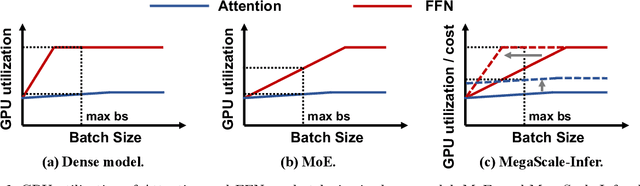
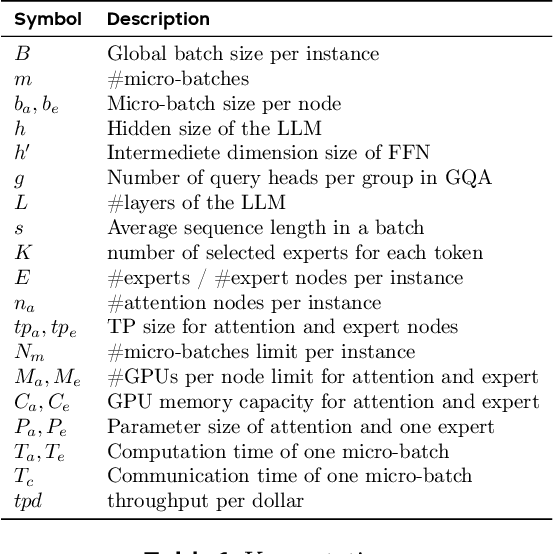
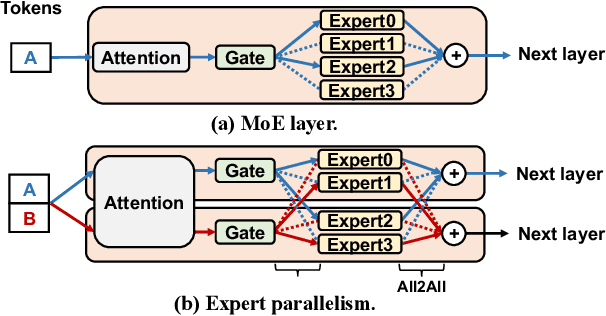
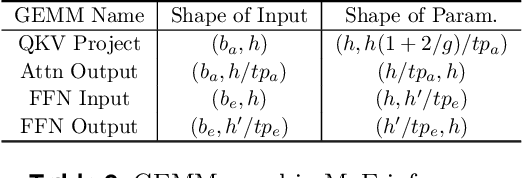
Mixture-of-Experts (MoE) showcases tremendous potential to scale large language models (LLMs) with enhanced performance and reduced computational complexity. However, its sparsely activated architecture shifts feed-forward networks (FFNs) from being compute-intensive to memory-intensive during inference, leading to substantially lower GPU utilization and increased operational costs. We present MegaScale-Infer, an efficient and cost-effective system for serving large-scale MoE models. MegaScale-Infer disaggregates attention and FFN modules within each model layer, enabling independent scaling, tailored parallelism strategies, and heterogeneous deployment for both modules. To fully exploit disaggregation in the presence of MoE's sparsity, MegaScale-Infer introduces ping-pong pipeline parallelism, which partitions a request batch into micro-batches and shuttles them between attention and FFNs for inference. Combined with distinct model parallelism for each module, MegaScale-Infer effectively hides communication overhead and maximizes GPU utilization. To adapt to disaggregated attention and FFN modules and minimize data transmission overhead (e.g., token dispatch), MegaScale-Infer provides a high-performance M2N communication library that eliminates unnecessary GPU-to-CPU data copies, group initialization overhead, and GPU synchronization. Experimental results indicate that MegaScale-Infer achieves up to 1.90x higher per-GPU throughput than state-of-the-art solutions.

Minder: Faulty Machine Detection for Large-scale Distributed Model Training
Nov 04, 2024


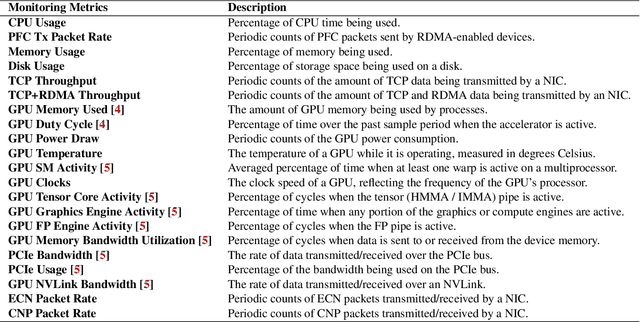
Large-scale distributed model training requires simultaneous training on up to thousands of machines. Faulty machine detection is critical when an unexpected fault occurs in a machine. From our experience, a training task can encounter two faults per day on average, possibly leading to a halt for hours. To address the drawbacks of the time-consuming and labor-intensive manual scrutiny, we propose Minder, an automatic faulty machine detector for distributed training tasks. The key idea of Minder is to automatically and efficiently detect faulty distinctive monitoring metric patterns, which could last for a period before the entire training task comes to a halt. Minder has been deployed in our production environment for over one year, monitoring daily distributed training tasks where each involves up to thousands of machines. In our real-world fault detection scenarios, Minder can accurately and efficiently react to faults within 3.6 seconds on average, with a precision of 0.904 and F1-score of 0.893.
MegaScale: Scaling Large Language Model Training to More Than 10,000 GPUs
Feb 23, 2024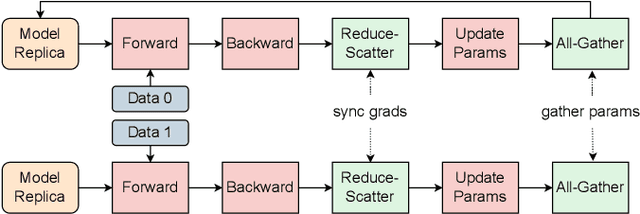
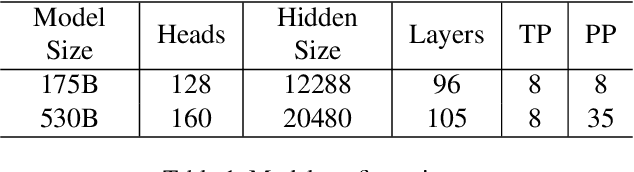
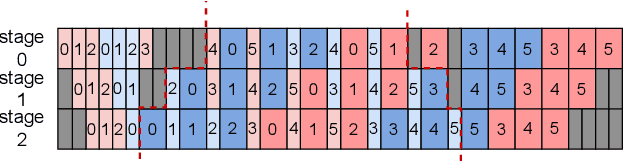
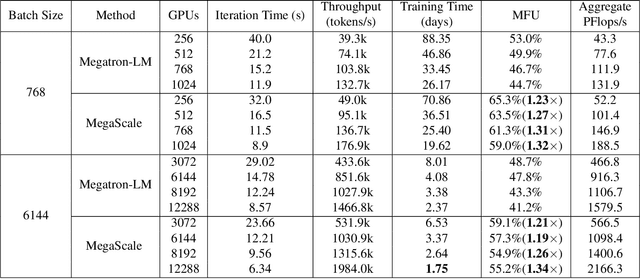
We present the design, implementation and engineering experience in building and deploying MegaScale, a production system for training large language models (LLMs) at the scale of more than 10,000 GPUs. Training LLMs at this scale brings unprecedented challenges to training efficiency and stability. We take a full-stack approach that co-designs the algorithmic and system components across model block and optimizer design, computation and communication overlapping, operator optimization, data pipeline, and network performance tuning. Maintaining high efficiency throughout the training process (i.e., stability) is an important consideration in production given the long extent of LLM training jobs. Many hard stability issues only emerge at large scale, and in-depth observability is the key to address them. We develop a set of diagnosis tools to monitor system components and events deep in the stack, identify root causes, and derive effective techniques to achieve fault tolerance and mitigate stragglers. MegaScale achieves 55.2% Model FLOPs Utilization (MFU) when training a 175B LLM model on 12,288 GPUs, improving the MFU by 1.34x compared to Megatron-LM. We share our operational experience in identifying and fixing failures and stragglers. We hope by articulating the problems and sharing our experience from a systems perspective, this work can inspire future LLM systems research.