 Add to Chrome
 Add to Firefox
 Add to Edge
Weaving Multi-Source Evidence for Biomedical Reasoning: The BioMedHop Benchmark and BioWeave Framework
Jun 15, 2026
Biomedical question answering (QA) increasingly requires reasoning over interacting entities, where supporting evidence is scattered across biomedical knowledge graphs, literature documents, and web-accessible resources. However, existing biomedical QA benchmarks mainly focus on exam-style knowledge, literature comprehension, or short-range multi-hop inference, leaving source-conditioned graph reasoning and evidence topology construction underexplored. To fill this gap, we introduce BioMedHop, a multi-source graph-grounded benchmark for evaluating biomedical reasoning over structured evidence topologies. BioMedHop contains 10,045 instances across KG, document, web, and hybrid evidence settings, covering shared-neighbor matching, intersection reasoning, path-based reasoning, and counting, with option-based, open-ended, and numeric count renderings. To support this benchmark, we further propose BioWeave, a source-aware reasoning framework that retrieves biomedical KG paths, gathers supporting clues from documents and web sources, assembles them into a unified evidence graph, and verifies answers through entity-level evidence support. Comprehensive experiments show that BioWeave achieves the best overall performance among compared methods on BioMedHop, outperforming the strong hybrid baseline ToG-2 by 10.5% in the overall average. Moreover, BioWeave consistently improves different LLM backbones and enables smaller models, such as Qwen3-4B, to achieve reasoning performance comparable to GPT-4-Turbo.

HyperJoin: LLM-augmented Hypergraph Link Prediction for Joinable Table Discovery
Jan 03, 2026As a pivotal task in data lake management, joinable table discovery has attracted widespread interest. While existing language model-based methods achieve remarkable performance by combining offline column representation learning with online ranking, their design insufficiently accounts for the underlying structural interactions: (1) offline, they directly model tables into isolated or pairwise columns, thereby struggling to capture the rich inter-table and intra-table structural information; and (2) online, they rank candidate columns based solely on query-candidate similarity, ignoring the mutual interactions among the candidates, leading to incoherent result sets. To address these limitations, we propose HyperJoin, a large language model (LLM)-augmented Hypergraph framework for Joinable table discovery. Specifically, we first construct a hypergraph to model tables using both the intra-table hyperedges and the LLM-augmented inter-table hyperedges. Consequently, the task of joinable table discovery is formulated as link prediction on this constructed hypergraph. We then design HIN, a Hierarchical Interaction Network that learns expressive column representations through bidirectional message passing over columns and hyperedges. To strengthen coherence and internal consistency in the result columns, we cast online ranking as a coherence-aware top-k column selection problem. We then introduce a reranking module that leverages a maximum spanning tree algorithm to prune noisy connections and maximize coherence. Experiments demonstrate the superiority of HyperJoin, achieving average improvements of 21.4% (Precision@15) and 17.2% (Recall@15) over the best baseline.
Skeleton Supervised Airway Segmentation
Mar 11, 2024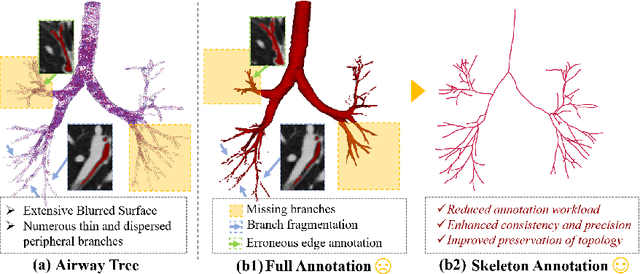
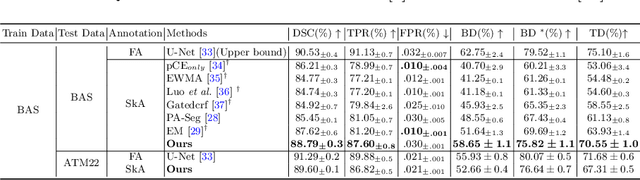
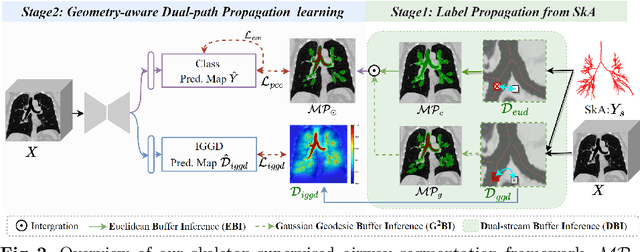
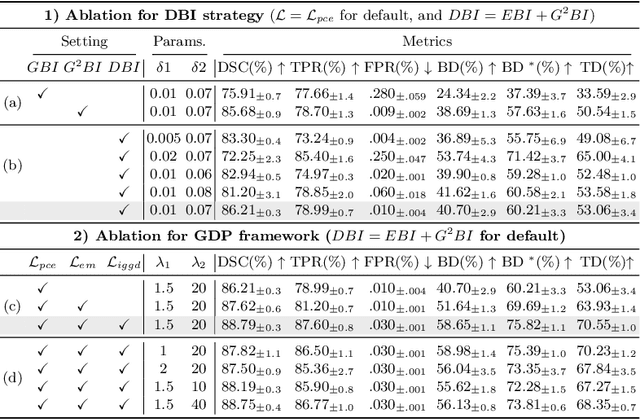
Fully-supervised airway segmentation has accomplished significant triumphs over the years in aiding pre-operative diagnosis and intra-operative navigation. However, full voxel-level annotation constitutes a labor-intensive and time-consuming task, often plagued by issues such as missing branches, branch annotation discontinuity, or erroneous edge delineation. label-efficient solutions for airway extraction are rarely explored yet primarily demanding in medical practice. To this end, we introduce a novel skeleton-level annotation (SkA) tailored to the airway, which simplifies the annotation workflow while enhancing annotation consistency and accuracy, preserving the complete topology. Furthermore, we propose a skeleton-supervised learning framework to achieve accurate airway segmentation. Firstly, a dual-stream buffer inference is introduced to realize initial label propagation from SkA, avoiding the collapse of direct learning from SkA. Then, we construct a geometry-aware dual-path propagation framework (GDP) to further promote complementary propagation learning, composed of hard geometry-aware propagation learning and soft geometry-aware propagation guidance. Experiments reveal that our proposed framework outperforms the competing methods with SKA, which amounts to only 1.96% airways, and achieves comparable performance with the baseline model that is fully supervised with 100% airways, demonstrating its significant potential in achieving label-efficient segmentation for other tubular structures, such as vessels.
GDDS: Pulmonary Bronchioles Segmentation with Group Deep Dense Supervision
Mar 16, 2023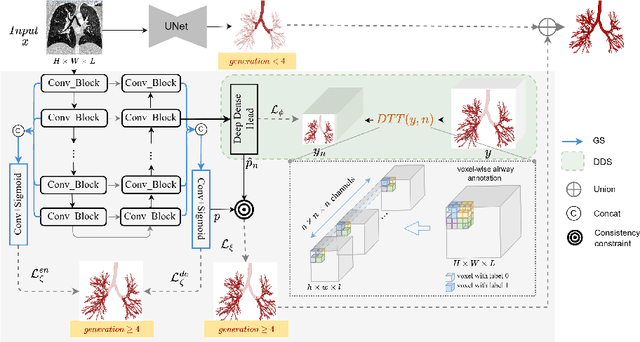
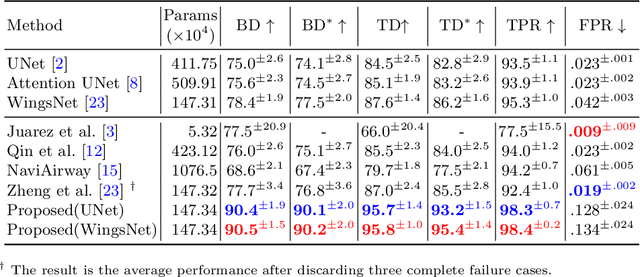
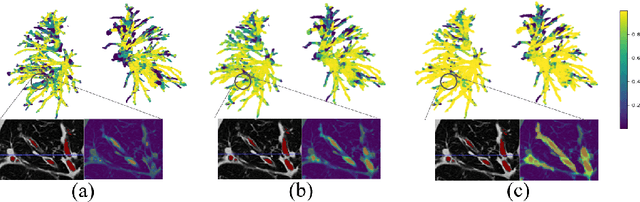
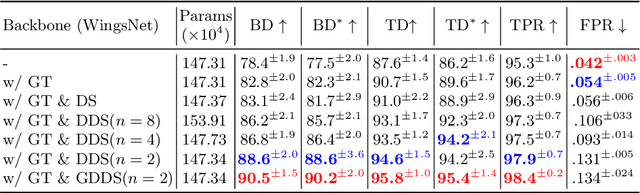
Airway segmentation, especially bronchioles segmentation, is an important but challenging task because distal bronchus are sparsely distributed and of a fine scale. Existing neural networks usually exploit sparse topology to learn the connectivity of bronchioles and inefficient shallow features to capture such high-frequency information, leading to the breakage or missed detection of individual thin branches. To address these problems, we contribute a new bronchial segmentation method based on Group Deep Dense Supervision (GDDS) that emphasizes fine-scale bronchioles segmentation in a simple-but-effective manner. First, Deep Dense Supervision (DDS) is proposed by constructing local dense topology skillfully and implementing dense topological learning on a specific shallow feature layer. GDDS further empowers the shallow features with better perception ability to detect bronchioles, even the ones that are not easily discernible to the naked eye. Extensive experiments on the BAS benchmark dataset have shown that our method promotes the network to have a high sensitivity in capturing fine-scale branches and outperforms state-of-the-art methods by a large margin (+12.8 % in BD and +8.8 % in TD) while only introducing a small number of extra parameters.