 Add to Chrome
 Add to Firefox
 Add to Edge
LFP: Efficient and Accurate End-to-End Lane-Level Planning via Camera-LiDAR Fusion
Sep 21, 2024
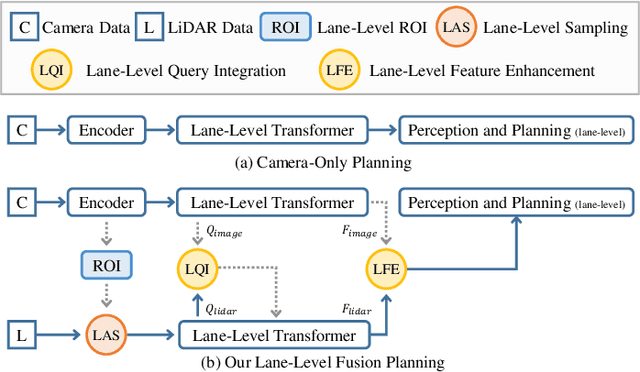
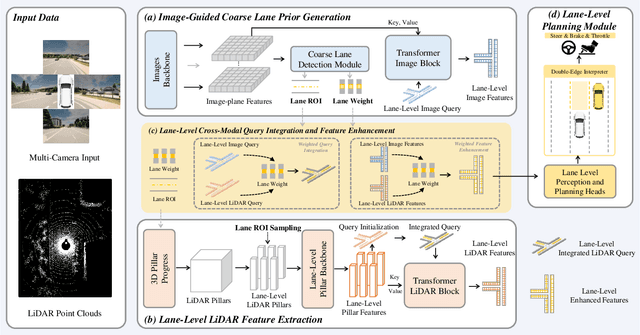
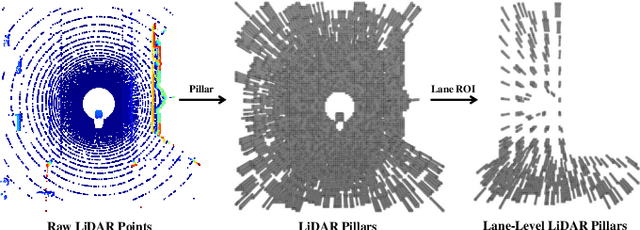
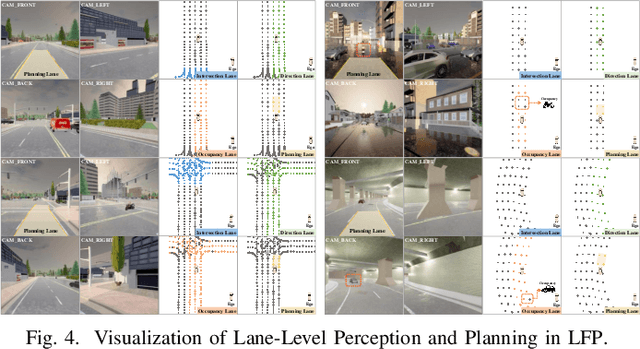
Multi-modal systems enhance performance in autonomous driving but face inefficiencies due to indiscriminate processing within each modality. Additionally, the independent feature learning of each modality lacks interaction, which results in extracted features that do not possess the complementary characteristics. These issue increases the cost of fusing redundant information across modalities. To address these challenges, we propose targeting driving-relevant elements, which reduces the volume of LiDAR features while preserving critical information. This approach enhances lane level interaction between the image and LiDAR branches, allowing for the extraction and fusion of their respective advantageous features. Building upon the camera-only framework PHP, we introduce the Lane-level camera-LiDAR Fusion Planning (LFP) method, which balances efficiency with performance by using lanes as the unit for sensor fusion. Specifically, we design three modules to enhance efficiency and performance. For efficiency, we propose an image-guided coarse lane prior generation module that forecasts the region of interest (ROI) for lanes and assigns a confidence score, guiding LiDAR processing. The LiDAR feature extraction modules leverages lane-aware priors from the image branch to guide sampling for pillar, retaining essential pillars. For performance, the lane-level cross-modal query integration and feature enhancement module uses confidence score from ROI to combine low-confidence image queries with LiDAR queries, extracting complementary depth features. These features enhance the low-confidence image features, compensating for the lack of depth. Experiments on the Carla benchmarks show that our method achieves state-of-the-art performance in both driving score and infraction score, with maximum improvement of 15% and 14% over existing algorithms, respectively, maintaining high frame rate of 19.27 FPS.

Perception Helps Planning: Facilitating Multi-Stage Lane-Level Integration via Double-Edge Structures
Jul 16, 2024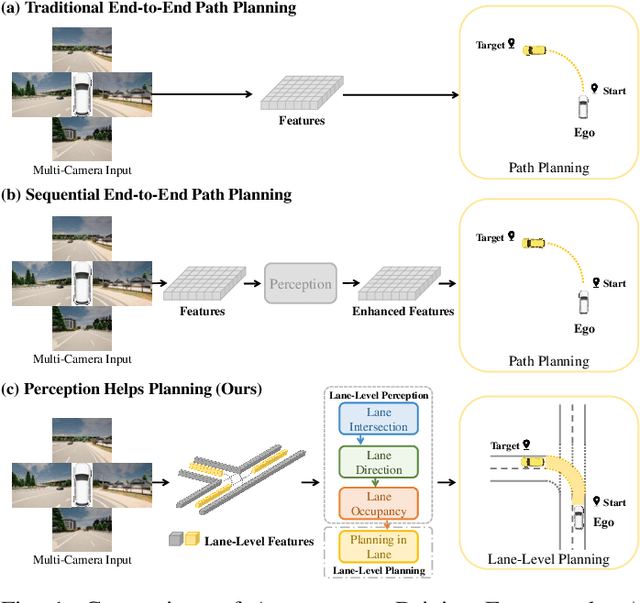
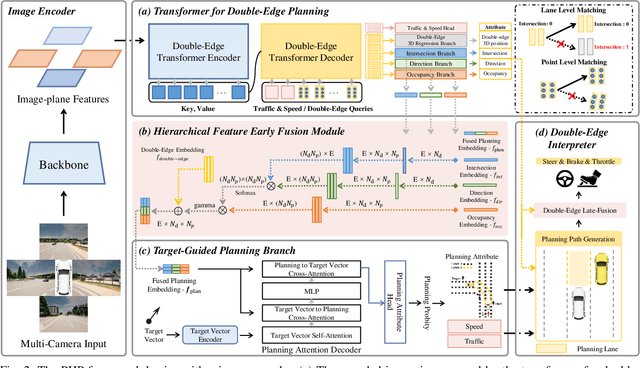
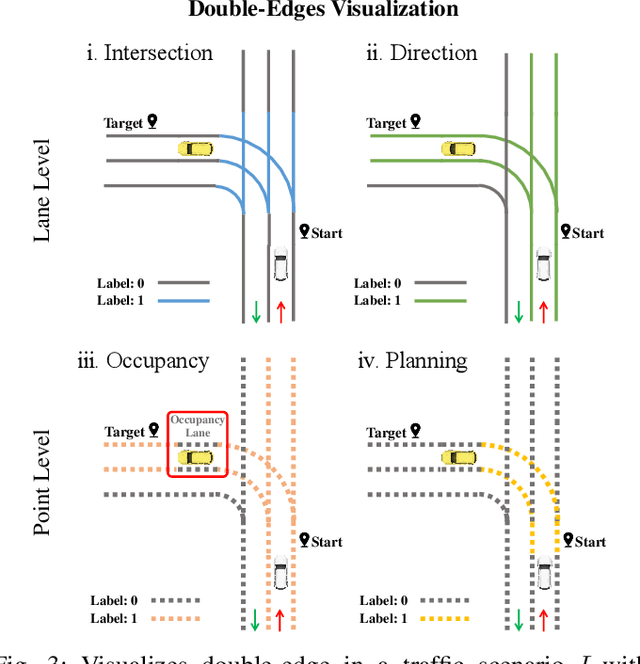

When planning for autonomous driving, it is crucial to consider essential traffic elements such as lanes, intersections, traffic regulations, and dynamic agents. However, they are often overlooked by the traditional end-to-end planning methods, likely leading to inefficiencies and non-compliance with traffic regulations. In this work, we endeavor to integrate the perception of these elements into the planning task. To this end, we propose Perception Helps Planning (PHP), a novel framework that reconciles lane-level planning with perception. This integration ensures that planning is inherently aligned with traffic constraints, thus facilitating safe and efficient driving. Specifically, PHP focuses on both edges of a lane for planning and perception purposes, taking into consideration the 3D positions of both lane edges and attributes for lane intersections, lane directions, lane occupancy, and planning. In the algorithmic design, the process begins with the transformer encoding multi-camera images to extract the above features and predicting lane-level perception results. Next, the hierarchical feature early fusion module refines the features for predicting planning attributes. Finally, the double-edge interpreter utilizes a late-fusion process specifically designed to integrate lane-level perception and planning information, culminating in the generation of vehicle control signals. Experiments on three Carla benchmarks show significant improvements in driving score of 27.20%, 33.47%, and 15.54% over existing algorithms, respectively, achieving the state-of-the-art performance, with the system operating up to 22.57 FPS.
LDP: A Local Diffusion Planner for Efficient Robot Navigation and Collision Avoidance
Jul 02, 2024The conditional diffusion model has been demonstrated as an efficient tool for learning robot policies, owing to its advancement to accurately model the conditional distribution of policies. The intricate nature of real-world scenarios, characterized by dynamic obstacles and maze-like structures, underscores the complexity of robot local navigation decision-making as a conditional distribution problem. Nevertheless, leveraging the diffusion model for robot local navigation is not trivial and encounters several under-explored challenges: (1) Data Urgency. The complex conditional distribution in local navigation needs training data to include diverse policy in diverse real-world scenarios; (2) Myopic Observation. Due to the diversity of the perception scenarios, diffusion decisions based on the local perspective of robots may prove suboptimal for completing the entire task, as they often lack foresight. In certain scenarios requiring detours, the robot may become trapped. To address these issues, our approach begins with an exploration of a diverse data generation mechanism that encompasses multiple agents exhibiting distinct preferences through target selection informed by integrated global-local insights. Then, based on this diverse training data, a diffusion agent is obtained, capable of excellent collision avoidance in diverse scenarios. Subsequently, we augment our Local Diffusion Planner, also known as LDP by incorporating global observations in a lightweight manner. This enhancement broadens the observational scope of LDP, effectively mitigating the risk of becoming ensnared in local optima and promoting more robust navigational decisions.
CLMASP: Coupling Large Language Models with Answer Set Programming for Robotic Task Planning
Jun 05, 2024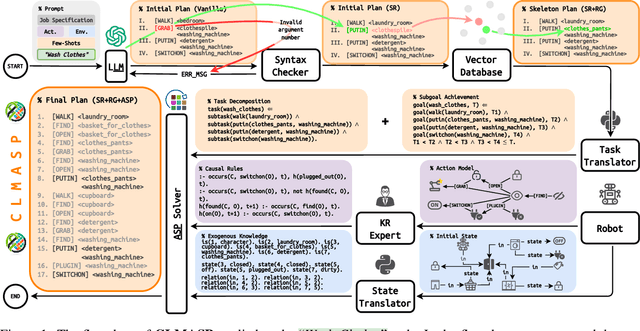

Large Language Models (LLMs) possess extensive foundational knowledge and moderate reasoning abilities, making them suitable for general task planning in open-world scenarios. However, it is challenging to ground a LLM-generated plan to be executable for the specified robot with certain restrictions. This paper introduces CLMASP, an approach that couples LLMs with Answer Set Programming (ASP) to overcome the limitations, where ASP is a non-monotonic logic programming formalism renowned for its capacity to represent and reason about a robot's action knowledge. CLMASP initiates with a LLM generating a basic skeleton plan, which is subsequently tailored to the specific scenario using a vector database. This plan is then refined by an ASP program with a robot's action knowledge, which integrates implementation details into the skeleton, grounding the LLM's abstract outputs in practical robot contexts. Our experiments conducted on the VirtualHome platform demonstrate CLMASP's efficacy. Compared to the baseline executable rate of under 2% with LLM approaches, CLMASP significantly improves this to over 90%.
Safe and Personalizable Logical Guidance for Trajectory Planning of Autonomous Driving
May 22, 2024
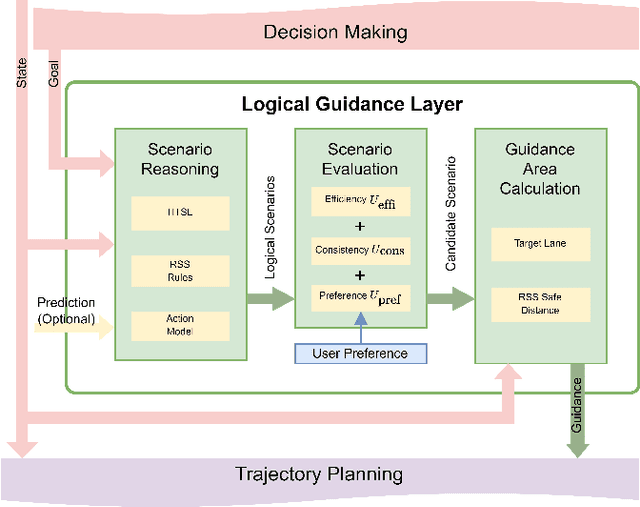
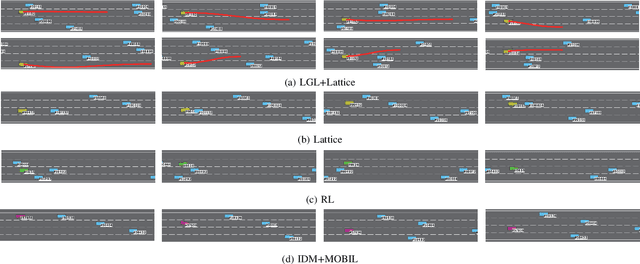
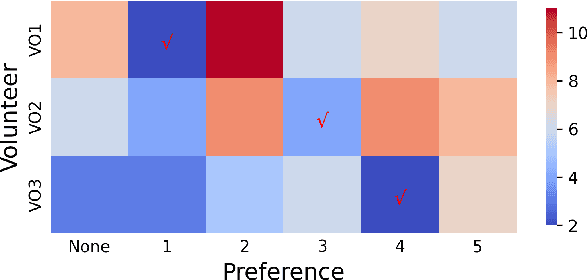
Autonomous vehicles necessitate a delicate balance between safety, efficiency, and user preferences in trajectory planning. Existing traditional or learning-based methods face challenges in adequately addressing all these aspects. In response, this paper proposes a novel component termed the Logical Guidance Layer (LGL), designed for seamless integration into autonomous driving trajectory planning frameworks, specifically tailored for highway scenarios. The LGL guides the trajectory planning with a local target area determined through scenario reasoning, scenario evaluation, and guidance area calculation. Integrating the Responsibility-Sensitive Safety (RSS) model, the LGL ensures formal safety guarantees while accommodating various user preferences defined by logical formulae. Experimental validation demonstrates the effectiveness of the LGL in achieving a balance between safety and efficiency, and meeting user preferences in autonomous highway driving scenarios.
Traffic Scenario Logic: A Spatial-Temporal Logic for Modeling and Reasoning of Urban Traffic Scenarios
May 22, 2024


Formal representations of traffic scenarios can be used to generate test cases for the safety verification of autonomous driving. However, most existing methods are limited in highway or highly simplified intersection scenarios due to the intricacy and diversity of traffic scenarios. In response, we propose Traffic Scenario Logic (TSL), which is a spatial-temporal logic designed for modeling and reasoning of urban pedestrian-free traffic scenarios. TSL provides a formal representation of the urban road network that can be derived from OpenDRIVE, i.e., the de facto industry standard of high-definition maps for autonomous driving, enabling the representation of a broad range of traffic scenarios. We implemented the reasoning of TSL using Telingo, i.e., a solver for temporal programs based on the Answer Set Programming, and tested it on different urban road layouts. Demonstrations show the effectiveness of TSL in test scenario generation and its potential value in areas like decision-making and control verification of autonomous driving.
Rotation Initialization and Stepwise Refinement for Universal LiDAR Calibration
May 09, 2024


Autonomous systems often employ multiple LiDARs to leverage the integrated advantages, enhancing perception and robustness. The most critical prerequisite under this setting is the estimating the extrinsic between each LiDAR, i.e., calibration. Despite the exciting progress in multi-LiDAR calibration efforts, a universal, sensor-agnostic calibration method remains elusive. According to the coarse-to-fine framework, we first design a spherical descriptor TERRA for 3-DoF rotation initialization with no prior knowledge. To further optimize, we present JEEP for the joint estimation of extrinsic and pose, integrating geometric and motion information to overcome factors affecting the point cloud registration. Finally, the LiDAR poses optimized by the hierarchical optimization module are input to time synchronization module to produce the ultimate calibration results, including the time offset. To verify the effectiveness, we conduct extensive experiments on eight datasets, where 16 diverse types of LiDARs in total and dozens of calibration tasks are tested. In the challenging tasks, the calibration errors can still be controlled within 5cm and 1{\deg} with a high success rate.
Rendering-Enhanced Automatic Image-to-Point Cloud Registration for Roadside Scenes
Apr 08, 2024Prior point cloud provides 3D environmental context, which enhances the capabilities of monocular camera in downstream vision tasks, such as 3D object detection, via data fusion. However, the absence of accurate and automated registration methods for estimating camera extrinsic parameters in roadside scene point clouds notably constrains the potential applications of roadside cameras. This paper proposes a novel approach for the automatic registration between prior point clouds and images from roadside scenes. The main idea involves rendering photorealistic grayscale views taken at specific perspectives from the prior point cloud with the help of their features like RGB or intensity values. These generated views can reduce the modality differences between images and prior point clouds, thereby improve the robustness and accuracy of the registration results. Particularly, we specify an efficient algorithm, named neighbor rendering, for the rendering process. Then we introduce a method for automatically estimating the initial guess using only rough guesses of camera's position. At last, we propose a procedure for iteratively refining the extrinsic parameters by minimizing the reprojection error for line features extracted from both generated and camera images using Segment Anything Model (SAM). We assess our method using a self-collected dataset, comprising eight cameras strategically positioned throughout the university campus. Experiments demonstrate our method's capability to automatically align prior point cloud with roadside camera image, achieving a rotation accuracy of 0.202 degrees and a translation precision of 0.079m. Furthermore, we validate our approach's effectiveness in visual applications by substantially improving monocular 3D object detection performance.
MM-Gaussian: 3D Gaussian-based Multi-modal Fusion for Localization and Reconstruction in Unbounded Scenes
Apr 05, 2024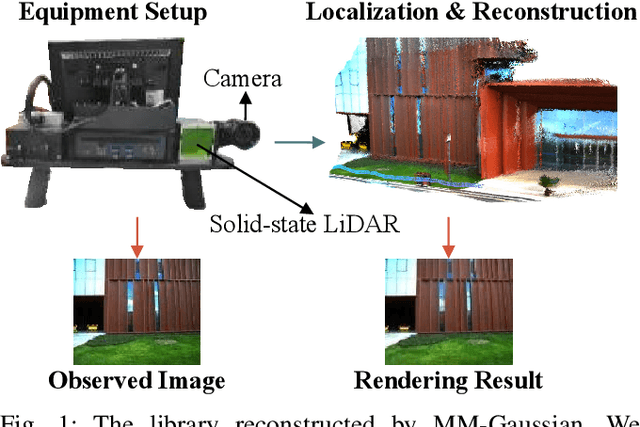

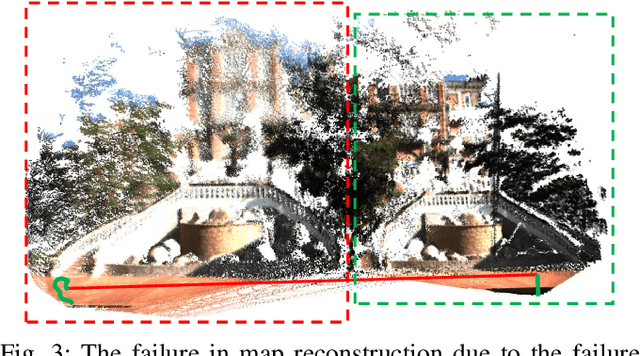
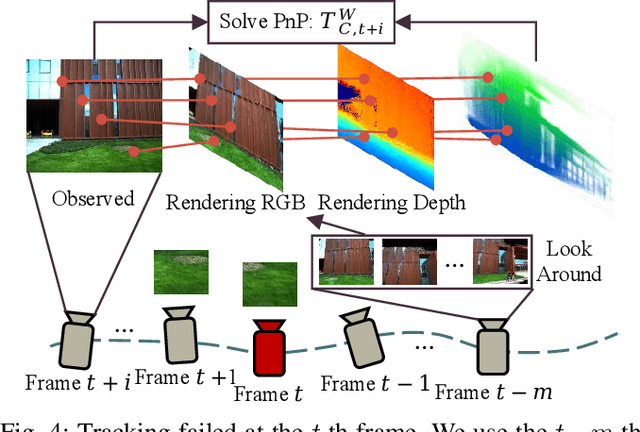
Localization and mapping are critical tasks for various applications such as autonomous vehicles and robotics. The challenges posed by outdoor environments present particular complexities due to their unbounded characteristics. In this work, we present MM-Gaussian, a LiDAR-camera multi-modal fusion system for localization and mapping in unbounded scenes. Our approach is inspired by the recently developed 3D Gaussians, which demonstrate remarkable capabilities in achieving high rendering quality and fast rendering speed. Specifically, our system fully utilizes the geometric structure information provided by solid-state LiDAR to address the problem of inaccurate depth encountered when relying solely on visual solutions in unbounded, outdoor scenarios. Additionally, we utilize 3D Gaussian point clouds, with the assistance of pixel-level gradient descent, to fully exploit the color information in photos, thereby achieving realistic rendering effects. To further bolster the robustness of our system, we designed a relocalization module, which assists in returning to the correct trajectory in the event of a localization failure. Experiments conducted in multiple scenarios demonstrate the effectiveness of our method.
CORP: A Multi-Modal Dataset for Campus-Oriented Roadside Perception Tasks
Apr 04, 2024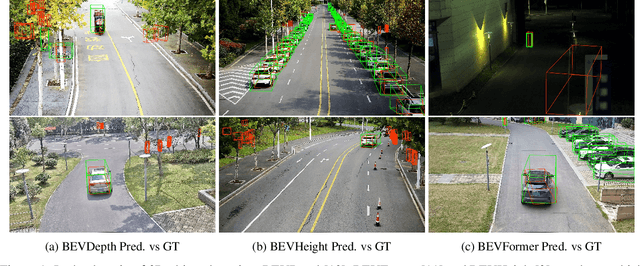

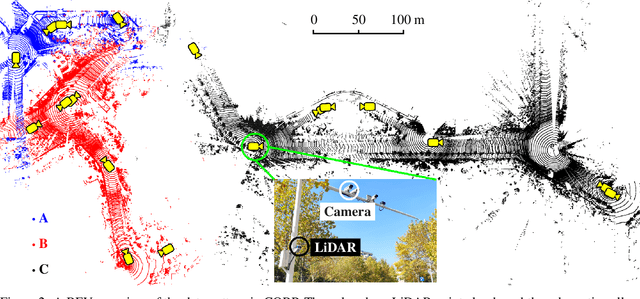
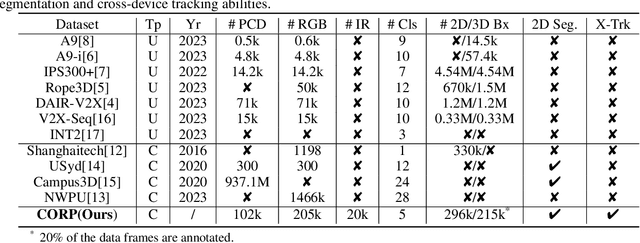
Numerous roadside perception datasets have been introduced to propel advancements in autonomous driving and intelligent transportation systems research and development. However, it has been observed that the majority of their concentrates is on urban arterial roads, inadvertently overlooking residential areas such as parks and campuses that exhibit entirely distinct characteristics. In light of this gap, we propose CORP, which stands as the first public benchmark dataset tailored for multi-modal roadside perception tasks under campus scenarios. Collected in a university campus, CORP consists of over 205k images plus 102k point clouds captured from 18 cameras and 9 LiDAR sensors. These sensors with different configurations are mounted on roadside utility poles to provide diverse viewpoints within the campus region. The annotations of CORP encompass multi-dimensional information beyond 2D and 3D bounding boxes, providing extra support for 3D seamless tracking and instance segmentation with unique IDs and pixel masks for identifying targets, to enhance the understanding of objects and their behaviors distributed across the campus premises. Unlike other roadside datasets about urban traffic, CORP extends the spectrum to highlight the challenges for multi-modal perception in campuses and other residential areas.