 Add to Chrome
 Add to Firefox
 Add to Edge
MechGeo: Autoformalizing and Proving Euclidean Geometry in Lean 4
Aug 03, 2026
We present MechGeo, a Mathlib native agentic framework that jointly addresses faithful autoformalization and certified proof construction for Euclidean geometry. In this framework, GeoFormalizer represents informal problems in GeoIR, deterministically translates them into Lean 4, and iteratively repairs candidate statements using structural diagnostics and semantic evaluation. GeoProver constructs geometric proof plans, derives intermediate lemmas, and selectively algebraizes suitable subgoals through a library verified in Lean. Singular or SymPy may generate algebraic certificates, but all resulting proofs and counterexamples are checked by Lean's kernel. Experiments across seven LLM backbones show substantial improvements in autoformalization, particularly for models with weaker direct translation performance. On 43 historical IMO geometry problems, GeoFormalizer generates formal statements that GeoProver proves in 29 cases; for the remaining 14, it constructs counterexamples verified in Lean and proves all repaired statements after expert correction. Together with IMO 2026 Problem 2, this yields, to the best of our knowledge, the largest reported collection of automated, kernel-checked Lean proofs for IMO geometry problems. On the 14 geometry statements in LEAP's Lean-IMO-Bench, MechGeo proves 12 for the first time, formally refutes the remaining two, and proves both repaired statements. These results establish counterexample guided diagnosis, geometric reasoning, and certified symbolic computation as a practical foundation for trustworthy formal geometry.

Beyond Facial Consistency: Personalized Person Image Generation with Holistic Identity Preservation
Jul 28, 2026Personalized person image generation requires preserving subject identity across both local facial details and broader appearance cues. Existing methods typically emphasize only one level of identity information, leading to an inherent trade-off between facial fidelity and overall appearance consistency. To address this, we first propose a simple dual-branch baseline that unifies global appearance control and local facial control within a shared generation framework. This simple combination of different branches yields promising results, but suffers from instability in practice due to uncoordinated branch contributions. To this end, we propose Dynamic Balancing Scaling (DBS), a fine-tuning strategy for improving face and appearance identity coordination. DBS consists of two components: adaptive temporal gating, which dynamically modulates branch contributions along the denoising trajectory, and region-aware optimization, which improves the coordination of facial, appearance, and global supervision. Together, these designs alleviate persistent face-branch over-dominance and encourage more effective appearance-aware guidance. We also introduce Pexels-100, a benchmark for evaluating holistic identity consistency in personalized person generation. Experiments show that DBS achieves a better trade-off between facial fidelity and appearance consistency than existing open-source baselines, while providing a controllable basic framework for holistic identity modeling.
SoccerNet 2024 Challenges Results
Sep 16, 2024
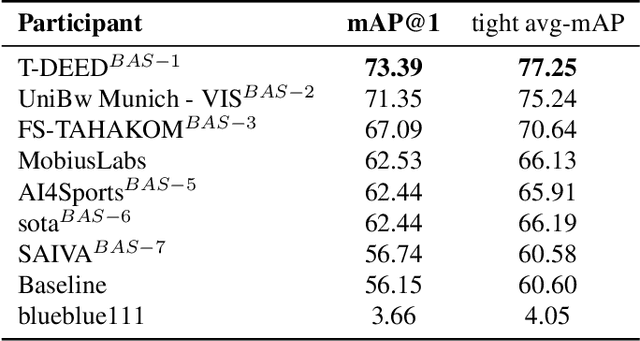
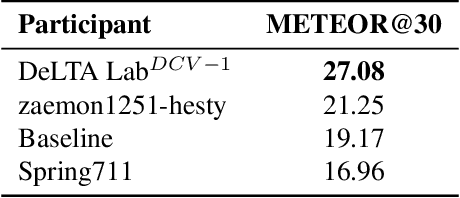
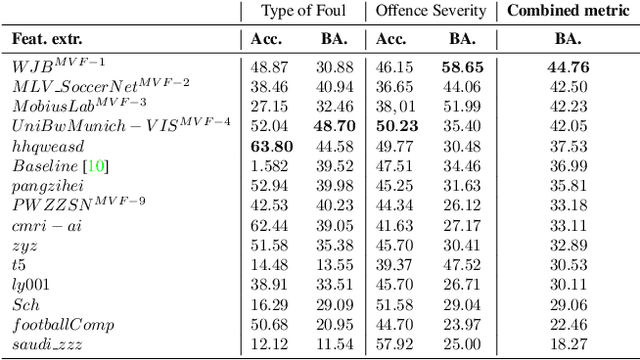
The SoccerNet 2024 challenges represent the fourth annual video understanding challenges organized by the SoccerNet team. These challenges aim to advance research across multiple themes in football, including broadcast video understanding, field understanding, and player understanding. This year, the challenges encompass four vision-based tasks. (1) Ball Action Spotting, focusing on precisely localizing when and which soccer actions related to the ball occur, (2) Dense Video Captioning, focusing on describing the broadcast with natural language and anchored timestamps, (3) Multi-View Foul Recognition, a novel task focusing on analyzing multiple viewpoints of a potential foul incident to classify whether a foul occurred and assess its severity, (4) Game State Reconstruction, another novel task focusing on reconstructing the game state from broadcast videos onto a 2D top-view map of the field. Detailed information about the tasks, challenges, and leaderboards can be found at https://www.soccer-net.org, with baselines and development kits available at https://github.com/SoccerNet.
CORP: A Multi-Modal Dataset for Campus-Oriented Roadside Perception Tasks
Apr 04, 2024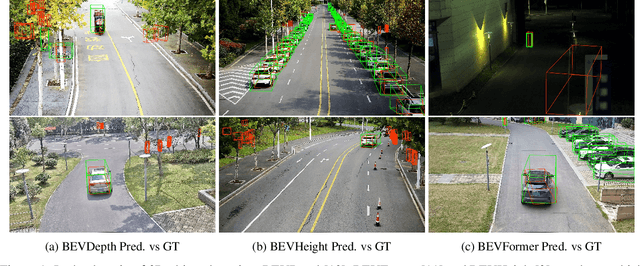

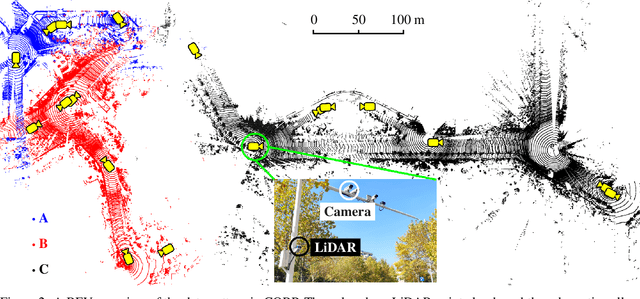
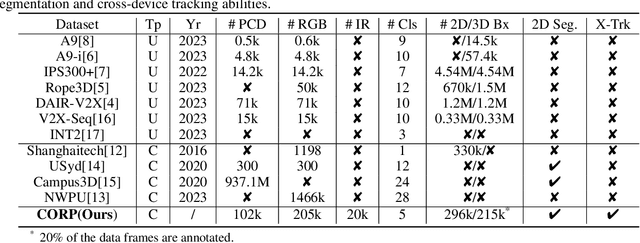
Numerous roadside perception datasets have been introduced to propel advancements in autonomous driving and intelligent transportation systems research and development. However, it has been observed that the majority of their concentrates is on urban arterial roads, inadvertently overlooking residential areas such as parks and campuses that exhibit entirely distinct characteristics. In light of this gap, we propose CORP, which stands as the first public benchmark dataset tailored for multi-modal roadside perception tasks under campus scenarios. Collected in a university campus, CORP consists of over 205k images plus 102k point clouds captured from 18 cameras and 9 LiDAR sensors. These sensors with different configurations are mounted on roadside utility poles to provide diverse viewpoints within the campus region. The annotations of CORP encompass multi-dimensional information beyond 2D and 3D bounding boxes, providing extra support for 3D seamless tracking and instance segmentation with unique IDs and pixel masks for identifying targets, to enhance the understanding of objects and their behaviors distributed across the campus premises. Unlike other roadside datasets about urban traffic, CORP extends the spectrum to highlight the challenges for multi-modal perception in campuses and other residential areas.
CalibFormer: A Transformer-based Automatic LiDAR-Camera Calibration Network
Nov 26, 2023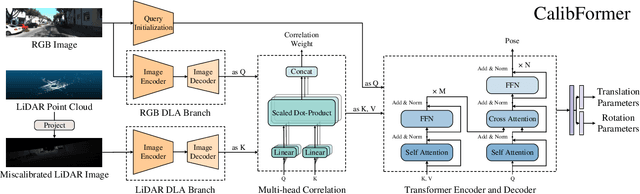
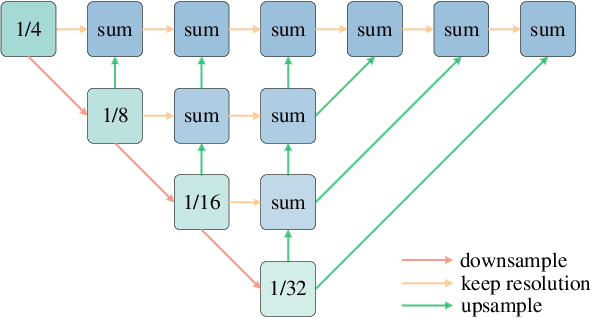
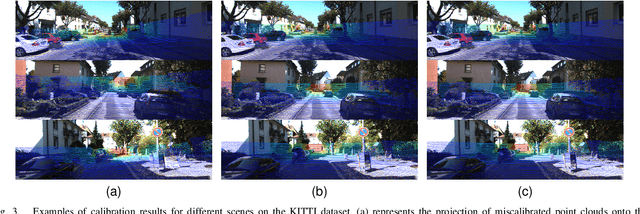
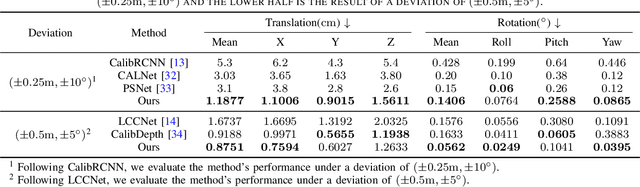
The fusion of LiDARs and cameras has been increasingly adopted in autonomous driving for perception tasks. The performance of such fusion-based algorithms largely depends on the accuracy of sensor calibration, which is challenging due to the difficulty of identifying common features across different data modalities. Previously, many calibration methods involved specific targets and/or manual intervention, which has proven to be cumbersome and costly. Learning-based online calibration methods have been proposed, but their performance is barely satisfactory in most cases. These methods usually suffer from issues such as sparse feature maps, unreliable cross-modality association, inaccurate calibration parameter regression, etc. In this paper, to address these issues, we propose CalibFormer, an end-to-end network for automatic LiDAR-camera calibration. We aggregate multiple layers of camera and LiDAR image features to achieve high-resolution representations. A multi-head correlation module is utilized to identify correlations between features more accurately. Lastly, we employ transformer architectures to estimate accurate calibration parameters from the correlation information. Our method achieved a mean translation error of $0.8751 \mathrm{cm}$ and a mean rotation error of $0.0562 ^{\circ}$ on the KITTI dataset, surpassing existing state-of-the-art methods and demonstrating strong robustness, accuracy, and generalization capabilities.