 Add to Chrome
 Add to Firefox
 Add to Edge
Soul: Breathe Life into Digital Human for High-fidelity Long-term Multimodal Animation
Dec 15, 2025
We propose a multimodal-driven framework for high-fidelity long-term digital human animation termed $\textbf{Soul}$, which generates semantically coherent videos from a single-frame portrait image, text prompts, and audio, achieving precise lip synchronization, vivid facial expressions, and robust identity preservation. We construct Soul-1M, containing 1 million finely annotated samples with a precise automated annotation pipeline (covering portrait, upper-body, full-body, and multi-person scenes) to mitigate data scarcity, and we carefully curate Soul-Bench for comprehensive and fair evaluation of audio-/text-guided animation methods. The model is built on the Wan2.2-5B backbone, integrating audio-injection layers and multiple training strategies together with threshold-aware codebook replacement to ensure long-term generation consistency. Meanwhile, step/CFG distillation and a lightweight VAE are used to optimize inference efficiency, achieving an 11.4$\times$ speedup with negligible quality loss. Extensive experiments show that Soul significantly outperforms current leading open-source and commercial models on video quality, video-text alignment, identity preservation, and lip-synchronization accuracy, demonstrating broad applicability in real-world scenarios such as virtual anchors and film production. Project page at https://zhangzjn.github.io/projects/Soul/

Fast OBDD Reordering using Neural Message Passing on Hypergraph
Nov 06, 2018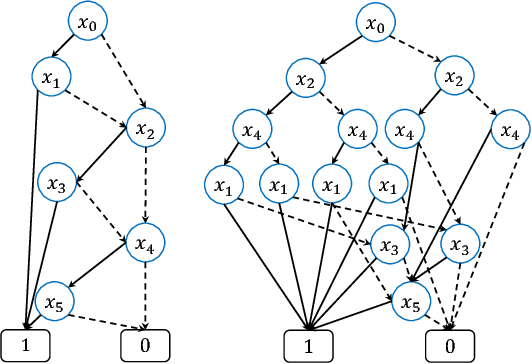

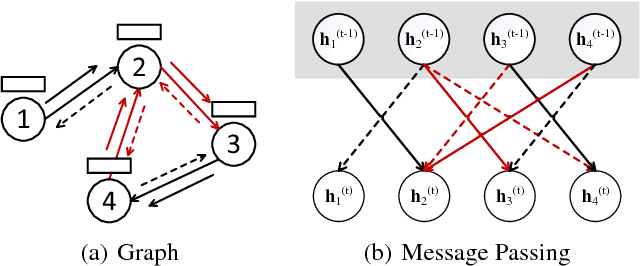
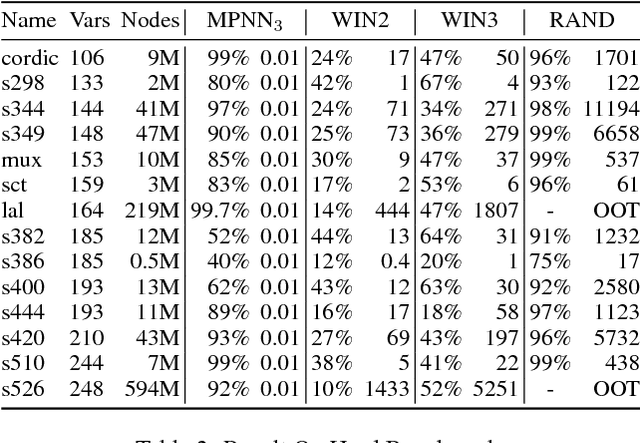
Ordered binary decision diagrams (OBDDs) are an efficient data structure for representing and manipulating Boolean formulas. With respect to different variable orders, the OBDDs' sizes may vary from linear to exponential in the number of the Boolean variables. Finding the optimal variable order has been proved a NP-complete problem. Many heuristics have been proposed to find a near-optimal solution of this problem. In this paper, we propose a neural network-based method to predict near-optimal variable orders for unknown formulas. Viewing these formulas as hypergraphs, and lifting the message passing neural network into 3-hypergraph (MPNN3), we are able to learn the patterns of Boolean formula. Compared to the traditional methods, our method can find a near-the-best solution with an extremely shorter time, even for some hard examples.To the best of our knowledge, this is the first work on applying neural network to OBDD reordering.