 Add to Chrome
 Add to Firefox
 Add to Edge
Generalized Source Tracing: Detecting Novel Audio Deepfake Algorithm with Real Emphasis and Fake Dispersion strategy
Jun 05, 2024
With the proliferation of deepfake audio, there is an urgent need to investigate their attribution. Current source tracing methods can effectively distinguish in-distribution (ID) categories. However, the rapid evolution of deepfake algorithms poses a critical challenge in the accurate identification of out-of-distribution (OOD) novel deepfake algorithms. In this paper, we propose Real Emphasis and Fake Dispersion (REFD) strategy for audio deepfake algorithm recognition, demonstrating its effectiveness in discriminating ID samples while identifying OOD samples. For effective OOD detection, we first explore current post-hoc OOD methods and propose NSD, a novel OOD approach in identifying novel deepfake algorithms through the similarity consideration of both feature and logits scores. REFD achieves 86.83% F1-score as a single system in Audio Deepfake Detection Challenge 2023 Track3, showcasing its state-of-the-art performance.

Generalized Fake Audio Detection via Deep Stable Learning
Jun 05, 2024

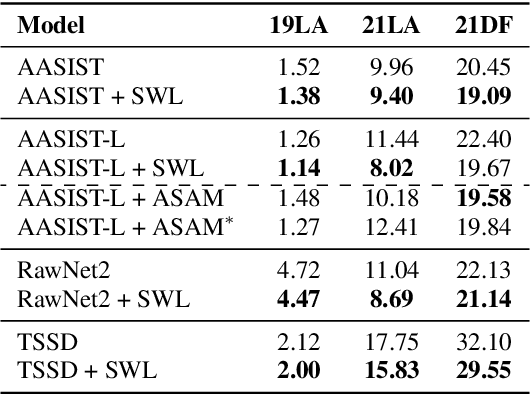

Although current fake audio detection approaches have achieved remarkable success on specific datasets, they often fail when evaluated with datasets from different distributions. Previous studies typically address distribution shift by focusing on using extra data or applying extra loss restrictions during training. However, these methods either require a substantial amount of data or complicate the training process. In this work, we propose a stable learning-based training scheme that involves a Sample Weight Learning (SWL) module, addressing distribution shift by decorrelating all selected features via learning weights from training samples. The proposed portable plug-in-like SWL is easy to apply to multiple base models and generalizes them without using extra data during training. Experiments conducted on the ASVspoof datasets clearly demonstrate the effectiveness of SWL in generalizing different models across three evaluation datasets from different distributions.
EVDA: Evolving Deepfake Audio Detection Continual Learning Benchmark
May 15, 2024The rise of advanced large language models such as GPT-4, GPT-4o, and the Claude family has made fake audio detection increasingly challenging. Traditional fine-tuning methods struggle to keep pace with the evolving landscape of synthetic speech, necessitating continual learning approaches that can adapt to new audio while retaining the ability to detect older types. Continual learning, which acts as an effective tool for detecting newly emerged deepfake audio while maintaining performance on older types, lacks a well-constructed and user-friendly evaluation framework. To address this gap, we introduce EVDA, a benchmark for evaluating continual learning methods in deepfake audio detection. EVDA includes classic datasets from the Anti-Spoofing Voice series, Chinese fake audio detection series, and newly generated deepfake audio from models like GPT-4 and GPT-4o. It supports various continual learning techniques, such as Elastic Weight Consolidation (EWC), Learning without Forgetting (LwF), and recent methods like Regularized Adaptive Weight Modification (RAWM) and Radian Weight Modification (RWM). Additionally, EVDA facilitates the development of robust algorithms by providing an open interface for integrating new continual learning methods
Can large language models understand uncommon meanings of common words?
May 09, 2024Large language models (LLMs) like ChatGPT have shown significant advancements across diverse natural language understanding (NLU) tasks, including intelligent dialogue and autonomous agents. Yet, lacking widely acknowledged testing mechanisms, answering `whether LLMs are stochastic parrots or genuinely comprehend the world' remains unclear, fostering numerous studies and sparking heated debates. Prevailing research mainly focuses on surface-level NLU, neglecting fine-grained explorations. However, such explorations are crucial for understanding their unique comprehension mechanisms, aligning with human cognition, and finally enhancing LLMs' general NLU capacities. To address this gap, our study delves into LLMs' nuanced semantic comprehension capabilities, particularly regarding common words with uncommon meanings. The idea stems from foundational principles of human communication within psychology, which underscore accurate shared understandings of word semantics. Specifically, this paper presents the innovative construction of a Lexical Semantic Comprehension (LeSC) dataset with novel evaluation metrics, the first benchmark encompassing both fine-grained and cross-lingual dimensions. Introducing models of both open-source and closed-source, varied scales and architectures, our extensive empirical experiments demonstrate the inferior performance of existing models in this basic lexical-meaning understanding task. Notably, even the state-of-the-art LLMs GPT-4 and GPT-3.5 lag behind 16-year-old humans by 3.9% and 22.3%, respectively. Additionally, multiple advanced prompting techniques and retrieval-augmented generation are also introduced to help alleviate this trouble, yet limitations persist. By highlighting the above critical shortcomings, this research motivates further investigation and offers novel insights for developing more intelligent LLMs.
The Codecfake Dataset and Countermeasures for the Universally Detection of Deepfake Audio
May 08, 2024


With the proliferation of Audio Language Model (ALM) based deepfake audio, there is an urgent need for effective detection methods. Unlike traditional deepfake audio generation, which often involves multi-step processes culminating in vocoder usage, ALM directly utilizes neural codec methods to decode discrete codes into audio. Moreover, driven by large-scale data, ALMs exhibit remarkable robustness and versatility, posing a significant challenge to current audio deepfake detection (ADD) models. To effectively detect ALM-based deepfake audio, we focus on the mechanism of the ALM-based audio generation method, the conversion from neural codec to waveform. We initially construct the Codecfake dataset, an open-source large-scale dataset, including two languages, millions of audio samples, and various test conditions, tailored for ALM-based audio detection. Additionally, to achieve universal detection of deepfake audio and tackle domain ascent bias issue of original SAM, we propose the CSAM strategy to learn a domain balanced and generalized minima. Experiment results demonstrate that co-training on Codecfake dataset and vocoded dataset with CSAM strategy yield the lowest average Equal Error Rate (EER) of 0.616% across all test conditions compared to baseline models.
MER 2024: Semi-Supervised Learning, Noise Robustness, and Open-Vocabulary Multimodal Emotion Recognition
Apr 29, 2024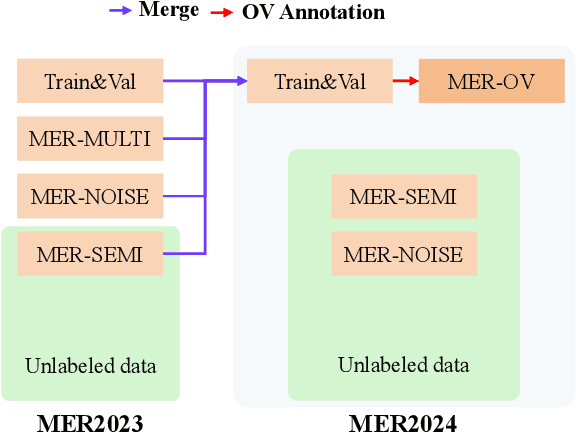


Multimodal emotion recognition is an important research topic in artificial intelligence. Over the past few decades, researchers have made remarkable progress by increasing dataset size and building more effective architectures. However, due to various reasons (such as complex environments and inaccurate labels), current systems still cannot meet the demands of practical applications. Therefore, we plan to organize a series of challenges around emotion recognition to further promote the development of this field. Last year, we launched MER2023, focusing on three topics: multi-label learning, noise robustness, and semi-supervised learning. This year, we continue to organize MER2024. In addition to expanding the dataset size, we introduce a new track around open-vocabulary emotion recognition. The main consideration for this track is that existing datasets often fix the label space and use majority voting to enhance annotator consistency, but this process may limit the model's ability to describe subtle emotions. In this track, we encourage participants to generate any number of labels in any category, aiming to describe the emotional state as accurately as possible. Our baseline is based on MERTools and the code is available at: https://github.com/zeroQiaoba/MERTools/tree/master/MER2024.
KS-LLM: Knowledge Selection of Large Language Models with Evidence Document for Question Answering
Apr 24, 2024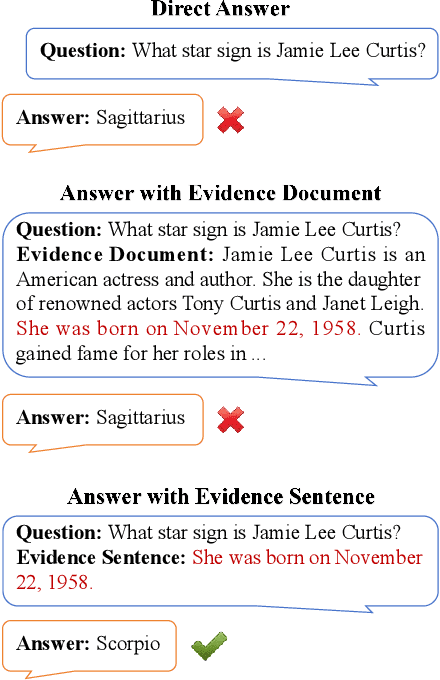

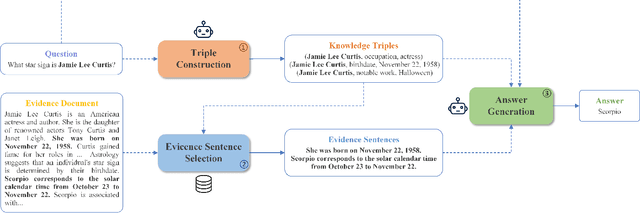

Large language models (LLMs) suffer from the hallucination problem and face significant challenges when applied to knowledge-intensive tasks. A promising approach is to leverage evidence documents as extra supporting knowledge, which can be obtained through retrieval or generation. However, existing methods directly leverage the entire contents of the evidence document, which may introduce noise information and impair the performance of large language models. To tackle this problem, we propose a novel Knowledge Selection of Large Language Models (KS-LLM) method, aiming to identify valuable information from evidence documents. The KS-LLM approach utilizes triples to effectively select knowledge snippets from evidence documents that are beneficial to answering questions. Specifically, we first generate triples based on the input question, then select the evidence sentences most similar to triples from the evidence document, and finally combine the evidence sentences and triples to assist large language models in generating answers. Experimental comparisons on several question answering datasets, such as TriviaQA, WebQ, and NQ, demonstrate that the proposed method surpasses the baselines and achieves the best results.
Multimodal Fusion with Pre-Trained Model Features in Affective Behaviour Analysis In-the-wild
Mar 22, 2024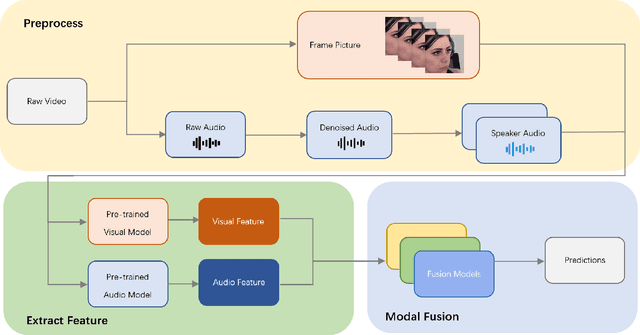
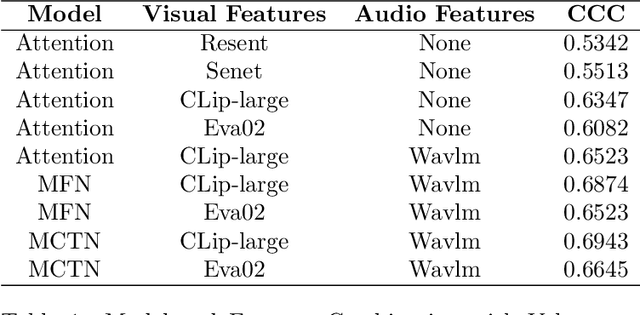

Multimodal fusion is a significant method for most multimodal tasks. With the recent surge in the number of large pre-trained models, combining both multimodal fusion methods and pre-trained model features can achieve outstanding performance in many multimodal tasks. In this paper, we present our approach, which leverages both advantages for addressing the task of Expression (Expr) Recognition and Valence-Arousal (VA) Estimation. We evaluate the Aff-Wild2 database using pre-trained models, then extract the final hidden layers of the models as features. Following preprocessing and interpolation or convolution to align the extracted features, different models are employed for modal fusion. Our code is available at GitHub - FulgenceWen/ABAW6th.
Can Deception Detection Go Deeper? Dataset, Evaluation, and Benchmark for Deception Reasoning
Feb 18, 2024Deception detection has attracted increasing attention due to its importance in many practical scenarios. Currently, data scarcity harms the development of this field. On the one hand, it is costly to hire participants to simulate deception scenarios. On the other hand, it is difficult to collect videos containing deceptive behaviors on the Internet. To address data scarcity, this paper proposes a new data collection pipeline. Specifically, we use GPT-4 to simulate a role-play between a suspect and a police officer. During interrogation, the suspect lies to the police officer to evade responsibility for the crime, while the police officer uncovers the truth and gathers evidence. Compared with previous datasets, this strategy reduces data collection costs, providing a promising way to increase the dataset size. Meanwhile, we extend the traditional deception detection task to deception reasoning, further providing evidence for deceptive parts. This dataset can also be used to evaluate the complex reasoning capability of current large language models and serve as a reasoning benchmark for further research.
Progressive Distillation Based on Masked Generation Feature Method for Knowledge Graph Completion
Jan 19, 2024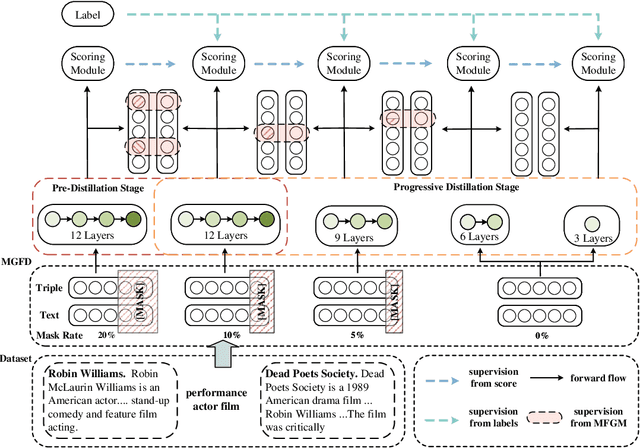

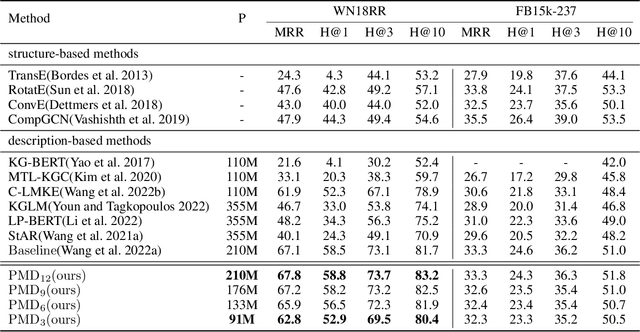
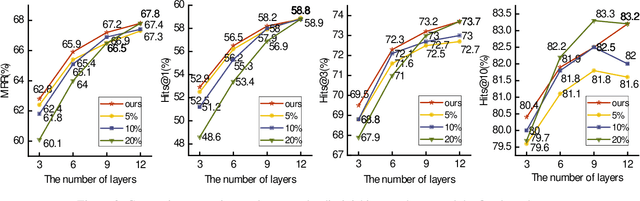
In recent years, knowledge graph completion (KGC) models based on pre-trained language model (PLM) have shown promising results. However, the large number of parameters and high computational cost of PLM models pose challenges for their application in downstream tasks. This paper proposes a progressive distillation method based on masked generation features for KGC task, aiming to significantly reduce the complexity of pre-trained models. Specifically, we perform pre-distillation on PLM to obtain high-quality teacher models, and compress the PLM network to obtain multi-grade student models. However, traditional feature distillation suffers from the limitation of having a single representation of information in teacher models. To solve this problem, we propose masked generation of teacher-student features, which contain richer representation information. Furthermore, there is a significant gap in representation ability between teacher and student. Therefore, we design a progressive distillation method to distill student models at each grade level, enabling efficient knowledge transfer from teachers to students. The experimental results demonstrate that the model in the pre-distillation stage surpasses the existing state-of-the-art methods. Furthermore, in the progressive distillation stage, the model significantly reduces the model parameters while maintaining a certain level of performance. Specifically, the model parameters of the lower-grade student model are reduced by 56.7\% compared to the baseline.