 Add to Chrome
 Add to Firefox
 Add to Edge
Hermite Curves as Trajectory Priors for Vision-Language-Action Models
Aug 02, 2026
Despite recent progress in Vision-Language-Action (VLA) models for robotic manipulation, the action chunk remains a weakly structured interface. Existing work typically flatten each chunk into per-timestep controls, relying on implicit data learning that manifests as jagged motion and boundary discontinuities during physical execution. To address these limitations, we introduce Hermite trajectory priors, parameterizing the chunk trajectory as a piecewise cubic Hermite curve defined by endpoint positions and velocities to explicitly enforce smoothness and continuity. We instantiate this fixed operator across discrete autoregressive and continuous generative paradigms via three variants: (1) Hermite Tokens, which predict quantized boundary variables autoregressively; (2) Hermite Scaffold, which decomposes clean actions into a base scaffold and residuals; and (3) Hermite Regularization, which applies the prior strictly as an auxiliary training objective. Across simulation benchmarks and real-robot platforms, Hermite Regularization achieves superior performance among these three variants, improving π0.5 baseline success rates from 95.9% to 98.7% on LIBERO, 85.7% to 90.9% on LIBERO-plus, and 63.4% to 90.0% across four real-robot tasks without additional inference overhead. Trajectory analyses reveal that explicitly structuring trajectory priors serves most effectively as a learning inductive bias rather than a runtime constraint.

ChunkFlow: Towards Continuity-Consistent Chunked Policy Learning
Jul 14, 2026Vision-language action (VLA) models increasingly adopt chunked action heads to satisfy real-time constraints; however, this introduces boundary jitter: overlapping regions between consecutive chunks often yield inconsistent predictions, degrading temporal coherence and the task success rate. Existing methods, such as inference-time blending, merely reweight mismatched proposals without correcting underlying errors, leading to residual accumulation under biased or noisy histories. We propose ChunkFlow, a seam-aware training-and-execution framework for chunked policies that aligns chunk structure with boundary execution. It partitions each chunk into frozen, editable, and future zones, applies deterministic overlap blending at execution, and trains raw predictions with seam and first- and second-order continuity losses. History corruption and scheduled sampling improve robustness to executed-history errors, while an AWAC fine-tuning stage adapts the policy without removing these structural regularizers. Under mild smoothness assumptions, pre-blending seam discrepancies provably decay with increasing overlap. Experiments on CALVIN, LIBERO, and real robots show an improved success-stability trade-off with low-latency inference. Project page: https://cytoderm-ai.github.io/chunkflow.
IC-Mapper: Instance-Centric Spatio-Temporal Modeling for Online Vectorized Map Construction
Mar 05, 2025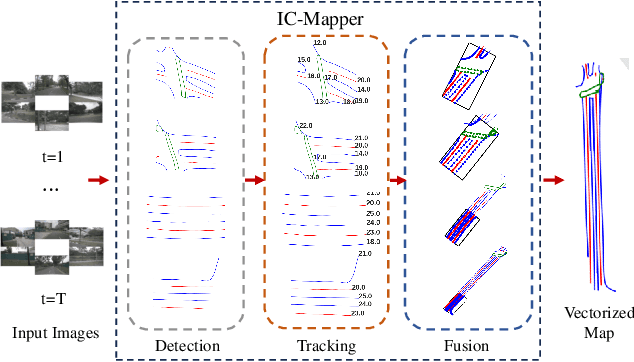
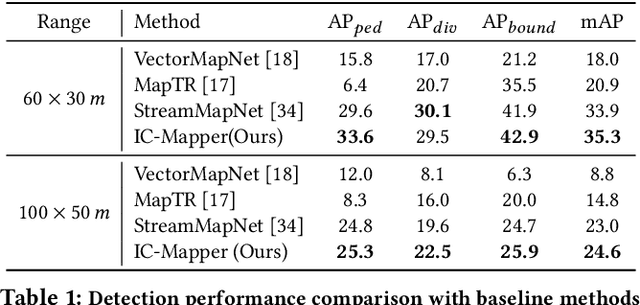
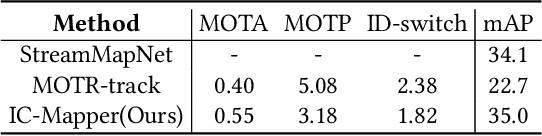
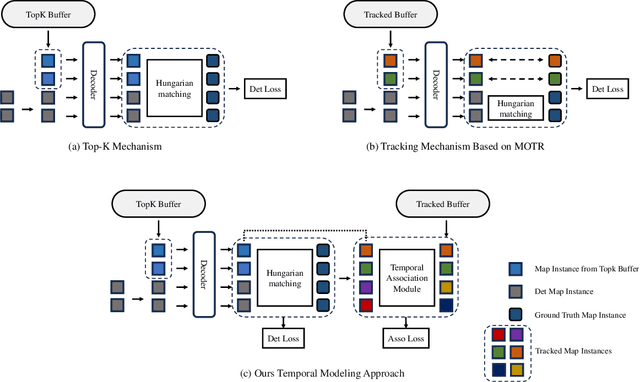
Online vector map construction based on visual data can bypass the processes of data collection, post-processing, and manual annotation required by traditional map construction, which significantly enhances map-building efficiency. However, existing work treats the online mapping task as a local range perception task, overlooking the spatial scalability required for map construction. We propose IC-Mapper, an instance-centric online mapping framework, which comprises two primary components: 1) Instance-centric temporal association module: For the detection queries of adjacent frames, we measure them in both feature and geometric dimensions to obtain the matching correspondence between instances across frames. 2) Instance-centric spatial fusion module: We perform point sampling on the historical global map from a spatial dimension and integrate it with the detection results of instances corresponding to the current frame to achieve real-time expansion and update of the map. Based on the nuScenes dataset, we evaluate our approach on detection, tracking, and global mapping metrics. Experimental results demonstrate the superiority of IC-Mapper against other state-of-the-art methods. Code will be released on https://github.com/Brickzhuantou/IC-Mapper.