 Add to Chrome
 Add to Firefox
 Add to Edge
Point as Skeleton: Accumulated Point Cloud Enhanced Autoregressive Generation for Closed-Loop Autonomous Driving Simulation
Jul 07, 2026
Evaluating end-to-end autonomous driving (E2E-AD) remains challenging, as existing driving simulation methods often trade off closed-loop interactivity (e.g., CARLA) and real-world visual fidelity (e.g., nuScenes). We present \textbf{\emph{Point as Skeleton}}, a generative sensor simulation framework for state-updated autoregressive driving video generation, in which an autoregressive generator synthesizes visual observations from step-wise updated ego states, actor states, scene maps, and point-cloud skeleton conditions. To support closed-loop rollout, we introduce Reset-and-Roll, which adapts rolling diffusion inference to simulation by preventing future-conditioned latent states from being committed across simulation steps. To stabilize error accumulation during step-wise autoregressive rollout, we introduce point-cloud skeletons that decouple foreground and background assets and project them into camera-view painted-point and template-depth conditions, providing appearance and geometric cues. We further implement a nuPlan-based renderer-level closed-loop generative interface for evaluating generation under ego deviations from the original log. Experiments on nuScenes and nuPlan show that \textit{Point as Skeleton} improves autoregressive generation quality during closed-loop rollout, demonstrating its potential for visually faithful closed-loop driving simulation. The code is available at https://github.com/krauwu/point-as-skeleton.

VLK: Learning Humanoid Loco-Manipulation from Synthetic Interactions in Reconstructed Scenes
Jun 29, 2026Perception-based humanoid loco-manipulation requires connecting egocentric observations and task instructions to whole-body motion. Learning this mapping requires synchronized egocentric images, language commands, and robot-compatible kinematic trajectories, yet no existing data source provides this complete tuple at scale. We address this bottleneck by generating vision-language-kinematics (VLK) supervision synthetically in reconstructed scenes. Our pipeline leverages 3D Gaussian Splatting to reconstruct metric-scale indoor environments, synthesizes navigation and object-interaction trajectories using privileged scene information, and renders paired egocentric observations after the fact. We produce 48,000 paired trajectories with no human intervention and train a VLK policy that predicts short-horizon whole-body kinematic trajectories. A whole-body tracker converts these predictions into actions on the physical humanoid. We evaluate on the physical Unitree G1 performing navigation and single-object transport, demonstrating that synthesized interactions in reconstructed scenes provide effective supervision for sim-to-real perception-based humanoid loco-manipulation. Project Website: https://vision-language-kinematics.github.io/
MUSIC: Learning Muscle-Driven Dexterous Hand Control
Apr 26, 2026We present a data-driven approach for physics-based, muscle-driven dexterous control that enables musculoskeletal hands to perform precise piano playing for novel pieces of music outside the reference dataset. Our approach combines high-frequency muscle-level control with low-frequency latent-space coordination in a hierarchical architecture. At the low level, general single-hand policies are trained via reinforcement learning to generate dynamic muscle-tendon activations while tracking trajectories from a large reference motion dataset. The resulting tracking policies are then distilled into variational autoencoder (VAE) models, yielding smooth and structured latent spaces that abstract away low-level muscle dynamics. For the high level, we train piece-specific policies to operate in this latent space, coordinating bimanual motions based on specific goals, denoted by note events extracted from given musical scores, to synthesize performances beyond the reference data. In addition, we present an enhanced musculoskeletal hand model that supports fine control of fingers for accurate low-level motion tracking and diverse high-level motion synthesis. We evaluate the control pipeline of our approach on a diverse piano repertoire spanning multiple musical styles and technical demands. Results demonstrate that our approach can synthesize coordinated bimanual motions with accurate key presses, and achieve the state-of-the-art performance of piano playing in physics-based dexterous control. We also show that our musculoskeletal hand model demonstrates superior biomechanical stability and tracking precision compared to the existing model, and validate that our musculoskeletal hand model and muscle-driven controller can generate physiologically plausible activation patterns that align with human electromyography (EMG) recordings.
AtomicVLA: Unlocking the Potential of Atomic Skill Learning in Robots
Mar 08, 2026Recent advances in Visual-Language-Action (VLA) models have shown promising potential for robotic manipulation tasks. However, real-world robotic tasks often involve long-horizon, multi-step problem-solving and require generalization for continual skill acquisition, extending beyond single actions or skills. These challenges present significant barriers for existing VLA models, which use monolithic action decoders trained on aggregated data, resulting in poor scalability. To address these challenges, we propose AtomicVLA, a unified planning-and-execution framework that jointly generates task-level plans, atomic skill abstractions, and fine-grained actions. AtomicVLA constructs a scalable atomic skill library through a Skill-Guided Mixture-of-Experts (SG-MoE), where each expert specializes in mastering generic yet precise atomic skills. Furthermore, we introduce a flexible routing encoder that automatically assigns dedicated atomic experts to new skills, enabling continual learning. We validate our approach through extensive experiments. In simulation, AtomicVLA outperforms $π_{0}$ by 2.4\% on LIBERO, 10\% on LIBERO-LONG, and outperforms $π_{0}$ and $π_{0.5}$ by 0.22 and 0.25 in average task length on CALVIN. Additionally, our AtomicVLA consistently surpasses baselines by 18.3\% and 21\% in real-world long-horizon tasks and continual learning. These results highlight the effectiveness of atomic skill abstraction and dynamic expert composition for long-horizon and lifelong robotic tasks. The project page is \href{https://zhanglk9.github.io/atomicvla-web/}{here}.
KrwEmd: Revising the Imperfect-Recall Abstraction from Forgetting Everything
Nov 15, 2025Excessive abstraction is a critical challenge in hand abstraction-a task specific to games like Texas hold'em-when solving large-scale imperfect-information games, as it impairs AI performance. This issue arises from extreme implementations of imperfect-recall abstraction, which entirely discard historical information. This paper presents KrwEmd, the first practical algorithm designed to address this problem. We first introduce the k-recall winrate feature, which not only qualitatively distinguishes signal observation infosets by leveraging both future and, crucially, historical game information, but also quantitatively captures their similarity. We then develop the KrwEmd algorithm, which clusters signal observation infosets using earth mover's distance to measure discrepancies between their features. Experimental results demonstrate that KrwEmd significantly improves AI gameplay performance compared to existing algorithms.
No-Regret Strategy Solving in Imperfect-Information Games via Pre-Trained Embedding
Nov 15, 2025High-quality information set abstraction remains a core challenge in solving large-scale imperfect-information extensive-form games (IIEFGs)-such as no-limit Texas Hold'em-where the finite nature of spatial resources hinders strategy solving over the full game. State-of-the-art AI methods rely on pre-trained discrete clustering for abstraction, yet their hard classification irreversibly loses critical information: specifically, the quantifiable subtle differences between information sets-vital for strategy solving-thereby compromising the quality of such solving. Inspired by the word embedding paradigm in natural language processing, this paper proposes the Embedding CFR algorithm, a novel approach for solving strategies in IIEFGs within an embedding space. The algorithm pre-trains and embeds features of isolated information sets into an interconnected low-dimensional continuous space, where the resulting vectors more precisely capture both the distinctions and connections between information sets. Embedding CFR presents a strategy-solving process driven by regret accumulation and strategy updates within this embedding space, with accompanying theoretical analysis verifying its capacity to reduce cumulative regret. Experiments on poker show that with the same spatial overhead, Embedding CFR achieves significantly faster exploitability convergence compared to cluster-based abstraction algorithms, confirming its effectiveness. Furthermore, to our knowledge, it is the first algorithm in poker AI that pre-trains information set abstractions through low-dimensional embedding for strategy solving.
Retargeting Matters: General Motion Retargeting for Humanoid Motion Tracking
Oct 02, 2025Humanoid motion tracking policies are central to building teleoperation pipelines and hierarchical controllers, yet they face a fundamental challenge: the embodiment gap between humans and humanoid robots. Current approaches address this gap by retargeting human motion data to humanoid embodiments and then training reinforcement learning (RL) policies to imitate these reference trajectories. However, artifacts introduced during retargeting, such as foot sliding, self-penetration, and physically infeasible motion are often left in the reference trajectories for the RL policy to correct. While prior work has demonstrated motion tracking abilities, they often require extensive reward engineering and domain randomization to succeed. In this paper, we systematically evaluate how retargeting quality affects policy performance when excessive reward tuning is suppressed. To address issues that we identify with existing retargeting methods, we propose a new retargeting method, General Motion Retargeting (GMR). We evaluate GMR alongside two open-source retargeters, PHC and ProtoMotions, as well as with a high-quality closed-source dataset from Unitree. Using BeyondMimic for policy training, we isolate retargeting effects without reward tuning. Our experiments on a diverse subset of the LAFAN1 dataset reveal that while most motions can be tracked, artifacts in retargeted data significantly reduce policy robustness, particularly for dynamic or long sequences. GMR consistently outperforms existing open-source methods in both tracking performance and faithfulness to the source motion, achieving perceptual fidelity and policy success rates close to the closed-source baseline. Website: https://jaraujo98.github.io/retargeting_matters. Code: https://github.com/YanjieZe/GMR.
Learning to Ball: Composing Policies for Long-Horizon Basketball Moves
Sep 26, 2025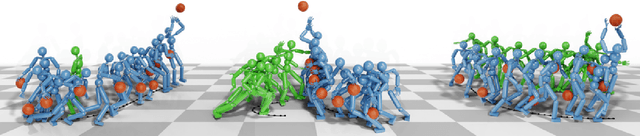
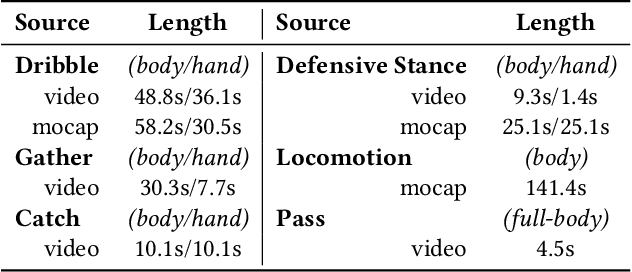
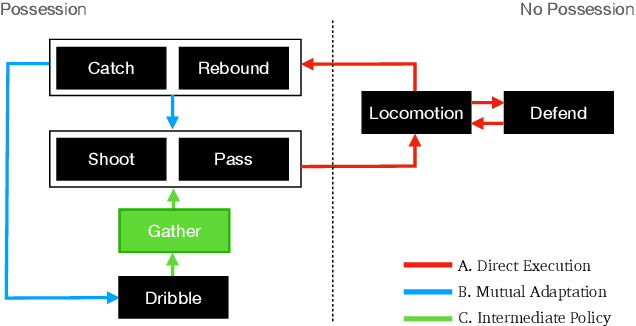

Learning a control policy for a multi-phase, long-horizon task, such as basketball maneuvers, remains challenging for reinforcement learning approaches due to the need for seamless policy composition and transitions between skills. A long-horizon task typically consists of distinct subtasks with well-defined goals, separated by transitional subtasks with unclear goals but critical to the success of the entire task. Existing methods like the mixture of experts and skill chaining struggle with tasks where individual policies do not share significant commonly explored states or lack well-defined initial and terminal states between different phases. In this paper, we introduce a novel policy integration framework to enable the composition of drastically different motor skills in multi-phase long-horizon tasks with ill-defined intermediate states. Based on that, we further introduce a high-level soft router to enable seamless and robust transitions between the subtasks. We evaluate our framework on a set of fundamental basketball skills and challenging transitions. Policies trained by our approach can effectively control the simulated character to interact with the ball and accomplish the long-horizon task specified by real-time user commands, without relying on ball trajectory references.
* ACM Transactions on Graphics (Proceedings of SIGGRAPH Asia 2025). Website: http://pei-xu.github.io/basketball. Video: https://youtu.be/2RBFIjjmR2I. Code: https://github.com/xupei0610/basketball
WGSR-Bench: Wargame-based Game-theoretic Strategic Reasoning Benchmark for Large Language Models
Jun 12, 2025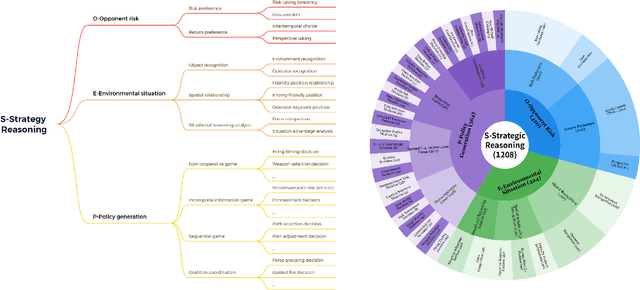
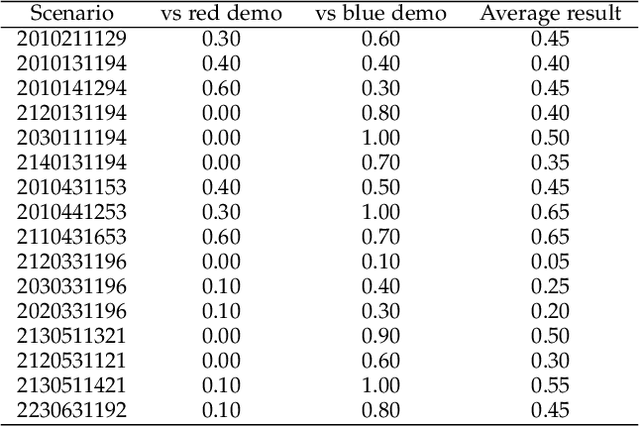
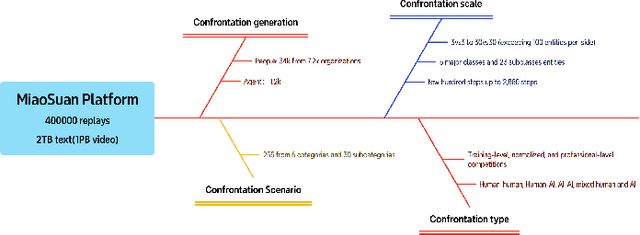
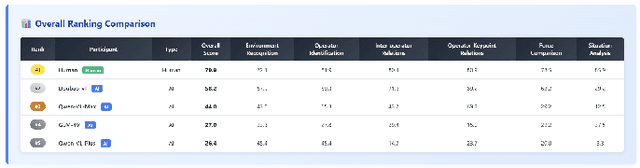
Recent breakthroughs in Large Language Models (LLMs) have led to a qualitative leap in artificial intelligence' s performance on reasoning tasks, particularly demonstrating remarkable capabilities in mathematical, symbolic, and commonsense reasoning. However, as a critical component of advanced human cognition, strategic reasoning, i.e., the ability to assess multi-agent behaviors in dynamic environments, formulate action plans, and adapt strategies, has yet to be systematically evaluated or modeled. To address this gap, this paper introduces WGSR-Bench, the first strategy reasoning benchmark for LLMs using wargame as its evaluation environment. Wargame, a quintessential high-complexity strategic scenario, integrates environmental uncertainty, adversarial dynamics, and non-unique strategic choices, making it an effective testbed for assessing LLMs' capabilities in multi-agent decision-making, intent inference, and counterfactual reasoning. WGSR-Bench designs test samples around three core tasks, i.e., Environmental situation awareness, Opponent risk modeling and Policy generation, which serve as the core S-POE architecture, to systematically assess main abilities of strategic reasoning. Finally, an LLM-based wargame agent is designed to integrate these parts for a comprehensive strategy reasoning assessment. With WGSR-Bench, we hope to assess the strengths and limitations of state-of-the-art LLMs in game-theoretic strategic reasoning and to advance research in large model-driven strategic intelligence.
FürElise: Capturing and Physically Synthesizing Hand Motions of Piano Performance
Oct 08, 2024Piano playing requires agile, precise, and coordinated hand control that stretches the limits of dexterity. Hand motion models with the sophistication to accurately recreate piano playing have a wide range of applications in character animation, embodied AI, biomechanics, and VR/AR. In this paper, we construct a first-of-its-kind large-scale dataset that contains approximately 10 hours of 3D hand motion and audio from 15 elite-level pianists playing 153 pieces of classical music. To capture natural performances, we designed a markerless setup in which motions are reconstructed from multi-view videos using state-of-the-art pose estimation models. The motion data is further refined via inverse kinematics using the high-resolution MIDI key-pressing data obtained from sensors in a specialized Yamaha Disklavier piano. Leveraging the collected dataset, we developed a pipeline that can synthesize physically-plausible hand motions for musical scores outside of the dataset. Our approach employs a combination of imitation learning and reinforcement learning to obtain policies for physics-based bimanual control involving the interaction between hands and piano keys. To solve the sampling efficiency problem with the large motion dataset, we use a diffusion model to generate natural reference motions, which provide high-level trajectory and fingering (finger order and placement) information. However, the generated reference motion alone does not provide sufficient accuracy for piano performance modeling. We then further augmented the data by using musical similarity to retrieve similar motions from the captured dataset to boost the precision of the RL policy. With the proposed method, our model generates natural, dexterous motions that generalize to music from outside the training dataset.