 Add to Chrome
 Add to Firefox
 Add to Edge
Agentic Reinforcement Learning with Self-Distilled Reward Shaping
Aug 04, 2026
Agentic reinforcement learning enables LLM agents to learn through interaction, but sparse trajectory-level rewards reveal success without identifying which intermediate decisions deserve credit. Training-only privileged skills can provide denser supervision by allowing the same frozen policy snapshot to rescore fixed tokens from skill-free trajectories while conditioned on task-matched procedural skills. Existing methods, however, do not jointly calibrate teacher scores across interaction steps, relate teacher confidence to realized returns, and integrate the resulting signal into native reward-to-advantage construction. We introduce Agentic Reinforcement Learning with Self-Distilled Reward Shaping (ADRS), a framework for constructing return-associated token-level credit for multi-turn language agents. ADRS centers and normalizes privileged token scores within each step, modulates them with a return-associated Teacher Value Advantage (TVA) gate based on within-group confidence--return association, and incorporates the gated token signal into native RL credit construction. Together, these components determine what the teacher prefers, when that preference is return-relevant, and how it enters the native reinforcement-learning credit path, while keeping rollouts and inference skill-free. Finally, experiments across three interactive benchmarks show that ADRS consistently improves performance on long-horizon tasks, with gains persisting across RL backbones, reduced-data settings, unseen tasks, and extended training. For anonymous review, our code is available at the following the link: https://github.com/gitrxh/ADRS-arxiv

When Does Muon Help Agentic Reinforcement Learning?
Jul 20, 2026Muon is competitive with AdamW in large-scale pre-training, but its value for reinforcement-learning (RL) post-training remains unclear. We study vanilla Muon in sparse-reward agentic RL through matched single-seed comparisons with AdamW on ALFWorld using Qwen2.5-0.5B-Instruct. Under Group-in-Group Policy Optimization (GiGPO), applying Muon only to hidden weight matrices raises final-window validation success from 0.290 to 0.546 (+88%); high-rate AdamW controls retain no post-update success. The effect depends on the advantage estimator and learning rate. At 3e-5, Muon improves GRPO from 0.161 to 0.268, whereas GraphGPO's late-window gap narrows near saturation. At 1e-5, GraphGPO Muon reaches 0.901, raises normalized validation AUC from 0.399 to 0.556, and reaches 0.5 and 0.75 success 30 and 60 updates earlier, respectively. These exploratory results show that Muon can benefit agentic RL and motivate studying the policy optimizer, advantage estimator, and learning rate jointly.
The Path to Self-Evolving Clinical Systems: Scaling Medical Agents from Assistance to Autonomy
Jul 13, 2026The growing ability of large language models and vision language models to jointly interpret and reason over images and text is reshaping medical agents, moving them from task specific predictors toward autonomous systems that perceive, reason, plan, remember, and act in clinical environments. This work departs from the capability first perspective of existing literature and instead begins from clinical deployment, asking what tasks, contamination resistant benchmarks, and interactive training environments are required before medical agents can be trusted in practice. Medical agents are formalized as sequential decision making systems under partial observability, together with a three level autonomy taxonomy spanning assisted, cooperative, and fully autonomous operation. The field is organized along a unified scaling spine consisting of framework scaling, capability scaling, and environment scaling. Within this framework, clinical environment scaling, the integration of tools, data, and clinical gyms, is identified as the most actionable yet underexplored direction for agents operating in PACS, EHR, and FHIR ecosystems. Clinical self evolution, where agents improve through interaction with their environments rather than parameter scaling alone, is further positioned as a key research frontier, drawing insights from self improving agents, agent gyms, and test time compute scaling. Applications across radiology, pathology, ophthalmology, and hospital workflows are examined together with deployment challenges including hallucination, cascading failures, and fairness. By consolidating more than 300 references, with particular emphasis on advances from 2025 to 2026, this work provides a roadmap toward trustworthy, self improving medical imaging systems for real clinical practice.
EasyLens: A Training-Free Plug-and-Play Subtle-Lesion Representation Amplifier for Medical Vision-Language Models
Jun 04, 2026Medical vision-language models (VLMs) have shown increasing potential for clinical image interpretation, including lesion detection and report generation. However, their practical utility remains limited by insufficient sensitivity to subtle lesions, whose visual evidence is often sparse, low-contrast, and embedded within complex anatomical context. As local visual tokens are aggregated, these weak lesion cues can become underrepresented in global image representations, making them difficult for medical VLMs to recognize. Existing efforts to improve lesion sensitivity mainly rely on medical-domain vision-encoder pre-training, clinical-term-guided alignment, or trainable pathological representation enhancement. Although effective, these approaches usually require additional training or model-specific adaptation and may overfit to particular disease morphologies, limiting their applicability to frozen medical VLMs. To address these limitations, we propose EasyLens, a training-free plug-and-play subtle-lesion representation amplifier for medical VLMs. EasyLens first constructs EasyBank, a pathology-anatomy prototype space that provides lesion-related prototypes and anatomy-aware normal references for comparing suspicious patches against both pathological and normal anatomical patterns. To avoid blindly amplifying normal tissues, EasyTag selects lesion-relevant patches through counterfactual prototype reasoning. To counteract the dilution of subtle lesion cues in global image representations, EasyAmplifier strengthens the selected lesion-relevant patch representations through morphology-guided residual enhancement, thereby increasing their contribution to the global image embedding. Experiments on multiple medical image datasets and frozen medical VLM backbones show that EasyLens improves subtle-lesion detection and outperforms existing encoder-enhancement baselines.
Learning from Medical Entity Trees: An Entity-Centric Medical Data Engineering Framework for MLLMs
Apr 28, 2026Multimodal Large Language Models (MLLMs) have shown transformative potential in medical applications, yet their performance is hindered by conventional data curation strategies that rely on coarse-grained partitioning by modality or department. Such fragmented approaches fail to capture the hierarchical and interconnected nature of clinical medical knowledge, limiting the models' ability to perform fine-grained recognition and complex reasoning. In this paper, we propose a novel Entity-Centric Medical Data Engineering framework. We automatically extract entities from authoritative medical literature to construct a Medical Entity Tree (MET), a hierarchical structure that systematically encodes diseases, anatomical structures, modalities, and symptoms into a unified knowledge repository. Building upon the MET, we propose an advanced data engine that includes: (1) node-guided retrieval to anchor raw data to specific medical concepts, (2) a two-stage hybrid filtering and alignment pipeline to ensure precise visual-semantic correspondence, and (3) knowledge-aware data synthesis to generate enriched captions and targeted reasoning VQA pairs, leveraging structural constraints. Extensive evaluations across six medical benchmarks demonstrate that our approach significantly enhances the medical capabilities of general-purpose MLLMs, improving their ability to handle complex clinical queries and achieve state-of-the-art performance in diverse medical contexts.
MedXIAOHE: A Comprehensive Recipe for Building Medical MLLMs
Feb 16, 2026We present MedXIAOHE, a medical vision-language foundation model designed to advance general-purpose medical understanding and reasoning in real-world clinical applications. MedXIAOHE achieves state-of-the-art performance across diverse medical benchmarks and surpasses leading closed-source multimodal systems on multiple capabilities. To achieve this, we propose an entity-aware continual pretraining framework that organizes heterogeneous medical corpora to broaden knowledge coverage and reduce long-tail gaps (e.g., rare diseases). For medical expert-level reasoning and interaction, MedXIAOHE incorporates diverse medical reasoning patterns via reinforcement learning and tool-augmented agentic training, enabling multi-step diagnostic reasoning with verifiable decision traces. To improve reliability in real-world use, MedXIAOHE integrates user-preference rubrics, evidence-grounded reasoning, and low-hallucination long-form report generation, with improved adherence to medical instructions. We release this report to document our practical design choices, scaling insights, and evaluation framework, hoping to inspire further research.
DEEPMED: Building a Medical DeepResearch Agent via Multi-hop Med-Search Data and Turn-Controlled Agentic Training & Inference
Jan 26, 2026Medical reasoning models remain constrained by parametric knowledge and are thus susceptible to forgetting and hallucinations. DeepResearch (DR) models ground outputs in verifiable evidence from tools and perform strongly in general domains, but their direct transfer to medical field yields relatively limited gains. We attribute this to two gaps: task characteristic and tool-use scaling. Medical questions require evidence interpretation in a knowledge-intensive clinical context; while general DR models can retrieve information, they often lack clinical-context reasoning and thus "find it but fail to use it," leaving performance limited by medical abilities. Moreover, in medical scenarios, blindly scaling tool-call can inject noisy context, derailing sensitive medical reasoning and prompting repetitive evidence-seeking along incorrect paths. Therefore, we propose DeepMed. For data, we deploy a multi-hop med-search QA synthesis method supporting the model to apply the DR paradigm in medical contexts. For training, we introduce a difficulty-aware turn-penalty to suppress excessive tool-call growth. For inference, we bring a monitor to help validate hypotheses within a controlled number of steps and avoid context rot. Overall, on seven medical benchmarks, DeepMed improves its base model by 9.79\% on average and outperforms larger medical reasoning and DR models.
GLM-4.1V-Thinking: Towards Versatile Multimodal Reasoning with Scalable Reinforcement Learning
Jul 02, 2025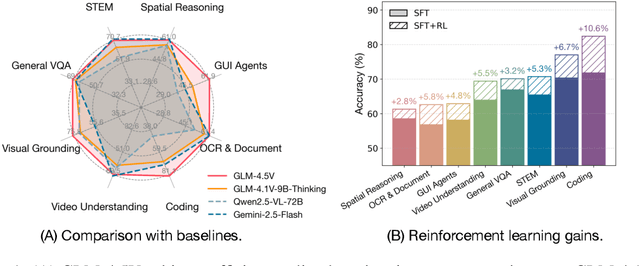
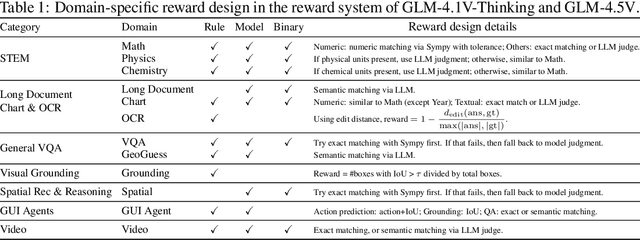
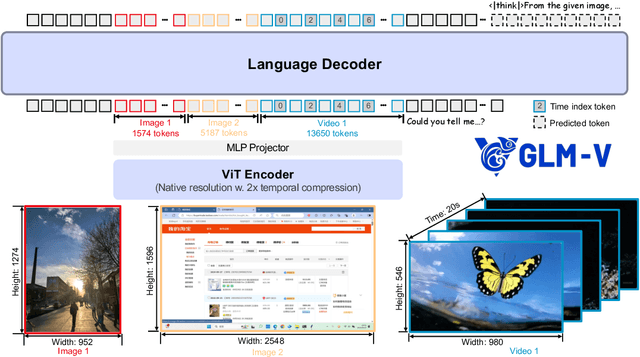
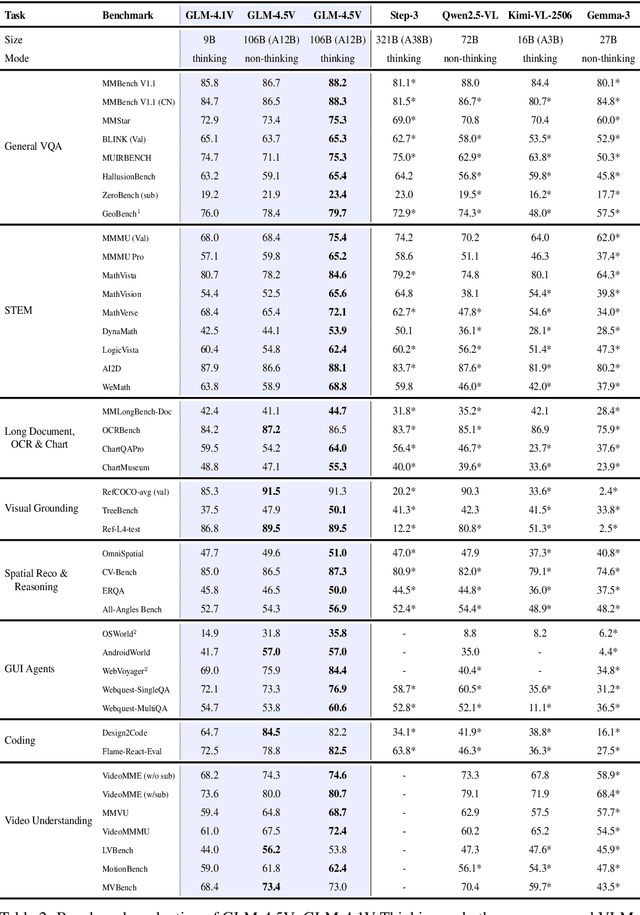
We present GLM-4.1V-Thinking, a vision-language model (VLM) designed to advance general-purpose multimodal understanding and reasoning. In this report, we share our key findings in the development of the reasoning-centric training framework. We first develop a capable vision foundation model with significant potential through large-scale pre-training, which arguably sets the upper bound for the final performance. We then propose Reinforcement Learning with Curriculum Sampling (RLCS) to unlock the full potential of the model, leading to comprehensive capability enhancement across a diverse range of tasks, including STEM problem solving, video understanding, content recognition, coding, grounding, GUI-based agents, and long document understanding. We open-source GLM-4.1V-9B-Thinking, which achieves state-of-the-art performance among models of comparable size. In a comprehensive evaluation across 28 public benchmarks, our model outperforms Qwen2.5-VL-7B on nearly all tasks and achieves comparable or even superior performance on 18 benchmarks relative to the significantly larger Qwen2.5-VL-72B. Notably, GLM-4.1V-9B-Thinking also demonstrates competitive or superior performance compared to closed-source models such as GPT-4o on challenging tasks including long document understanding and STEM reasoning, further underscoring its strong capabilities. Code, models and more information are released at https://github.com/THUDM/GLM-4.1V-Thinking.
Enhancing LLM-based Recommendation through Semantic-Aligned Collaborative Knowledge
Apr 14, 2025Large Language Models (LLMs) demonstrate remarkable capabilities in leveraging comprehensive world knowledge and sophisticated reasoning mechanisms for recommendation tasks. However, a notable limitation lies in their inability to effectively model sparse identifiers (e.g., user and item IDs), unlike conventional collaborative filtering models (Collabs.), thus hindering LLM to learn distinctive user-item representations and creating a performance bottleneck. Prior studies indicate that integrating collaborative knowledge from Collabs. into LLMs can mitigate the above limitations and enhance their recommendation performance. Nevertheless, the significant discrepancy in knowledge distribution and semantic space between LLMs and Collab. presents substantial challenges for effective knowledge transfer. To tackle these challenges, we propose a novel framework, SeLLa-Rec, which focuses on achieving alignment between the semantic spaces of Collabs. and LLMs. This alignment fosters effective knowledge fusion, mitigating the influence of discriminative noise and facilitating the deep integration of knowledge from diverse models. Specifically, three special tokens with collaborative knowledge are embedded into the LLM's semantic space through a hybrid projection layer and integrated into task-specific prompts to guide the recommendation process. Experiments conducted on two public benchmark datasets (MovieLens-1M and Amazon Book) demonstrate that SeLLa-Rec achieves state-of-the-art performance.
Joint Pre-training and Local Re-training: Transferable Representation Learning on Multi-source Knowledge Graphs
Jun 05, 2023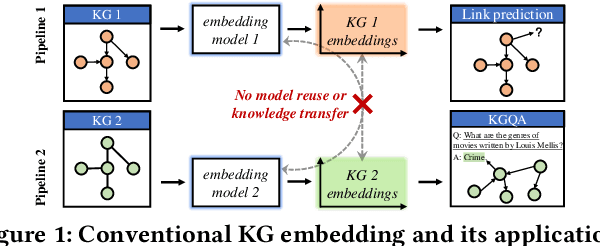


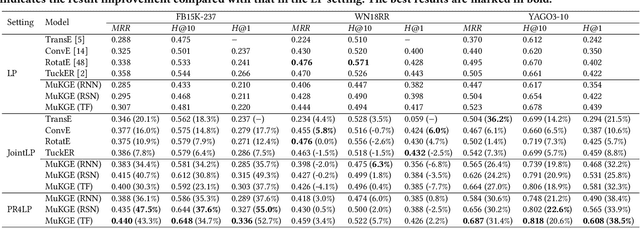
In this paper, we present the ``joint pre-training and local re-training'' framework for learning and applying multi-source knowledge graph (KG) embeddings. We are motivated by the fact that different KGs contain complementary information to improve KG embeddings and downstream tasks. We pre-train a large teacher KG embedding model over linked multi-source KGs and distill knowledge to train a student model for a task-specific KG. To enable knowledge transfer across different KGs, we use entity alignment to build a linked subgraph for connecting the pre-trained KGs and the target KG. The linked subgraph is re-trained for three-level knowledge distillation from the teacher to the student, i.e., feature knowledge distillation, network knowledge distillation, and prediction knowledge distillation, to generate more expressive embeddings. The teacher model can be reused for different target KGs and tasks without having to train from scratch. We conduct extensive experiments to demonstrate the effectiveness and efficiency of our framework.