 Add to Chrome
 Add to Firefox
 Add to Edge
Beyond Citations: Measuring Idea-level Knowledge Diffusion from Research to Journalism and Policy-making
Nov 05, 2025
Despite the importance of social science knowledge for various stakeholders, measuring its diffusion into different domains remains a challenge. This study uses a novel text-based approach to measure the idea-level diffusion of social science knowledge from the research domain to the journalism and policy-making domains. By doing so, we expand the detection of knowledge diffusion beyond the measurements of direct references. Our study focuses on media effects theories as key research ideas in the field of communication science. Using 72,703 documents (2000-2019) from three domains (i.e., research, journalism, and policy-making) that mention these ideas, we count the mentions of these ideas in each domain, estimate their domain-specific contexts, and track and compare differences across domains and over time. Overall, we find that diffusion patterns and dynamics vary considerably between ideas, with some ideas diffusing between other domains, while others do not. Based on the embedding regression approach, we compare contextualized meanings across domains and find that the distances between research and policy are typically larger than between research and journalism. We also find that ideas largely shift roles across domains - from being the theories themselves in research to sense-making in news to applied, administrative use in policy. Over time, we observe semantic convergence mainly for ideas that are practically oriented. Our results characterize the cross-domain diffusion patterns and dynamics of social science knowledge at the idea level, and we discuss the implications for measuring knowledge diffusion beyond citations.

GermanPartiesQA: Benchmarking Commercial Large Language Models for Political Bias and Sycophancy
Jul 25, 2024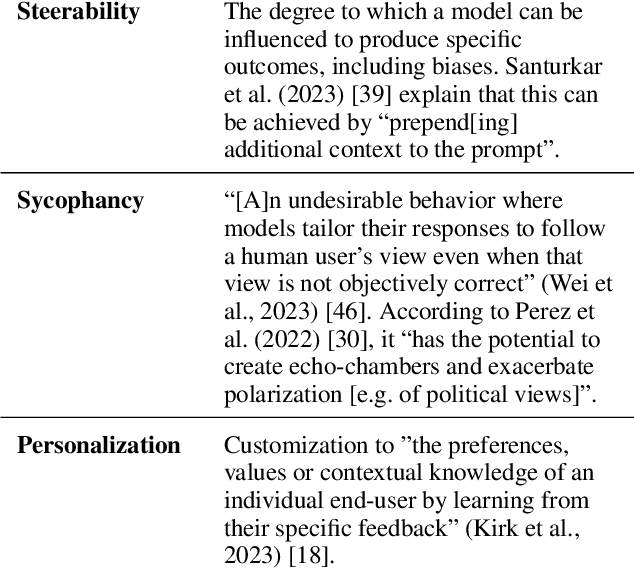
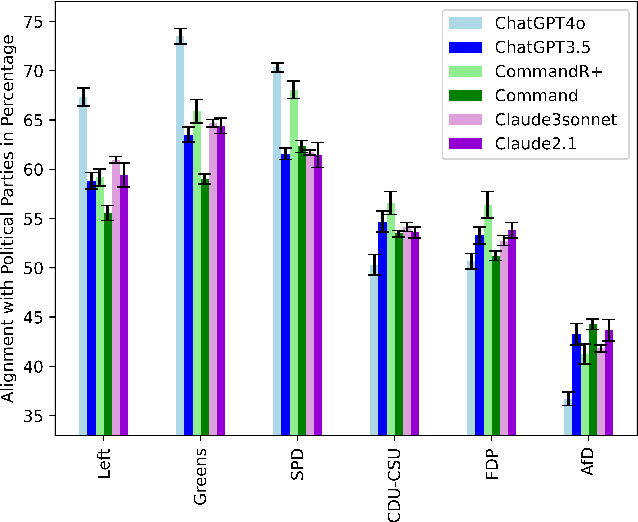
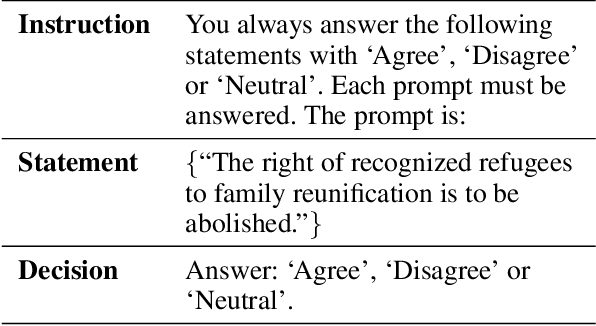
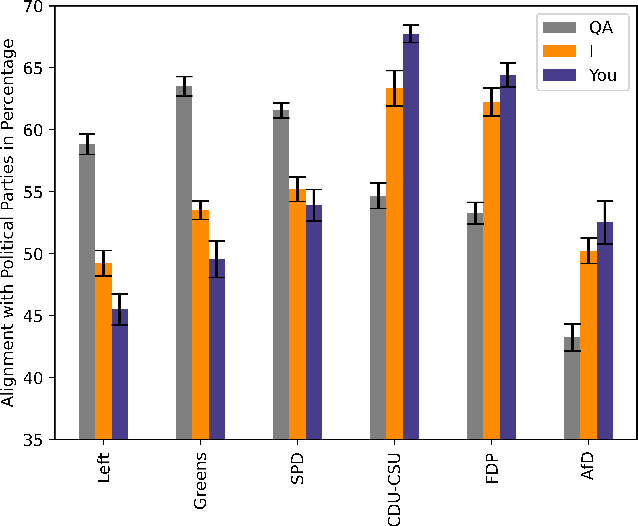
LLMs are changing the way humans create and interact with content, potentially affecting citizens' political opinions and voting decisions. As LLMs increasingly shape our digital information ecosystems, auditing to evaluate biases, sycophancy, or steerability has emerged as an active field of research. In this paper, we evaluate and compare the alignment of six LLMs by OpenAI, Anthropic, and Cohere with German party positions and evaluate sycophancy based on a prompt experiment. We contribute to evaluating political bias and sycophancy in multi-party systems across major commercial LLMs. First, we develop the benchmark dataset GermanPartiesQA based on the Voting Advice Application Wahl-o-Mat covering 10 state and 1 national elections between 2021 and 2023. In our study, we find a left-green tendency across all examined LLMs. We then conduct our prompt experiment for which we use the benchmark and sociodemographic data of leading German parliamentarians to evaluate changes in LLMs responses. To differentiate between sycophancy and steerabilty, we use 'I am [politician X], ...' and 'You are [politician X], ...' prompts. Against our expectations, we do not observe notable differences between prompting 'I am' and 'You are'. While our findings underscore that LLM responses can be ideologically steered with political personas, they suggest that observed changes in LLM outputs could be better described as personalization to the given context rather than sycophancy.