 Add to Chrome
 Add to Firefox
 Add to Edge
VIRGi: View-dependent Instant Recoloring of 3D Gaussians Splats
Mar 03, 2026
3D Gaussian Splatting (3DGS) has recently transformed the fields of novel view synthesis and 3D reconstruction due to its ability to accurately model complex 3D scenes and its unprecedented rendering performance. However, a significant challenge persists: the absence of an efficient and photorealistic method for editing the appearance of the scene's content. In this paper we introduce VIRGi, a novel approach for rapidly editing the color of scenes modeled by 3DGS while preserving view-dependent effects such as specular highlights. Key to our method are a novel architecture that separates color into diffuse and view-dependent components, and a multi-view training strategy that integrates image patches from multiple viewpoints. Improving over the conventional single-view batch training, our 3DGS representation provides more accurate reconstruction and serves as a solid representation for the recoloring task. For 3DGS recoloring, we then introduce a rapid scheme requiring only one manually edited image of the scene from the end-user. By fine-tuning the weights of a single MLP, alongside a module for single-shot segmentation of the editable area, the color edits are seamlessly propagated to the entire scene in just two seconds, facilitating real-time interaction and providing control over the strength of the view-dependent effects. An exhaustive validation on diverse datasets demonstrates significant quantitative and qualitative advancements over competitors based on Neural Radiance Fields representations.

AutoSew: A Geometric Approach to Stitching Prediction with Graph Neural Networks
Feb 25, 2026Automating garment assembly from sewing patterns remains a significant challenge due to the lack of standardized annotation protocols and the frequent absence of semantic cues. Existing methods often rely on panel labels or handcrafted heuristics, which limit their applicability to real-world, non-conforming patterns. We present AutoSew, a fully automatic, geometry-based approach for predicting stitch correspondences directly from 2D pattern contours. AutoSew formulates the problem as a graph matching task, leveraging a Graph Neural Network to capture local and global geometric context, and employing a differentiable optimal transport solver to infer stitching relationships-including multi-edge connections. To support this task, we update the GarmentCodeData dataset modifying over 18k patterns with realistic multi-edge annotations, reflecting industrial assembly scenarios. AutoSew achieves 96% F1-score and successfully assembles 73.3% of test garments without error, outperforming existing methods while relying solely on geometric input. Our results demonstrate that geometry alone can robustly guide stitching prediction, enabling scalable garment assembly without manual input.
Φeat: Physically-Grounded Feature Representation
Nov 14, 2025Foundation models have emerged as effective backbones for many vision tasks. However, current self-supervised features entangle high-level semantics with low-level physical factors, such as geometry and illumination, hindering their use in tasks requiring explicit physical reasoning. In this paper, we introduce $Φ$eat, a novel physically-grounded visual backbone that encourages a representation sensitive to material identity, including reflectance cues and geometric mesostructure. Our key idea is to employ a pretraining strategy that contrasts spatial crops and physical augmentations of the same material under varying shapes and lighting conditions. While similar data have been used in high-end supervised tasks such as intrinsic decomposition or material estimation, we demonstrate that a pure self-supervised training strategy, without explicit labels, already provides a strong prior for tasks requiring robust features invariant to external physical factors. We evaluate the learned representations through feature similarity analysis and material selection, showing that $Φ$eat captures physically-grounded structure beyond semantic grouping. These findings highlight the promise of unsupervised physical feature learning as a foundation for physics-aware perception in vision and graphics. These findings highlight the promise of unsupervised physical feature learning as a foundation for physics-aware perception in vision and graphics.
Fine-Grained Spatially Varying Material Selection in Images
Jun 11, 2025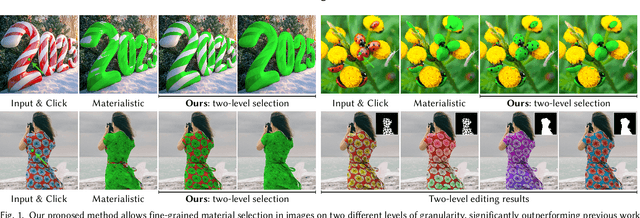
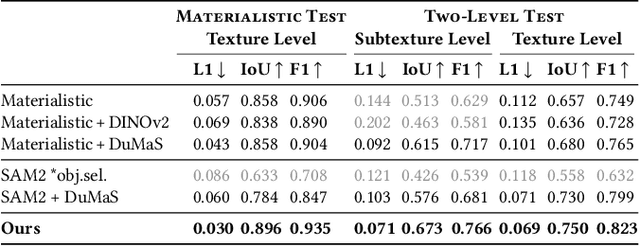
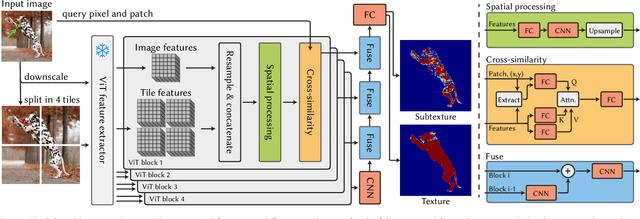
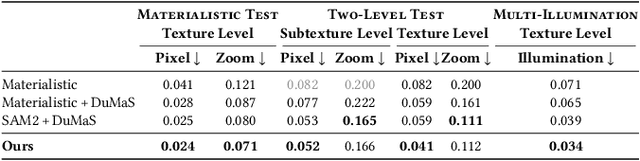
Selection is the first step in many image editing processes, enabling faster and simpler modifications of all pixels sharing a common modality. In this work, we present a method for material selection in images, robust to lighting and reflectance variations, which can be used for downstream editing tasks. We rely on vision transformer (ViT) models and leverage their features for selection, proposing a multi-resolution processing strategy that yields finer and more stable selection results than prior methods. Furthermore, we enable selection at two levels: texture and subtexture, leveraging a new two-level material selection (DuMaS) dataset which includes dense annotations for over 800,000 synthetic images, both on the texture and subtexture levels.
Single-image Reflectance and Transmittance Estimation from Any Flatbed Scanner
Feb 20, 2025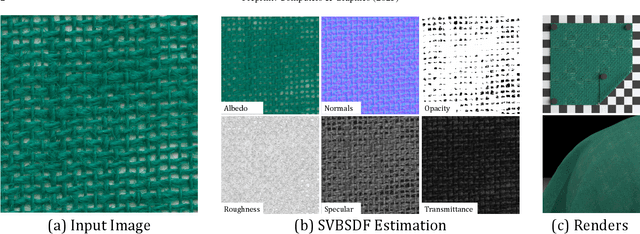
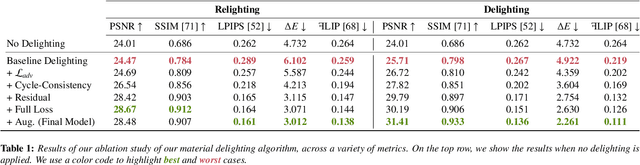
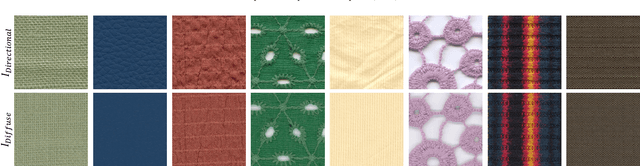
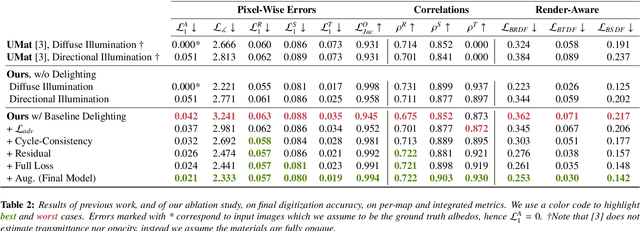
Flatbed scanners have emerged as promising devices for high-resolution, single-image material capture. However, existing approaches assume very specific conditions, such as uniform diffuse illumination, which are only available in certain high-end devices, hindering their scalability and cost. In contrast, in this work, we introduce a method inspired by intrinsic image decomposition, which accurately removes both shading and specularity, effectively allowing captures with any flatbed scanner. Further, we extend previous work on single-image material reflectance capture with the estimation of opacity and transmittance, critical components of full material appearance (SVBSDF), improving the results for any material captured with a flatbed scanner, at a very high resolution and accuracy
IReNe: Instant Recoloring of Neural Radiance Fields
Jun 10, 2024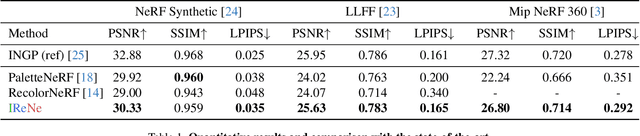
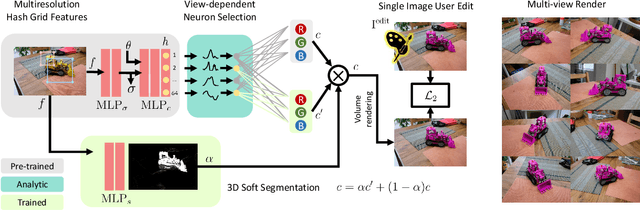
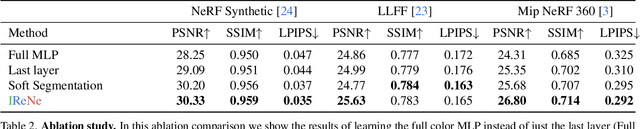
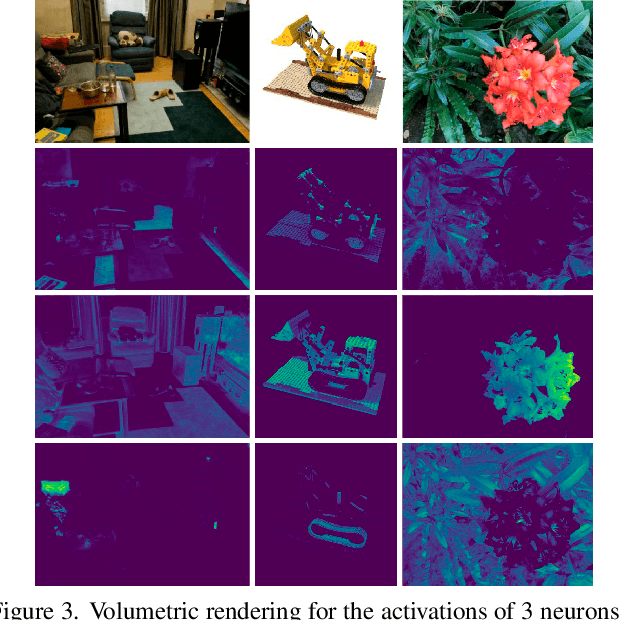
Advances in NERFs have allowed for 3D scene reconstructions and novel view synthesis. Yet, efficiently editing these representations while retaining photorealism is an emerging challenge. Recent methods face three primary limitations: they're slow for interactive use, lack precision at object boundaries, and struggle to ensure multi-view consistency. We introduce IReNe to address these limitations, enabling swift, near real-time color editing in NeRF. Leveraging a pre-trained NeRF model and a single training image with user-applied color edits, IReNe swiftly adjusts network parameters in seconds. This adjustment allows the model to generate new scene views, accurately representing the color changes from the training image while also controlling object boundaries and view-specific effects. Object boundary control is achieved by integrating a trainable segmentation module into the model. The process gains efficiency by retraining only the weights of the last network layer. We observed that neurons in this layer can be classified into those responsible for view-dependent appearance and those contributing to diffuse appearance. We introduce an automated classification approach to identify these neuron types and exclusively fine-tune the weights of the diffuse neurons. This further accelerates training and ensures consistent color edits across different views. A thorough validation on a new dataset, with edited object colors, shows significant quantitative and qualitative advancements over competitors, accelerating speeds by 5x to 500x.
IReNe: Instant Recoloring in Neural Radiance Fields
May 30, 2024Advances in NERFs have allowed for 3D scene reconstructions and novel view synthesis. Yet, efficiently editing these representations while retaining photorealism is an emerging challenge. Recent methods face three primary limitations: they're slow for interactive use, lack precision at object boundaries, and struggle to ensure multi-view consistency. We introduce IReNe to address these limitations, enabling swift, near real-time color editing in NeRF. Leveraging a pre-trained NeRF model and a single training image with user-applied color edits, IReNe swiftly adjusts network parameters in seconds. This adjustment allows the model to generate new scene views, accurately representing the color changes from the training image while also controlling object boundaries and view-specific effects. Object boundary control is achieved by integrating a trainable segmentation module into the model. The process gains efficiency by retraining only the weights of the last network layer. We observed that neurons in this layer can be classified into those responsible for view-dependent appearance and those contributing to diffuse appearance. We introduce an automated classification approach to identify these neuron types and exclusively fine-tune the weights of the diffuse neurons. This further accelerates training and ensures consistent color edits across different views. A thorough validation on a new dataset, with edited object colors, shows significant quantitative and qualitative advancements over competitors, accelerating speeds by 5x to 500x.
TexTile: A Differentiable Metric for Texture Tileability
Mar 19, 2024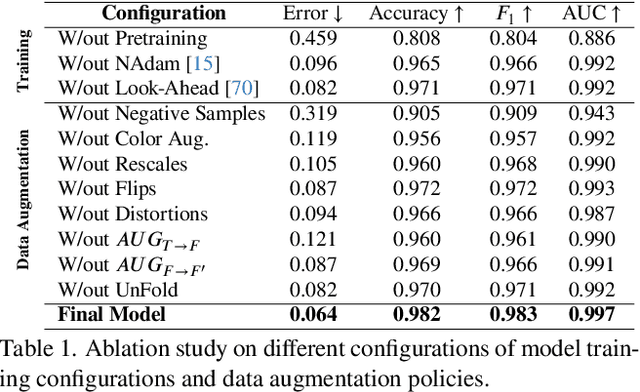
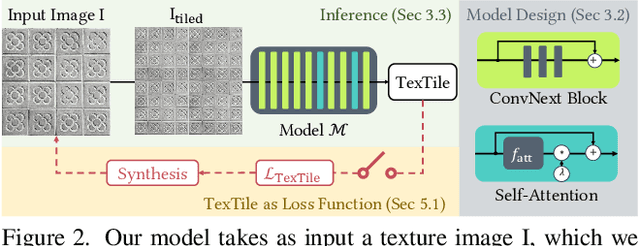
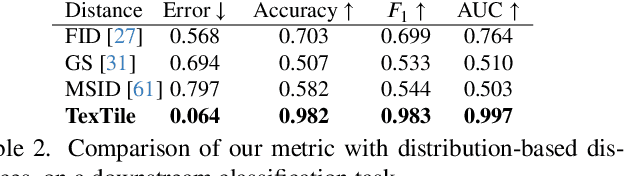

We introduce TexTile, a novel differentiable metric to quantify the degree upon which a texture image can be concatenated with itself without introducing repeating artifacts (i.e., the tileability). Existing methods for tileable texture synthesis focus on general texture quality, but lack explicit analysis of the intrinsic repeatability properties of a texture. In contrast, our TexTile metric effectively evaluates the tileable properties of a texture, opening the door to more informed synthesis and analysis of tileable textures. Under the hood, TexTile is formulated as a binary classifier carefully built from a large dataset of textures of different styles, semantics, regularities, and human annotations.Key to our method is a set of architectural modifications to baseline pre-train image classifiers to overcome their shortcomings at measuring tileability, along with a custom data augmentation and training regime aimed at increasing robustness and accuracy. We demonstrate that TexTile can be plugged into different state-of-the-art texture synthesis methods, including diffusion-based strategies, and generate tileable textures while keeping or even improving the overall texture quality. Furthermore, we show that TexTile can objectively evaluate any tileable texture synthesis method, whereas the current mix of existing metrics produces uncorrelated scores which heavily hinders progress in the field.
NeuBTF: Neural fields for BTF encoding and transfer
Jul 03, 2023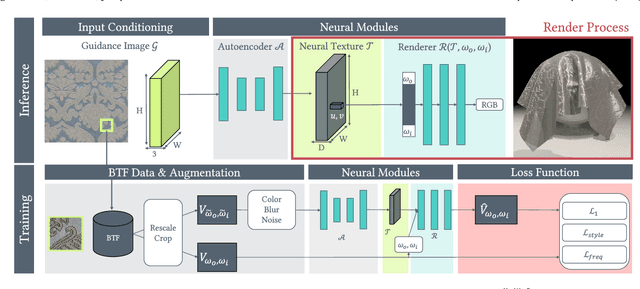
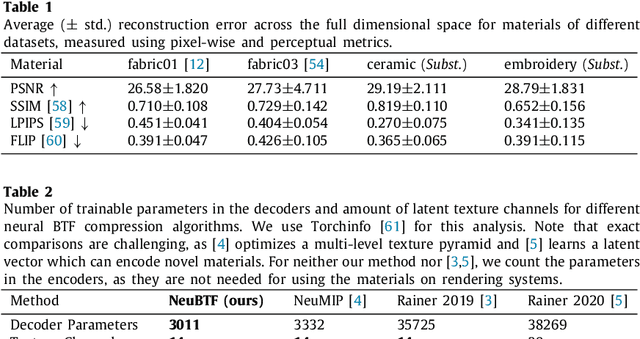
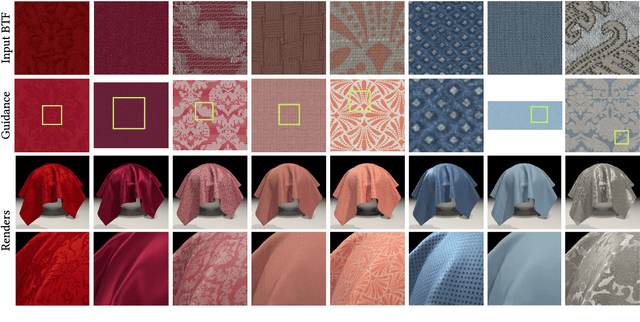

Neural material representations are becoming a popular way to represent materials for rendering. They are more expressive than analytic models and occupy less memory than tabulated BTFs. However, existing neural materials are immutable, meaning that their output for a certain query of UVs, camera, and light vector is fixed once they are trained. While this is practical when there is no need to edit the material, it can become very limiting when the fragment of the material used for training is too small or not tileable, which frequently happens when the material has been captured with a gonioreflectometer. In this paper, we propose a novel neural material representation which jointly tackles the problems of BTF compression, tiling, and extrapolation. At test time, our method uses a guidance image as input to condition the neural BTF to the structural features of this input image. Then, the neural BTF can be queried as a regular BTF using UVs, camera, and light vectors. Every component in our framework is purposefully designed to maximize BTF encoding quality at minimal parameter count and computational complexity, achieving competitive compression rates compared with previous work. We demonstrate the results of our method on a variety of synthetic and captured materials, showing its generality and capacity to learn to represent many optical properties.
* 9 pages, 7 figures. Accepted to Computers & Graphics (Special Section on CEIG 2023). Project Website: https://carlosrodriguezpardo.es/projects/NeuBTF/
UMat: Uncertainty-Aware Single Image High Resolution Material Capture
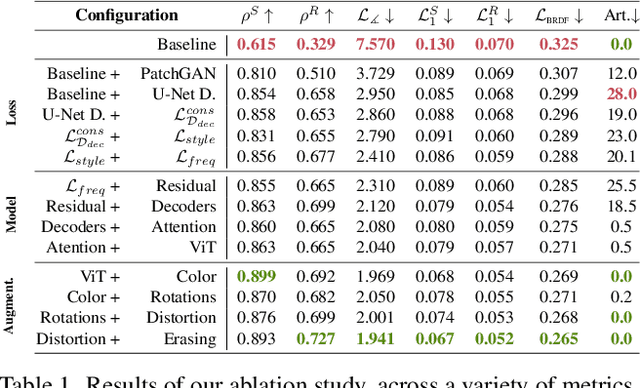
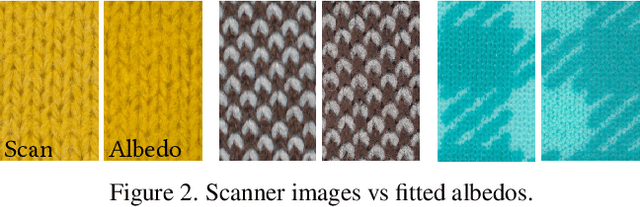
May 25, 2023
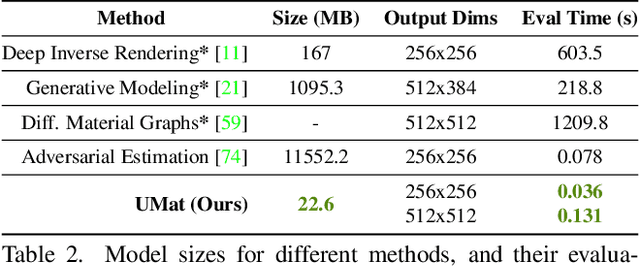
We propose a learning-based method to recover normals, specularity, and roughness from a single diffuse image of a material, using microgeometry appearance as our primary cue. Previous methods that work on single images tend to produce over-smooth outputs with artifacts, operate at limited resolution, or train one model per class with little room for generalization. Previous methods that work on single images tend to produce over-smooth outputs with artifacts, operate at limited resolution, or train one model per class with little room for generalization. In contrast, in this work, we propose a novel capture approach that leverages a generative network with attention and a U-Net discriminator, which shows outstanding performance integrating global information at reduced computational complexity. We showcase the performance of our method with a real dataset of digitized textile materials and show that a commodity flatbed scanner can produce the type of diffuse illumination required as input to our method. Additionally, because the problem might be illposed -more than a single diffuse image might be needed to disambiguate the specular reflection- or because the training dataset is not representative enough of the real distribution, we propose a novel framework to quantify the model's confidence about its prediction at test time. Our method is the first one to deal with the problem of modeling uncertainty in material digitization, increasing the trustworthiness of the process and enabling more intelligent strategies for dataset creation, as we demonstrate with an active learning experiment.