 Add to Chrome
 Add to Firefox
 Add to Edge
WavCraft: Audio Editing and Generation with Natural Language Prompts
Mar 15, 2024

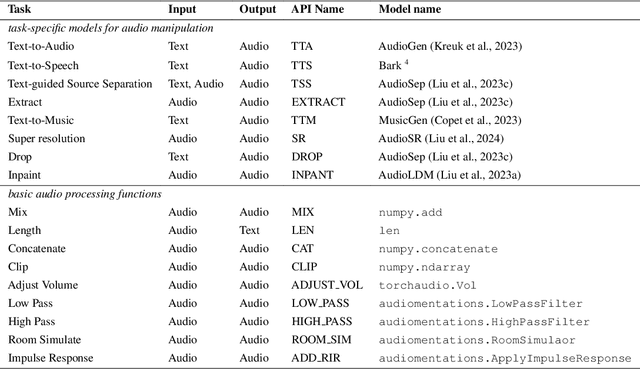


We introduce WavCraft, a collective system that leverages large language models (LLMs) to connect diverse task-specific models for audio content creation and editing. Specifically, WavCraft describes the content of raw sound materials in natural language and prompts the LLM conditioned on audio descriptions and users' requests. WavCraft leverages the in-context learning ability of the LLM to decomposes users' instructions into several tasks and tackle each task collaboratively with audio expert modules. Through task decomposition along with a set of task-specific models, WavCraft follows the input instruction to create or edit audio content with more details and rationales, facilitating users' control. In addition, WavCraft is able to cooperate with users via dialogue interaction and even produce the audio content without explicit user commands. Experiments demonstrate that WavCraft yields a better performance than existing methods, especially when adjusting the local regions of audio clips. Moreover, WavCraft can follow complex instructions to edit and even create audio content on the top of input recordings, facilitating audio producers in a broader range of applications. Our implementation and demos are available at https://github.com/JinhuaLiang/WavCraft.

Hierarchical Tree-structured Knowledge Graph For Academic Insight Survey
Feb 07, 2024Research surveys have always posed a challenge for beginner researchers who lack of research training. These researchers struggle to understand the directions within their research topic, and the discovery of new research findings within a short time. One way to provide intuitive assistance to beginner researchers is by offering relevant knowledge graphs(KG) and recommending related academic papers. However, existing navigation knowledge graphs primarily rely on keywords in the research field and often fail to present the logical hierarchy among multiple related papers clearly. Moreover, most recommendation systems for academic papers simply rely on high text similarity, which can leave researchers confused as to why a particular article is being recommended. They may lack of grasp important information about the insight connection between "Issue resolved" and "Issue finding" that they hope to obtain. To address these issues, this study aims to support research insight surveys for beginner researchers by establishing a hierarchical tree-structured knowledge graph that reflects the inheritance insight of research topics and the relevance insight among the academic papers.
DisDet: Exploring Detectability of Backdoor Attack on Diffusion Models
Feb 05, 2024


In the exciting generative AI era, the diffusion model has emerged as a very powerful and widely adopted content generation and editing tool for various data modalities, making the study of their potential security risks very necessary and critical. Very recently, some pioneering works have shown the vulnerability of the diffusion model against backdoor attacks, calling for in-depth analysis and investigation of the security challenges of this popular and fundamental AI technique. In this paper, for the first time, we systematically explore the detectability of the poisoned noise input for the backdoored diffusion models, an important performance metric yet little explored in the existing works. Starting from the perspective of a defender, we first analyze the properties of the trigger pattern in the existing diffusion backdoor attacks, discovering the important role of distribution discrepancy in Trojan detection. Based on this finding, we propose a low-cost trigger detection mechanism that can effectively identify the poisoned input noise. We then take a further step to study the same problem from the attack side, proposing a backdoor attack strategy that can learn the unnoticeable trigger to evade our proposed detection scheme. Empirical evaluations across various diffusion models and datasets demonstrate the effectiveness of the proposed trigger detection and detection-evading attack strategy. For trigger detection, our distribution discrepancy-based solution can achieve a 100\% detection rate for the Trojan triggers used in the existing works. For evading trigger detection, our proposed stealthy trigger design approach performs end-to-end learning to make the distribution of poisoned noise input approach that of benign noise, enabling nearly 100\% detection pass rate with very high attack and benign performance for the backdoored diffusion models.
ELRT: Efficient Low-Rank Training for Compact Convolutional Neural Networks
Jan 18, 2024Low-rank compression, a popular model compression technique that produces compact convolutional neural networks (CNNs) with low rankness, has been well-studied in the literature. On the other hand, low-rank training, as an alternative way to train low-rank CNNs from scratch, has been exploited little yet. Unlike low-rank compression, low-rank training does not need pre-trained full-rank models, and the entire training phase is always performed on the low-rank structure, bringing attractive benefits for practical applications. However, the existing low-rank training solutions still face several challenges, such as a considerable accuracy drop and/or still needing to update full-size models during the training. In this paper, we perform a systematic investigation on low-rank CNN training. By identifying the proper low-rank format and performance-improving strategy, we propose ELRT, an efficient low-rank training solution for high-accuracy, high-compactness, low-rank CNN models. Our extensive evaluation results for training various CNNs on different datasets demonstrate the effectiveness of ELRT.
Improving the Robustness of 3D Human Pose Estimation: A Benchmark and Learning from Noisy Input
Dec 11, 2023Despite the promising performance of current 3D human pose estimation techniques, understanding and enhancing their generalization on challenging in-the-wild videos remain an open problem. In this work, we focus on the robustness of 2D-to-3D pose lifters. To this end, we develop two benchmark datasets, namely Human3.6M-C and HumanEva-I-C, to examine the robustness of video-based 3D pose lifters to a wide range of common video corruptions including temporary occlusion, motion blur, and pixel-level noise. We observe the poor generalization of state-of-the-art 3D pose lifters in the presence of corruption and establish two techniques to tackle this issue. First, we introduce Temporal Additive Gaussian Noise (TAGN) as a simple yet effective 2D input pose data augmentation. Additionally, to incorporate the confidence scores output by the 2D pose detectors, we design a confidence-aware convolution (CA-Conv) block. Extensively tested on corrupted videos, the proposed strategies consistently boost the robustness of 3D pose lifters and serve as new baselines for future research.
Acoustic Prompt Tuning: Empowering Large Language Models with Audition Capabilities
Nov 30, 2023The auditory system plays a substantial role in shaping the overall human perceptual experience. While prevailing large language models (LLMs) and visual language models (VLMs) have shown their promise in solving a wide variety of vision and language understanding tasks, only a few of them can be generalised to the audio domain without compromising their domain-specific capacity. In this work, we introduce Acoustic Prompt Turning (APT), a new adapter extending LLMs and VLMs to the audio domain by soft prompting only. Specifically, APT applies an instruction-aware audio aligner to generate soft prompts, conditioned on both input text and sounds, as language model inputs. To mitigate the data scarcity in the audio domain, a multi-task learning strategy is proposed by formulating diverse audio tasks in a sequence-to-sequence manner. Moreover, we improve the framework of audio language model by using interleaved audio-text embeddings as the input sequence. This improved framework imposes zero constraints on the input format and thus is capable of tackling more understanding tasks, such as few-shot audio classification and audio reasoning. To further evaluate the reasoning ability of audio networks, we propose natural language audio reasoning (NLAR), a new task that analyses across two audio clips by comparison and summarization. Experiments show that APT-enhanced LLMs (namely APT-LLMs) achieve competitive results compared to the expert models (i.e., the networks trained on the targeted datasets) across various tasks. We finally demonstrate the APT's ability in extending frozen VLMs to the audio domain without finetuning, achieving promising results in the audio-visual question and answering task. Our code and model weights are released at https://github.com/JinhuaLiang/APT.
ATGNN: Audio Tagging Graph Neural Network
Nov 02, 2023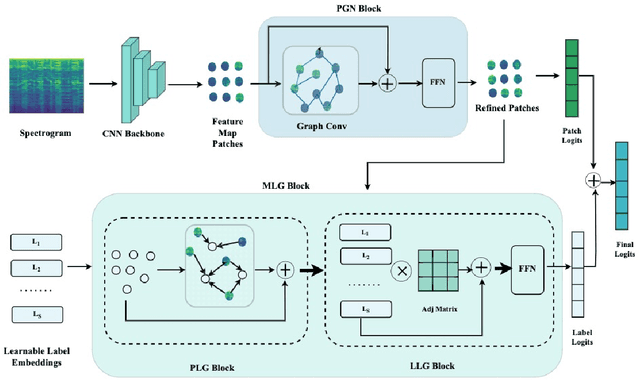
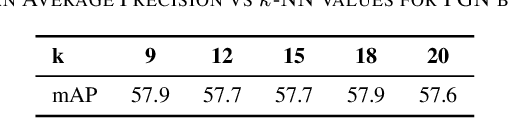
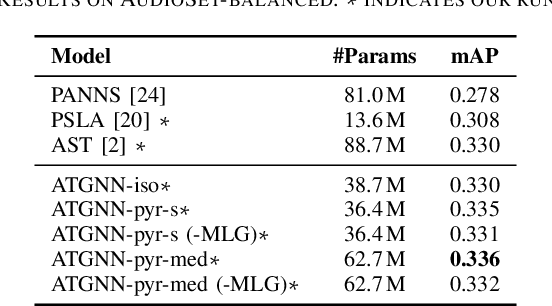
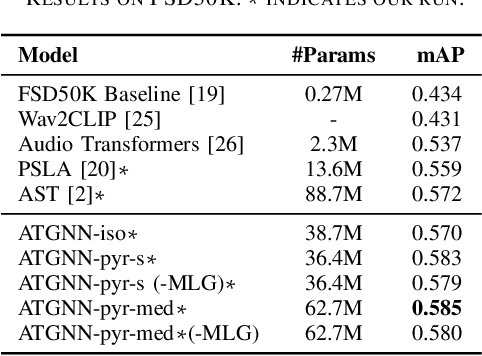
Deep learning models such as CNNs and Transformers have achieved impressive performance for end-to-end audio tagging. Recent works have shown that despite stacking multiple layers, the receptive field of CNNs remains severely limited. Transformers on the other hand are able to map global context through self-attention, but treat the spectrogram as a sequence of patches which is not flexible enough to capture irregular audio objects. In this work, we treat the spectrogram in a more flexible way by considering it as graph structure and process it with a novel graph neural architecture called ATGNN. ATGNN not only combines the capability of CNNs with the global information sharing ability of Graph Neural Networks, but also maps semantic relationships between learnable class embeddings and corresponding spectrogram regions. We evaluate ATGNN on two audio tagging tasks, where it achieves 0.585 mAP on the FSD50K dataset and 0.335 mAP on the AudioSet-balanced dataset, achieving comparable results to Transformer based models with significantly lower number of learnable parameters.
A Deep Learning Architecture with Spatio-Temporal Focusing for Detecting Respiratory Anomalies
Jun 25, 2023This paper presents a deep learning system applied for detecting anomalies from respiratory sound recordings. Our system initially performs audio feature extraction using Continuous Wavelet transformation. This transformation converts the respiratory sound input into a two-dimensional spectrogram where both spectral and temporal features are presented. Then, our proposed deep learning architecture inspired by the Inception-residual-based backbone performs the spatial-temporal focusing and multi-head attention mechanism to classify respiratory anomalies. In this work, we evaluate our proposed models on the benchmark SPRSound (The Open-Source SJTU Paediatric Respiratory Sound) database proposed by the IEEE BioCAS 2023 challenge. As regards the Score computed by an average between the average score and harmonic score, our robust system has achieved Top-1 performance with Scores of 0.810, 0.667, 0.744, and 0.608 in Tasks 1-1, 1-2, 2-1, and 2-2, respectively.
Adapting Language-Audio Models as Few-Shot Audio Learners
May 28, 2023We presented the Treff adapter, a training-efficient adapter for CLAP, to boost zero-shot classification performance by making use of a small set of labelled data. Specifically, we designed CALM to retrieve the probability distribution of text-audio clips over classes using a set of audio-label pairs and combined it with CLAP's zero-shot classification results. Furthermore, we designed a training-free version of the Treff adapter by using CALM as a cosine similarity measure. Experiments showed that the proposed Treff adapter is comparable and even better than fully-supervised methods and adaptation methods in low-shot and data-abundant scenarios. While the Treff adapter shows that combining large-scale pretraining and rapid learning of domain-specific knowledge is non-trivial for obtaining generic representations for few-shot learning, it is still limited to audio classification tasks. In the future, we will explore how to use audio-language models in diverse audio domains.
CoRe-Sleep: A Multimodal Fusion Framework for Time Series Robust to Imperfect Modalities
Mar 27, 2023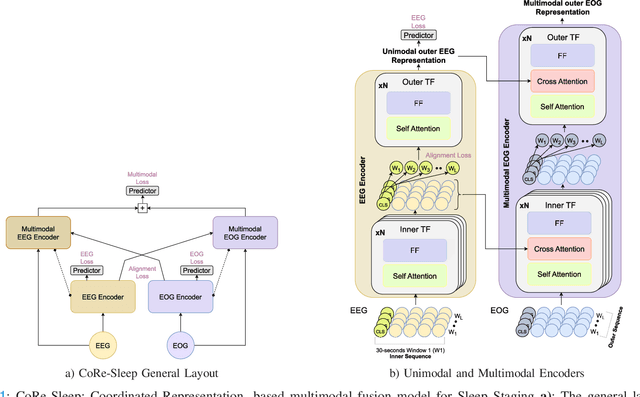
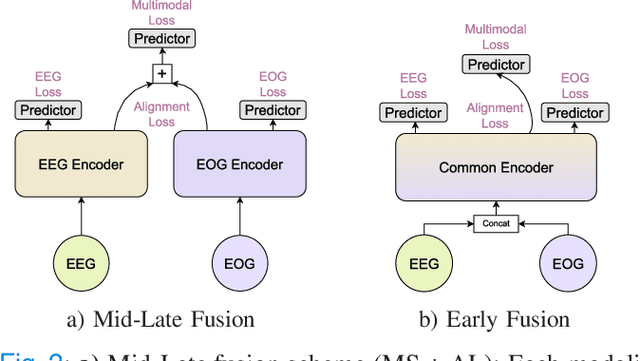
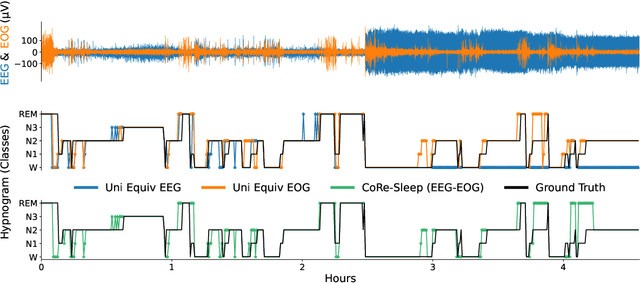
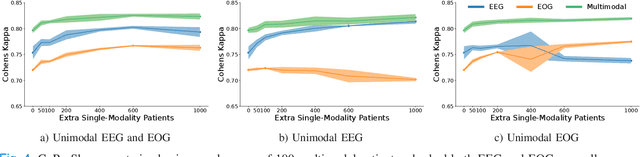
Sleep abnormalities can have severe health consequences. Automated sleep staging, i.e. labelling the sequence of sleep stages from the patient's physiological recordings, could simplify the diagnostic process. Previous work on automated sleep staging has achieved great results, mainly relying on the EEG signal. However, often multiple sources of information are available beyond EEG. This can be particularly beneficial when the EEG recordings are noisy or even missing completely. In this paper, we propose CoRe-Sleep, a Coordinated Representation multimodal fusion network that is particularly focused on improving the robustness of signal analysis on imperfect data. We demonstrate how appropriately handling multimodal information can be the key to achieving such robustness. CoRe-Sleep tolerates noisy or missing modalities segments, allowing training on incomplete data. Additionally, it shows state-of-the-art performance when testing on both multimodal and unimodal data using a single model on SHHS-1, the largest publicly available study that includes sleep stage labels. The results indicate that training the model on multimodal data does positively influence performance when tested on unimodal data. This work aims at bridging the gap between automated analysis tools and their clinical utility.