 Add to Chrome
 Add to Firefox
 Add to Edge
Information-theoretic Multimodal Representation Learning for Electrocardiogram Signals
May 26, 2026
Electrocardiograms (ECGs) are widely used non-invasive measurements of cardiac activity and play a central role in clinical diagnosis. Recent multimodal approaches align ECG signals with clinical reports to incorporate diagnostic semantics, but clinical reports often fail to preserve the rich physiological structure of ECG waveforms, particularly across multiple levels of abstraction ranging from coarse diagnostic categories to fine-grained morphology. To address this limitation, we formulate ECG representation learning from an information-theoretic perspective and derive a tractable objective that jointly preserves signal structure and integrates clinical semantics. Based on this principle, we propose \textbf{MERIT} (Multimodal ECG Representation via Information Theory), a dual-branch pretraining framework combining masked ECG modeling with ECG--text contrastive alignment. Extensive experiments on PTB-XL and additional benchmarks demonstrate consistent improvements over prior methods, including gains exceeding $3%$ F1 on PTB-XL All and $5%$ F1 on SubClass classification. In zero-shot evaluation, MERIT further improves performance by up to $ +2.66\%$ AUC and $ +2.11\%$ F1 on PTB-XL SubClass, while also demonstrating robustness under multiple distribution-shift settings. Moreover, leveraging the learned ECG representations for ECG-conditioned clinical text generation with large language models improves text quality across several metrics, including ROUGE and METEOR. Together, these results demonstrate that MERIT learns more informative and clinically meaningful ECG representations, particularly for fine-grained clinical applications.

NeuroAtlas: Benchmarking Foundation Models for Clinical EEG and Brain-Computer Interfaces
May 14, 2026Foundation models (FMs) promise to extract unified representations that generalize across downstream tasks. They have emerged across fields, including electroencephalography (EEG), but it is less clear how effective they are in this particular field. Published evaluations differ in datasets, in the EEG-specific preprocessing that might influence reported results, and in the reported metrics, frequently obscuring the clinical relevance in EEG. We introduce NeuroAtlas, the largest EEG benchmark to date: 42 datasets and 260k hours covering clinical EEG (epilepsy, sleep medicine, brain age estimation) and brain-computer interfaces, and include multiple datasets per task along with bespoke clinical evaluation metrics. Besides evaluating EEG-FMs with respect to supervised baselines, we present results from generic time-series FMs. We report three findings. First, EEG-specific FMs do not consistently outperform time-series FMs, which have neither EEG-focused architectures nor been pretrained on EEG. Second, standard machine learning metrics are insufficient to assess clinical utility: thus, we thoroughly evaluate more appropriate measures such as the quality of event-level decision-making, hypnogram-derived features, and the brain-age gap in the domains of epilepsy, sleep, and brain age, respectively. Third, model rankings and performance can vary substantially within domains. We conclude that pretrained models perform largely on par, with only narrow advantages for a few, and that current models do not yet deliver on the promise of an out-of-the-box unified EEG model. NeuroAtlas exposes this gap and provides the datasets and metrics for the next generation of unified EEG FMs.
SeizeIT2: Wearable Dataset Of Patients With Focal Epilepsy
Feb 03, 2025


The increasing technological advancements towards miniaturized physiological measuring devices have enabled continuous monitoring of epileptic patients outside of specialized environments. The large amounts of data that can be recorded with such devices holds significant potential for developing automated seizure detection frameworks. In this work, we present SeizeIT2, the first open dataset of wearable data recorded in patients with focal epilepsy. The dataset comprises more than 11,000 hours of multimodal data, including behind-the-ear electroencephalography, electrocardiography, electromyography and movement (accelerometer and gyroscope) data. The dataset contains 886 focal seizures recorded from 125 patients across five different European Epileptic Monitoring Centers. We present a suggestive training/validation split to propel the development of AI methodologies for seizure detection, as well as two benchmark approaches and evaluation metrics. The dataset can be accessed on OpenNeuro and is stored in Brain Imaging Data Structure (BIDS) format.
Multimodal Fusion Balancing Through Game-Theoretic Regularization
Nov 11, 2024


Multimodal learning can complete the picture of information extraction by uncovering key dependencies between data sources. However, current systems fail to fully leverage multiple modalities for optimal performance. This has been attributed to modality competition, where modalities strive for training resources, leaving some underoptimized. We show that current balancing methods struggle to train multimodal models that surpass even simple baselines, such as ensembles. This raises the question: how can we ensure that all modalities in multimodal training are sufficiently trained, and that learning from new modalities consistently improves performance? This paper proposes the Multimodal Competition Regularizer (MCR), a new loss component inspired by mutual information (MI) decomposition designed to prevent the adverse effects of competition in multimodal training. Our key contributions are: 1) Introducing game-theoretic principles in multimodal learning, where each modality acts as a player competing to maximize its influence on the final outcome, enabling automatic balancing of the MI terms. 2) Refining lower and upper bounds for each MI term to enhance the extraction of task-relevant unique and shared information across modalities. 3) Suggesting latent space permutations for conditional MI estimation, significantly improving computational efficiency. MCR outperforms all previously suggested training strategies and is the first to consistently improve multimodal learning beyond the ensemble baseline, clearly demonstrating that combining modalities leads to significant performance gains on both synthetic and large real-world datasets.
MixNet: Joining Force of Classical and Modern Approaches Toward the Comprehensive Pipeline in Motor Imagery EEG Classification
Sep 06, 2024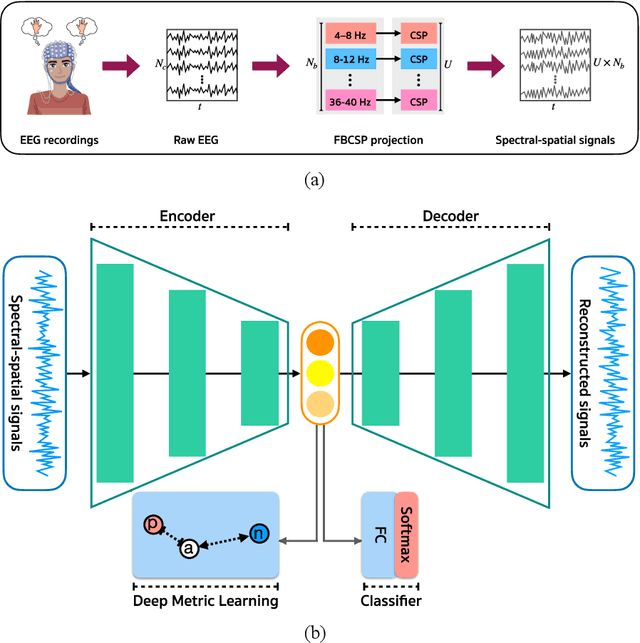
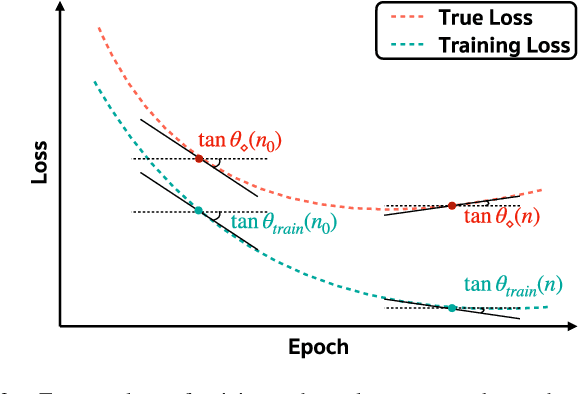
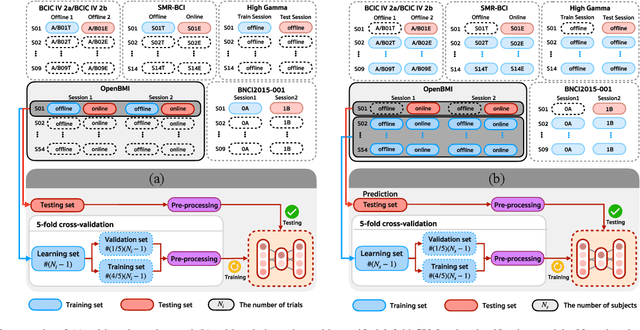
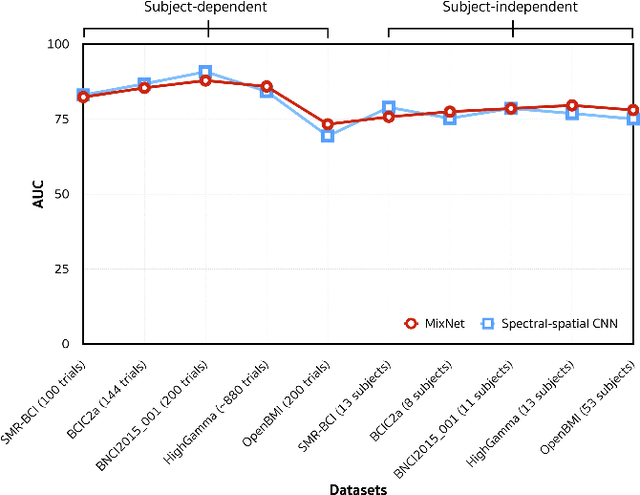
Recent advances in deep learning (DL) have significantly impacted motor imagery (MI)-based brain-computer interface (BCI) systems, enhancing the decoding of electroencephalography (EEG) signals. However, most studies struggle to identify discriminative patterns across subjects during MI tasks, limiting MI classification performance. In this article, we propose MixNet, a novel classification framework designed to overcome this limitation by utilizing spectral-spatial signals from MI data, along with a multitask learning architecture named MIN2Net, for classification. Here, the spectral-spatial signals are generated using the filter-bank common spatial patterns (FBCSPs) method on MI data. Since the multitask learning architecture is used for the classification task, the learning in each task may exhibit different generalization rates and potential overfitting across tasks. To address this issue, we implement adaptive gradient blending, simultaneously regulating multiple loss weights and adjusting the learning pace for each task based on its generalization/overfitting tendencies. Experimental results on six benchmark data sets of different data sizes demonstrate that MixNet consistently outperforms all state-of-the-art algorithms in subject-dependent and -independent settings. Finally, the low-density EEG MI classification results show that MixNet outperforms all state-of-the-art algorithms, offering promising implications for Internet of Thing (IoT) applications, such as lightweight and portable EEG wearable devices based on low-density montages.
* Supplementary materials and source codes are available on-line at https://github.com/Max-Phairot-A/MixNet
Improving Multimodal Learning with Multi-Loss Gradient Modulation
May 13, 2024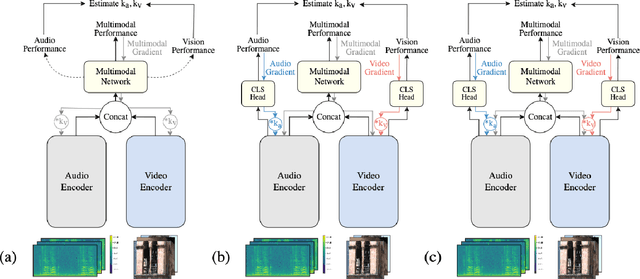

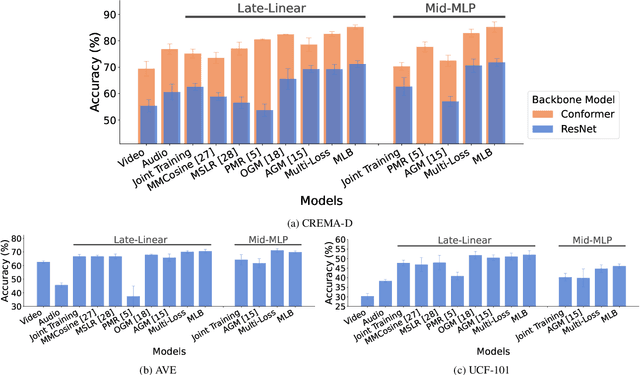

Learning from multiple modalities, such as audio and video, offers opportunities for leveraging complementary information, enhancing robustness, and improving contextual understanding and performance. However, combining such modalities presents challenges, especially when modalities differ in data structure, predictive contribution, and the complexity of their learning processes. It has been observed that one modality can potentially dominate the learning process, hindering the effective utilization of information from other modalities and leading to sub-optimal model performance. To address this issue the vast majority of previous works suggest to assess the unimodal contributions and dynamically adjust the training to equalize them. We improve upon previous work by introducing a multi-loss objective and further refining the balancing process, allowing it to dynamically adjust the learning pace of each modality in both directions, acceleration and deceleration, with the ability to phase out balancing effects upon convergence. We achieve superior results across three audio-video datasets: on CREMA-D, models with ResNet backbone encoders surpass the previous best by 1.9% to 12.4%, and Conformer backbone models deliver improvements ranging from 2.8% to 14.1% across different fusion methods. On AVE, improvements range from 2.7% to 7.7%, while on UCF101, gains reach up to 6.1%.
Multimodal wearable EEG, EMG and accelerometry measurements improve the accuracy of tonic-clonic seizure detection in-hospital
Mar 19, 2024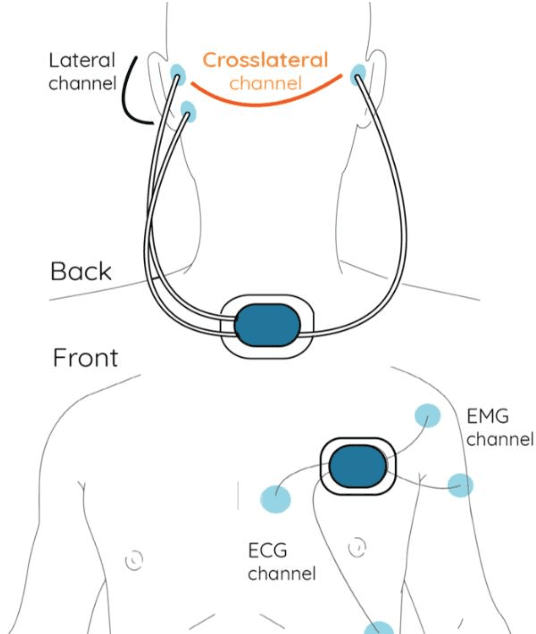
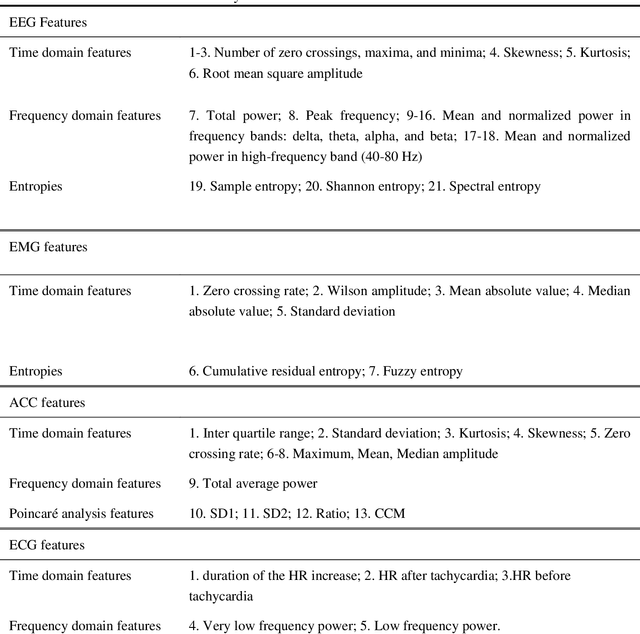
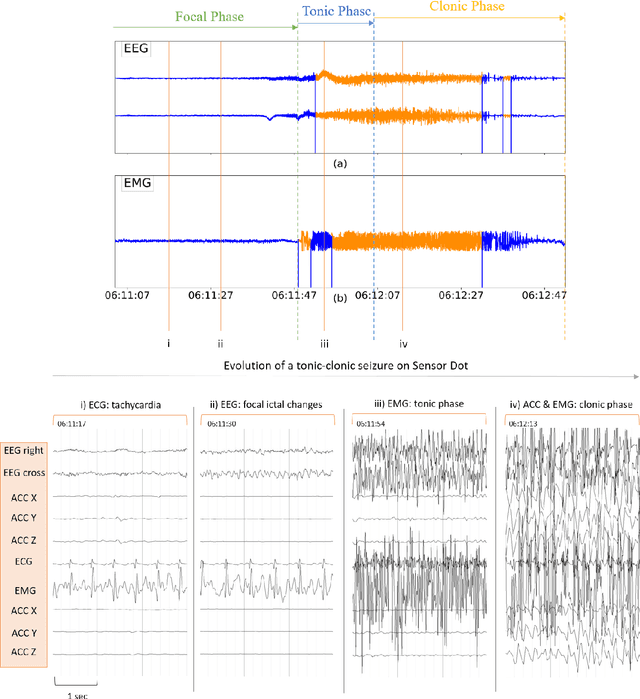
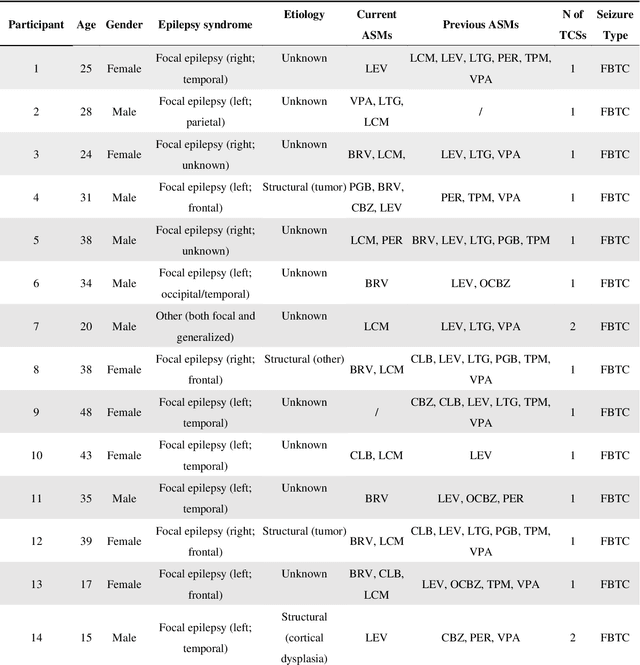
Objective: Most current wearable tonic-clonic seizure (TCS) detection systems are based on extra-cerebral signals, such as electromyography (EMG) or accelerometry (ACC). Although many of these devices show good sensitivity in seizure detection, their false positive rates (FPR) are still relatively high. Wearable EEG may improve performance; however, studies investigating this remain scarce. This paper aims 1) to investigate the possibility of detecting TCSs with a behind-the-ear, two-channel wearable EEG, and 2) to evaluate the added value of wearable EEG to other non-EEG modalities in multimodal TCS detection. Method: We included 27 participants with a total of 44 TCSs from the European multicenter study SeizeIT2. The multimodal wearable detection system Sensor Dot (Byteflies) was used to measure two-channel, behind-the-ear EEG, EMG, electrocardiography (ECG), ACC and gyroscope (GYR). First, we evaluated automatic unimodal detection of TCSs, using performance metrics such as sensitivity, precision, FPR and F1-score. Secondly, we fused the different modalities and again assessed performance. Algorithm-labeled segments were then provided to a neurologist and a wearable data expert, who reviewed and annotated the true positive TCSs, and discarded false positives (FPs). Results: Wearable EEG outperformed the other modalities in unimodal TCS detection by achieving a sensitivity of 100.0% and a FPR of 10.3/24h (compared to 97.7% sensitivity and 30.9/24h FPR for EMG; 95.5% sensitivity and 13.9 FPR for ACC). The combination of wearable EEG and EMG achieved overall the most clinically useful performance in offline TCS detection with a sensitivity of 97.7%, a FPR of 0.4/24 h, a precision of 43.0%, and a F1-score of 59.7%. Subsequent visual review of the automated detections resulted in maximal sensitivity and zero FPs.
Increasing Performance And Sample Efficiency With Model-agnostic Interactive Feature Attributions
Jun 28, 2023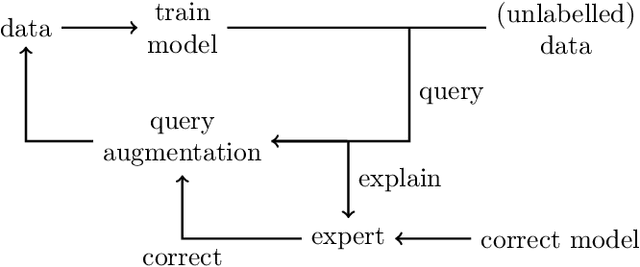
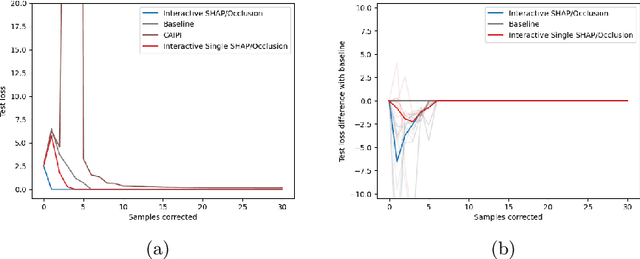
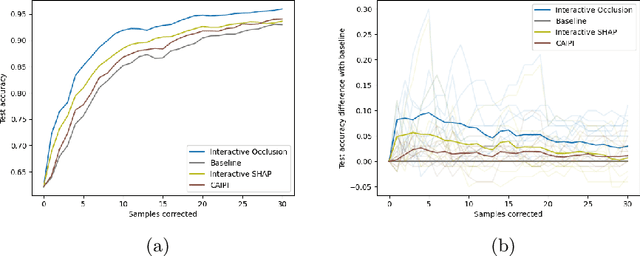
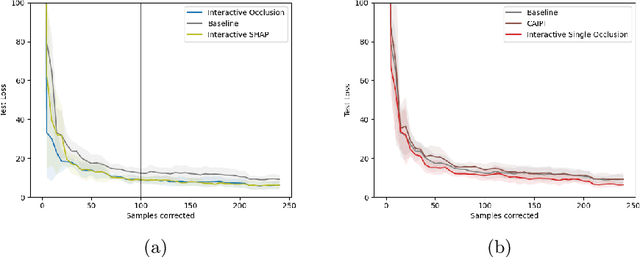
Model-agnostic feature attributions can provide local insights in complex ML models. If the explanation is correct, a domain expert can validate and trust the model's decision. However, if it contradicts the expert's knowledge, related work only corrects irrelevant features to improve the model. To allow for unlimited interaction, in this paper we provide model-agnostic implementations for two popular explanation methods (Occlusion and Shapley values) to enforce entirely different attributions in the complex model. For a particular set of samples, we use the corrected feature attributions to generate extra local data, which is used to retrain the model to have the right explanation for the samples. Through simulated and real data experiments on a variety of models we show how our proposed approach can significantly improve the model's performance only by augmenting its training dataset based on corrected explanations. Adding our interactive explanations to active learning settings increases the sample efficiency significantly and outperforms existing explanatory interactive strategies. Additionally we explore how a domain expert can provide feature attributions which are sufficiently correct to improve the model.
Explaining the Model and Feature Dependencies by Decomposition of the Shapley Value
Jun 19, 2023Shapley values have become one of the go-to methods to explain complex models to end-users. They provide a model agnostic post-hoc explanation with foundations in game theory: what is the worth of a player (in machine learning, a feature value) in the objective function (the output of the complex machine learning model). One downside is that they always require outputs of the model when some features are missing. These are usually computed by taking the expectation over the missing features. This however introduces a non-trivial choice: do we condition on the unknown features or not? In this paper we examine this question and claim that they represent two different explanations which are valid for different end-users: one that explains the model and one that explains the model combined with the feature dependencies in the data. We propose a new algorithmic approach to combine both explanations, removing the burden of choice and enhancing the explanatory power of Shapley values, and show that it achieves intuitive results on simple problems. We apply our method to two real-world datasets and discuss the explanations. Finally, we demonstrate how our method is either equivalent or superior to state-to-of-art Shapley value implementations while simultaneously allowing for increased insight into the model-data structure.
U-PASS: an Uncertainty-guided deep learning Pipeline for Automated Sleep Staging
Jun 07, 2023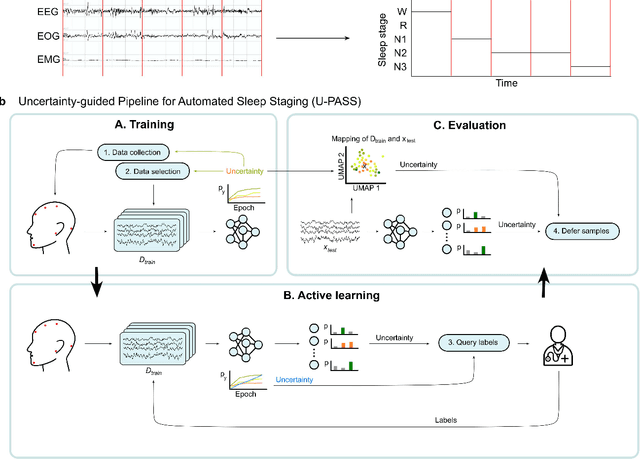
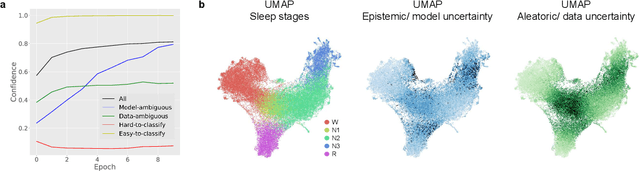
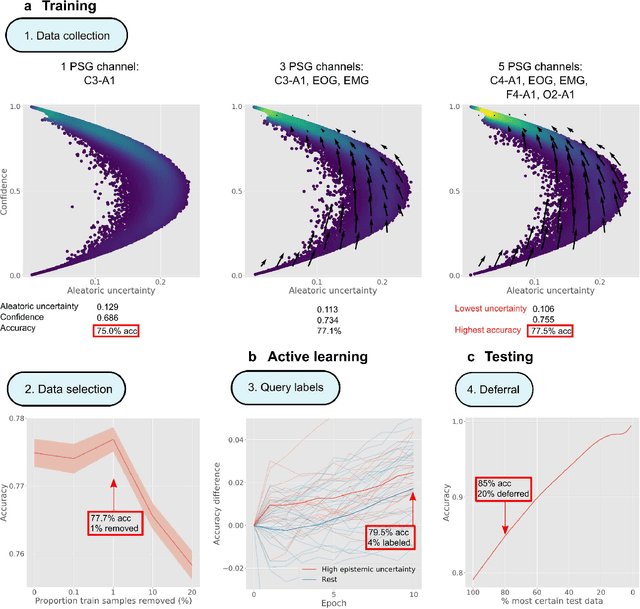
As machine learning becomes increasingly prevalent in critical fields such as healthcare, ensuring the safety and reliability of machine learning systems becomes paramount. A key component of reliability is the ability to estimate uncertainty, which enables the identification of areas of high and low confidence and helps to minimize the risk of error. In this study, we propose a machine learning pipeline called U-PASS tailored for clinical applications that incorporates uncertainty estimation at every stage of the process, including data acquisition, training, and model deployment. The training process is divided into a supervised pre-training step and a semi-supervised finetuning step. We apply our uncertainty-guided deep learning pipeline to the challenging problem of sleep staging and demonstrate that it systematically improves performance at every stage. By optimizing the training dataset, actively seeking informative samples, and deferring the most uncertain samples to an expert, we achieve an expert-level accuracy of 85% on a challenging clinical dataset of elderly sleep apnea patients, representing a significant improvement over the baseline accuracy of 75%. U-PASS represents a promising approach to incorporating uncertainty estimation into machine learning pipelines, thereby improving their reliability and unlocking their potential in clinical settings.