 Add to Chrome
 Add to Firefox
 Add to Edge
SoundnessBench: Can Your AI Scientist Really Tell Good Research Ideas from Bad Ones?
May 28, 2026
Autonomous AI research agents aim to accelerate scientific discovery by automating the research pipeline, from hypothesis generation to peer review. However, existing benchmarks rarely test a fundamental bottleneck: whether Large Language Models can judge the methodological viability of a research idea before expending time and computational resources. We introduce SoundnessBench, a curated benchmark of 1,099 machine-learning research proposals reconstructed from ICLR submissions, labeled with reviewer soundness sub-scores, and audited against source papers. SoundnessBench should be interpreted as a benchmark for recoverable proposal-stage soundness rather than exact prediction of full-paper review outcomes. Across 12 frontier LLMs, we find a pervasive optimism bias: under standard prompting, models frequently rate low-soundness proposals as sound, while aggressive prompting largely shifts errors from false positives to false negatives. Additional controls for public-corpus contamination, paper-identifying phrases, surface features, and human audit quality suggest that this behavior is not explained by a single confounder. Our results indicate that current LLMs are not yet reliable as standalone first-gate evaluators for scientific rigor.

Can You Make It Sound Like You? Post-Editing LLM-Generated Text for Personal Style
Apr 27, 2026Despite the growing use of large language models (LLMs) for writing tasks, users may hesitate to rely on LLMs when personal style is important. Post-editing LLM-generated drafts or translations is a common collaborative writing strategy, but it remains unclear whether users can effectively reshape LLM-generated text to reflect their personal style. We conduct a pre-registered online study ($n=81$) in which participants post-edit LLM-generated drafts for writing tasks where personal style matters to them. Using embedding-based style similarity metrics, we find that post-editing increases stylistic similarity to participants' unassisted writing and reduces similarity to fully LLM-generated output. However, post-edited text still remains stylistically closer in style to LLM text than to participants' unassisted control text, and it exhibits reduced stylistic diversity compared to unassisted human text. We find a gap between perceived stylistic authenticity and model-measured stylistic similarity, with post-edited text often perceived as representative of participants' personal style despite remaining detectable LLM stylistic traces.
Bias in the Tails: How Name-conditioned Evaluative Framing in Resume Summaries Destabilizes LLM-based Hiring
Apr 21, 2026Research has documented LLMs' name-based bias in hiring and salary recommendations. In this paper, we instead consider a setting where LLMs generate candidate summaries for downstream assessment. In a large-scale controlled study, we analyze nearly one million resume summaries produced by 4 models under systematic race-gender name perturbations, using synthetic resumes and real-world job postings. By decomposing each summary into resume-grounded factual content and evaluative framing, we find that factual content remains largely stable, while evaluative language exhibits subtle name-conditioned variation concentrated in the extremes of the distribution, especially in open-source models. Our hiring simulation demonstrates how evaluative summary transforms directional harm into symmetric instability that might evade conventional fairness audit, highlighting a potential pathway for LLM-to-LLM automation bias.
ResearchRubrics: A Benchmark of Prompts and Rubrics For Evaluating Deep Research Agents
Nov 10, 2025Deep Research (DR) is an emerging agent application that leverages large language models (LLMs) to address open-ended queries. It requires the integration of several capabilities, including multi-step reasoning, cross-document synthesis, and the generation of evidence-backed, long-form answers. Evaluating DR remains challenging because responses are lengthy and diverse, admit many valid solutions, and often depend on dynamic information sources. We introduce ResearchRubrics, a standardized benchmark for DR built with over 2,800+ hours of human labor that pairs realistic, domain-diverse prompts with 2,500+ expert-written, fine-grained rubrics to assess factual grounding, reasoning soundness, and clarity. We also propose a new complexity framework for categorizing DR tasks along three axes: conceptual breadth, logical nesting, and exploration. In addition, we develop human and model-based evaluation protocols that measure rubric adherence for DR agents. We evaluate several state-of-the-art DR systems and find that even leading agents like Gemini's DR and OpenAI's DR achieve under 68% average compliance with our rubrics, primarily due to missed implicit context and inadequate reasoning about retrieved information. Our results highlight the need for robust, scalable assessment of deep research capabilities, to which end we release ResearchRubrics(including all prompts, rubrics, and evaluation code) to facilitate progress toward well-justified research assistants.
SMARTER: A Data-efficient Framework to Improve Toxicity Detection with Explanation via Self-augmenting Large Language Models
Sep 18, 2025WARNING: This paper contains examples of offensive materials. Toxic content has become pervasive on social media platforms. We introduce SMARTER, a data-efficient two-stage framework for explainable content moderation using Large Language Models (LLMs). In Stage 1, we leverage LLMs' own outputs to generate synthetic explanations for both correct and incorrect labels, enabling alignment via preference optimization with minimal human supervision. In Stage 2, we refine explanation quality through cross-model training, allowing weaker models to align stylistically and semantically with stronger ones. Experiments on three benchmark tasks -- HateXplain, Latent Hate, and Implicit Hate -- demonstrate that SMARTER enables LLMs to achieve up to a 13.5% macro-F1 improvement over standard few-shot baselines while using only a fraction of the full training data. Our framework offers a scalable strategy for low-resource settings by harnessing LLMs' self-improving capabilities for both classification and explanation.
VietMix: A Naturally Occurring Vietnamese-English Code-Mixed Corpus with Iterative Augmentation for Machine Translation
May 30, 2025Machine translation systems fail when processing code-mixed inputs for low-resource languages. We address this challenge by curating VietMix, a parallel corpus of naturally occurring code-mixed Vietnamese text paired with expert English translations. Augmenting this resource, we developed a complementary synthetic data generation pipeline. This pipeline incorporates filtering mechanisms to ensure syntactic plausibility and pragmatic appropriateness in code-mixing patterns. Experimental validation shows our naturalistic and complementary synthetic data boost models' performance, measured by translation quality estimation scores, of up to 71.84 on COMETkiwi and 81.77 on XCOMET. Triangulating positive results with LLM-based assessments, augmented models are favored over seed fine-tuned counterparts in approximately 49% of judgments (54-56% excluding ties). VietMix and our augmentation methodology advance ecological validity in neural MT evaluations and establish a framework for addressing code-mixed translation challenges across other low-resource pairs.
Benchmark Evaluations, Applications, and Challenges of Large Vision Language Models: A Survey
Jan 04, 2025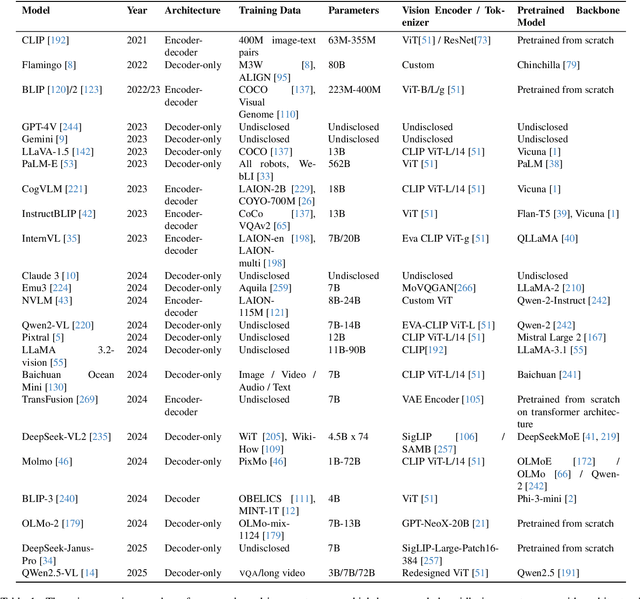
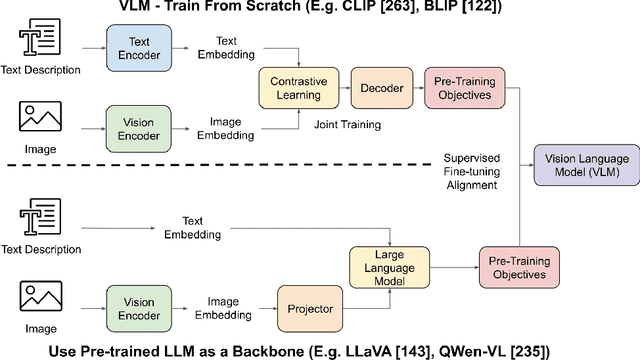
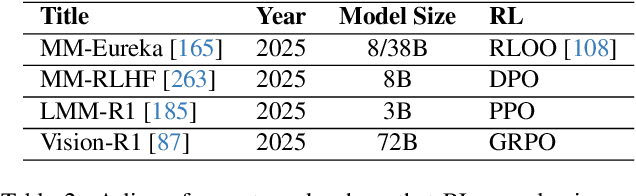
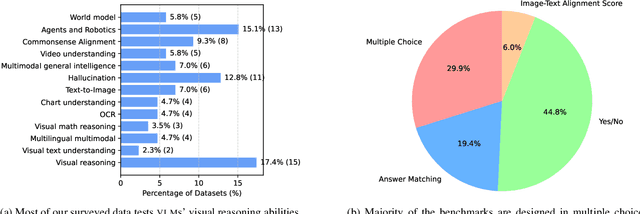
Multimodal Vision Language Models (VLMs) have emerged as a transformative technology at the intersection of computer vision and natural language processing, enabling machines to perceive and reason about the world through both visual and textual modalities. For example, models such as CLIP, Claude, and GPT-4V demonstrate strong reasoning and understanding abilities on visual and textual data and beat classical single modality vision models on zero-shot classification. Despite their rapid advancements in research and growing popularity in applications, a comprehensive survey of existing studies on VLMs is notably lacking, particularly for researchers aiming to leverage VLMs in their specific domains. To this end, we provide a systematic overview of VLMs in the following aspects: model information of the major VLMs developed over the past five years (2019-2024); the main architectures and training methods of these VLMs; summary and categorization of the popular benchmarks and evaluation metrics of VLMs; the applications of VLMs including embodied agents, robotics, and video generation; the challenges and issues faced by current VLMs such as hallucination, fairness, and safety. Detailed collections including papers and model repository links are listed in https://github.com/zli12321/Awesome-VLM-Papers-And-Models.git.
"You Gotta be a Doctor, Lin": An Investigation of Name-Based Bias of Large Language Models in Employment Recommendations
Jun 18, 2024Social science research has shown that candidates with names indicative of certain races or genders often face discrimination in employment practices. Similarly, Large Language Models (LLMs) have demonstrated racial and gender biases in various applications. In this study, we utilize GPT-3.5-Turbo and Llama 3-70B-Instruct to simulate hiring decisions and salary recommendations for candidates with 320 first names that strongly signal their race and gender, across over 750,000 prompts. Our empirical results indicate a preference among these models for hiring candidates with White female-sounding names over other demographic groups across 40 occupations. Additionally, even among candidates with identical qualifications, salary recommendations vary by as much as 5% between different subgroups. A comparison with real-world labor data reveals inconsistent alignment with U.S. labor market characteristics, underscoring the necessity of risk investigation of LLM-powered systems.
HateCOT: An Explanation-Enhanced Dataset for Generalizable Offensive Speech Detection via Large Language Models
Mar 18, 2024The ubiquitousness of social media has led to the need for reliable and efficient detection of offensive content to limit harmful effects. This has led to a proliferation of datasets and models related to detecting offensive content. While sophisticated models have attained strong performance on individual datasets, these models often do not generalize due to differences between how "offensive content" is conceptualized, and the resulting differences in how these datasets are labeled. In this paper, we introduce HateCOT, a dataset of 52,000 samples drawn from diverse existing sources with explanations generated by GPT-3.5-Turbo and human-curated. We show that pre-training models for the detection of offensive content on HateCOT significantly boots open-sourced Language Models on three benchmark datasets in both zero and few-shot settings, despite differences in domain and task.} We further find that HateCOT enables effective K-shot fine-tuning in the low-resource settings.
PANDA (Pedantic ANswer-correctness Determination and Adjudication):Improving Automatic Evaluation for Question Answering and Text Generation
Feb 17, 2024

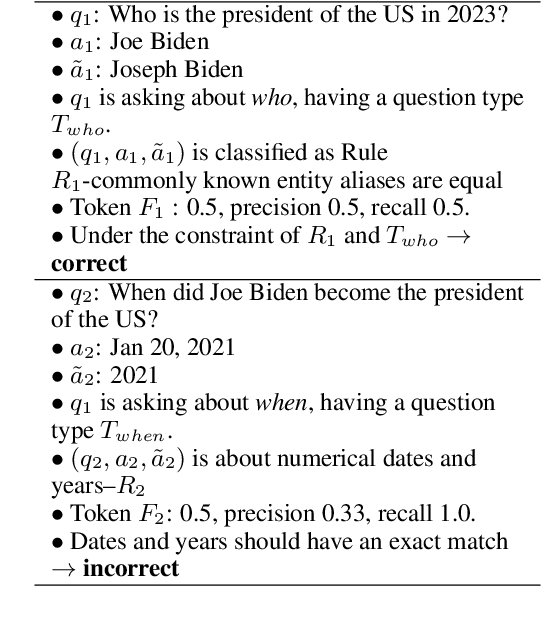

Question answering (QA) can only make progress if we know if an answer is correct, but for many of the most challenging and interesting QA examples, current answer correctness (AC) metrics do not align with human judgments, particularly verbose, free form answers from large language models (LLM). There are two challenges: a lack of data and that models are too big. LLM based scorers correlate better with humans, but this expensive task has only been tested on limited QA datasets. We rectify these issues by providing clear guidelines for evaluating machine QA adopted from human QA contests. We also introduce Precise ANswer correctness Determination and Adjudication (PANDA), a small, efficient, deterministic AC classifier (812 KB) that more accurately evaluates answer correctness.