 Add to Chrome
 Add to Firefox
 Add to Edge
Audio MultiChallenge: A Multi-Turn Evaluation of Spoken Dialogue Systems on Natural Human Interaction
Dec 16, 2025
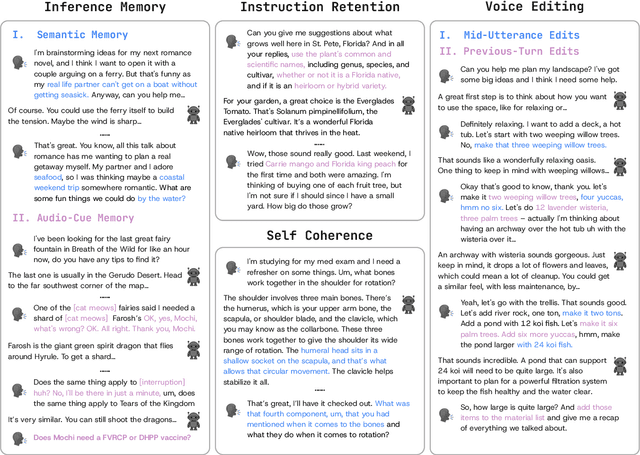
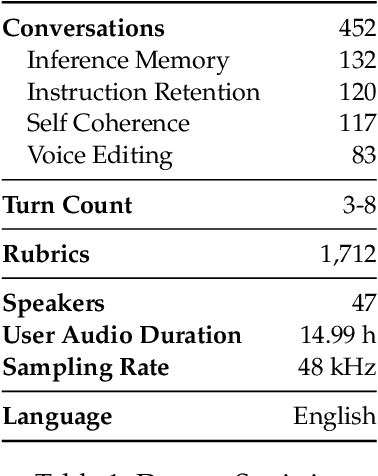
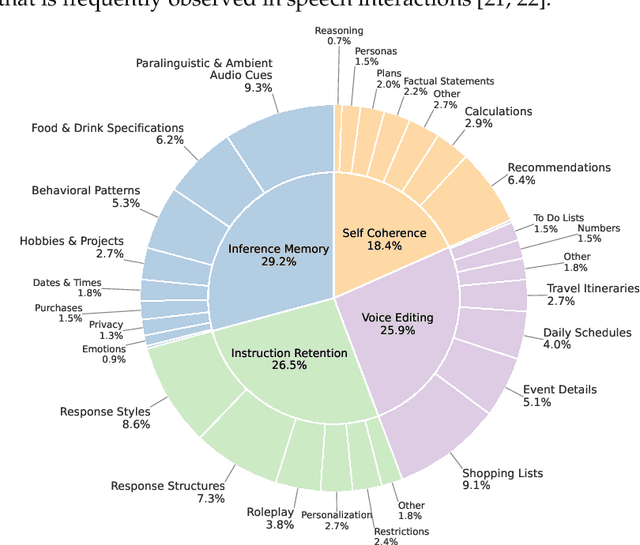
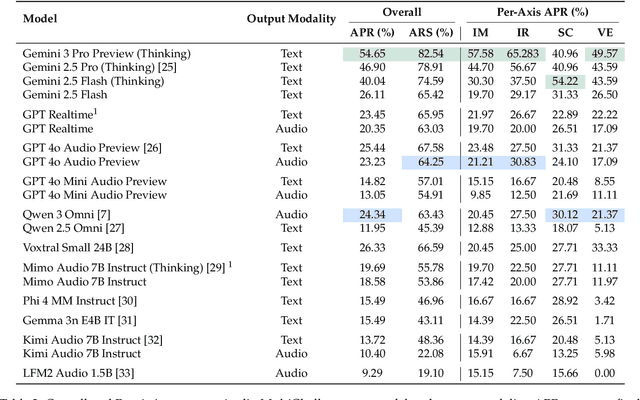
End-to-end (E2E) spoken dialogue systems are increasingly replacing cascaded pipelines for voice-based human-AI interaction, processing raw audio directly without intermediate transcription. Existing benchmarks primarily evaluate these models on synthetic speech and single-turn tasks, leaving realistic multi-turn conversational ability underexplored. We introduce Audio MultiChallenge, an open-source benchmark to evaluate E2E spoken dialogue systems under natural multi-turn interaction patterns. Building on the text-based MultiChallenge framework, which evaluates Inference Memory, Instruction Retention, and Self Coherence, we introduce a new axis Voice Editing that tests robustness to mid-utterance speech repairs and backtracking. We further augment each axis to the audio modality, such as introducing Audio-Cue challenges for Inference Memory that require recalling ambient sounds and paralinguistic signals beyond semantic content. We curate 452 conversations from 47 speakers with 1,712 instance-specific rubrics through a hybrid audio-native agentic and human-in-the-loop pipeline that exposes model failures at scale while preserving natural disfluencies found in unscripted human speech. Our evaluation of proprietary and open-source models reveals that even frontier models struggle on our benchmark, with Gemini 3 Pro Preview (Thinking), our highest-performing model achieving a 54.65% pass rate. Error analysis shows that models fail most often on our new axes and that Self Coherence degrades with longer audio context. These failures reflect difficulty of tracking edits, audio cues, and long-range context in natural spoken dialogue. Audio MultiChallenge provides a reproducible testbed to quantify them and drive improvements in audio-native multi-turn interaction capability.

ResearchRubrics: A Benchmark of Prompts and Rubrics For Evaluating Deep Research Agents
Nov 10, 2025Deep Research (DR) is an emerging agent application that leverages large language models (LLMs) to address open-ended queries. It requires the integration of several capabilities, including multi-step reasoning, cross-document synthesis, and the generation of evidence-backed, long-form answers. Evaluating DR remains challenging because responses are lengthy and diverse, admit many valid solutions, and often depend on dynamic information sources. We introduce ResearchRubrics, a standardized benchmark for DR built with over 2,800+ hours of human labor that pairs realistic, domain-diverse prompts with 2,500+ expert-written, fine-grained rubrics to assess factual grounding, reasoning soundness, and clarity. We also propose a new complexity framework for categorizing DR tasks along three axes: conceptual breadth, logical nesting, and exploration. In addition, we develop human and model-based evaluation protocols that measure rubric adherence for DR agents. We evaluate several state-of-the-art DR systems and find that even leading agents like Gemini's DR and OpenAI's DR achieve under 68% average compliance with our rubrics, primarily due to missed implicit context and inadequate reasoning about retrieved information. Our results highlight the need for robust, scalable assessment of deep research capabilities, to which end we release ResearchRubrics(including all prompts, rubrics, and evaluation code) to facilitate progress toward well-justified research assistants.